

Four minutes of taxi from the stand to the runway: should the second engine keep running? The question seems arithmetic – two engines at idle burn twice as much as one – but it is not. The saving window is much shorter than the taxi time, and a large part of what is saved on the engine is given back elsewhere: to the APU, the brakes, the tires. The balance depends on the conditions, and some factors can make the question irrelevant before it is even asked.
The savings window is shorter than the taxi time
The mental calculation is always the same: the fuel consumption of a large turbofan at ground idle – in the order of hundreds of kilograms per hour – multiplied by the duration of the taxi. The result is flattering and wrong, because it attributes all the savings of the time between position and threshold.
Two limits shrink it. Upstream, pushback, the first engine start and the initial movement take time, whatever procedure is chosen. Downstream, the second engine must be started, its parameters checked, and then it must stabilize at idle for the time prescribed by the manufacturer – typically a few minutes, the exact value being type-specific – before takeoff thrust can be applied. Add the flight control check, configuration, and the time lost to a late runway change, and what remains is the stretch actually taxied on one engine.
One point deserves correcting, because the misconception is widespread: the procedure does not add an engine cycle. On departure, the second engine is started once, just later; on arrival, it is shut down once, just earlier. The engine cycle counter does not move, and the argument of accelerated hot-section ageing does not apply here. The costs, if any, lie elsewhere.
The savings from running one engine instead of two are much smaller than you might think. You lose time starting and stopping the second engine, and the actual fuel saved is only during the middle part of the taxi. The rest of the time, you’re either preparing to shut down or restarting the engine.
On an Airbus A320, the savings window for single-engine taxi is typically 8-10 minutes. If your taxi is only 5 minutes, you might not save any fuel at all because the startup and shutdown times eat up most of the potential savings.
The APU is the forgotten accountant of the operation
The second start needs air. Only two sources: the APU or cross-bleed from the running engine. This choice decides almost everything in the balance and is rarely considered as such.
If the APU is running during taxi to remain available, its consumption is directly deducted from the announced savings. It is not negligible compared to an engine at idle: For a short taxi, it can completely cancel them out. Cross-bleed avoids these costs, but requires that the running engine has sufficient compressor speed to operate the starter. The thrust then increases on one side while the aircraft is taxiing. For this exact reason, most procedures require that maneuvers be straight, at low speed or stopped, never in a turn or near another aircraft.
An additional systems constraint is sometimes discovered during taxi. With one engine, one generator and one hydraulic system are supplied from a backup source: electric pump, PTU or APU. However, nose wheel steering and normal braking are not powered by every system, and those are the ones you need. The question is not « Can we shut down an engine? », but « Which one, and what remains powered? ».
| Configuration | Air source for the start | Costs deducted | Effect during maneuvers |
|---|---|---|---|
| Two engines from the stand | not applicable | none, but double consumption during the entire taxi | symmetric thrust, standard control, uniform airflow |
| One engine, APU remains in operation | APU | APU consumption during the entire taxi duration, ground emissions | Start without disturbances, no thrust change |
| One engine, start by cross-bleed | running engine | brief power increase on the running engine, APU shut down the rest of the time | speed and thrust increase on one side, hold straight |
| One engine, second start at the holding point | APU or cross-bleed | Stabilization time comes out of the waiting time, risk of delay when lining up | maximum savings window, no buffer time |
What the procedure shifts in emissions
Idle is the operating state in which combustion is the least efficient in the entire landing-takeoff cycle: unburned hydrocarbon and carbon monoxide emissions are highest there, while nitrogen oxides are lowest. Shutting down an engine at idle removes a larger share of local pollutants than of fuel; the air quality argument is stronger than the fuel argument, and it is the one airport operators put forward.
The trade-off reads the same way. Running the remaining engine above idle improves combustion efficiency but increases nitrogen oxides. And an APU that keeps running emits on the ground, in a confined area where nothing disperses, what an engine would have emitted while taxiing. Noise follows the same logic: a ground observer perceives the loudest source, not the sum, and one engine at breakaway thrust can be more disturbing at the adjacent stand than two engines at idle.
The remaining engine does not run at idle
Moving a loaded aircraft requires breakaway thrust, which is normally shared between two engines. With one engine, the same total thrust must be produced at a single point of application, several meters off the longitudinal axis. The resulting yawing moment is the product of this thrust and this lever arm: it increases with mass, slope and anything that demands more thrust.
At first, it is countered by nose wheel steering. However, the side force a nose wheel can develop is limited by its load and the available friction. On a wet, slippery or contaminated surface, this ceiling drops; steering saturates, and only differential braking remains to hold the track. The difficult case is a turn towards the running engine: the thrust works against the turn instead of helping it, and demands more steering, more braking and often a burst of thrust so as not to stall halfway through the turn – which worsens the yawing moment one was trying to limit.
Jet blast follows thrust. The area in which blast velocity remains dangerous extends much further than at idle. On a crowded apron with personnel, ground equipment and vehicles, this parameter governs the operation before any fuel consideration.
The trap of the cross-bleed start in a turn. The power increase required for cross-bleed produces extra thrust from the running engine, precisely when control is already at the limit. The reflex is then to brake to hold the track, putting energy into one brake while the other stays cold – and the temperature difference shows up later at the holding point. The cross-bleed start is set up in a straight line, before or after the turn.
What the brakes and tires return to the calculation
With two engines at idle, taxiing proceeds in stages: residual thrust accelerates the aircraft, then rolling resistance and short, light brake applications slow it down. With one engine, idle thrust rarely sustains movement at high mass: thrust has to be added, and the excess then has to be dissipated. The technique changes – it becomes a sequence of thrust and brake applications, more frequent than before.
The total energy put into the brakes is not necessarily higher; operational experience differs on this point, and the type of airport matters more than the procedure. However, the asymmetry is undeniable. The differential braking used to counter the yawing moment always loads the same side, and wear is uneven between the main landing gears. The same goes for the tires: harder, sustained steering increases wear on the nose tires, which wear by scrubbing, not by rolling.
Brake temperature is the other cost, and the most operational one. It determines the energy absorption margin available in the event of a rejected takeoff and, above a threshold defined in the documentation, requires waiting before lining up. At the holding point with hot brakes, this means paying twice: the fuel burned while waiting and the savings that preceded it.
The trap of hot brakes at the holding point. The temperature indication takes time to rise, and the peak is often reached after stopping, when airflow no longer cools the wheels. A value that is acceptable on the taxiway says nothing about the value two minutes later. The decisive value is the one at the actual takeoff, not at the last turn.
The conditions that make the question irrelevant
Part of the subject is not a trade-off: there are cases where the procedure is not open to discussion. What they have in common is that the available friction, the thrust margin, or both are degraded.
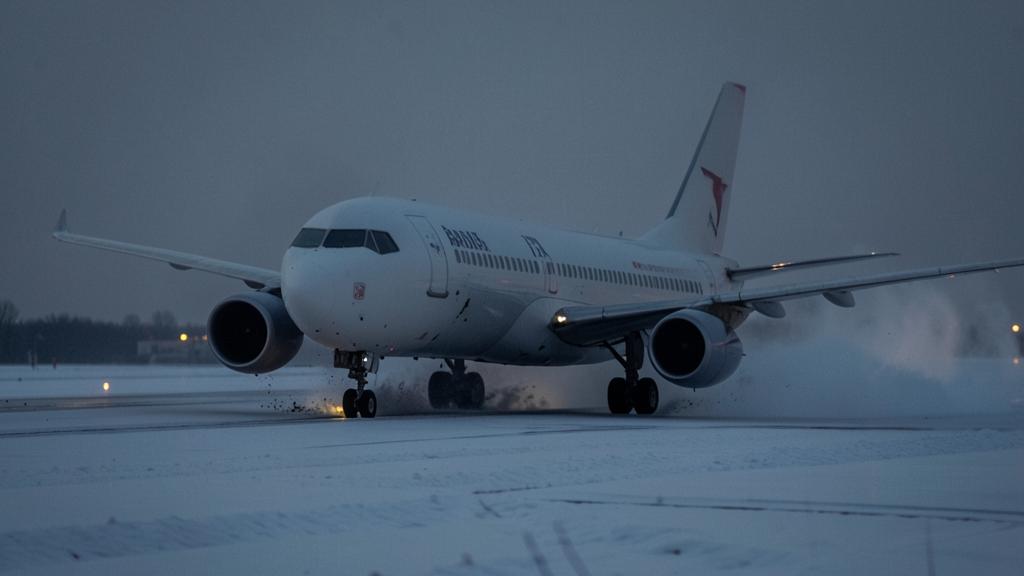
A taxiway covered with slush combines both effects. Lateral friction decreases while rolling resistance requires higher breakaway thrust; and the running engine, alone, throws up and ingests more contaminants. The second engine, for its part, is started with an inlet that has received what the first one kicked up.
| Condition | Affected mechanism | Warning signal |
|---|---|---|
| Contaminated surfaces: slush, snow, standing water | reduced lateral grip on the nose landing gear, higher breakaway thrust, contaminants thrown into the inlet | the aircraft starts to yaw despite heavy steering, or refuses to move at idle |
| Ground icing conditions | no anti-icing on a shut-down engine and no airflow to clear what has built up on the spinner and the fan blades | visible icing on a leading edge or an inlet, temperature near the dew point |
| Slope, soft ground, damaged surface | increased rolling resistance and breakaway thrust, longer jet blast area | more than one thrust application needed to move off after each stop |
| Crowded area, personnel, and ground material | the blast area of one engine at high thrust exceeds that of two engines at idle | Cones, ground vehicles or personnel behind the aircraft, in the blast axis |
| High mass and tight turns | maximum yawing moment and minimum available side force on the nose landing gear at the same time | turn that must be performed in the direction of the running engine |
| Short taxi or dense takeoff sequence | the stabilization time before takeoff thrust does not fit in the remaining time | announced queue, probable runway change, or takeoff |
Ground icing conditions pose another, more insidious problem: a shut-down engine has no anti-icing. Ice builds up on its inlet, its spinner and its fan blades, whereas on the running engine it is normally shed from the leading edges by rotation, periodic run-ups and hot anti-icing air. Whatever has accumulated during taxi will be ingested at takeoff, when the aircraft is already close to the runway. This is why most operating procedures simply exclude single-engine taxi when ground icing conditions are forecast or observed.
The right reflex: decide at the stand, not during taxi. Make the decision before moving, while the taxi route, the runway conditions, the departure sequence and the mass can all still be weighed. Announce it, with the engine concerned and the point where the second engine will be started: the crew then knows what to expect, and reverting to the normal procedure will be an explicit choice, not an improvisation during taxi.
The procedure is different upon return
Taxi with one engine upon arrival is subject to a constraint that does not exist on departure: the cool-down period. After a high-power phase and the use of thrust reversers, the engine must run at idle for the time prescribed by the manufacturer before shutdown, otherwise the residual heat in the hot section is not carried away by airflow and lubricant. The risk is not immediate: it takes the form of oil coking in the bearing compartments and thermal rotor bow. For a short arrival taxi, this time alone consumes most of the time available, saving nothing.
The choice of engine is not neutral. It depends on the hydraulic system that powers nose wheel steering and normal braking, the APU status, the side from which the stand is entered and the direction of the last turn – preferably keep the engine that helps the turn rather than the one that resists it. It also depends on the ground crew: the hazard area of a running engine when entering the stand differs from side to side, and the ground crew lead must know which one is still running.
The right reflex on arrival: announce the side before entering the stand. Tell the ground crew which engine is still running, and shut it down only once stopped with chocks in place, if the stand configuration requires it. The minute saved by an early shutdown is worth nothing compared with a ground agent who walks round the wrong side of the aircraft because he thought both engines were shut down.
What else must be checked in your own documentation
Four points deserve to be looked up in the operations manual, rather than assumed. The exact duration of stabilization before applying takeoff thrust and the cooling duration before shutdown, specific to the aircraft type and sometimes to the engine standard. The rule for cross-bleed: allowed during taxi or only at the position. The brake temperature limit applied before alignment and how it is read. Finally, who makes the decision: the company policy with a list of conditions, a simple recommendation, or the full authority of the captain – all three formulations exist and do not mean the same thing.
There remains a gray area that the documentation will not fill. The saved fuel is measured, summed, and presented; the wear of the brakes and tires attributable to the procedure is rarely measured at the fleet level, as it mixes with the geometry of the airport, the mass, and the driving style. The accounting is asymmetrical by nature, and a positive result is not necessarily complete. If you are preparing a type rating, this is the argument an examiner is looking for: not the recitation of conditions, but the ability to explain why each one is there. Operators continue the discussion in the FL330 forum.
In case of discrepancy, the applicable text, the aircraft flight manual and the operator’s approved documentation take precedence over everything above: this article explains mechanisms but does not replace any procedure.


Leave a Reply
You must be logged in to post a comment.