
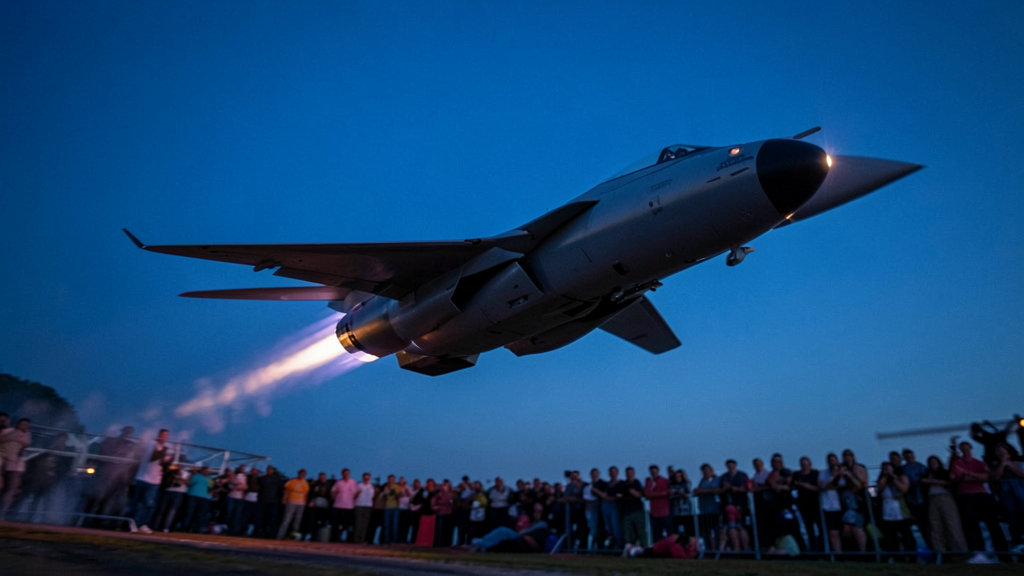
A show sequence is the most-watched minute in the life of an aeroplane programme and the least representative one. The aircraft is light, the crew is a test crew, the authorisation is not the one under which the type will earn its living, and the sequence has been rehearsed until it stopped being a manoeuvre and became a procedure. Everything on display is real. Almost none of it transfers to the line. This is what a demonstration is actually built from, which questions it genuinely answers, and which ones it cannot touch.
A display is not the flight the type was sold for
The first thing to settle is what kind of flight is being watched, because it decides which rulebook applies. A demonstration is not a commercial air transport operation: nobody on board has bought a seat, no cargo is carried for remuneration, and the flight is not being conducted to move anything from A to B. In the European system it therefore does not sit under Part-CAT, the commercial air transport rules; depending on the operator, on the aircraft and on the purpose of the flight, it is handled under the non-commercial or the specialised operating rules, or — for a prototype still in flight test — under the conditions attached to its permit to fly. That is not a technicality. Part-CAT is where a great deal of the operational conservatism lives — the aerodrome selection rules, the alternate policy, the passenger-carrying provisions. A display flight is not exempt from safety; it is governed by a different and narrower set of constraints, written for a flight whose entire profile is known in advance.
The display itself — the crowd line, the minimum heights, the categories of manoeuvre permitted, the qualification the pilot must hold — is a national competence. Flying displays have not been harmonised across Europe the way commercial air transport has. The state where the show takes place authorises the event, approves the flying programme and requires the display pilot to hold whatever national qualification it has established; the United Kingdom’s Display Authorisation is the best-known example of that model. Two shows in two states can therefore run to genuinely different separation distances and height floors for the same aircraft flying the same sequence.
Airworthiness status is the other half. A certified aeroplane flies on its certificate of airworthiness and inside the limitations of its flight manual, full stop. A prototype does not have one yet: it flies on a permit to fly issued under Part 21, with approved flight conditions attached. Those conditions are specific and restrictive — they name what the aircraft may do, over what terrain, and who may be on board. When a brand-new type appears at a show, the document that allows it to be there is not a certificate; it is a permission with an expiry date and a list.
A display flight follows different rules than normal commercial flights. It’s like a special event with its own safety rules, not the usual ones for passenger flights.
A new fighter jet prototype might fly at a Paris air show under a permit to fly, not a full airworthiness certificate. It can only perform specific manoeuvres over approved terrain, and only with test pilots on board.
The mass is chosen before the sequence is
The single most consequential decision in preparing a demonstration is the take-off mass, and it is made first. The aircraft carries fuel for the sequence, for the transit, for reserves and for a diversion — and nothing else. No payload, no cabin fit in many cases, sometimes flight-test instrumentation and its ballast. The result is an aeroplane much closer to its operating empty mass than to its maximum take-off mass.
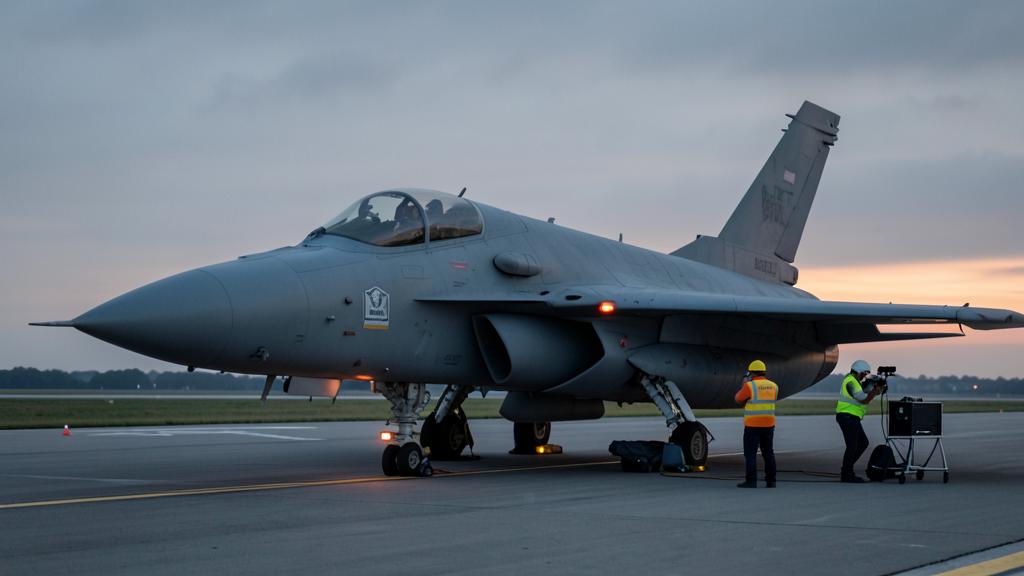
Everything the crowd finds impressive follows from that one number. Stall speed varies with the square root of mass, so every speed in the sequence — rotation, manoeuvring, minimum display speed — comes down together. Thrust does not fall with mass, so the thrust-to-weight ratio rises steeply, which is the whole explanation for the climb angle after take-off that people film and repost. Wing loading falls, so the same bank angle can be held at a much lower speed — and turn radius goes with the square of speed. And the surplus energy available to recover from any point in the sequence is larger than anything a line crew will ever have.
Centre of gravity is chosen too, not accepted. The loading is built to place the CG where the sequence wants it, within the certified envelope, and the fuel schedule during the display is planned so it stays there. This is also why a sequence is flown to a fuel plan rather than to a clock: the same manoeuvre at the beginning and at the end of the display is not the same manoeuvre, because several tonnes have gone.
| Item | Demonstration sequence | Line sector |
|---|---|---|
| Take-off mass | Chosen; near operating empty mass plus sequence fuel | Imposed by payload, route and rules; often near a structural or performance limit |
| Centre of gravity | Placed deliberately for the sequence | Result of the load sheet, inside the envelope |
| Payload | None, or instrumentation | The reason the flight exists |
| Crew | Test crew, often with a flight test engineer, rehearsed on this sequence | Line crew, possibly meeting for the first time that morning |
| Profile | Known metre by metre, validated in advance | Known in outline; the detail is negotiated with ATC in real time |
| Weather | A go/no-go criterion; the sequence changes or is cancelled | Something to be operated in, within minima |
| Escape | Pre-briefed at every gate, with a ground authority able to stop the display | Go-around, diversion, hold — decided by the crew in the moment |
| Airworthiness basis | Certificate of airworthiness, or a permit to fly with attached conditions | Certificate of airworthiness plus the operator’s approvals |
Why the turns look impossible, and why they are not
A steep turn in a display draws more comment than anything else, and the physics behind it is simple enough to defuse the mystery entirely. In a level turn, the load factor depends only on bank angle — n = 1 / cos φ — and the radius depends on bank angle and true airspeed — R = V² / (g · tan φ). Mass does not appear in either expression. What mass does is set the speed at which the aeroplane can fly at all.
| Bank angle | Load factor | Radius at 140 kt TAS | Radius at 180 kt TAS | Radius at 200 kt TAS |
|---|---|---|---|---|
| 30° | 1.15 g | 0.49 NM | 0.82 NM | 1.01 NM |
| 45° | 1.41 g | 0.29 NM | 0.47 NM | 0.58 NM |
| 60° | 2.00 g | 0.16 NM | 0.27 NM | 0.34 NM |
| 67° | 2.56 g | 0.12 NM | 0.20 NM | 0.25 NM |
Read the table across rather than down. Going from 45° to 60° of bank at a fixed speed cuts the radius by nearly half, and costs another six-tenths of a g. Dropping from 200 kt to 140 kt at a fixed bank angle halves the radius as well, and costs nothing at all in load factor. The display aeroplane does both, and the reason it can hold 140 kt in a turn while a line aeroplane cannot is mass. The manoeuvre is not aggressive; the configuration is unusual.
On fly-by-wire types with full envelope protection, there is a further layer. In the normal control law the aircraft will not exceed its angle-of-attack limit or its bank-angle limit no matter what the pilot commands — on Airbus fly-by-wire aeroplanes the normal-law bank limit is 67°, which is precisely the last line of the table above. A display pilot can therefore place the stick on the stop and let the law fly the limit. That looks like extraordinary handling and is in fact a demonstration of the protection working exactly as certified. It is a legitimate thing to show. It is not a claim that the aeroplane will do the same in an alternate or direct law, where the protections are gone.
The trap. The most common wrong conclusion drawn from a display is “so the type can do that”. It can — at that mass, at that centre of gravity, in that control law, with that crew, on a rehearsed line, with a briefed escape. Change any one of those and the demonstration stops being evidence. Nothing seen at a show belongs in an operator’s decision-making unless it also appears in the flight manual.
A display shows what the plane can do in very specific conditions, not what it will do in real operations. The plane is lighter, the crew is trained for this, and the manoeuvres are rehearsed.
A fighter jet might show a 67° bank turn at 140 kt in a display, but the same manoeuvre at maximum take-off mass would require much higher speeds and more energy.
The crew, the rehearsal and the escape
Manufacturer display sequences are flown by experimental test pilots, usually with a flight test engineer on board, and they are built the way test points are built: from the top down. The sequence is first flown at altitude, then progressively lowered as each element is validated, with the energy state at every gate measured rather than felt. By the time it is flown in front of a crowd, each element has an entry speed, an entry height, a target attitude and a minimum energy below which the pilot does something different — and that something different is briefed, not invented.
That is the real difference from line flying, and it is worth naming precisely. A line crew manages a flight whose detail is unknown until it happens. A display crew executes a profile whose every parameter is known before engine start, and whose only real variables are wind, turbulence and the state of the aircraft. The display director on the ground holds the authority to stop the programme. The display line and the crowd line are surveyed. There is nothing improvised in a good display, and a display that looks improvised is a problem, not a feature.
What a demonstration genuinely proves
Having stripped away the exaggerations, a display still carries real information — just narrower information than the audience assumes.
- That the aeroplane flies. For a prototype, appearing at a show is evidence that flight testing has reached a state where the airframe can be taken away from the test base and flown to a schedule. That is a genuine programme milestone and competitors read it as one.
- Handling qualities at the points actually used. Low-speed behaviour, roll response, pitch authority at high angle of attack: the sequence exercises these and the aircraft either does what the model said or it does not.
- Control law behaviour. Protection limits being flown deliberately, and behaving repeatably, is meaningful information about the flight control system’s maturity.
- Repeatability. Flying the same sequence four days running in different winds, with no unscheduled maintenance, says something modest but real about systems maturity.
- Crew and organisation. A display is a small, visible test of preparation, briefing discipline and the ability to stop.
What it cannot tell you, and where the answer actually lives
The questions a professional audience actually cares about are almost all invisible at a show, and every one of them is settled by a document rather than by a manoeuvre.
| What the display seems to show | What it does not establish | Where the answer comes from |
|---|---|---|
| A very steep climb after take-off | Take-off performance at operational mass, on a hot day, at altitude, with an engine failure | Certified performance data in the aircraft flight manual, with its regulated margins |
| A short ground roll | Field length required at maximum take-off mass on a contaminated runway | The flight manual and the operator’s performance software |
| An apparently quiet fly-past | Certified noise level | ICAO Annex 16, Volume I — measured at defined reference points under a defined procedure |
| A long, effortless sequence | Fuel burn per seat over a real stage length | Payload-range and cruise performance data, and in-service fuel monitoring |
| Four faultless display days | Dispatch reliability in an airline environment | Fleet in-service data, accumulated over years |
| A clean, simple-looking aeroplane | Maintenance burden and cost of ownership | The maintenance programme built on the MSG-3 analysis, and the operator’s own experience |
| An impressive cabin mock-up beside the static | What the customer’s cabin will weigh, cost or take to certify | The cabin definition, the certification route chosen for it, and the industrialisation plan |
What the accident record wrote into the rules
Display flying has a long and unhappy history, and most of the constraints that look excessive today were bought at a price. Farnborough in 1952, where a prototype broke up and its wreckage reached the spectators, is the accident behind treating crowd separation as a designed quantity rather than a habit. Paris in 1973, where a prototype broke up during its display sequence, is the case usually cited for building a manufacturer’s sequence as a validated set of test points flown by a test crew, rather than as a competitive spectacle. Habsheim in 1988 — a low fly-past at a small aerodrome, with passengers on board — is the reason normally given for keeping demonstration flying and the carriage of ordinary passengers firmly apart. Shoreham in 2015, where a display aircraft came down on a public road, led to a substantial tightening of United Kingdom rules on ex-military jets and on the oversight of display authorisations.
The common thread is not primarily airmanship. In each case the response was to change what may be planned — the geometry, the energy margin, who may be on board, what may be flown over what ground — rather than to ask pilots to do better, because the plan is the part of a display an authority can actually control.
The reflex that works. When a display makes a type look capable, ask one question before anything else: at what mass? Then ask what the same manoeuvre would require at maximum take-off mass on a hot day with an engine out. That single pair of questions separates a demonstration from performance data, and it is the habit that keeps show impressions out of operational judgement. It comes up often in the type-programme discussions on the FL330 forums.
Reading a display like a professional
None of this is an argument against demonstrations. They are an honest, tightly controlled piece of flight testing performed in public, and the discipline behind them is genuinely impressive — more impressive, in fact, than the manoeuvres. What they are not is evidence about an aeroplane’s working life. The display answers “can this airframe, at this mass, with this crew, fly this rehearsed sequence?” The operator’s question is “what will this type do, at operational mass, with a line crew, on a bad day, for twenty years?” Those two questions do not overlap anywhere.
So watch the sequence for what it is. Note the mass, the authorisation, the crew and the rehearsal — the four things that were decided before anyone got in. Then close the question and go and read the flight manual, because that is where the aeroplane you will actually operate is described.


Leave a Reply
You must be logged in to post a comment.