
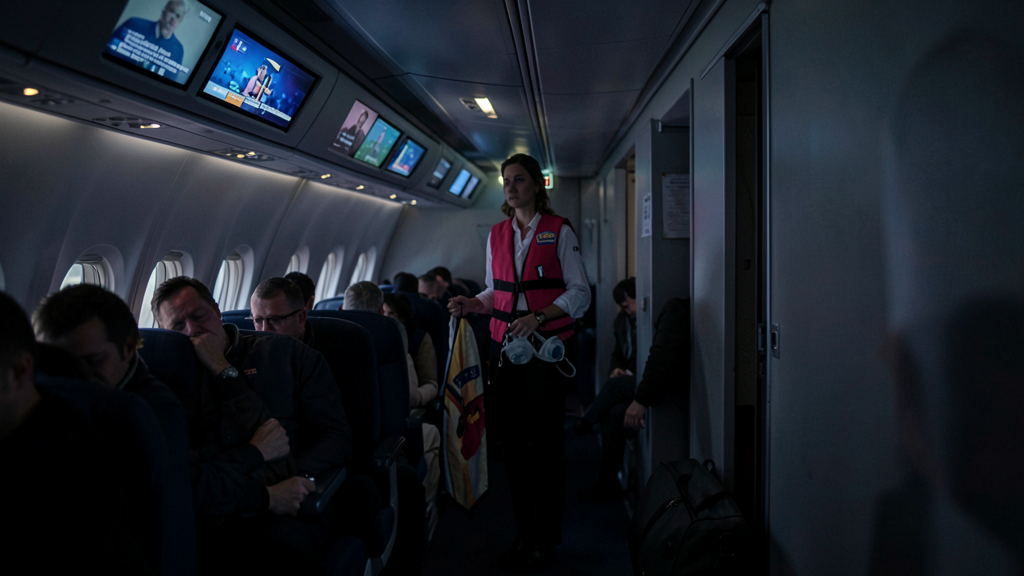
A recorded safety demonstration standardises the wording, survives a tired crew on the fourth sector, and plays in four languages without an accent. It also quietly removes the one thing the live demonstration was doing besides transmitting information: putting several pairs of eyes on the cabin at the exact moment somebody decides not to listen. The requirement was never written around a performance. It was written around passengers who end up knowing certain things — and the medium discharges only part of that.
The rule describes an outcome, not a channel
Read the international standard and the European operating rules side by side and the same grammar appears in both: the operator shall ensure that passengers are made familiar with, or briefed on, a defined list of items. ICAO Annex 6, Part I puts the obligation on the operator and lists what the passenger must end up knowing — seat belts, emergency exits, life jackets where carried, oxygen, and the other emergency equipment provided for individual use, backed by a briefing card at each seat. Part-CAT carries the same obligation into European commercial air transport and hands the method to the operations manual.
Nothing in that construction privileges a human voice over a screen, and nothing forbids one. The regulator’s interest is in the state of the passenger at the end of the process, and it leaves the operator to demonstrate that the chosen method reaches that state. The FAA writes its equivalent rule closer to the act itself — around an oral briefing given before take-off, with recorded media admitted under the conditions in the rule and in the operator’s approved procedures — which is a real divergence in emphasis and one worth checking before assuming a European cabin procedure transfers to a US certificate.
The practical consequence is the part crews rarely hear stated plainly. Pressing play satisfies the transmission. It does not satisfy the obligation, because the obligation includes several things the recording is structurally incapable of doing.
The rules care about passengers knowing safety info, not how they learn it. A video can show the basics, but it can’t check if people understand, handle special cases, or spot problems in the cabin.
On an Airbus A320, a video shows two overwing exits, but a wet-leased aircraft from another airline might have only one. The crew must announce this difference—something the video can’t do.
The demonstration was also a survey
When four crew members stand in the aisles holding a belt and a mask, they are transmitting information in one direction and collecting it in the other. In ninety seconds, standing where they stand, they see the passenger asleep against the window with no belt visible, the one with noise-cancelling headphones and a book, the one whose lap-held infant has no loop belt fitted, the exit-row occupant who has just put a rucksack against the door, the passenger who cannot reach forward far enough to brace, and the one whose condition was noticed at the door and is now confirmed.
None of that is written down as a duty of the demonstration, which is precisely why it disappears without anybody deciding to remove it. Switch to video and the crew is typically doing something else during playback — securing galleys, arming, completing the boarding count, dealing with a late bag. The information channel from cabin to crew closes at the one moment in the flight when it is densest.
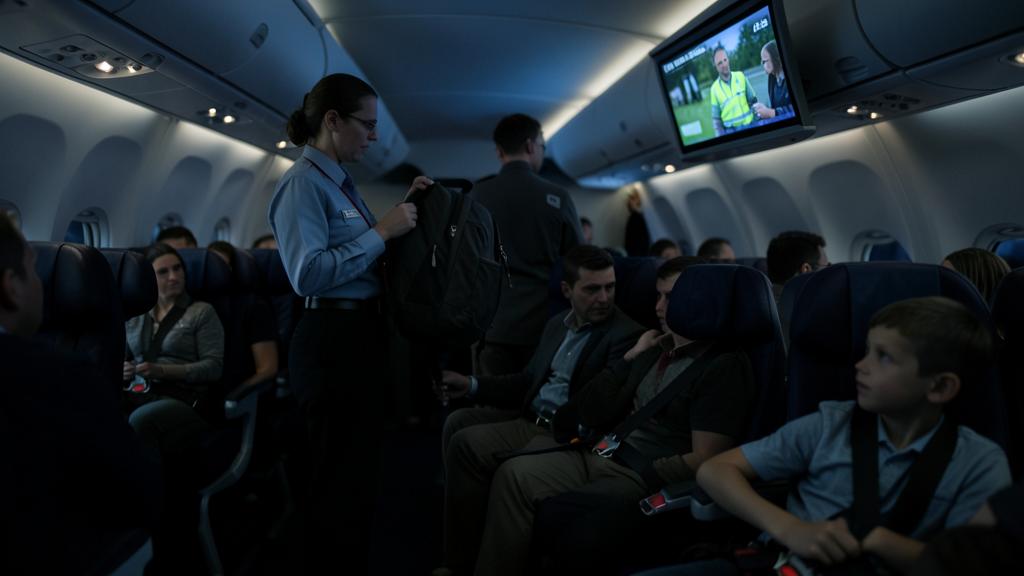
The trap. A cabin safety procedure that says “safety video played” and nothing else has documented the transmission and lost the observation. If nobody in the crew complement is tasked to be in the cabin, facing aft, watching passengers rather than the screen, the operator has changed two things while believing it changed one.
What the recording cannot know
A video is made once, for a configuration, and then flies for years. Every gap between that recording and today’s aeroplane is a gap the crew has to close by speaking.
The most common is the aircraft substitution. A registration swap inside a fleet is usually harmless; a swap across sub-fleets, or a wet-leased aircraft flying under the contracting operator’s flight number with the operating carrier’s cabin, produces a cabin whose exit count, exit type, life-jacket stowage and brace position may not be the ones on the screen. The passenger does not notice that the video shows an overwing exit the aeroplane does not have. The crew has to.
The second is the unserviceable item carried under the minimum equipment list. An exit blocked with seats out of service, a slide deactivated, a passenger address system with one zone inoperative, a screen or a whole video system deferred — each is legal, each is accompanied by an operational restriction, and none of it is in the recording. The dispatch condition usually names the compensating procedure; it is almost always a briefing given by a person.
The third is language. A recording carries the languages it was recorded in. A passenger who speaks none of them is not briefed, whatever played on the screen, and the briefing card plus a direct approach from a crew member is the only route left. This is not an edge case on charter and leisure networks.
| Element of the obligation | Recording | Stays a crew action |
|---|---|---|
| Standard content: belts, exits, life jacket, oxygen, no smoking, electronic devices | Yes, and more consistently than a live demonstration | Confirming it actually played, in the right language set, before the door closes on the operator’s timeline |
| Configuration actually flown today | Only if the recording matches the sub-fleet | Announcing every difference: exit count and type, jacket stowage, brace position |
| Items deferred under the minimum equipment list | No | The compensating briefing named in the dispatch condition |
| Exit-seat suitability and duties | No — a general statement is not an individual brief | Face-to-face brief, and reseating where the occupant is not suitable |
| Passengers requiring individual attention | No | Individual brief, recorded as given |
| Observation of the cabin during the briefing | Structurally impossible | Positioned, deliberate watching, with a plan for what to do about what is seen |
| Questions | No | Availability, and visibly so |
The passengers a broadcast never reaches
Several categories of passenger have long been treated as requiring something more than the general briefing, and the reason is the same in every case: either their duties differ from those of the rest of the cabin, or their capacity to act on the general briefing is reduced. The operations manual is the authority on the exact list and wording for a given operator and state; the logic behind the list is stable everywhere.
| Category | Why the general briefing is insufficient | What the individual brief adds |
|---|---|---|
| Occupants of exit rows | They have a task, not just a behaviour — and most of them did not seek it | Suitability check, operation of that exit, the instruction to wait for a crew command, and the requirement to keep the area clear |
| Passengers with reduced mobility | Evacuation assumptions in the general briefing do not hold; assistance has to be planned, not improvised | Their assistant, the intended route, the sequence — they are helped when the flow allows, not first |
| Unaccompanied minors | Compliance without comprehension; they follow the person next to them | Nearest exits, brace, and who they follow if the crew is not visible |
| Infants held on a lap, and child restraint devices | Belt and brace differ, and fitting errors are common and silent | Fitting checked physically, brace shown, and the device’s approval and installation verified |
| Passengers seated at a non-standard station | Equipment, belt type and evacuation route are not the ones on the screen | That station’s belt, oxygen, exit and duty |
| Escorted passengers, including those subject to removal | Restraint, seating and the escort’s duties change the evacuation picture for the rows around them | Briefing of the escort, and of the crew, on what happens to the restraint in an evacuation |
| Passengers who understand none of the broadcast languages | Nothing was transmitted at all | Card, demonstration, and a physical check of belt and exit |
The point of separating these out is not administrative. In every one of them, the failure of the general briefing is invisible from the flight deck, invisible from the galley, and invisible in the paperwork unless somebody records that the individual brief happened. A cabin where the video played and no individual brief was given can be perfectly documented and materially unbriefed.
Watching has to be scheduled, or it does not happen
The honest problem with attention monitoring during a recorded briefing is not willingness. It is that the playback window coincides exactly with the crew’s densest workload — doors armed and cross-checked, galley secured, count reconciled, last-minute passengers seated, cabin secure call to be made before the aeroplane is moving. Something has to be moved for someone to be free.
Operators who make this work do the same few things. Playback is triggered at a defined point rather than whenever the aisle looks clear, so the crew can plan around it. At least one crew member per zone is assigned to the cabin during playback, positioned facing the passengers, with no securing task in that window. The compliance walk that follows is not a belt check but a set of specific questions: who did not look up at all, who is impaired, which exit-row occupant has not been briefed, which lap infant has no loop belt, which aisle is obstructed. And the crew has an agreed response to each of those, up to and including reseating and, in the extreme, offload — because an observation with no available response stops being made within a month.
The right habit. Treat playback as a task with an owner, in the same way arming a door has one. “Zone two watches the cabin during the video” is a line in the pre-flight crew briefing that costs five seconds and restores the channel the recording removed. If nobody is named, everybody secures and nobody watches.
When the system fails, the fallback is a person
Cabin video systems fail regularly, and the failure is often partial: one zone dark, audio present without picture, the wrong language set loaded, playback starting while boarding is still in progress and finishing before half the cabin is seated. Partial failures are the dangerous ones, because they look like success from the galley.
| What fails | What it looks like | What has to happen |
|---|---|---|
| Whole system inoperative, deferred at dispatch | Known before boarding | Manual demonstration to the operator’s standard procedure, and the deferral’s compensating procedure applied as written |
| One zone or a bank of screens dark | Nothing on the crew panel; only visible from the cabin | Manual demonstration in the affected zone — not a repeat broadcast to the whole cabin |
| Audio without picture, or picture without audio | Playback “ran” | Treat as a failed briefing; demonstrate |
| Wrong language set for the passenger mix | Playback completed normally | Card-based individual briefing for the affected passengers |
| Playback overlapping boarding, or truncated by an early push | Timings look normal in the log | Rebroadcast or demonstrate; a briefing half the cabin missed has not been given |
Each of these is also a maintenance input. A screen bank that has been dark for six sectors and demonstrated around each time is a defect nobody has reported, and the deferral that should have carried a compensating procedure was never raised. Writing it in the cabin log is the difference between a robust workaround and an undocumented one.
What the paperwork has to be able to show
Two audiences read the record afterwards, and they want different things. The compliance monitoring function wants evidence that the operator’s own procedure was applied: briefing given, method used, individual briefs given to the categories the manual names. The safety function wants the things the procedure did not anticipate — the substitution that made the recording wrong, the third dark screen this month, the exit-row occupant who had to be reseated, the passenger who was never reached because no crew member spoke the language.
The second set is the one that goes missing, because there is no box for it. It arrives only through the voluntary report, and only if the crew believes the report leads somewhere. A cabin safety report saying “video played in zone 3 with no audio, manual demonstration given, third occurrence this month on this registration” is worth more to the operator than a hundred flights where the box was ticked, and it costs the same two minutes as the flight report already takes. Operators who run their cabin reporting through the same occurrence scheme as the flight deck, with the same protections, get these; operators who treat cabin reports as a separate and lesser channel do not. The reporting culture underneath that difference is a management-system question rather than a cabin one, and it is discussed in the operational material on FL330.
What the trade actually is
Nothing above is an argument against the recorded briefing. It is more consistent, it does not degrade at four in the morning, it handles multilingual cabins that no crew complement could cover, and it removes the variability that made the live demonstration uneven between crews and between sectors. Those are real gains and they are the reason the industry moved.
- Video transmits but can’t adapt to real-time issues like aircraft substitutions, unserviceable items, or language barriers.
- Crew must monitor passengers during playback to spot problems like unsecured infants, obstructed aisles, or unbriefed exit-row passengers.
- Special cases (exit rows, disabled passengers, non-native speakers) always need face-to-face briefings.
- Failures must be logged—partial video failures can look like success and must be documented for maintenance.
The trade is that a video transmits and cannot receive. Every part of the obligation that requires the crew to know something about this particular cabin — who is in the exit row, who has not understood, which screen is dark, which passenger cannot brace, which configuration is not the recorded one — survives the change unaltered and now has no natural moment attached to it. It has to be given one deliberately: a named crew member, in the cabin, during playback, with an agreed response to what they see.
Put more bluntly, the recording discharges the part of the briefing that a regulator can verify from a document, and leaves the operator holding the part that only the crew can perform. Crews who articulate it that way stop treating the video as the briefing and start treating it as the first minute of one.


Leave a Reply
You must be logged in to post a comment.