
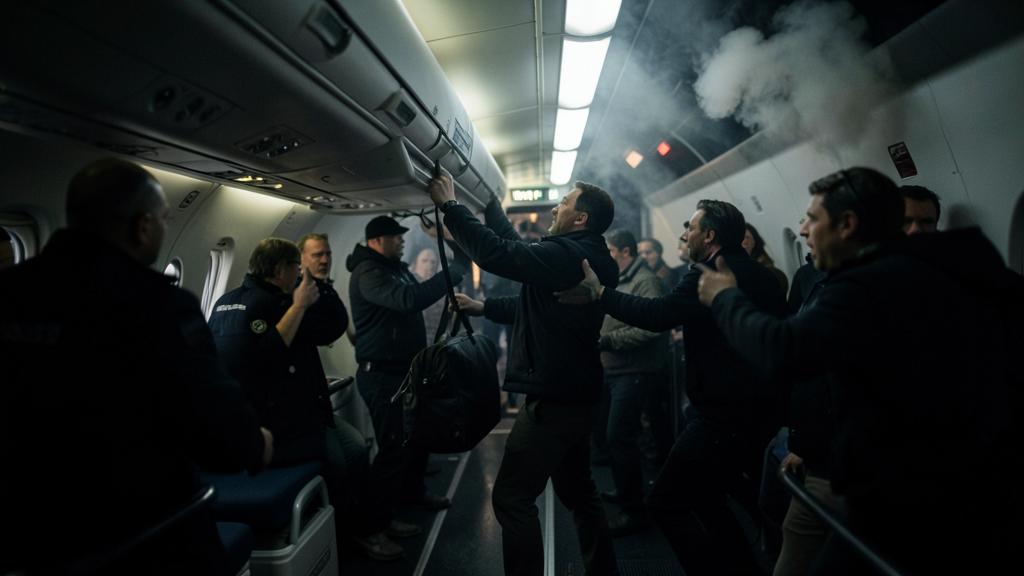
The passenger who stops to open a bin while the cabin fills with smoke is not defying anybody. He is finishing a sequence he has run a hundred times in that exact scene: aircraft stopped, belt released, hand up, bag down, walk out. The evacuation borrows the same physical setting as every normal arrival, and under stress the most practised routine wins. That is why prohibition fails and why the wording, the register and above all the timing of what the cabin crew say decide whether the bins stay shut.
Ninety seconds, and nobody in the bins
The number that sizes exits, slide capacity and cabin layout comes from the certification evacuation demonstration required of large transport aeroplanes: the full certificated passenger complement leaves in ninety seconds, using only the exits on one side, in darkness, with a mixed-age population of volunteers. The protocol is deliberately unhelpful — obstructions are placed in the aisles, only a fraction of the exits are available, and the crew complement is the minimum. It is a demanding test.
What the protocol does not contain is a single participant who stops to retrieve property. Volunteers are briefed, motivated, know it is a test and know exactly what is expected of them. The demonstration therefore measures the aeroplane, not the population. Every second lost to a bin on a real aeroplane is spent out of a budget that was never sized to pay for it.
Retrieval is therefore not a marginal irritant to be scolded out of existence in the safety demonstration. It is an unmodelled variable sitting on top of a margin that was already tight — and the one variable in the chain that cabin crew can influence directly on the day.
The evacuation test is designed to be hard, but it doesn’t account for people grabbing bags. In real life, every second wasted on bags is time we don’t have, and crew can’t control many factors—except how they talk to passengers.
On an Airbus A320, the certification test requires a full cabin of up to 180 passengers to evacuate within 90 seconds using only half of the exits. If even a few passengers stop in the aisle to grab bags, everyone behind them waits: a few seconds lost at the front can add tens of seconds to the whole flow—enough to turn a safe exit into a dangerous one, especially with smoke or a slide performing poorly.
Not disobedience: a script running to completion
Behaviour under acute stress does not become random. It becomes narrow and habitual. Attention contracts onto a small number of cues, deliberate reasoning slows, and the brain reaches for the best-practised routine associated with the situation it believes it is in. For an aeroplane sitting still on the ground with the belt signs out and doors being opened, the best-practised routine in every frequent flyer’s repertoire is disembarkation.
Look at what the cabin actually presents at the moment of an evacuation. The aeroplane has stopped. The engines are spooling down. People are standing. Doors are being operated. Somebody is talking on the public address. Every cue that normally triggers the arrival script is present, and the bin — the object at the centre of that script — is directly above the passenger’s head, at eye level, within reach, while the exit may be twenty rows away and invisible.
Two further mechanisms compound it. The first is subjective time compression: retrieving a bag feels like a two-second act, and the passenger performing it has no model of the queue forming behind him. The second is that the act is not the output of a decision at all, which is why it is impervious to argument. You cannot reason a reflex out of somebody who is not reasoning.
| Cue present in the cabin | What the arrival script does with it | What the evacuation needs instead |
|---|---|---|
| Aeroplane stopped, engines running down | Stand, gather belongings | Stay seated and braced until commanded |
| Seat belt released | Hand goes up to the bin latch | Hands empty, body turned toward the aisle |
| Bin directly overhead | Open it, take the bag down | Leave it closed and locate the nearest usable exit |
| Door being operated | Queue by row, wait your turn politely | Move to the nearest usable exit regardless of row |
| A voice on the public address | Listen for information | Act on a shouted command without processing it |
Four passengers, four different reasons, four different answers
Treating retrieval as one behaviour is why countermeasures underperform. At least four distinct people do it, and only one of them is running on automatic.
The script runner is the classic case above. He is barely aware of the act and will often be genuinely surprised to be told he did it. The only thing that reaches him is an interruption of the cue chain: a command that arrives before his hand does, loud enough and physical enough to break the sequence.
The reasoner has decided. Passport, residence permit, medication, house keys, phone, laptop, the child’s documents — he has performed a cost-benefit calculation, badly, and concluded that being in a foreign country with no identity papers is the bigger problem. He is not wrong about the consequence; he is wrong about the arithmetic. He is unreachable during the event, because he has already thought about it. The only argument that meets him is made before departure, and it is a practical one: what you cannot afford to lose should never be in the bin in the first place.
The non-believer sees no flames from seat 34K, hears no explosion, and construes the event as an operational inconvenience. Behavioural inaction — hesitating, waiting for confirmation, continuing to sit — is one of the best-documented patterns in evacuation research, and taking a bag is simply its active form. He is calibrating the seriousness of the event on the only instrument available to him: the demeanour of the crew.
The imitator does it because the row in front did it. One open bin publicly licenses the behaviour for everyone who can see it, and in a narrow single-aisle cabin that is a large number of people. This is why the first few seconds are worth more than the next thirty, and why a command delivered late is not a partial success but close to no success at all.
Why « please do not take your hand baggage » is a weak sentence
The phrase that appears in many safety demonstrations has four separate defects, and they compound.
It is a negation. To understand a prohibition, a listener has to represent the action first and then cancel it. Under load, the cancellation is the part that fails. Worse, the sentence names the object — hand baggage — and puts it in mind at the moment you least want it there.
It prescribes nothing. It tells the passenger what not to do and leaves the far more urgent question unanswered. A person whose reasoning has narrowed needs one positive action, not a constraint on a space of actions he is no longer able to search.
Its register is wrong. « Please », « sir », « kindly », the measured cabin-announcement cadence — these are the exact acoustic markers of routine service. Passengers infer urgency from register at least as much as from content, and a correctly worded instruction delivered in a service voice is heard as a service announcement.
It is too long. Multi-clause sentences do not survive an aural warning, a cabin full of shouting, and one ear against a headrest. Anything that cannot be shouted in a breath will not be transmitted.
| What is said | Processing demanded | Failure mode |
|---|---|---|
| « Please do not take your hand baggage » | Represent the act, cancel it, then invent a substitute action | Names the bag, supplies no action, service register |
| « Leave your bags! » | Negation removed, but the object is still the subject of the sentence | Better; still directs attention overhead |
| « Leave everything! This way! » | One prohibition folded into one movement instruction | Works only if repeated and paired with a pointing arm |
| « Evacuate, evacuate » from the flight deck | Recognise a change of state | Names the state, not the action; useless without cabin commands |
| « Get out! Get out! » with an arm sweep at the door | Move | Strongest wording, delivered where the bins have already been opened |
The command that works, and the place it has to come from
The shape of an effective evacuation command is not controversial and is reflected in operators’ standard command sets: two or three words, imperative, positive, one action, repeated continuously, delivered at maximum volume, paired with an unmistakable gesture and with eye contact where possible. In a cabin with a dozen first languages, the arm carries more than the words do, and a crew member pointing and physically directing traffic is understood by everybody.
The harder problem is geography. Bins are opened in the rows; commands are shouted at the doors. By the time a passenger arrives in front of a crew member, the bag is already in his hand and the decision to abandon it has become a public loss he has to accept in front of witnesses. Any procedural gain therefore lives in the seconds between the order to evacuate and the first movement in the cabin — the window in which crew are still moving to their stations and the public address is the only instrument that reaches everybody at once.
The trap. A calm, polite voice is read as a routine announcement, whatever it says. Passengers calibrate the seriousness of an event on crew demeanour before they calibrate it on content. A perfectly worded command delivered in service register does not underperform slightly — it is decoded as « nothing is really wrong », which is precisely the belief that produces retrieval.
Timing: the same words are strong or worthless depending on when they land
A common mistake in cabin safety communication is putting the explanation and the command in the same slot. They belong in different ones, and neither works in the other’s place.
The pre-departure safety demonstration is the weakest slot that exists for changing behaviour: attention is low, no threat is credible, and whatever is retained decays over the following hours. That does not make it worthless — it is where the phrase becomes familiar, so that hearing it later triggers recognition rather than parsing — but expecting it to overcome a reflex four hours later is asking it to do something it cannot do.
The prepared-emergency briefing is the strongest slot that exists, and it is chronically underused. A few minutes before a planned evacuation the threat is credible, attention is total and retention only has to last minutes. This is where you explain why — a bag punctures or fouls a slide, a bag in the aisle is a dam, a bag in one hand removes the hand you need on the way down — and where you name, in advance, the exact words you are going to shout. It is also where the cabin can be physically pre-configured: everything stowed, laps and hands empty, heels off, aisles clear, exit rows briefed by name.
In an unprepared event, nothing exists except the shouted command and whatever was pre-loaded. There is no time to explain anything to anybody, and any attempt to do so costs seconds at the worst possible moment.
| Slot | Passenger state | What it can realistically achieve |
|---|---|---|
| Pre-departure demonstration and safety card | Distracted, no perceived threat | Familiarity with the phrase and the exit count; no behaviour change on its own |
| Prepared-emergency briefing, minutes before | Alert, threat credible, attention undivided | Explanation, physical pre-configuration, pre-announcement of the command |
| The command itself | Narrowed attention, high noise | Interrupt the sequence; nothing else |
| On the ground, clear of the aeroplane | Adrenaline falling, property salient again | Hold the group together and stop re-entry attempts |
The right reflex. Spend part of a prepared-emergency briefing saying the command out loud, in the words you will use, and telling people that the next time they hear it they must move without answering. A phrase rehearsed three minutes earlier is recognised instantly; the same phrase heard once at pushback is parsed, and parsing costs the seconds you do not have.
Blocking the gesture rather than forbidding it
Engineering answers have been proposed for years — bin latches that inhibit on a signal from the flight deck, for instance — and none has been adopted, for a reason worth understanding rather than resenting: any lock is itself a failure mode. A latch that can refuse to open is a latch that can trap emergency equipment or block a normal disembarkation, and it would have to be shown to fail safe under conditions in which nothing else is behaving normally. The certification burden is heavier than the behavioural gain.
That leaves the levers the industry actually controls, and most of them sit upstream of the cabin crew. Cabin bag policy is one: a cabin in which every bin is packed to the ceiling and every second passenger has a large wheeled case is a cabin where retrieval takes longer, obstructs more and injures more on the slide. Commercial structures that push bags out of the hold and into the cabin move the risk with them, and it is more honest to say so than to load the entire mitigation onto four people shouting.
The lever that does belong to the crew is stowage discipline, and here the effect cuts both ways: a properly stowed cabin is one where the aisle stays clear when a bin is opened, and also one where the bag comes out in a single movement. Comparing standard command wording across fleets — the FL330 forums carry a running thread on it — is one of the few ways to discover that your own phrase is the weak one.
Writing the report so it is worth something
Most post-evacuation reports contain the sentence « some passengers evacuated with cabin baggage », and that sentence is unusable. It cannot be counted, compared or fed into any subsequent design or training work. What makes an account usable is the detail that reconstructs the mechanism: where in the cabin retrieval started, at what point in the sequence relative to the command, what words had actually been used and in what tone, whether crew were visible from that row, whether the passenger’s bin was above him or across the aisle, whether the bag went down the slide and what it did on arrival, and whether anybody attempted to go back.
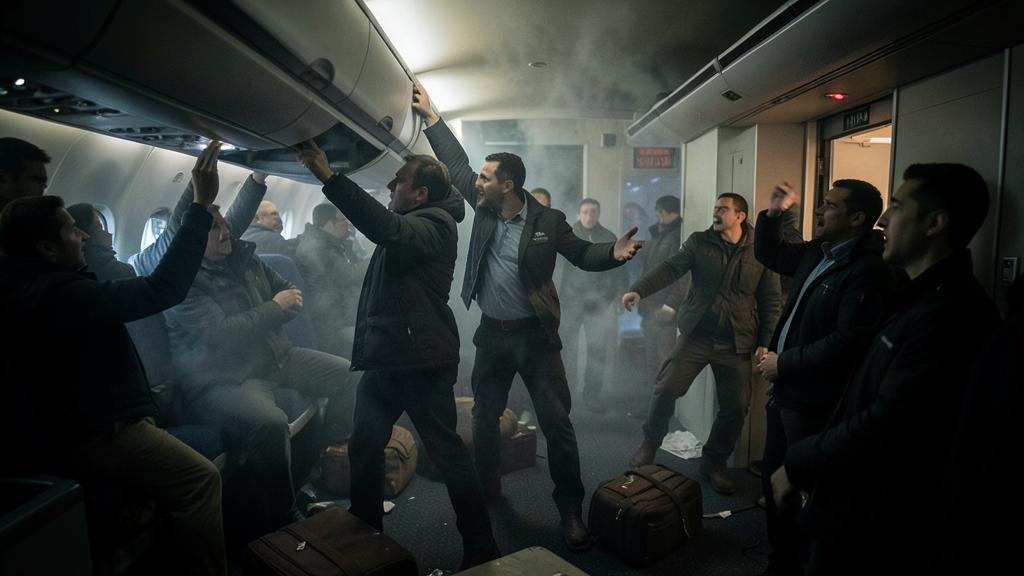
An evacuation is a reportable occurrence under the European occurrence reporting regime, so the report will be written in any case; the question is only whether it says something. The same holds for the debrief crews give each other before they scatter: five minutes of specific recollection while it is fresh beats any questionnaire circulated a week later. Operators who collect it consistently end up with what the certification demonstration will never provide — a description of what their own passengers actually do.


Leave a Reply
You must be logged in to post a comment.