
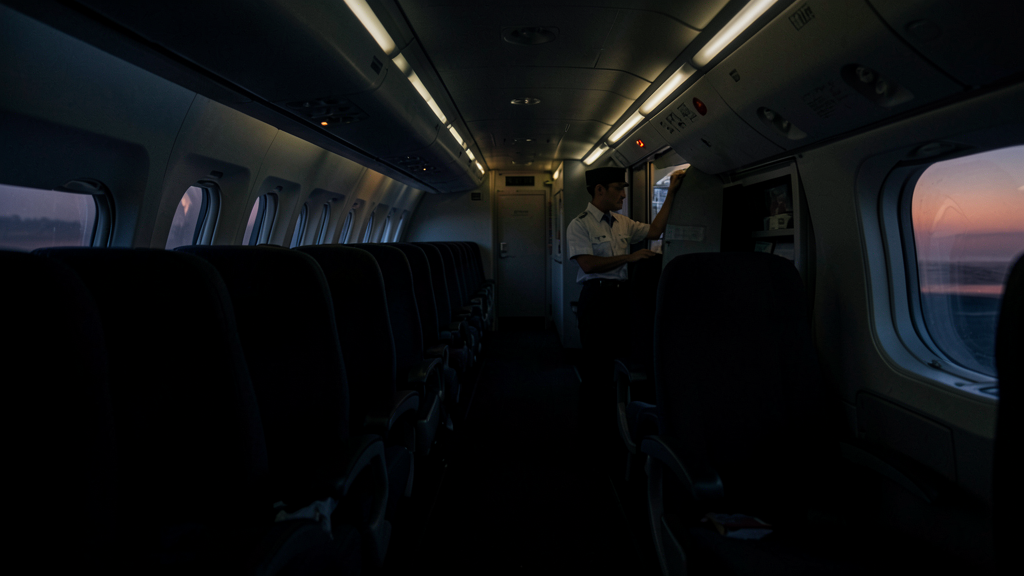
Fifty is not a safety constant. It is a coarse divisor laid over a certification objective — everyone out of a burning aeroplane in ninety seconds, through half the exits — and the arithmetic it produces sets a payroll line for the whole life of a cabin configuration. The number that trips people up is not the divisor. It is what the rule counts: seats installed, deck by deck, whether or not anyone is sitting in them.
Two numbers, two authorities, two documents
A cabin has at least three population figures attached to it, and confusing them is the origin of most of the arguments between commercial planning and flight operations.
The first is the certified maximum passenger seating capacity. It is an airworthiness number, fixed at type certification and amended by approved design changes. It is limited by the emergency exits: their type, their number, and their distribution along the fuselage. This is the number that says a given airframe cannot legally carry more than so many people no matter how the seats are arranged, and it lives in the type certificate data sheet and the aeroplane flight manual.
The second is the number of seats actually fitted, recorded in the layout of passenger accommodation. In the European scheme the operational ceiling derived from it is the maximum operational passenger seating configuration — the figure declared in the operations manual, which may be at or below the certified capacity but never above it.
The third is the minimum cabin crew complement. It is an operational requirement, set by the state of the operator under the framework of ICAO Annex 6, Part I, which obliges each state to establish a minimum and to establish it on the basis of seating capacity or number of passengers. In the European rules the operator requirements for air operations settle that choice, and they set the minimum as the greater of two numbers: the crew complement established for that cabin configuration during certification, and one cabin crew member for every fifty, or fraction of fifty, passenger seats installed on the same deck. The divisor is the branch everyone quotes, and usually the one that binds — but a cabin certified with more crew than the arithmetic produces keeps the certification number.
The three numbers are set by different texts, changed by different processes, and audited by different people. A densification project touches all three, and the one that bites first is rarely the one the project started with.
Where the fifty actually comes from
It is a regulatory convention of long standing rather than a value derived from a specific experiment. What can be traced is the objective it serves.
Transport aeroplane certification requires that the full seating capacity be evacuated within ninety seconds, in darkness, with the exits on one side of the fuselage unavailable, using participants of mixed age and physical condition who have not rehearsed the exit they will use, and with the crew complement the applicant proposes as the minimum for that configuration. That demonstration is what ties exit type and exit number to a maximum head count. Live demonstrations have themselves injured participants, which is why much of the modern evidence base is analytical or drawn from earlier tests rather than a fresh full-scale evacuation for every derivative.
The demonstration produces a pairing: this many people, through these exits, with this many crew. The operating rule then has to generalise that pairing across every configuration an operator might build, and it does so with a divisor. Fifty is coarse on purpose. It is auditable from a document anyone can read, it needs no engineering judgement at the ramp, and it errs on the side of more crew in the configurations where the geometry is awkward.
The ratio has no relationship to where the doors are: a step every fifty seats is arithmetic, not geometry. That is why the headcount is only a floor, and why duty stations, exit coverage and assist space are layered on top of it.
The “one crew per fifty seats” rule is a simple way to ensure enough crew for emergencies, based on old evacuation tests. It doesn’t account for exact door locations or passenger numbers, just installed seats per deck.
An Airbus A320 with 180 seats needs 4 cabin crew (180/50 = 3.6, rounded up). Even if only 50 passengers board, the crew count stays at 4 because the rule counts seats, not passengers.
Installed, not occupied
Two different quantities appear in the same rule set, and they are not interchangeable.
Whether cabin crew are required at all turns on the aeroplane, not on the load. In the European scheme the requirement arises for an aeroplane whose declared seating configuration exceeds nineteen, as soon as a single passenger is carried. How many are required is then a question about seats installed, deck by deck.
What follows catches every operator who thinks of the complement as a service level. Take a sixty-seat aeroplane. Carry sixty passengers and the rule asks for two cabin crew members. Carry six, on a thin sector, and it asks for the same two — computed on the sixty seats bolted to the floor, not on the six people sitting in them. The load factor appears nowhere in the calculation, and no amount of empty cabin makes a position go away.
The trap. Blocking a row in the reservation system, taping off seats, or capping the booking class inventory does not change the count. The rule follows the seats recorded in the layout of passenger accommodation, not the seats sold. To move the number you have to change the aeroplane, under approved data, and update the manuals and the weight and balance file that go with it.
The second qualifier is on the same deck. On a twin-deck aeroplane the calculation is run per deck and rounded per deck, which costs crew that an aggregate calculation would not. Two hundred and twenty seats on the main deck and thirty on the upper deck is five plus one — six — where two hundred and fifty seats on a single deck would be five. The rounding is where the money is.
| Seats installed | Minimum cabin crew | The seat that changed it |
|---|---|---|
| 50 | 1 | — |
| 51 | 2 | The 51st doubles the complement |
| 100 | 2 | — |
| 101 | 3 | One seat, one full position |
| 150 | 3 | The common single-aisle sweet spot |
| 151 to 186 | 4 | The whole densified narrow-body band sits here |
| 200 | 4 | — |
| 201 | 5 | — |
What crossing a multiple of fifty actually costs
The extra salary is the smallest item on the list, and the one the business case usually starts with. The binding constraint is normally physical.
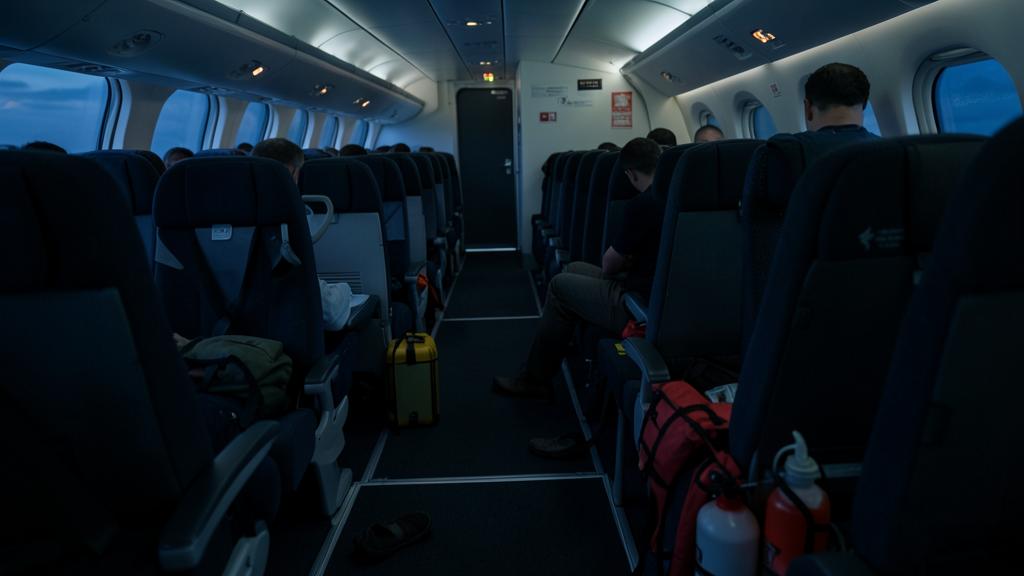
An additional cabin crew member needs a certified attendant seat. That seat has to exist, be structurally approved for the loads, be located where the rule wants it — adjacent to a floor-level exit, with a restraint system, and positioned so the occupant can see the cabin area for which they are responsible. Adding one is a design change with approved data behind it, not a matter of bolting a folding seat to a bulkhead. On a densified narrow-body the space it would occupy is precisely the space the extra row was meant to use.
Around the seat sits a train of consequences: an additional set of personal emergency equipment, protective breathing equipment and portable oxygen quantities recalculated, life jacket and life raft capacity checked against the new total, crew rest provisions on the sectors where they apply, and duty station diagrams reissued in the operations manual. The weight and balance file changes twice — once for the seats, once for the crew member and their equipment. Rostering absorbs the position across every rotation the configuration will fly.
| Item | Governed by | Fails how |
|---|---|---|
| Exit-limited capacity | Type certificate, flight manual | Hard ceiling — the seats simply cannot be certified |
| Cabin crew minimum | Operating rules, seats installed per deck | One extra position, permanently |
| Attendant seat and station | Approved design change, layout of passenger accommodation | Nowhere to put the person the ratio just bought |
| Emergency equipment quantities | Operating rules, keyed item by item to seats fitted or persons on board | Found at the next ramp check, not in the spreadsheet |
| Exit row access and assist space | Certification requirements on exit access | Pitch reduction blocks an exit the demonstration relied on |
| Weight and balance | Operator data, loading manual | Envelope or payload penalty on the marginal sectors |
The right reflex. Run the arithmetic on the layout of passenger accommodation before the commercial case is signed, not after. The question is never « how many seats fit » but « which of the three ceilings — exits, crew ratio, attendant station — do these seats hit first ». They are rarely the same one, and the cheapest configuration is usually the one that stops on a multiple of fifty rather than one seat past it.
The ratio says nothing about where they sit
A headcount is not exit coverage. Two cabins with identical complements can be prepared very differently for the ninety seconds that matter, and the rules that close that gap are separate from the ratio.
Cabin crew are required to occupy assigned stations during the critical phases of flight, and the assignment is not free. The stations must be distributed through the cabin so that assisted evacuation is possible from each required exit, with a direct view of the cabin area under that crew member’s responsibility wherever practicable. On a single-aisle aeroplane with four crew and four floor-level exits the mapping is obvious. On a densified cabin with an over-wing exit pair, a rear galley complex and a mid-cabin partition, it is not: the arithmetic can be satisfied by four people clustered fore and aft while a pair of over-wing exits has no crew member within reach of it.
This is why the operations manual carries a duty station diagram per configuration and why a configuration change requires the diagram to be reissued and retrained. It is also why a crew member deadheading, positioning, or riding as a passenger does not count toward the minimum. Counting toward the minimum means being rostered as operating crew, assigned a station, briefed for that configuration and current on that type. A qualified colleague in seat 14C is a passenger.
The narrow doors below the minimum
Every scheme provides some relief, and each piece of relief is conditional in ways that are easy to misremember at the gate.
The first is the unforeseen-circumstances case: a crew member becomes unavailable after the flight is under way commercially, and the operator is permitted to depart with fewer. The permission is not free. It is typically conditional on reducing the number of passengers carried, on the flight not exceeding stated parameters, on a procedure already written in the operations manual, and on a report to the competent authority. It exists to recover a disruption, not to plan a roster.
The second is ground operations. Both the European and United States schemes allow a reduced number on board while passengers embark or disembark, and both attach conditions about the ability to initiate an evacuation, about the exits available and about communication with the flight deck. Neither leaves a cabin with passengers in it and nobody qualified to start that evacuation. Refuelling with passengers on board carries its own set. How far the number may fall, and on what conditions, differs between the two schemes and between operators, and the only version that binds a crew is the one in their own manual.
| Question | Counted on | Practical effect |
|---|---|---|
| Is any cabin crew member required? | Declared seating configuration, plus at least one passenger on board | Above the threshold the requirement arises whatever the load factor |
| How many are required? | Seats installed, per deck | An empty cabin costs the same complement as a full one |
| How much emergency equipment? | Mixed — some items on seats fitted, some on persons on board | Read the item, not the habit; the two bases sit side by side in the same rules |
| How many may be missing at the gate? | Operations manual relief clause | Conditional, reportable, and never a rostering tool |
The third is the operator’s own number above the minimum. Many carriers roster a service complement higher than the regulatory floor. Once that number is written into the operations manual as the standard complement, dispatching below it is a deviation from an approved or declared procedure — which is exactly what an audit is looking for, even where the regulatory minimum is still met.
How the two schemes diverge
One crew member per fifty seats is not a world rule. ICAO obliges states to set a minimum and to base it on seating capacity or passengers carried; it does not impose the divisor. The European rules chose the flat divisor on seats installed per deck. The United States rules in Part 121 express the requirement in bands keyed to seating capacity — one attendant above a threshold in the small band, two up to a hundred, then an additional one for each unit or part of a unit of fifty above that.
At most common configurations the two produce the same headcount, which is why the divergence is easy to miss. It shows up at the margins and in the wording: how a deck is treated, what counts as a seat, how far the number may be reduced on the ground, and what the operator must report when it is. An operator running a mixed fleet under two certificates, or wet-leasing across the Atlantic, cannot assume that a crew complement legal at one end is legal at the other.
What the auditor actually reads
Findings in this area are rarely about the headcount. The headcount is a division, and it is right or wrong on the spot. Findings are about the paper trail behind it: a layout of passenger accommodation that does not match the aeroplane, a duty station diagram for a configuration that was superseded two seasons ago, a reduced-crew departure with no report on file, emergency equipment quantities computed for the pre-densification cabin, or a manual that states a complement the roster never actually produces.
Each of those is the same failure in a different costume: the seat count moved, and one of the documents that depends on it did not move with it. Operators who treat a cabin reconfiguration as a documentation project with a seating consequence, rather than a seating project with a documentation consequence, tend not to collect these findings. It is one of the themes covered in the cabin operations material on the FL330 training platform.


Leave a Reply
You must be logged in to post a comment.