
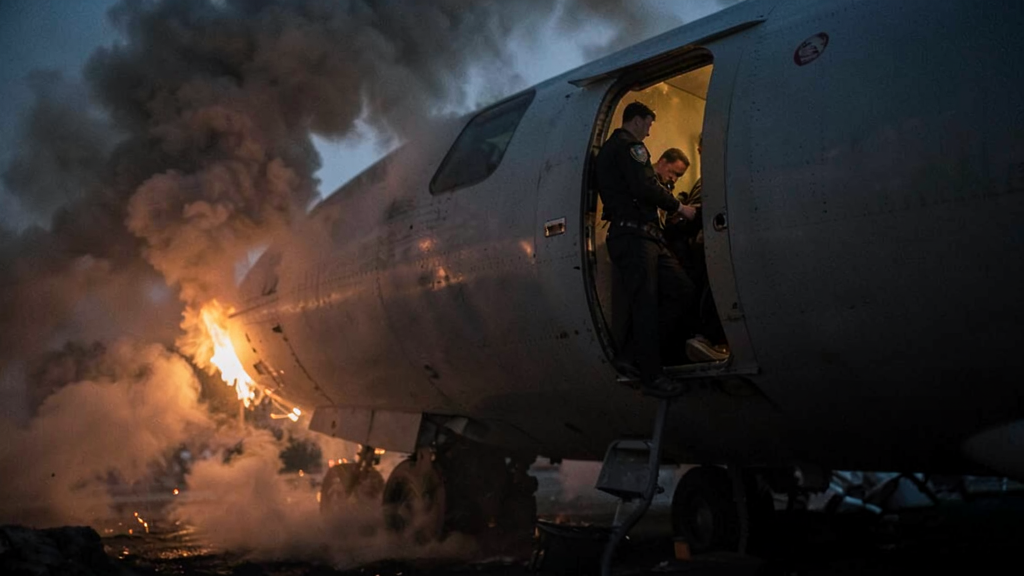
Every evacuation drill ends with the doors open. The decision that precedes it — whether this particular exit should open at all — is taken by one person, standing at one door, with a viewport the size of a paperback and seconds rather than minutes in which to use it. It is one of the very few calls a cabin crew member makes alone, without a checklist, without a command, and with cues that each say something slightly different. Getting it wrong in either direction kills people: an exit opened into fire, or an exit refused when it was the only one left.
The command that never specifies a door
The flight deck orders the evacuation. It does not, and cannot, say which exits to use. From the flight deck the crew sees a windshield’s worth of nose and whatever the engine indications and fire warnings are saying; it has no line of sight to the rear service door, none to the overwing exits, and no view whatever of the side the aircraft has come to rest on if the fuselage is between it and the fire. When the flight deck can say something useful — wind, which engine, where the fire indication is — it should, and the well-drilled operator builds that into the emergency brief. But the exit-by-exit decision is delegated by design, not by omission.
That delegation is why every operator’s door drill contains an assessment step. The wording differs between operators; the sequence does not: assess, then operate. The crew member reaches the exit, looks out, decides, and only then touches the handle — the one point in the procedure where the aeroplane’s emergency plan may be overruled by what is actually outside.
What the ninety seconds assumed
The ninety-second figure everyone quotes comes from the large-aeroplane certification codes, and it is a demonstration, not a prediction. Its conditions are deliberately artificial in both directions. No more than half the fuselage side exits may be used, and which half is not left to the applicant alone, so the demonstration is normally flown with one side unavailable, which is severe. The aeroplane is on its gear, on level ground, in darkness, with a trained crew, no fire, no smoke, no fuel on the ground, nobody pulling a bag out of a bin and no wind blowing anything anywhere, which is not.
The consequence for the person at the door is this: losing every exit on one side is inside the design assumption. Losing them asymmetrically — one forward left, one aft right, the overwing pair unusable — is not. The demonstration validates a capacity, and validates it for one clean, contiguous loss. Everything it excluded eats the margin, and there is no second allowance underneath.
The 90-second evacuation rule is based on ideal conditions that don’t exist in real emergencies. If exits are lost in a messy way, the crew has to improvise beyond what was tested.
On a Boeing 737 with a runway excursion, the left side exits are blocked by fire. The crew must use only the right side, but the wind pushes flames toward those exits. The 90-second rule doesn’t account for this, so the crew must decide fast.
| Element | In the demonstration | On the day |
|---|---|---|
| Exits available | One side of the fuselage only | Any combination, including exits lost in the middle of the cabin |
| Aircraft attitude | On its gear, level ground | Gear collapsed, nose-down, banked, off the paved surface |
| Fire | None | Fuel pool, engine, wheel well, cabin interior — each with a different growth rate |
| Smoke | None | Stratified at the ceiling and descending, obscuring the exit signs first |
| Wind | None | Decides which side of the fuselage the flames are pushed onto |
| Occupants | Able-bodied volunteers in a prescribed age and sex mix, obstructions placed in advance | Reduced mobility, infants, baggage retrieved despite commands, blocked aisles |
| Crew knowledge | Knows the aeroplane is intact | Knows nothing about the exterior until the assessment at the door |
Reading the outside: what each cue proves
The cues arrive together and they are not equally reliable. A glow through the viewport at night is close to conclusive — flame with a direct line of sight to that door — but a fuel fire in bright daylight can be almost invisible, and a crew member drilled only at night will look for a glow the daylight has erased. Smoke density says how much is burning and very little about where; smoke flattened along the fuselage says more about the wind than the fire.
Heat at the door is the cue most often misread. The door skin is thin metal on most types and conducts well, so a door adjacent to flame becomes hot quickly and unambiguously: heat present is strong evidence. The reverse does not hold. A door cool to the back of the hand tells you only that nothing is burning against that panel at that moment; a fuel pool spreading under the wing produces no heat at the frame until it arrives. Operators differ on whether a touch check is even in the drill, and where it is, it confirms and never clears.
| Cue | Establishes | Does not establish | Weight in the decision |
|---|---|---|---|
| Glow through the viewport | Flame with line of sight to this exit | Whether it is spreading or dying; nothing at all in strong daylight | Disqualifying on its own |
| Heat at the door skin or frame | Fire already against the structure here | Absence of heat says nothing about a pool eight metres away | Disqualifying if present; worthless if absent |
| Smoke density outside | Something substantial is burning | Where it is burning, or whether this side is the safe side | Supporting only |
| Direction the smoke is laid over | Local wind at ground level | The fire’s position relative to the fuselage on its own | Decisive once combined with where the fire is |
| Debris, fluid, or an unusual surface below | Slide will land on something it was not designed for | Whether the slide will actually fail | Weighs against, rarely disqualifying alone |
| Engine noise on that side | A rotating engine near the slide path | Whether it will be shut down before people reach the ground | Disqualifying while it persists |
| Aircraft attitude at this door | Slide geometry outside what was demonstrated | Whether the slide will still inflate usefully | Judgement, against the alternatives |
The exit before the outside: the door and the slide
Two failures are cheaper to detect than the fire, and are checked first because they are binary. The door may be deformed, jammed by a fuselage that no longer holds its shape, or blocked by structure that has moved; forcing it spends the only resource the crew has, which is time. The escape slide has its own envelope: it is demonstrated to deploy and remain usable in a wind the certification code specifies, from the most critical direction, with the aeroplane on its gear on level ground. Every one of those conditions can be absent, and a collapsed nose gear changes the slide angle at every forward exit at once.
A slide that deploys into flame, into a fuel spill or across sharp debris is not a slide. It is a fabric structure holding pressure, and it stops holding it. That is the reason the assessment covers the ground under the exit and not only the horizon: an exit can be clear of fire at eye level and still open onto a surface the slide cannot survive.
The trap. A cool door is not a clear door. Heat reaches the skin only from fire already close to the structure, so the cue arrives late and only for fires that have already reached the aeroplane. The dangerous geometry — a fuel pool spreading under the wing toward the fuselage — produces a normal-feeling door for as long as it takes to decide, and a wall of flame at the bottom of the slide afterwards.
Wind, fuel, and the exit that is serviceable and still wrong
Once the door and the slide are eliminated, the remaining question is not « is there fire outside » but « is this side of the aeroplane the side the fire is moving away from ». Fire and smoke go downwind. An exit on the upwind side puts people out ahead of the fire and lets them walk away from it; an exit downwind of a burning fuel pool puts them into the plume, which carries heat and combustion products well beyond the visible flame. It is the geometric fact that reorders every other cue: the same fire, at the same distance, gives an acceptable exit on one side of the fuselage and an unacceptable one on the other.
Opening a door also changes the fire inside. A cabin filling with smoke has a hot, buoyant layer at the ceiling and cooler air below it, and the stratification is what keeps a crawling passenger alive. Opening an exit creates flow through the cabin, and where the openings are decides the direction. Opening on the windward side pressurises the cabin and pushes the smoke layer away from that door; opening downwind of an exterior fire, or opening two exits that put the fire on the inflow path, draws heat and combustion products through the cabin along the route people are trying to use. The exit is not a hole in a static box. It is one end of a chimney whose other end the crew has already opened elsewhere.
Redirecting the flow without building the second jam
Refusing an exit is half the decision; the other half is where those people now go, and it has to be issued in the same breath. A refusal with no redirection produces a stationary crowd at the door — worse than either alternative, because that crowd also blocks the aisle feeding the exit that is still usable.
The commands that work are short, imperative, repeated identically, and physical. The crew member stands in the doorway, blocks it with the body and an outstretched arm, and issues a direction rather than a prohibition: naming where to go moves people, naming what is closed does not. In a wide-body the cross-aisle redirection has to be given where the choice is still available, upstream of the exit rather than at it.
| Situation | Effect on the flow | What the crew does |
|---|---|---|
| One exit refused, its pair on the opposite side usable | Nearest case to the certification assumption; capacity roughly halves locally | Body block, direction given across the cabin, repeated command |
| Both exits of a pair refused | The section between two exit pairs has to drain longitudinally along the aisle | Direction given upstream, aisle kept moving, no discussion at the door |
| Exit refused after passengers have already reached it | Stationary crowd forms and blocks the feed to the remaining exit | Block physically first, command second — the arm moves faster than the sentence |
| Overwing exits unusable, floor-level exits available | Mid-cabin has no local outlet; the two aisles carry everything | Continuous directive commands from both ends, no counter-flow permitted |
The passenger who opens the overwing exit anyway
Self-help exits are, in most cabins, out of reach of a crew member at the moment they matter, and they are operated by whoever is sitting in the row. The assessment at that exit is therefore performed — or not performed — by a passenger briefed once, verbally, forty minutes earlier. It is the one exit whose refusal cannot be enforced by standing in front of it.
What can be influenced is the briefing. An exit-row briefing that covers only the mechanism — the handle, the weight of the hatch, where to put it — trains an action and not a decision. One that adds the condition, in one sentence, gives the passenger the same rule the crew uses: look outside first, and if there is fire on that side, do not open it and move away from the exit.
The right reflex. Make the exit-row briefing end on the condition rather than on the mechanism. « Look through the window first — if you see fire outside, leave it closed and come forward » costs four seconds at the gate and is the only version of the assessment that will exist at that exit if the cabin fills with smoke.
Water, slopes, and the exits nobody demonstrated
Ditching inverts several of the cues. An exit below or near the waterline is refused on sight, and the assessment shifts to which exits remain above it as the aeroplane settles — a moving line, not a fixed one. Slides that double as rafts also change the cost of a refusal, since it may remove flotation the survivors need afterwards; that trade-off belongs to the operator’s ditching procedure, not to a judgement at the door.
An unusual attitude on land does something subtler: it moves every slide’s geometry at once and in the same direction, so the crew cannot compare one exit against another using its normal picture. Nose-down makes the forward slides shallow and the aft slides nearly vertical; an aeroplane at rest across a ditch may have the exits on one side almost at ground level. None of that was demonstrated, and the honest position is that the crew is comparing degraded options rather than choosing a good one.
Making the decision defensible afterwards
An evacuation is reportable in most jurisdictions whether or not anyone was hurt, and the exit decisions are what investigators want in most detail, because no recorder holds them: nothing in the flight data says why the aft right door stayed closed. What makes it reconstructable is the crew member’s own account of the cues in the order they were perceived: what was visible through the viewport, whether the door was warm, which way the smoke was laid over, whether an engine was still turning, and how long the assessment took.
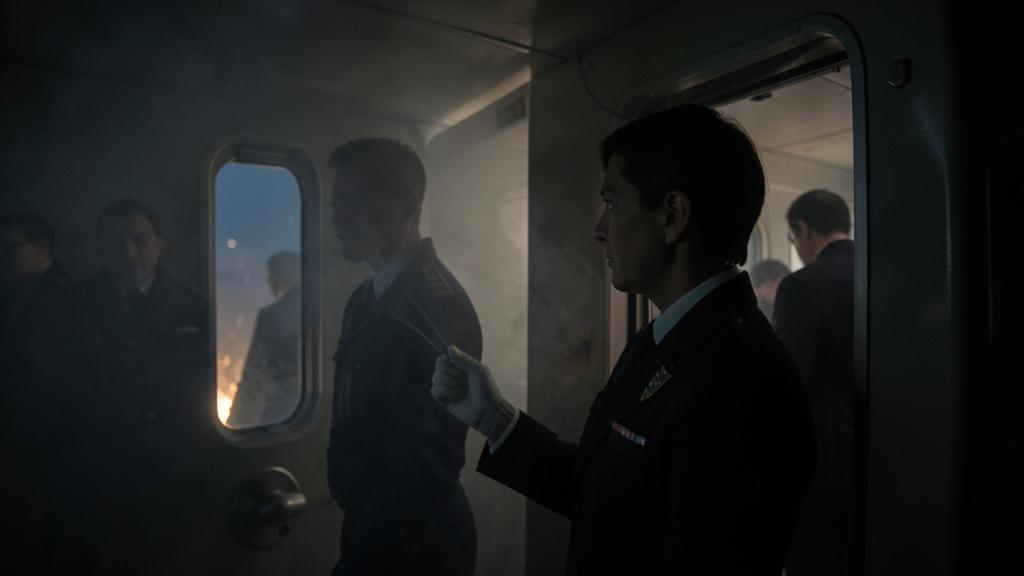
That level of detail also protects the crew member: a refusal that saved lives and one that cost time look identical in the outcome data if the reasoning was never written down. Operators that debrief evacuations properly feed the cue-reading back into recurrent training, which is where it belongs, alongside the certification background covered on the FL330 training platform.
One point distinguishes a trained crew member from a well-intentioned one. The exit assessment is not a search for permission to open the door; it is a search for a reason not to, conducted knowing that most of those reasons are invisible from inside, and that the two that are visible — flame and heat — arrive too late to be relied on alone.


Leave a Reply
You must be logged in to post a comment.