
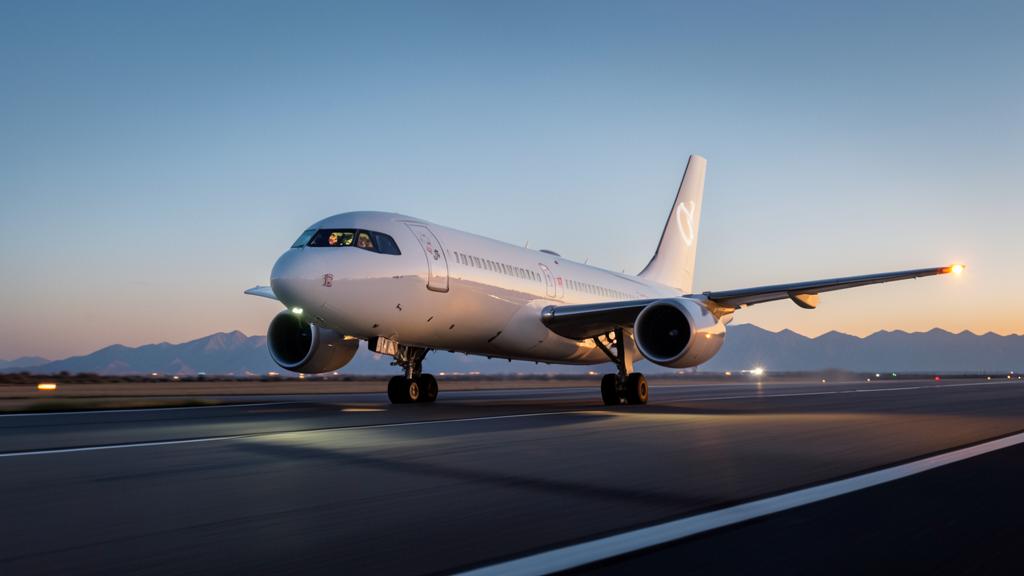
Runway length is the limit crews think in. It is the one printed on the chart, the one that shortens when the runway is wet, the one that produces the familiar feeling of a takeoff performance problem. At high-elevation airfields that instinct misleads, because the runways there tend to be long — built long precisely because the air is thin — and the binding constraint moves elsewhere. Often it lands on the tyres, which know nothing about density altitude and everything about how fast the ground is going past.
Several limits, one answer
A takeoff weight is not computed. It is selected, as the lowest of a set of independently derived maxima, each of which protects against a different failure. The structural maximum takeoff mass comes from the airframe. The field length limit protects the ability to stop by the end of the accelerate-stop distance available and to get airborne within the takeoff distance available. The climb limit protects the minimum certificated gradient with an engine failed, segment by segment; the obstacle limit protects the specific obstacles in the departure path, and does it on the net flight path. The brake energy limit protects the wheels and brakes against the energy of a rejected takeoff at V1. The tyre speed limit protects the tyres against the speed they will actually reach.
Only the lowest of them matters on the day, and which one that is depends less on the aeroplane than on where it is standing and what the air is doing. At a sea-level airfield with a short or contaminated runway, the field length limit binds and the mental model built there is correct. At a hot, high airfield with four kilometres of pavement, field length has stopped mattering long before anything else does. What binds instead is the climb limit — the engine is producing less thrust and the wing is working in thinner air — and, at heavier weights or faster rotation speeds, the tyre speed limit.
| Situation | Usual binding limit | Reason |
|---|---|---|
| Sea level, short or contaminated runway | Field length | Accelerate-stop or takeoff distance runs out first |
| Sea level, long dry runway, low obstacles | Structural maximum | Nothing physical constrains before the airframe does |
| Sea level, long runway, close terrain | Obstacle or climb | Net flight path, not distance, is the constraint |
| High elevation, long runway, moderate temperature | Climb | Thrust and gradient degrade with density before distance does |
| High elevation, long runway, high temperature, high rotation speed | Tyre speed, sometimes brake energy | Ground speed at rotation rises with the density ratio |
| High elevation with a tailwind component | Tyre speed | The wind component adds directly to ground speed |
What rises with density altitude, and what does not
The speeds a crew flies are calibrated airspeeds, and calibrated airspeed is a measure of dynamic pressure, not of motion. For a given weight and configuration, the rotation speed in CAS is set by margins against the stall and against minimum control speed on the ground. Those margins are aerodynamic. They do not care how thin the air is.
True airspeed does. In the standard atmosphere the relationship is close to TAS = CAS / √σ, where sigma is the density ratio. That single square root is the whole mechanism of this article. At a density altitude of 8,000 ft the density ratio is about 0.786, so true airspeed exceeds calibrated by roughly 13 %. At 14,000 ft the ratio is about 0.65 and the excess is about 24 %.
Ground speed, in still air, equals true airspeed. So the aeroplane rotates at the same indication and the same aerodynamic margin it always did, while the runway goes past a quarter faster than it would at sea level.
| Density altitude | Density ratio | TAS / CAS | Ground speed at rotation |
|---|---|---|---|
| Sea level | 1.00 | 1.00 | 160 kt |
| 2,000 ft | 0.94 | 1.03 | 165 kt |
| 5,000 ft | 0.86 | 1.08 | 172 kt |
| 8,000 ft | 0.79 | 1.13 | 180 kt |
| 10,000 ft | 0.74 | 1.16 | 186 kt |
| 12,000 ft | 0.69 | 1.20 | 192 kt |
| 14,000 ft | 0.65 | 1.24 | 198 kt |
Note the term “density altitude” rather than field elevation. Density altitude is pressure altitude corrected for temperature, so a field at 6,000 ft on a hot afternoon can be operating at a density altitude well above 9,000 ft. The same field at dawn in winter is a different aerodrome as far as this table is concerned, which is why the departure that was comfortable yesterday morning is not necessarily comfortable this afternoon.
At high altitudes, the air is thinner, so the plane needs to go faster over the ground to get the same lift. But the tyres only care about how fast they’re spinning, not how thin the air is. So at high altitudes, the tyres can reach their speed limit before the runway runs out.
A Boeing 737 rotating at 160 kt CAS at a density altitude of 10,000 ft will have a ground speed of 186 kt (214 mph). If the tyres are rated for 225 mph, that leaves only 11 mph of margin. Add a 10 kt tailwind, and the ground speed jumps to 196 kt (226 mph), exceeding the tyre limit.
The tyre only knows its speed over the ground
A tyre is qualified against a maximum speed, and that speed is a ground speed. It is a structural and thermal qualification: above it, the carcass deflection cycles faster than the rubber can dissipate the heat, and standing waves develop in the tread. The tyre does not measure dynamic pressure and has no way of knowing that the reason it is turning quickly is a low density ratio rather than a heavy aeroplane at sea level.
Ratings are published in miles per hour and are stamped on the sidewall. Transport-category mains commonly sit somewhere in the region of 200 to 235 mph, but the applicable number is the limitation stated in the aircraft flight manual for the tyres approved on your aeroplane — not a figure read off a sidewall in a hangar and remembered. Conversion matters here and is a routine source of error: 225 mph is about 196 kt, not 225 kt.
Put the two halves together. An aeroplane rotating at 160 kt CAS at a density altitude of 10,000 ft is doing roughly 186 kt over the ground in still air. That is about 214 mph, already inside the band where transport tyre ratings live. It has not exceeded anything yet, but the margin that felt enormous at sea level has become a matter of a few knots.
The trap. The tyre speed limitation is expressed as a ground speed, and every other speed on the flight deck is not. A crew that mentally compares the tyre limit against the airspeed indicator will conclude there is a large margin at exactly the airfields where there is not. At a density altitude of 14,000 ft the indicated value and the ground speed differ by nearly a quarter, and the difference is entirely in the unfavourable direction.
The wind term is added, not scaled
Everything above assumed still air. Wind changes ground speed by simple addition of the component along the runway, and this is where a marginal case becomes a limiting one.
Return to the 186 kt still-air example. Ten knots of tailwind makes it 196 kt over the ground, which is about 226 mph. A ten-knot component is unremarkable, at or within the certified tailwind limit of most types, and would be a non-event at sea level. At altitude it can be the difference between a legal takeoff and one that has quietly exceeded a limitation.
Two practical consequences follow. The first is that the runway choice at a high-elevation airfield is a performance decision and not only a convenience decision — accepting a downwind runway to save taxi time is a different trade there than it is at home. The second is that the wind used in the calculation has to be the wind that will exist at the moment of rotation, which at mountain airfields is not always the wind reported by the tower a few minutes earlier. Valley airfields with diurnal circulation and terrain-channelled flow can shift a component substantially inside a short window.
Brake energy fails in the same place
The tyre speed limit rarely arrives alone. The maximum brake energy speed is the other constraint that scales with ground speed, and it scales worse: the energy a brake must absorb during a rejected takeoff varies with the square of the speed at which the reject begins, and with the mass. A quarter more ground speed is more than half again as much energy.
The maximum brake energy speed is published as an airspeed but derived from that energy, so at high density altitude it falls in CAS terms. When it falls below the V1 that the field length calculation wants, the takeoff has become brake-energy limited and the weight must come down. The failure mode if it is ignored is not subtle: a high-energy rejected takeoff produces brake temperatures that release the fusible plugs, deflating the tyres deliberately to prevent a burst, and it produces a cooling requirement measured in tens of minutes before the aeroplane can be dispatched again — or moved, if the airfield has no other means of clearing the runway.
Both limits therefore point the same way, and both are relieved by the same actions. That is convenient, because it means a crew that manages one has usually managed the other.
What actually buys margin, and what it costs
The relief actions are few and none of them is free. What matters is knowing which one you are spending.
- Reduce takeoff weight — Lower weight lowers rotation speed in CAS, so lowers ground speed. Cost: Payload or fuel; the usual last resort.
- Select a greater flap setting — Lower V speeds for the same weight. Cost: Second-segment climb gradient, which is often already the binding limit at altitude.
- Take the into-wind runway — Removes the tailwind component from ground speed directly. Cost: Taxi time, sometimes a longer departure routing.
- Depart at a cooler time — Lower density altitude, lower true airspeed for the same CAS. Cost: Schedule; frequently the only realistic option at a hot-and-high field.
- Decline the improved-climb technique — Avoids the deliberately raised V speeds used to buy climb performance. Cost: The climb-limited weight that technique would have gained.
The fifth line deserves emphasis because it runs against intuition. The improved-climb or overspeed technique increases the takeoff weight allowed by the climb limit, by accelerating to higher V speeds and converting the excess into gradient. It is exactly the right tool at a field where climb is binding — which describes most high-elevation airfields. But it works by raising the speed at which the aeroplane leaves the ground, so it consumes tyre speed and brake energy margin to buy climb margin. At a field where all three constraints are close together, that trade can move the binding limit rather than relieve it.
The right reflex. When the performance tool returns a weight that is tyre-speed limited, check the wind component and the flap setting before touching the payload. Those two are usually available, cost nothing in fuel, and move the answer more than most crews expect. Reducing weight is the correct action, but it is rarely the first one that should be considered.
Where the margin gets lost
Four recurring situations account for most of the surprises.
The afternoon departure at a field that was fine in the morning. Density altitude is a temperature story as much as an elevation story, and the difference between a cold morning and a hot afternoon at the same field can be several thousand feet of density altitude. Performance figures carried over from the inbound sector are not valid for the outbound one.
The convenient runway. A tailwind component that is legal is not therefore free, and at altitude it is expensive. The direction of the trade is the opposite of what taxi-fuel thinking suggests.
The tyre that was changed. The flight manual limitation assumes tyres of an approved rating are fitted. A wheel change carried out with a lower-rated but otherwise interchangeable part alters the aeroplane’s tyre speed limitation, and this is a configuration fact that lives in the maintenance records rather than on the flight deck. It belongs to the continuing airworthiness system — the Part-M and Part-145 side — and it is one of the few places where a maintenance decision silently changes a performance limitation. Operators flying regularly into high-elevation airfields have a reason to treat tyre part numbers as performance-relevant rather than purely as stock items.
The unplanned high-elevation diversion. A crew planning a departure from a mountain airfield has run the numbers. A crew that has diverted into one, and must now get out, has not, and is doing so tired, possibly at a worse time of day, and at a weight determined by the fuel they happened to arrive with rather than by choice. This is where a performance tool that will not return an answer is more useful than one that returns an optimistic one.
Landing, and the rejected takeoff
The same arithmetic applies on arrival, and it is less often discussed. The reference speed on approach is a calibrated airspeed derived from the landing weight and configuration, so touchdown ground speed rises with density altitude in exactly the same proportion. Landing weights are lower than takeoff weights, which usually keeps the result comfortable, but “usually” is doing work in that sentence at a heavy landing into a high-elevation field, and the aircraft flight manual is where to check rather than assume.
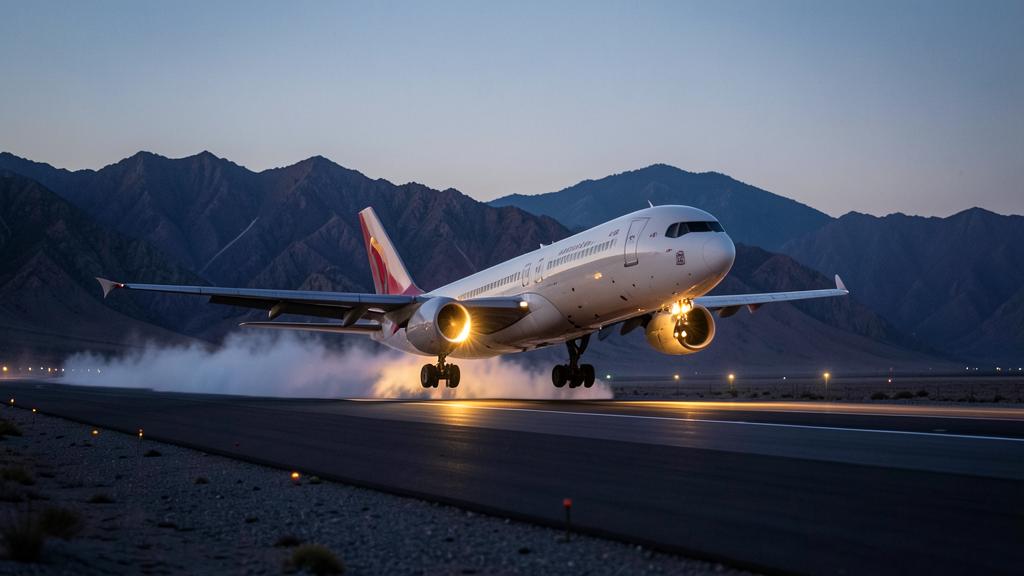
A rejected takeoff is the harshest case of all, because it combines the highest speed the tyres will see with the maximum energy the brakes will absorb, at the maximum weight, at the density altitude that produced both. It is also the case in which the crew has the least time to reason about limits. That is the argument for having thought about it on the ground: at a high-elevation field, the decision to reject is being taken in a regime where the equipment has less margin than the same decision would have at sea level, and where the consequences of stopping — deflated tyres, a blocked runway, a long cooling period — are heavier. None of that changes the reject criteria, but it does change what the crew should expect afterwards. The performance reasoning behind these trades is covered in more depth on the FL330 training platform.


Leave a Reply
You must be logged in to post a comment.