

Two aeroplanes carry the same type rating on your licence and do not ask the same thing of your hands. Two others carry different ratings and fly almost identically. The line between them is not drawn by the marketing name, by the fuselage length or by the operator’s convenience: it is drawn by an evaluation body, recorded in a matrix, and turned into a syllabus that may run to an afternoon of reading or to a week in a full flight simulator. Knowing what pushes a difference up that scale is the difference between reading a fleet notice and understanding it.
What a type rating actually names
A type rating is not a description of an aeroplane. It is an administrative object: an entry on a list published by the licensing authority, naming a set of aircraft that may be flown on one licence endorsement. The set is decided during the operational evaluation that accompanies certification, and it is decided on the basis of what a pilot must know and do — not on the basis of how the aircraft is sold.
The consequences are visible on any licence. A single-aisle family spanning four fuselage lengths, three decades of production and several engine choices can sit behind one endorsement. Two widebodies from the same manufacturer, sharing a philosophy and much of a flight deck, can require two. In one well-known case a narrowbody and a widebody from the same manufacturer were granted a common rating because their flight decks and handling were deliberately built to match. Nothing in the model number tells you which situation you are in.
What the licence endorsement therefore establishes is a boundary of legality, not a claim of equivalence. Inside a single rating, differences remain — and the regulatory system deals with them separately, through a graded requirement that never appears on the licence itself.
The instrument that decides
Since operational suitability data became part of European type certification, the determination lives in a document produced with the type certificate rather than negotiated afterwards. The flight crew section of that data designates the type rating, states the minimum training required for a pilot moving on to the type, and — the part that concerns us — publishes a master differences requirements matrix for every variant pair within the rating.
The United States system reaches the same place by an older route: a flight standardization board evaluates the aircraft and issues a report containing the same matrix, together with the framework for operator differences requirements tables. The two systems are not identical in procedure and can reach different conclusions on the same aircraft, but they share the essential architecture — an authority-owned matrix that sets a floor, and an operator-owned table that sits on top of it.
Two properties of that matrix are routinely missed. First, it is directional. The requirement for moving from the older variant to the newer one is not necessarily the requirement for moving the other way; a pilot who has learned the additional system on the newer aircraft is not in the same position as one who has never seen it. Second, it is a minimum. Nothing prevents an operator, or a national authority, from requiring more, and many do.
The ladder: what the letters mean
Differences are graded on a lettered scale that runs from something a pilot can absorb alone to something that can only be demonstrated in a device reproducing the aircraft. The scale exists precisely so that the question is never binary. Few variant differences require nothing at all, and few require a full course.
| Level | What it demands | Typical delivery | Kind of change that lands here |
|---|---|---|---|
| A | Self-instruction: the pilot is given the information and confirms receipt | Bulletin, handout, revised manual page, read-and-sign | A placard wording, a changed limitation figure, a new caution message |
| B | Aided instruction with a means of verifying knowledge | Computer-based training, classroom, video, a knowledge check | A new system with unchanged crew procedures; a revised checklist structure |
| C | Practice of procedures in a device, without full handling fidelity | Systems trainer, flat panel, procedures trainer | A different flight management system, a changed autoflight mode logic |
| D | Manoeuvres flown in a device reproducing the flight deck and handling | Full flight simulator, defined set of manoeuvres | Different thrust management, a changed non-normal procedure with handling consequences |
| E | Full manoeuvre training and demonstration | Full flight simulator, complete profile — the top of the scale before a separate rating | Different handling qualities, revised flight control laws, altered stall or upset behaviour |
Checking and currency carry their own, shorter scales alongside the training scale, and the three do not have to agree. A difference may require simulator training once and never require a separate check afterwards. Another may demand no additional training but impose a currency condition — the pilot must have flown that variant recently to fly it again. Reading only the training column is the most common way to misread the matrix.
What pushes a difference up the scale
The evaluation asks one question repeatedly: can a pilot competent on variant A, given this instruction, be relied upon to perform correctly on variant B under abnormal conditions and under time pressure? Everything that survives that question at the level of pure knowledge stays low on the ladder. Everything that touches trained motor responses, or that changes what a correct response looks like, climbs.
| Domain | Why it matters | Tends towards |
|---|---|---|
| Flight control laws, protections, handling qualities | Changes the aircraft’s response to a trained input, including at the edges of the envelope | The top of the scale, or a separate rating |
| Engine type, thrust rating, thrust management | Alters performance, asymmetry after failure, and the numbers a crew works to | Middle to upper, depending on procedural impact |
| Primary flight display, symbology, alerting philosophy | Changes where the eye goes and what a warning means under load | Middle, upper where alerting logic changes |
| Autoflight and flight management system | Procedural rather than manipulative, but dense and error-prone | Middle — device practice rather than simulator |
| Non-normal and emergency procedures | Depends entirely on whether the crew action itself changes | Low if wording only, high if the drill changes |
| Fuselage length, capacity, weights | Affects performance, rotation technique and ground manoeuvring | Low to middle; occasionally an operational restriction instead |
| Systems the crew never operates directly | Knowledge only, no changed action | The bottom of the scale |
Two examples make the mechanism concrete without needing the fine print. A stretched variant of a familiar single-aisle usually stays low: the systems are the same, the drills are the same, the performance numbers come from the same source, and what changes is a rotation attitude and a tail clearance margin best handled by briefing and by a limited number of landings. A re-engined variant of the same airframe often climbs: the engines behave differently after a failure, the thrust management differs, and the alerting may differ with them.
The trap. Assuming that a difference approved at a low level stays there. The matrix is a living determination, revised when in-service experience or an accident investigation shows the original judgement was optimistic. One widely reported case saw a difference initially accepted as aided instruction reassessed after the type’s grounding, with the return-to-service determinations requiring full flight simulator sessions instead. A syllabus you flew two years ago is not evidence of what is required today.
The differences matrix decides how much training a pilot needs to fly a new variant. Some changes just need reading, others need simulator time. The key question is whether the pilot can handle the new variant safely under pressure. If the changes affect how the plane flies, the training will be more intense.
An Airbus A320neo with new engines requires more training than an A320 with a longer fuselage. The neo’s engines behave differently after a failure, so pilots need simulator practice. The longer fuselage just changes takeoff rotation, which can be briefed.
Where the variant stops being a variant
At some point the evaluation concludes that no amount of graded differences training is enough, and a separate type rating is designated. There is no arithmetic threshold — no count of changed systems that triggers it. What triggers it is a judgement that the aircraft, in the hands of a pilot trained on the other one, would require re-learning rather than adjustment, and that the safest expression of that is a full course with its own skill test.
Between the two extremes sits a middle ground that airlines value enormously: two separate type ratings, held simultaneously, with an abbreviated course between them because the flight decks were designed for the transition. That arrangement — a short cross-crew qualification rather than a full type course — is a design objective for manufacturers with broad families, and it is worth distinguishing carefully from a shared rating. Two ratings held together still means two ratings on the licence, two sets of currency obligations, and an operator approval to operate both.
Flying more than one variant: the arithmetic nobody reads
Whatever the training level, operating several variants or types simultaneously is separately regulated. The operator needs an approved procedure for it. The pilot needs defined minimum experience before starting, and there are constraints on how a roster may mix them. Recency obligations continue to apply, and the currency column of the matrix determines whether flying variant A preserves recency on variant B or not.
European rules add a lapse condition that catches pilots on mixed fleets: where a variant has not been flown for a defined period after the differences training — two years, in the current text — the training must be done again or the variant checked before it can be flown. A pilot rostered almost exclusively on one variant of a family can therefore lose access to another without ever failing anything. Check the record, not the licence: the licence will show the rating regardless.
That is the other structural point. Differences training does not appear as a separate endorsement on a licence. It is recorded in the pilot’s logbook or equivalent record and in the operator’s training file. A pilot moving between operators carries the rating on paper, and will normally have the differences re-established under the new operator’s approved programme, against the new operator’s fleet configuration.
The rest of the crew, and the hangar
The question is not confined to the flight deck. Cabin crew training is structured the same way: aircraft type specific training, and separately, differences training when a variant introduces changed equipment, changed exits, changed door operation or a changed evacuation drill. A door that opens by a different sequence is precisely the kind of difference that must be trained rather than briefed, and the fact that the aircraft carries the same commercial name is irrelevant to it.
On the maintenance side the boundaries are drawn differently again, and often more finely. Engineering licence type ratings are granted against airframe and engine combinations, so two aircraft that a pilot flies on one endorsement can require two entries on an engineer’s licence — the engine variant being the usual reason. Anyone planning a fleet change should confirm the maintenance ratings independently: a flight crew conversion plan that assumes the hangar is covered because the pilots are covered will be wrong at the worst moment.
Reading a fleet notice properly
When the notice arrives, three questions settle what it actually means. Which document is it citing — the authority’s matrix, or the operator’s own table built on top of it? Which direction is the transition, and does the matrix treat the reverse differently? And what does it say about checking and currency, not just about training?
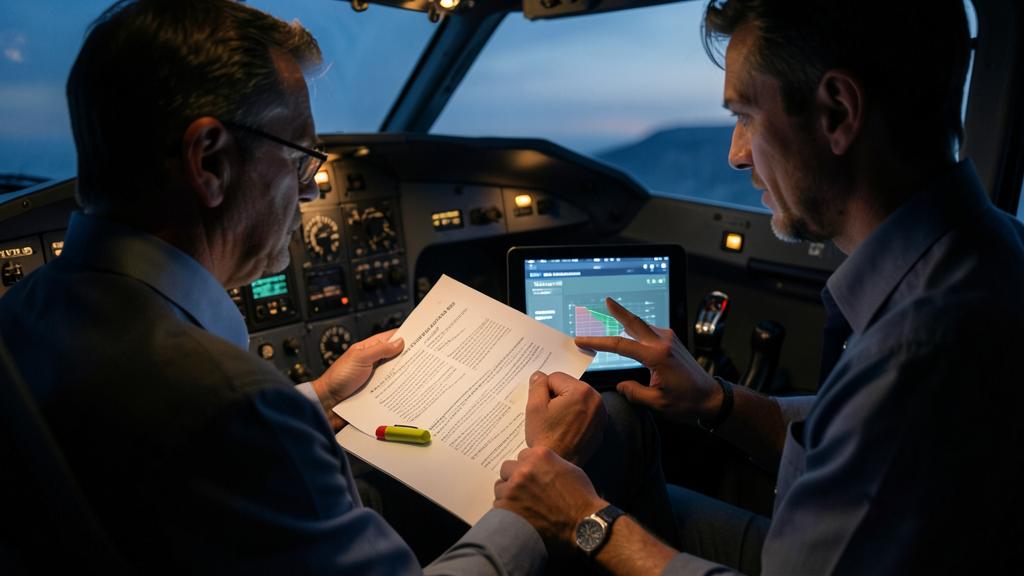
Beyond that, the honest caveat: an approved minimum is a floor built for a competent pilot who has been flying the other variant regularly. It is not a claim about you on the day. Where the difference concerns handling, treat the approved level as the paperwork and the first sector on the new variant as the training — brief the differences aloud, and say so if you want the other pilot’s hands closer than usual. Structured discussion of type-rating and conversion routes, including which family transitions are genuinely short, is available through the FL330 training resources.
The right reflex. Before a first flight on an unfamiliar variant, find the operator differences table for your own aircraft pair rather than the manufacturer’s general description. It lists the differences by system, in your operator’s configuration — which is the only configuration you will be flying, and frequently not the one the brochure describes.
| Actor | Decides | Cannot decide |
|---|---|---|
| Manufacturer | Proposes the design and the case for commonality; supplies the evidence | The type rating designation or the differences levels |
| Certifying authority | Type rating designation, master differences requirements, the minimum training and checking levels | How an individual operator delivers the training |
| Operator | Its own differences tables, the approved syllabus, anything above the minimum, roster rules for mixed fleets | Anything below the authority’s floor |
| Training organisation | Delivery, devices used, instructor allocation | The required level |
| Pilot | Whether to declare a gap before the sector, not after it | Which level applies |


Leave a Reply
You must be logged in to post a comment.