

A flight-hour engine support contract is often described in the same breath as insurance: a fixed rate per engine flight hour, and the maker absorbs the surprises. The description is half true. What the rate actually buys is the transfer of a defined list of technical risks, priced against an assumed pattern of use, with a second list of risks explicitly left behind. Reading the contract as a budgeting tool rather than as a risk allocation is how operators end up with a stable cost line and an unstable cash flow.
Three different things are being sold under one name
Flight-hour agreements come in shapes that look alike and behave differently. The first sells maintenance cost per hour: the operator pays a rate and the provider pays for the shop visits within a defined scope. The second sells availability: the provider guarantees that a serviceable engine is on wing or at the door within a stated period, which is a fundamentally different obligation and priced accordingly. The third sells engine hours as a service, where the operator never owns the asset at all.
The distinction decides who is exposed when an engine comes off unexpectedly. Under a pure cost-per-hour agreement, the shop visit is paid for but the aircraft may still be on the ground waiting for a spare — the delay is the operator’s problem. Under an availability commitment, the spare provisioning is part of what the rate paid for, and the remedy for a failure to supply is written into the contract. Operators sometimes discover the difference during their first unscheduled removal, which is late.
A fourth confusion is between the engine agreement and the airframe or component agreements sitting next to it. Auxiliary power units, nacelles, thrust reversers and quick engine change hardware are frequently outside the engine scope even though they arrive attached to the engine. Every interface in that list is a place where two contracts can both decline responsibility.
The rate is priced against a usage profile, not against your fleet
An engine flight-hour rate is not a market price for a type. It is a calculation built on assumptions about how that particular operator will use that particular engine, and the assumptions are written into the contract as conditions. Depart from them and the contract does not fail — it adjusts, usually in one direction.
The dominant assumption is the ratio between flight hours and flight cycles. An engine on long sectors accumulates hours between takeoffs; an engine on short sectors accumulates the thermal and mechanical cycles that consume life-limited parts and drive hot section deterioration. Two fleets with identical annual hours and different sector lengths are not the same risk, and the rate reflects it. A network change that shortens average sector length is a technical event before it is a commercial one.
Derate and thrust rating matter for the same physical reason: reduced takeoff thrust lowers turbine temperatures and extends time on wing. An operator whose flight operations department quietly reduces the use of assumed-temperature methods, or moves to airports where full thrust is routinely required, changes the deterioration rate the contract was priced on. So does environment — abrasive dust, salt, industrial pollution and high ambient temperatures accelerate erosion and blade coating loss in ways the provider will have modelled by route.
The engine support contract price depends on how you fly, not just how much. Short flights, hot climates, or using less power than expected can all make the contract more expensive over time.
An airline operating Airbus A320s with CFM56 engines on 2-hour regional routes (many cycles) pays a higher rate per hour than one flying 6-hour transcontinental routes (fewer cycles), even if both fly the same total hours per year.
| Variable | Direction of effect | Why |
|---|---|---|
| Shorter average sector length | Raises the rate | More cycles per hour: faster life-limited part consumption and hot section deterioration |
| Higher average derate | Lowers the rate | Lower turbine temperatures, longer time on wing |
| Erosive or high-temperature environment | Raises the rate | Accelerated blade and coating deterioration, more frequent restoration |
| Low annual utilisation | Raises the effective cost | Calendar-driven tasks and minimum billing floors spread over fewer hours |
| Contract duration | Longer term usually lowers the rate | The provider recovers shop visit cost over a predictable horizon |
| Fleet size and homogeneity | Larger and uniform lowers the rate | Pooling smooths removal variance; spares logistics simplify |
| Scope of included items | Raises the rate | Life-limited parts, spare engine access and transport are separately priced risks |
| Escalation formula | Raises the paid amount over time | Rates escalate against published labour and material indices |
What the provider genuinely takes on
The transferred risk is real and it is worth paying for. First, the variance of the shop visit itself: the difference between an expected performance restoration and the same engine opened to find a damaged high-pressure turbine is a large sum, and under the agreement it is absorbed rather than invoiced. Second, workscope discretion: the decision to do more work while the engine is open is taken by the party that pays for it, which removes a recurring negotiation and, incidentally, a recurring source of dispute.
Third, the timing of unscheduled removals. An operator budgeting on its own carries the risk that three engines come off in the same quarter; the provider carries it across a fleet of hundreds and prices the average. Fourth, where the contract includes it, the provisioning of spare engines and their transport, which is a capital and logistics burden most operators are relieved to move off their balance sheet.
Fifth, and least discussed, the provider takes on the technical judgement itself: fleet-wide deterioration data, the timing of service bulletin embodiment, and the choice of shop and workscope are made by the organisation with the largest data set on that engine. For an operator with a small fleet of a given type, that expertise is often worth more than the cash smoothing.
What stays with the operator, whatever the brochure says
The exclusion list is where the contract is actually written, and it is remarkably stable across providers because it follows a principle: the provider covers deterioration, not events. Anything caused by something other than the engine running normally tends to fall outside.
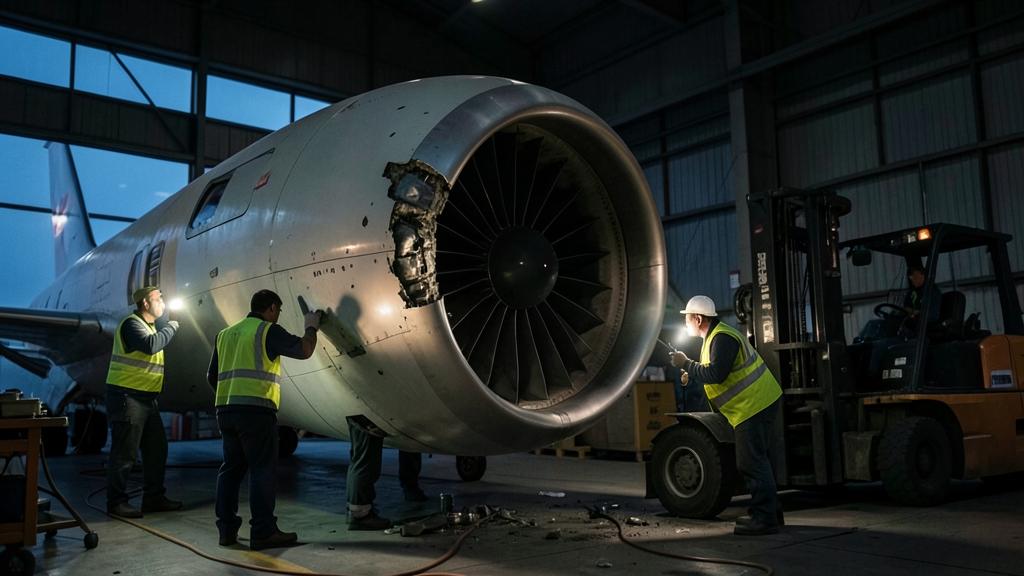
Foreign object damage is the archetype. A bird strike, a stone, a tool, ingested slush or debris from a poorly swept apron produces damage that is not deterioration, and the repair is billed. So is damage from a hard landing, a tail strike, hail, lightning, or a crew-induced exceedance recorded in the flight data. So is misfuelling, contaminated fuel, incorrect servicing fluid, damage during transport or storage, and corrosion attributable to how the engine was preserved. Operational events that generate an inspection requirement — an overspeed, an overtemperature, a surge — are typically inspected at the operator’s cost even when nothing is found.
Airworthiness directives sit in a category of their own. Their cost is sometimes shared, sometimes excluded, sometimes covered only where the underlying service bulletin was already included, and the treatment is negotiated rather than standard. Since an airworthiness directive is not optional and its timing is not the operator’s decision, this clause deserves as much attention as the headline rate.
| Cost element | Usually inside the rate | Usually the operator’s |
|---|---|---|
| Scheduled shop visit, performance restoration | Yes | — |
| Unscheduled removal from normal deterioration | Yes | — |
| Life-limited parts | Often, sometimes pro-rated or separately billed | Where excluded, at replacement cost |
| Foreign object damage, bird strike, hail, lightning | — | Yes, unless a separate rider is bought |
| Crew-induced exceedance and consequent inspection | — | Yes, evidenced from flight data |
| Line maintenance, on-wing checks, borescope | Sometimes, as a defined option | Frequently |
| Spare engine provision and lease during shop visit | Under availability-type scope | Under cost-per-hour scope |
| Transport, crating, customs | Sometimes | Frequently |
| Airworthiness directive embodiment | Negotiated, often shared | Negotiated, often shared |
| Damage from storage, preservation or handling | — | Yes |
The trap. Exclusions are proved with data the operator supplies. Flight data recording, engine condition monitoring and event reports are the evidence used to classify an event as deterioration or as damage. An operator that transmits complete data has a defensible position when classification is contested; one whose monitoring has gaps argues from assertion. Deciding to improve the data after the first disputed shop visit changes nothing about that shop visit.
Entry, exit and transfer: where the money actually moves
The rate is the visible number. The clauses that determine whether the contract was a good one are at its two ends.
At entry, an engine that has already accumulated deterioration is not the engine the rate was priced for. Providers address this with an induction assessment and a catch-up payment, or with an adjusted rate for an initial period. Signing a mid-life fleet onto a rate designed for new engines without settling that gap is not a saving; it is a deferred invoice.
At exit, return conditions decide the final bill. A contract that ends with engines close to a shop visit, with limited remaining life on critical parts or a degraded exhaust gas temperature margin, will produce a settlement in the provider’s favour. The mirror image is equally real: an operator that leaves the programme immediately after a major shop visit has paid for value it will not consume unless a credit mechanism exists. Both directions are negotiable, and neither is negotiable afterwards.
Transferability is the third end. Aircraft are sold, subleased and returned to lessors, and an engine programme that cannot be assigned to the next operator destroys value at exactly the moment the asset changes hands. Lessors care intensely about this, because a transferable programme with a strong provider is often what allows maintenance reserves to be reduced or waived. The engine contract and the lease return conditions have to be read as one document, and they rarely are.
Continuing airworthiness is not among the transferable risks
Whatever the contract says about who does the work, responsibility for the continuing airworthiness of the aircraft remains with the operator. Under the European framework that responsibility sits with the operator and its continuing airworthiness management organisation; the maintenance itself is performed by an appropriately approved maintenance organisation under Part-145. The international baseline is the same: the operator is answerable for the airworthiness of its aircraft.
The practical consequences are concrete. The operator’s organisation still owns the maintenance programme, the reliability monitoring, the airworthiness directive compliance record and the technical records. Records produced by the provider still have to arrive in the operator’s system in an acceptable form, and a records gap discovered at lease return is the operator’s loss regardless of who created it. A support contract can supply the work, the parts and the expertise; it cannot supply the accountability, and no clause purporting to do so has any effect on the authority.
Parts policy: the clause that forecloses your alternatives
Flight-hour agreements normally require the use of the maker’s parts and repairs. That is not merely commercial preference — the provider is guaranteeing an outcome and controls the inputs — but it removes options that some operators value: parts manufactured under a separate approval, and repairs developed outside the maker’s data. Regulatory acceptance of those alternatives is not uniform between the American and European systems, which adds a second layer to a decision that already binds the operator for the contract’s duration.
The point is not that the restriction is unreasonable. It is that the decision is being made at signature, for the whole term, often by people who will not be there when its consequences arrive. An operator that intends to keep an independent maintenance strategy for part of its fleet should structure that intention into the contract rather than discover the conflict at the first shop visit.
| Criterion | Flight-hour agreement | Time and material | Hybrid or capped |
|---|---|---|---|
| Cost predictability | High, within scope | Low | Medium to high |
| Exposure to shop visit variance | Provider | Operator | Shared to a threshold |
| Workscope control | Provider | Operator | Negotiated per visit |
| Freedom of shop and parts choice | Low | High | Medium |
| Value on asset sale or lease return | High if transferable | Depends on records and life remaining | Case by case |
| Suits | Stable, high-utilisation fleets | Strong in-house engineering, tolerance for variance | Mixed fleets, transitional periods |
The right reflex. Before comparing rates, write your own usage profile: average sector length, hours-to-cycles ratio, derate practice, annual utilisation per engine and route environment. Then ask each provider to state the profile their rate assumes. Two rates quoted against two different profiles are not comparable, and the gap between the assumed profile and the real one is the size of the adjustment you will pay later.
Governing the contract after signature
A flight-hour agreement is not a purchase; it is a relationship measured continuously. The variables that priced it — sector length, derate, utilisation, environment — are monitored and compared against the contractual assumptions, and material drift triggers adjustment. The operator that tracks the same variables internally sees the adjustment coming; the one that does not receives it as a surprise.
Three habits separate the two. Reconcile invoices against actual engine flight hours from your own source rather than the provider’s. Keep the removal history and the reason for each removal in a form that supports classification disputes. And review the contract against the fleet plan annually, because a decision to redeploy aircraft onto shorter sectors, to add a base in a dusty environment or to park aircraft for a season has a contractual cost that belongs in the business case at the time the decision is taken, not in the following year’s maintenance variance. Operators comparing structures across engine types discuss the practical clauses on the FL330 professional forums.


Leave a Reply
You must be logged in to post a comment.