
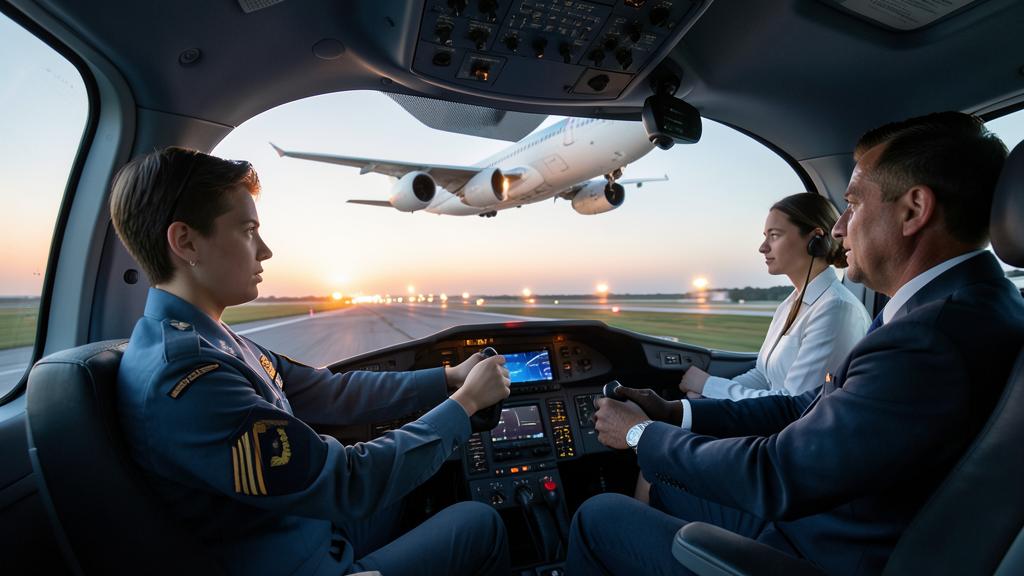
A type rating course on a large aeroplane can now be built almost entirely out of simulation, and the skill test at the end of it is normally flown in a device. Two steps survive on either side of that test that put the trainee in an actual aeroplane or on an actual flight deck: the familiarisation sector flown as an observer, and the first take-offs and landings performed under an instructor’s supervision. They are expensive, they are difficult to schedule, and they are periodically described as ceremonial. They are neither. Each closes a specific gap that the device is not qualified to close, and the gaps are not the ones most people assume.
Two steps that answer different questions
The familiarisation sector and the first supervised take-offs are routinely lumped together as « the aeroplane bit » of a conversion course. They have almost nothing in common. Familiarisation is about context: what the operation looks like when it is running, how the company’s procedures are actually spoken, what the traffic environment sounds like at that base, how the ground organisation behaves. The trainee flies nothing. The value is entirely in observation, and it is the cheapest step in the whole course.
The supervised take-offs are about the machine. A pilot who has flown a hundred approaches in a device has flown them in a mathematical model of a type, not in an individual airframe with its own rigging, its own trim state, its own engine acceleration characteristics and its own accumulated life. Closing that gap is what the aeroplane sessions exist for, and it is the reason the requirement did not disappear when zero flight time training arrived.
What a full flight simulator is qualified to reproduce
The qualification of a flight simulation training device is not a general statement that it is realistic. It is a statement that specific characteristics have been demonstrated to match reference data — normally the manufacturer’s flight-test data — within defined tolerances, over the region of the envelope where that data exists. The international criteria for device qualification, and the European certification specifications built on them, are written as tests and tolerances, not as impressions.
Inside that region the device is extremely good, and better than the aeroplane for training purposes. It can be repositioned, frozen, repeated and failed on command. It can present a dual hydraulic failure at the worst possible moment, twice, at no risk and no fuel cost. It gives an instructor a view of the trainee’s scan and decision sequence that no line sector provides. Nothing in what follows should be read as scepticism about the device: the argument is about the edges, not the centre.
Where the validated envelope stops
Three limits matter for the question at hand, and all three are structural rather than defects to be engineered away.
The first is motion. A synergistic motion platform has a bounded excursion. It reproduces the onset of an acceleration convincingly and then must wash out, returning to a neutral position slowly enough that the pilot does not perceive the return. Sustained acceleration cannot be produced at all, and is substituted by tilting the platform so that a component of gravity stands in for it. The cueing is a deliberate illusion tuned to be good enough for the manoeuvre, and it degrades exactly where the manoeuvre is long: a prolonged rotation, a sustained go-around, a heavy departure with a long acceleration.
The second is the visual system. Field of view, scene content, texture density and light modelling are all defined by the qualification level. The scene that most often defeats a display is not the night approach in fog — that one has little in it to render. It is the bright hazy day on a wide runway, where height and rate judgement in the flare rest on texture and perspective cues that any display abstracts.
The third is consequence. Every trainee knows the session ends and the aeroplane is a building. That knowledge is not a moral failing, it is an unavoidable property of simulation, and it changes the physiological state in which the exercise is flown. The first real take-off is the first time the sequence is performed with the outcome attached.
Simulators are great for most training, but they can’t fully replicate real-world sensations like sustained acceleration, precise visual cues, or the psychological weight of real consequences. That’s why pilots still need hands-on experience in actual aircraft.
On a bright summer day at Paris Charles de Gaulle, a new A320 pilot might struggle with height judgement during flare in the simulator, but the real challenge comes on the actual runway. The simulator’s display can’t perfectly replicate the subtle texture and perspective cues that help judge height over a wide, textured runway in daylight.
| Setting | Answers well | Cannot answer |
|---|---|---|
| Flight training device or fixed-base trainer | Flows, systems logic, procedural sequence, checklist discipline | Anything involving handling or timing under real cueing |
| Full flight simulator | Failure management, crew coordination, non-normal drills, repeatable rare events | Sustained accelerations, individual airframe behaviour, consequence |
| Familiarisation sector as an observer | How the operation actually runs: phraseology, tempo, ground interface | Nothing about the trainee’s own handling |
| The aeroplane, no passengers, quiet airfield | Real cueing, real flare, real thrust response, first ownership of the type | Realistic workload, commercial pressure, an operational environment |
| Line flying under supervision | Everything above combined, at the correct pace, with real consequences | Nothing — which is why it is the last step and the longest |
The familiarisation sector: an observer’s job is not passive
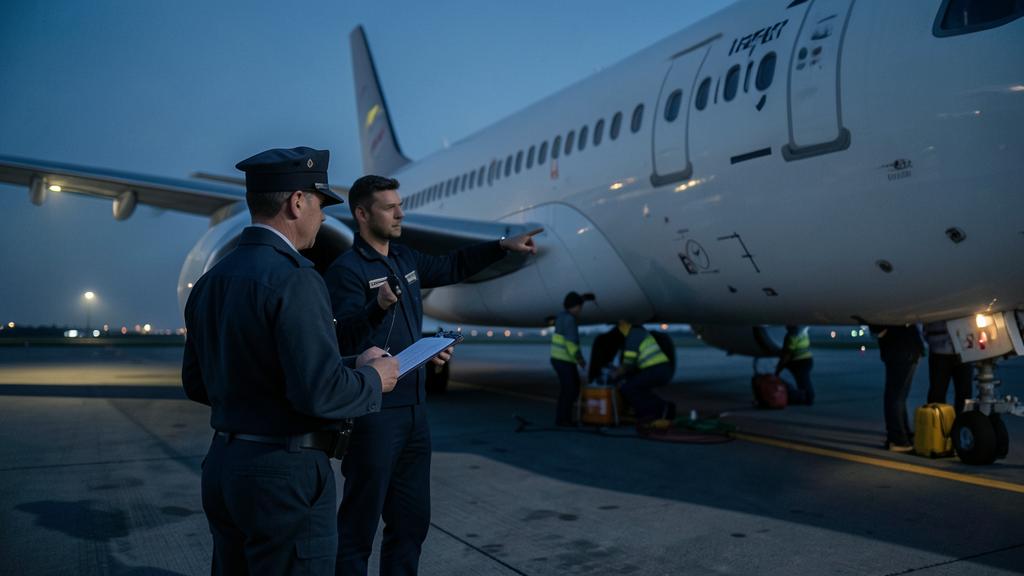
A familiarisation sector is flown from the supernumerary seat with no duties. That does not make it a spectator event, and the trainees who get the most out of it treat it as a structured observation with a list.
What is worth collecting: the actual cadence of the operating crew’s callouts as against the wording in the manual; where the briefings really happen in the flow and how long they take; how the crew handles the ground interface at that base; what the local frequency congestion sounds like and where in the arrival the workload spikes; how the paperwork and the loading documentation arrive and in what order; what the crew does with the time that the course, being efficient, compressed out of every simulator session.
That last point is the one most often missed. A simulator session removes waiting. In the aeroplane a large part of the skill is managing the periods in which nothing is required, so that everything is ready when something is. That rhythm cannot be taught in a device where the instructor repositions to twelve miles final.
The right instinct. Go into the familiarisation sector with three written questions you could not answer from the manual, and leave with three more. An observer with an agenda learns a course’s worth; an observer without one learns that the seat is uncomfortable.
Aerodrome competence: familiarisation with a regulatory purpose
The second, narrower meaning of familiarisation is aerodrome competence. European operating rules oblige the operator to establish a scheme for it, and the associated acceptable means of compliance describes a categorisation of aerodromes by how demanding they are. In the most demanding category the commander is expected to have visited the aerodrome as an observing crew member or to have been instructed on it in a suitable training device, on top of a documented self-briefing. The categories, the criteria and the validity period sit in the operator’s own scheme as accepted by its authority, and the equivalent obligations under other regimes are expressed differently.
The logic is worth stating because it is the same logic as the whole subject: some characteristics of a place — terrain, a non-standard arrival, an approach with a late visual segment, seasonal wind behaviour, a runway with unusual perspective — are transmitted poorly by a chart and well by having been there. The rule does not say the chart is wrong. It says the chart is not sufficient.
The first take-offs and landings in the aeroplane
Where a course is conducted with no flight time in the aeroplane at all, the applicable licensing rules replace that flight time with a defined set of take-offs and landings performed in the aeroplane under an instructor’s supervision, to be completed within a defined window, sometimes with conditions attached to the first of them. The number, the window and the conditions are set by the rule and by the approved course; they differ between regulatory systems and between courses, and they are not adjustable locally to fit a roster.
Those sessions are typically flown with no passengers, at an airfield chosen for its quietness, with an instructor qualified on the type on the flight deck. What the trainee is actually acquiring is a set of calibrations: what the thrust levers do to this engine at this weight, where the eye sits relative to the runway, how the nose behaves at rotation, what the flare feels like when the ground effect is real, how the brakes and the nosewheel steering respond, and how much the whole machine differs from the model that was flown all month.
| What differs | Simulator | Aeroplane, no passengers | Line flying under supervision |
|---|---|---|---|
| Motion cue | Onset only, washed out, tilt substitution | Real and sustained | Real and sustained |
| Height judgement in the flare | Abstracted by the display | Real, and usually the surprise | Real, with less margin to experiment |
| Weather | Chosen by the instructor | Whatever the day gives, within limits set for the exercise | Whatever the day gives |
| Traffic and frequency load | Scripted | Deliberately low | Real, and a primary source of workload |
| Consequence | Known to be absent | Present, with the cabin empty | Present, with the cabin full |
| Who is beside you | An instructor who can freeze the exercise | An instructor with the controls available | A commander running a commercial flight |
Line flying under supervision, and the check that ends it
The operator’s conversion course does not finish at the skill test. It finishes after a period of line flying under supervision, flown on revenue sectors with a designated line training commander, and closed by a line check. This is where the three previous settings are combined at the correct pace, and where the trainee stops flying a type and starts flying an operation.
Two constraints on this phase are worth knowing before joining an operator. European operating rules limit a flight crew to a single inexperienced member — inexperience being defined in hours and sectors on type by the applicable acceptable means of compliance and by the operator’s manual — which means a newly released copilot cannot be rostered with a newly released commander, and that single sentence shapes rosters across an entire summer at a growing airline. Operators additionally restrict which aerodromes and which conditions a low-experience pilot may operate into during and immediately after supervision. Neither restriction is a judgement on the individual. Both are recognitions that competence acquired in a compressed course needs sector count to consolidate, and that the ninety-day recency rule — three take-offs, approaches and landings before carrying passengers, creditable on type or in a qualified simulator — is a floor, not a target.
Why the calendar, not the syllabus, is the hard constraint
Everything above is straightforward until it has to be scheduled. Each of these steps consumes a resource that cannot be created quickly, and the resources do not become available at the same time.
| Resource | Why it is scarce | What happens when it is missing |
|---|---|---|
| Simulator slot | Fixed number of devices, sold across operators, best slots at unsociable hours | The course stretches, or is flown at three in the morning |
| Type rating instructor and examiner | A line pilot removed from the line to instruct is capacity lost twice | Sessions are grouped, and gaps open between them |
| An aeroplane out of revenue service | Every hour on a training detail is an hour not sold | Aeroplane sessions cluster into the low season, whatever the course dates say |
| A quiet airfield with the right approach | Availability, noise restrictions, opening hours, weather minima for the exercise | Positioning flights, or a wait for the weather |
| The trainee’s own validity windows | Recency and course-completion windows run on calendar days regardless of roster | Repeat training, at full cost, for a scheduling reason |
| Duty and rest limits | Training duties consume the same limits as flying duties | A day of the course is legally unavailable, however willing everyone is |
The trap. The validity windows attached to course elements run on calendar days and do not pause for a roster, a delay, sick leave or a device going unserviceable. A trainee who assumes the training department is tracking every one of them, and who does not track them personally, is one weather cancellation away from repeating a session that was already passed.
What to bring to yours
- Treat the familiarisation sector as data collection with written questions, not as a free ride to a base.
- Expect the height judgement in the flare to be the first genuine surprise, and expect it whatever your previous experience.
- Know your own validity windows in writing, on your own calendar, and confirm them rather than assume them.
- Ask early which aerodromes carry a competence restriction at your base, and how the operator’s scheme discharges it.
- Understand that the pairing restriction on inexperienced crew shapes your first months more than anything in the syllabus.
- Treat the ninety-day recency rule as a minimum condition rather than a standard of currency, particularly on a low-utilisation roster.
- Assume aeroplane sessions will be scheduled around commercial availability, and build your personal planning around that rather than around the course calendar.
These steps exist because a validated model and a maintained airframe are not the same object, and because an operation is not the sum of its procedures. Everything else — the cost, the awkward slots, the trip to a quiet airfield in the low season — is the price of finding that out with the cabin empty. Conversion courses and the transition into a first type are covered in more depth in the training material on FL330 training, and the practical experience of that first year is argued out at length on the FL330 forums.


Leave a Reply
You must be logged in to post a comment.