
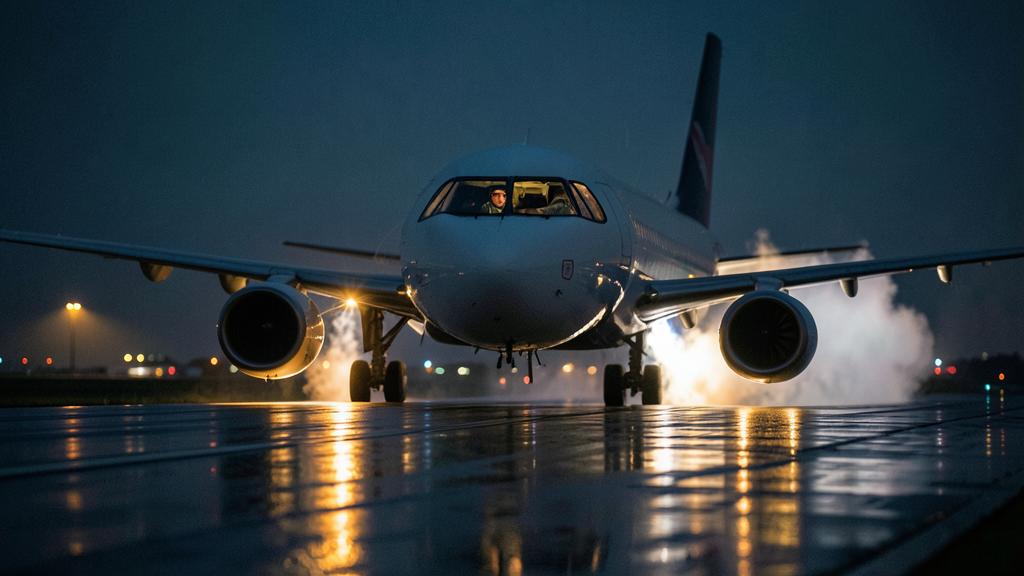
Ask a line pilot what the reversers are worth and the answer is usually a number of metres. Ask the performance engineer who built the table and the answer is a question: which table, on which surface, for which purpose. Thrust reverse is one of the few deceleration means whose contribution is deliberately ignored in some published distances and fully counted in others, and the reason is not conservatism for its own sake. It is a rule about what can be relied upon. Where that credit exists, why it disappears on a dry runway, how the physics distributes the benefit across the ground roll, and what an inoperative reverser really costs are four separate questions, and only the last of them is usually asked.
The same landing, three different distances
Before arguing about reverse credit it is worth separating the distances that carry the same name and do entirely different jobs. Confusing them is the origin of most of the folklore in this area.
The certified landing distance comes from flight test under the airworthiness code for large aeroplanes. It is a demonstrated, repeatable, measured figure on a dry runway with maximum manual braking, and it is the raw material for everything else. The dispatch landing distance is that figure divided by a regulatory factor to give the runway length you must have available before you may plan to land there — the long-standing rule for turbojets requires the landing distance available to be at least the landing distance divided by 0.60, with a further margin for a wet runway. The in-flight landing distance assessment is a different exercise entirely: an operational computation performed close to arrival, using the actual weight, the actual configuration, the actual reported surface condition and the actual braking selection, with its own operational safety margin.
Reverse thrust is treated differently in each of the three, and that is the whole subject.
| Distance | Purpose | Reverse credit |
|---|---|---|
| Certified landing distance, dry | Flight-test reference in the aeroplane flight manual | Normally none for turbojets |
| Dispatch landing distance | Runway length required before departure | None — it inherits the dry certified figure and applies a factor |
| Certified or approved wet and contaminated data | Operational planning on a degraded surface | Usually credited, and the credit is significant |
| In-flight landing distance assessment | The decision you actually make on the approach | Credited according to what you select, and the tables ask you which |
| Quick reference handbook abnormal landing data | Landing with a system failure | Credited or penalised depending on the failure, per the type |
Why the dry number ignores the reversers
The airworthiness code allows deceleration means other than the wheel brakes to be used in establishing the landing distance, but only where their operation is safe and reliable and where their use does not require exceptional skill. For turbojet transports, reverse thrust has historically not cleared that bar in the certified dry case, and the reasoning has three parts.
First, availability. A reverser is a mechanical system with an unlock, a deploy sequence and a stow sequence, any of which can fail or be inhibited. Awarding certified credit to a device that can be unavailable on the day would mean the certified distance is not always achievable. Second, the credit would be small in relative terms on a dry runway, where the tyre-to-surface friction is high and the wheel brakes are the dominant energy sink. Third — and this is the part that is rarely said out loud — a certified credit would create a hard operational dependency: an inoperative reverser would immediately invalidate the reference distance for every runway, rather than only for the degraded ones.
The result is the familiar asymmetry. On a dry runway, the reversers do a great deal of work and receive no credit for it. That is not a claim that they are useless. It is a claim that the published figure does not need them, which is a very different thing and which gives you a margin you did not pay for.
The trap. Because the dry number contains no reverse credit, some crews conclude that reverse thrust is essentially decorative on a dry runway. The certified distance assumes maximum manual braking from touchdown, which is not what happens on a normal line landing. In everyday operations with an autobrake selection well below maximum, reverse is often doing a large share of the actual work — it simply is not shortening the distance, for the reason set out below.
On dry runways, thrust reversers aren’t officially counted in landing distances because they might fail and aren’t as crucial as brakes. But they still help slow the plane, just without shortening the official stopping distance. On wet or icy runways, they become much more important because brakes work poorly, and reversers help a lot more.
An Airbus A320 landing on a dry runway at 60,000 kg might have a certified landing distance of about 900 metres, achieved with maximum braking and without reversers; divided by 0.60, this gives a required runway length of 1,500 metres. The reversers help slow the plane, but the certified number doesn’t count them. On a wet or contaminated runway, where the brakes are less effective, their contribution becomes much larger: the same plane might need 2,200 metres without reversers, but only 1,900 metres with them—showing their real value in slippery conditions.
The physics: reverse buys its distance early or not at all
A reverser produces a retarding force that is broadly of the same order throughout the deployed portion of the ground roll and does not depend on the tyres. The energy it removes is that force multiplied by the distance over which it acts. Since the aeroplane covers ground far faster in the first seconds after touchdown than in the last, the great majority of the benefit is delivered before the aeroplane has slowed appreciably.
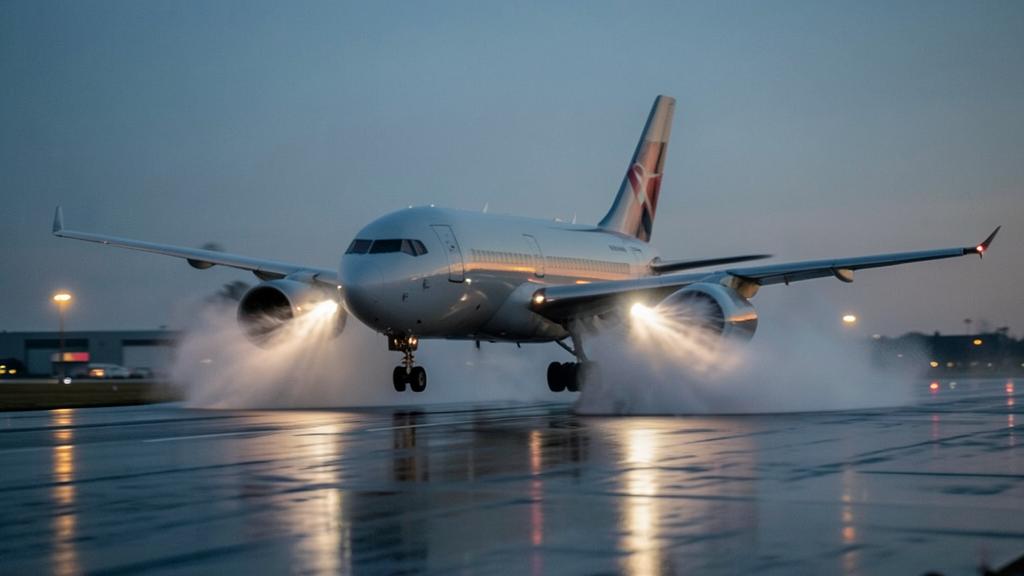
Three operational consequences follow directly, and they are more useful than any percentage.
- Selection delay is expensive. Every second between main-gear touchdown and reverse being effective is a second at the highest speed of the ground roll, which is precisely where the reverser earns most. This is why the performance model behind the tables includes an assumed transition time, and why a late or hesitant selection quietly invalidates it.
- Cancelling reverse at the type’s low-speed threshold costs almost nothing. The remaining benefit at low speed is a small fraction of the total, which is why type manuals can call for reverse idle at a threshold somewhere in the region of 60 to 80 knots, and for stowing shortly afterwards, without a meaningful cost in distance. The figures themselves are type-specific, and the threshold exists for reingestion, surge and, in winter, for the blowing snow that arrives at the flight deck windows at exactly the wrong moment.
- The benefit is insensitive to surface condition. Reverse thrust does not care what the runway is made of or what is on it. Wheel brakes care about nothing else.
That last point is the hinge of the entire subject. As the available tyre friction falls, the wheel brakes lose authority and the antiskid system limits brake pressure to what the surface will accept. The reverser’s contribution is unchanged in absolute terms — so its share of the total deceleration rises sharply, from marginal on a dry surface to decisive on a poor one.
| Reported surface | Wheel brakes | Thrust reverse | Aerodynamic drag and lift dump |
|---|---|---|---|
| Dry | Dominant | Secondary | Significant at high speed only |
| Good braking action, wet | Dominant but reduced | Meaningful | Significant at high speed only |
| Medium braking action | Comparable to reverse | Comparable to brakes | Significant at high speed only |
| Poor braking action | Limited by the surface | Often the largest single contributor | Significant at high speed only |
| Less than poor | Marginal | Primary retarding force available | Significant at high speed only |
The table is deliberately qualitative. The actual split depends on the number of engines, the reverser design, the bypass ratio, the aeroplane weight and the reported runway condition, and any single set of percentages quoted as universal is wrong for most of the fleet.
Where the credit reappears: the reporting format did the work
The move to the global reporting format changed the shape of this conversation. Where it is applied, runway condition reaches the crew as a condition code on a scale from a fully dry surface down to a surface worse than poor, derived by the aerodrome from the contaminant type, its depth and the temperature, and communicated with the same vocabulary that the landing performance software expects. That alignment is what makes an in-flight computation defensible rather than an educated guess.
In those degraded cases the manufacturer’s data does credit reverse, and the credit is large enough to change decisions. This is why a reverser that is irrelevant on a dry runway becomes a dispatch question the moment there is a chance of contamination at destination or at the alternate. On many types, the same inoperative reverser produces no change in the dry table and a substantial penalty in the contaminated one.
The status of that contaminated data deserves a word of caution. It has historically been supplied as advisory or approved supplementary material rather than as flight-tested certified performance, and its regulatory standing is not identical between manufacturers or between authorities. Where EASA and the FAA diverge, they diverge on the status of the data and on the operational margins to be applied, not on the underlying physics. Read your own aeroplane flight manual rather than a generalisation about the fleet.
The autobrake paradox
Here is the finding that surprises crews the first time they see it on a runway analysis: with a deceleration-target autobrake selected, adding reverse thrust does not shorten the landing distance at all. The autobrake is commanding a deceleration rate. Adding another retarding force simply causes the system to release brake pressure to hold that same rate. The aeroplane stops in the same place, using less brake.
Reverse only shortens the distance when the deceleration is limited by something other than an autobrake target the brakes can still meet: maximum manual braking, or a surface on which the commanded rate cannot be delivered because the friction is not there. Whether the highest autobrake setting on your type falls on one side of that line or the other is a question for the type documentation, not for a general rule. On a wet or contaminated runway, therefore, reverse both shortens the roll and offloads the brakes; on a dry runway with a low autobrake selection, it does the second only.
The right reflex. When the numbers are tight, ask what is limiting the deceleration before you ask what will increase it. If the autobrake target is the limit, more reverse does nothing for the distance and a higher autobrake selection does everything. If the surface is the limit, the reverse is what you have.
One reverser inoperative: reading the real penalty
Dispatch with a reverser inoperative is a routine minimum equipment list item on most types, generally with the unit deactivated and locked in the stowed position by maintenance under the associated procedure. What it costs operationally is not a single number, and the table below is the shape of the answer rather than the answer itself — the values are type-specific and live in your own documentation.
| Item | Typical effect |
|---|---|
| Dry certified and dispatch landing distance | Usually unchanged, because no credit was taken in the first place |
| Wet and contaminated landing data | Penalised, sometimes substantially; on some types certain condition codes become unavailable |
| Rejected take-off performance | Type-dependent; where reverse credit exists in the accelerate-stop data it is withdrawn |
| Crosswind limits on a slippery surface | May be reduced, because asymmetric reverse and reduced braking interact |
| Brake energy and turnaround | Higher brake temperatures, potentially a longer cooling time before the next departure |
| Drag and fuel | Normally no cruise drag penalty of its own; any fuel adjustment is stated in the minimum equipment list |
| Alternate selection | The real cost: destinations and alternates with a contamination risk become harder to justify |
Asymmetric reverse, and the case for putting it away
With one reverser deployed and the other stowed, the residual thrust asymmetry acts against directional control precisely where directional control is weakest — a slippery surface, low speed, and a nosewheel with little steering authority. Type manuals differ on whether asymmetric reverse is permitted at all, and where it is permitted the standard technique when directional control begins to degrade is to reduce the deployed reverser toward idle rather than to fight the yaw with rudder and differential braking. Differential braking on a low-friction surface is close to being an antiskid experiment.
The related trap is the reverser that fails to deploy on landing when both were selected. The correct response is the same and it is a handling response, not a performance one: symmetry first, distance second. A directional excursion costs more than a hundred metres of runway.
What to take back to your own tables
Three questions turn this into something checkable on your own type rather than a general argument. What does the aeroplane flight manual say about reverse credit in the dry landing distance — is it zero, or does your type take partial credit? What is the difference between the contaminated table with all reversers and the same table with one inoperative, at your typical landing weight and at a medium condition code? And which of your regular destinations would fail that comparison in winter?
Crews who run those three checks once tend to change their dispatch judgement permanently, because the answer is almost always that the reverser is free on a dry day and expensive on a wet one. That is the same conclusion the certification basis reached, arrived at from the other direction. Performance and runway-condition topics of this kind are covered in the type-agnostic performance material at FL330 training, but the numbers that matter are the ones in your own manual.


Leave a Reply
You must be logged in to post a comment.