
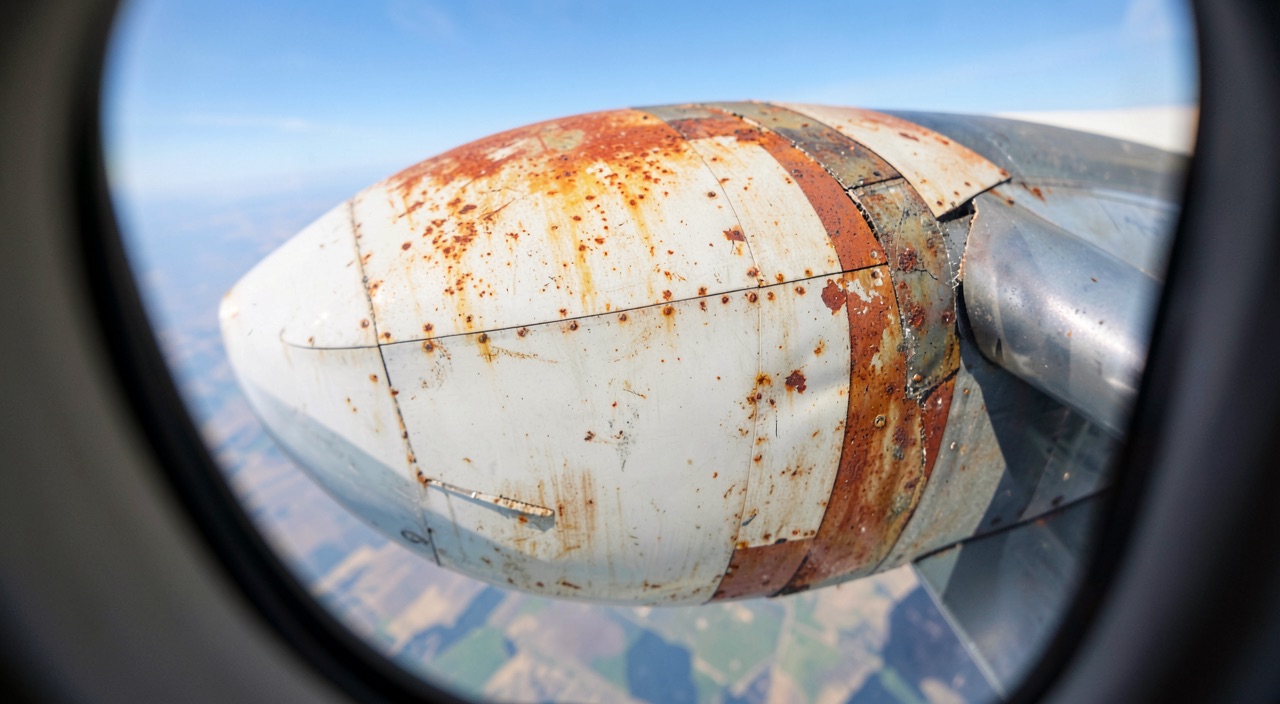
Level 390, cruise Mach, and the failure message for the second yaw damper appears: the cabin starts rocking slowly from nose to tail, the aircraft still flies, and the question that arises in the following seconds isn’t « what’s broken » but « what was this little box doing that nobody does now ». Mach trim and the yaw damper have this in common: they work silently on two flaws the airframe cannot correct on its own — a nose-down moment that grows with Mach, and a lateral oscillation that sweep sustains. None of this is a malfunction: it is the aircraft’s natural behaviour, made visible again.
Two functions, two unrelated instabilities
They are mentioned in the same breath because they sit side by side on the minimum equipment list and share the same status: stability augmentation, not automatic flight control. The resemblance stops there. Mach trim works in the longitudinal plane, on a slow and monotonic quantity, the Mach number. The yaw damper works in the lateral plane, on a fast and oscillatory quantity, yaw rate. One compensates a trend drift, the other damps a natural mode.
The distinction is not academic: it governs the nature of what manual flying must supply when the function is lost. Compensating a trend, a crew knows how to do — it is a matter of trim and attention to speed. Damping an oscillatory mode with a period of a few seconds is another matter entirely: the human loop is too slow and too far behind in phase to be placed in series with a rudder pedal without risking sustaining what it claims to extinguish.
The transonic regime: why the nose drops
As flight Mach number rises, local flow over the upper surface exceeds the speed of sound well before the aircraft itself does. A shock wave forms, and its position moves aft toward the trailing edge as Mach increases. This aft shift moves the centre of pressure in the same direction: the lever arm relative to the centre of gravity lengthens, and the resulting moment is nose-down. Two further effects compound this. The downwash field behind the wing changes: the flow seen by the horizontal tail changes orientation, which alters tail lift and hence pitch trim. And the elevator loses effectiveness as soon as a shock forms ahead of its hinge line, because part of the pressure variation it should transmit forward no longer crosses the shock.
What is visible from the flight deck is not merely a lowering pitch attitude: it is a reversal of the stick-force-per-speed gradient. In the transonic dive zone, acceleration generates a nose-down moment that accelerates the aircraft further still: the departure feeds on itself. This is exactly the property certification specifications forbid, by requiring that stick force remain positive and increasing with speed deviation throughout the operating envelope, up to the demonstration Mach numbers beyond the maximum operating Mach.
The aircraft naturally tends to pitch down at high speeds because of air pressure changes. Mach trim adds a small upward force to counteract this, keeping the plane stable. Without it, the nose would drop, and the crew would have to manually adjust the controls to keep the plane level.
What Mach trim injects, and what it does not provide
The function is disarmingly simple: a correction that is a function of Mach number alone, with no feedback loop on attitude or load factor, applied beyond a threshold Mach. Depending on the architecture, it acts by moving the adjustable horizontal stabiliser, by biasing the elevator’s neutral position, or by modifying the artificial-feel system’s force law. On fly-by-wire controls, it is no longer a separate box but a term in the control law: its degradation shows up as a law change rather than as a dedicated warning light.
What it does not provide deserves stating, because the confusion is common. It does not protect against overspeed: it makes the aircraft stable in speed, which is a different thing. It does not replace elevator trim: the crew keeps trimming for attitude, the Mach correction being added to their input. It does not operate below the threshold Mach, which explains why a failure remains invisible during a low climb and only appears at high cruise. Finally, on types where the correction runs through the adjustable stabiliser, its operation is visible: the trim wheel moves although nobody asked for anything. Whoever does not know this reads it as an anomaly; whoever does has a free health indicator right there.
Dutch roll: a coupling that sweep sustains
Take a sideslip, whatever its origin — a gust, thrust asymmetry, a rudder input. The fin produces a lateral force that creates a yawing moment bringing the nose back into the relative wind: this is weathercock stability, and it is clearly positive. But the same sideslip also acts in roll. On a swept wing, the advancing wing sees its leading edge less oblique to the relative wind: the useful velocity component is greater there, it generates more lift, and the aircraft rolls toward the opposite side. Geometric dihedral adds its own term in the same direction. There are the two ingredients of the mode: yaw generates roll, roll generates sideslip, and the whole thing goes round in circles.
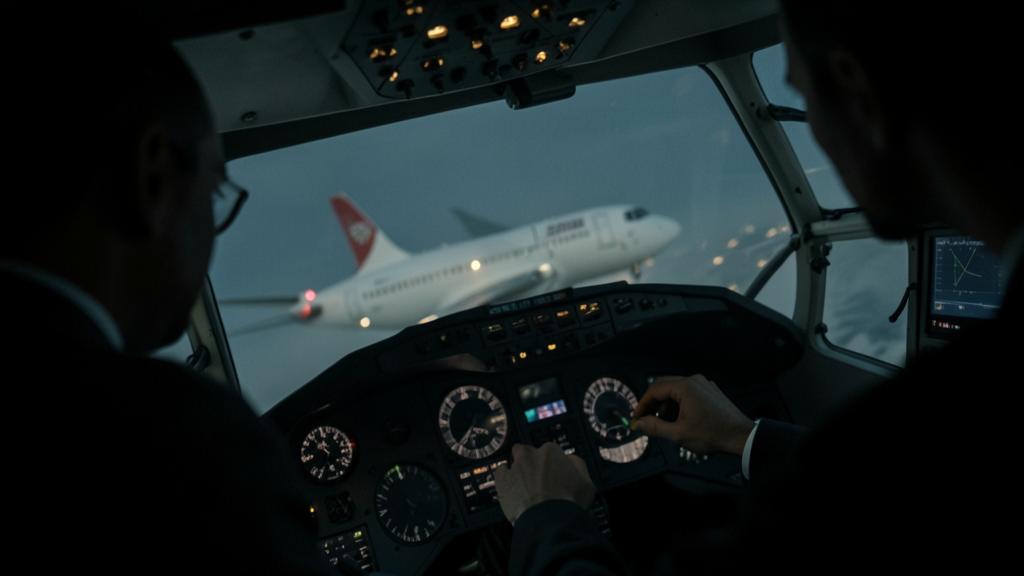
This oscillatory mode would be of no interest if it were well damped. The trouble is that yaw damping, which comes from the fin’s lever arm working against yaw rate, degrades with altitude. The damping moment varies as the product of air density and true airspeed, while the aircraft’s yaw inertia, for its part, does not change from one level to another. Now air density falls off much faster with altitude than true airspeed rises — and at constant Mach in the troposphere, true airspeed even decreases, as air temperature falls with level. The product that provides damping therefore shrinks as one climbs, while the inertia to be braked stays the same: the ratio tips the wrong way. Add that at high Mach a shock can reduce the fin’s effectiveness, and it becomes clear why a mode that was harmless at takeoff turns into an oscillation that refuses to die out at high cruise.
On a Boeing 737 at FL390, a yaw damper failure can cause a Dutch roll oscillation with a period of about 5 seconds. Without the damper, the oscillation may persist for several minutes, making it difficult for the crew to maintain stable flight, especially at high altitudes where the air is thinner and provides less natural damping.
The mode is also felt differently depending on where one sits: the oscillation is a rotation about an axis passing near the centre of gravity, and the lateral acceleration it produces grows with distance from that axis. A slight rocking on the flight deck, a distinct nuisance at the back of the cabin — hence the nature of the reports that come from the cabin crew when the function degrades without any failure being announced.
The yaw damper: a rate loop, not a slip-ball loop
The design follows directly from the diagnosis. What must be created is a yawing moment opposed to yaw rate — a damping term, not a restoring term. A rate gyro measures this rate, a high-pass filter removes the slow components, a gain limited in authority converts the signal into a deflection command, and a servo drives the rudder. On most transport types, this servo operates in series, without moving the rudder pedals: the crew feels nothing and cannot monitor its action from pedal position either.
The washout filter is the piece one must understand. Without it, the damper would oppose any yaw rate, including that of a steady turn, and it would have to be fought against on every heading change. With it, a sustained component — the sideslip of an engine failure, the yaw rate of an established turn — produces no permanent command. This is why a yaw damper never compensates for thrust asymmetry: that is not its job, it does not see that kind of signal. Limited deflection authority follows the same logic: a few degrees suffice to damp the mode, and more would risk an inadvertent rudder deflection whose consequences would be worse than the mode it is meant to damp.
Without the function: what the crew actually sees
The two losses have nothing in common, including in how they manifest. One is slow and reads on control forces; the other is immediate and reads on the flight path and on comfort.
| Criterion | Mach trim | Yaw damper |
|---|---|---|
| Flaw addressed | Nose-down moment growing with Mach, force gradient that reverses | Weakly damped yaw-roll oscillatory mode |
| Input quantity | Mach number alone, beyond a threshold | Yaw rate, high-pass filtered |
| Controlled surface | Adjustable stabiliser, elevator neutral point, or force law | Rudder, series servo |
| Rate of action | Slow, near static | Fast, at the mode’s period |
| Symptom on loss | Growing forward trim demand, force that lightens then reverses while accelerating | Sustained lateral rocking, accelerations at the rear of the cabin, heading that hunts |
| What the crew must supply | Manual trim and active speed monitoring | Roll damping on the control column, rudder pedals left alone |
| Effect on the envelope | Reduction of usable Mach depending on type | Altitude or speed limitation, operational restrictions depending on type |
On loss of Mach trim, the chronological order matters: first an unusual need for nose-down trim, then a lightening of control forces, finally, if speed is allowed to drift, a self-sustaining acceleration. The first sign is therefore a trim sign, not a speed sign — hence the value of knowing what a normal trim position looks like at one’s usual cruise Mach.
What manual flying must supply, and what it must forbid itself
Against the uncompensated nose-down tendency, the technique is classic: reduce Mach to exit the zone where the flaw is strongest, trim without hesitation, avoid rapid thrust changes that will swing Mach in both directions. The autopilot, when it remains available, holds attitude and trims; the question becomes up to what Mach the type’s documentation allows it to remain engaged.
Against Dutch roll, instinct is a poor adviser. The mode is seen first in roll, and the temptation is to correct it with rudder, since it is born of yaw. That is precisely the manoeuvre to avoid.
The trap: correcting a Dutch roll with rudder. The delay in perception, then decision, then aircraft response places the inputs out of phase: instead of damping the mode, they add energy to it and the amplitude grows. The second trap is structural: alternating rudder deflections, each individually within limits, can produce loads on the fin exceeding those required by certification, which does not assume rapid full-amplitude reversals.
The right reflex: damp in roll, on the control column or wheel, with small inputs opposing bank angle at the moment it reaches its maximum, and leave the feet at rest. This works on the branch of the coupling that is naturally best damped, the roll branch, and breaks the loop without exciting yaw. Reducing Mach and descending also restore the aerodynamic damping that was lost.
These two techniques are better trained in a simulator than read about, and they come up in checkrides as much as in technical selection interviews: the topic instantly separates whoever has understood the mechanism from whoever has memorised a procedure. Debriefs abound on the FL330 technical forum.
Deferring the failure, limitations, and grey zones
Both functions can be deferred on many types, but never for free, and the nature of the trade-off differs. For the damper, the restriction typically bears on altitude, on speed, sometimes on access to certain airspace or approaches, and on the availability of autoland, whose guidance requirements assume a servo-driven rudder. For Mach trim, the trade-off bears on usable Mach and on the availability of certain guidance modes. Many types carry two independent damper channels: losing the first is a maintenance event, losing both a handling event, and the minimum equipment list treats the two cases very differently.
One area the documentation handles poorly remains, because it is hard to put into words: partial degradation. A rate gyro that drifts slowly, a servo that loses authority, one channel working against the other, produce a residual oscillation with no failure message. The symptom is a lateral discomfort nobody knows how to attribute, first reported by the cabin crew, and which disappears as soon as the aircraft descends. A report that specifies altitude, Mach, and position in the cabin is worth far more to the shop than « vibrations in cruise ».
To check in your own documentation before the next checkride
Three points deserve to be opened, because the answers are type-specific and cannot be deduced from the principle alone. First, through which component does the Mach correction pass on your aircraft: if it is the adjustable stabiliser, you have a visual indicator of proper operation, otherwise you do not. Second, exactly what the minimum equipment list requires for one damper lost and for two, in terms of altitude, Mach, and permitted operations: the difference between the two lines is often greater than memory retains. Third, the exact wording of the Dutch roll recovery procedure in the operations manual: some manuals explicitly prescribe not using the rudder, others remain silent, and that silence is not a permission.
For anyone preparing a type rating or a checkride, the topic has a particular virtue: it forces one to connect an aerodynamic property, a system architecture, and a manual technique. Three areas of knowledge usually revised separately, and whose articulation is exactly what an examiner looks for. The applied aerodynamics modules offered by FL330 Formations cover the lateral mode and its compensation in that order.
This text sets out mechanisms, not instructions. The certification specifications applicable to the type, the approved flight manual, the operations manual, and the operator’s minimum equipment list take precedence over everything above, including where they describe a technique different from the one outlined here.
Questions fréquentes
Does the yaw damper coordinate turns?
No, and this is a common confusion. Its high-pass filter removes precisely the slow signals, so the yaw rate of an established turn produces no permanent rudder command. Turn coordination, when automated, is a separate rudder-control or autopilot function, not damping.
Why does Dutch roll worsen with altitude?
Because the damping moment produced by the fin varies as the product of air density and true airspeed, while the aircraft’s yaw inertia stays the same. As altitude increases, air density collapses far faster than true airspeed rises; at constant Mach in the troposphere, true airspeed even decreases with temperature. Damping relative to inertia therefore falls, and at high Mach a shock on the fin can further reduce its effectiveness.
How do you damp a Dutch roll without a yaw damper?
With small roll inputs, opposing bank angle at the moment it reaches its maximum, leaving the rudder pedals at rest. This works the naturally best-damped branch of the coupling. Reducing Mach and descending restore some of the lost aerodynamic damping, and the type’s operations manual procedure takes precedence over this general principle.
What do you do if Mach trim is lost in cruise?
Reduce Mach to exit the zone where the uncompensated nose-down moment is strongest, trim manually without delay, and actively monitor speed since speed stability is no longer assured. The Mach limitation to respect and the availability of the autopilot are type-specific and appear in the approved procedure.
Is the loss of a single damper a handling event?
On types fitted with two independent channels, losing the first is generally a maintenance event with no noticeable in-flight effect, the second channel providing the function. Losing both changes the nature of the flight and triggers altitude or speed limitations. The minimum equipment list treats the two situations separately, with very different trade-offs.
Does an unavailable yaw damper prohibit autoland?
On many types, yes, because automatic guidance on final approach, then alignment through the flare, assumes a servo-driven rudder to hold the track and damp lateral disturbances. The exact rule, and the minimums that follow from it, are set by the type’s limitations and by operational approvals, which must be checked before planning a low-visibility approach.


Leave a Reply
You must be logged in to post a comment.