
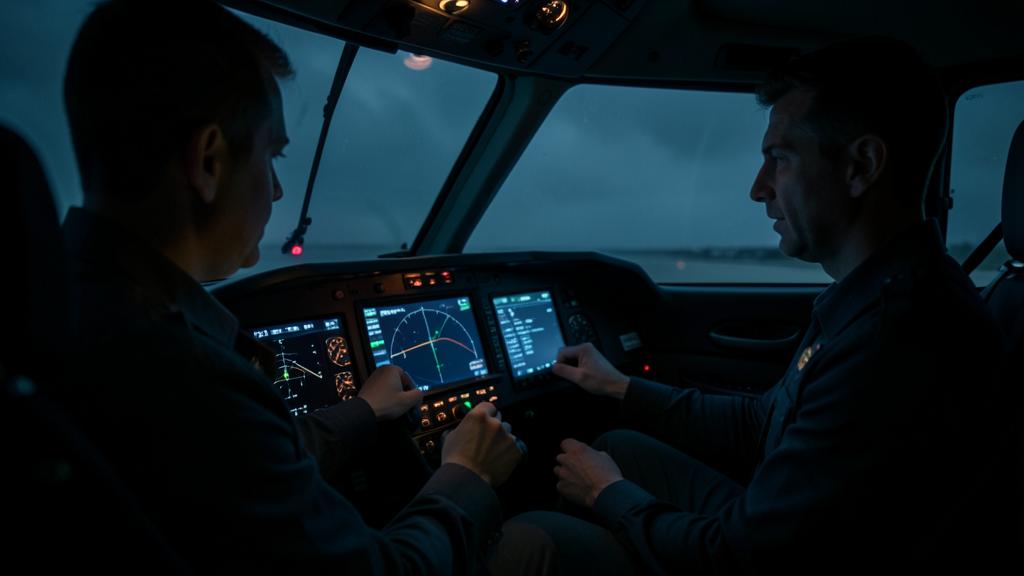
A flight duty period beginning at 05:00 and one beginning at 10:00 are not the same duty, even when the aeroplane, the route and the crew are identical. The limitation schemes in force in Europe and in the United States both weight the permitted duration by where the duty sits on the body clock, not by elapsed time alone. Knowing where that weighting comes from, how it is expressed in the tables, and where it stops is what separates a roster that merely complies from one that survives contact with a real night.
The rule names a window, and it is much narrower than « night »
Both major regulatory systems isolate a specific band of clock hours and treat everything that touches it differently. In the European scheme, the window of circadian low is defined as the period between 02:00 and 05:59 in the time zone to which the crew member is acclimatised. The United States rule uses the same hours, describing the window of circadian low as a period of maximum sleepiness occurring between 0200 and 0559 during a physiological night.
Two details in that definition do most of the work and are routinely missed. The first is that the window is anchored to the crew member’s own reference time zone, not to local time at the aerodrome. A crew acclimatised to Paris flying out of Dubai carries its window with it; the sun outside the flight deck is irrelevant to the calculation. The second is that this window is far narrower than the operational notion of night. Sunset to sunrise can span fourteen hours in a European winter; the circadian window spans four. A duty can be flown entirely in darkness and never touch the window, and a duty that begins in broad daylight can end inside it.
The window is also, deliberately, a fixed administrative object. The physiological trough it stands for is not fixed at all: it migrates with chronotype, with recent sleep history, and with the direction and size of any time zone shift. The regulator picked immovable clock hours because a roster has to be built and published months in advance, and no planning system can interrogate an individual’s phase. The fixed window is a proxy, and it is the crew’s job to know when their own trough has moved away from it.
The circadian low is a specific time window (2 AM to 6 AM) where pilots are naturally sleepier. Regulations use this fixed window as a safety measure, even though a person’s actual sleepiness can vary based on their personal sleep patterns and recent rest. Pilots must adjust their own awareness to this window, as the rules can’t account for every individual difference.
A pilot acclimatised to London (GMT) departing Dubai (GMT+4) at 07:00 local time is at 03:00 on their body clock, still inside their window of circadian low (02:00–05:59). Even though it’s daylight outside, the pilot’s body clock is in the sleepiest part of the night, requiring extra caution during this flight.
Two processes, and why elapsed time cannot separate them
Sleep and alertness are usually described with two interacting processes. The first is homeostatic: pressure to sleep accumulates continuously with time awake and discharges during sleep. The second is circadian: an endogenous oscillator, entrained principally by light, that drives alertness up and down on a roughly twenty-four-hour cycle regardless of how long the person has been awake. Core body temperature reaches its minimum near the end of the biological night, typically a couple of hours before habitual wake time, and objective performance measures track that minimum closely.
The consequences at the trough are not a matter of feeling tired. Reaction times lengthen, and more importantly the frequency of lapses — brief failures to respond at all — rises sharply. Sleep latency falls to its shortest value of the whole cycle, which is why unintended sleep is a night phenomenon rather than a duration phenomenon. Waking during the trough produces deeper and longer sleep inertia, which matters directly for in-flight rest: a pilot woken from bunk rest at 04:00 is not immediately the pilot who lay down. Laboratory work comparing sustained wakefulness with alcohol impairment found that around seventeen hours of continuous wakefulness degrades performance to a level broadly comparable with a blood alcohol concentration of about 0.05 per cent — a useful calibration precisely because it converts an invisible state into one the profession already treats as disqualifying.
The decisive point for rostering is that the two processes are independent. A crew member four hours into a duty at 03:00 has very little homeostatic pressure and a very poor circadian phase. A crew member twelve hours into a duty at 18:00 has high pressure and a good phase. Elapsed duty time is identical in neither direction and describes neither case. A limitation scheme built on duration alone would treat the first as fresh and the second as spent, and would be wrong about both. That is the entire justification for a table indexed by start time.
The useful habit. When assessing your own state before a night sector, ask two separate questions rather than one: how long have I been awake, and where is my body clock right now? Answering only the first is what produces the classic self-report of « I feel fine » at 02:30 on the fourth hour of duty.
How the weighting is actually expressed in the table
In the European scheme, the maximum daily flight duty period for an acclimatised crew is read from a table indexed by two axes: the start time of the duty, read in the reference time to which the crew is acclimatised, and the number of sectors to be flown. The most favourable start band is a broad one, running from early morning to the early afternoon, and it allows a maximum basic flight duty period of thirteen hours for one or two sectors. Each sector beyond the second removes a further half-hour, down to a floor reached at the highest sector counts. Start bands that push the duty towards or into the circadian window carry markedly lower maxima — roughly two hours lower at the bottom of the table than at the top for the same sector count.
What matters more than any individual cell is the shape. The table does not describe a duty that becomes hard after a certain number of hours; it describes a duty whose permitted length depends on where it begins, because where it begins determines where it ends.
| Axis | What it is a proxy for | Direction of effect |
|---|---|---|
| Start time of the duty, in the acclimatised time zone | Position of the duty relative to the circadian trough | Earlier and later start bands cut the maximum; the mid-morning band is the most generous |
| Number of sectors | Workload density: repeated departure, approach and turnaround cycles | Each sector beyond the second removes a fixed increment, down to a floor |
| Acclimatisation state | Whether the body clock is aligned with the local clock at all | An unknown state removes the start-time axis entirely and applies a single reduced column |
| Crew composition and rest facility class | Availability of a genuine in-flight sleep opportunity | Opens a separate augmented-crew table with much longer maxima |
Acclimatisation: the rule follows the clock the body kept, not the one on the wall
The moment a crew crosses time zones, « start time » stops being obvious, and the European scheme answers with an explicit acclimatisation state determined by the size of the time zone shift and the elapsed time since reporting. A crew member remains acclimatised to the departure reference time until enough zones and enough hours have accumulated, then either becomes acclimatised to the new zone after a defined recovery, or falls into an unknown state.
The unknown state is the most instructive part of the whole construction. When the body clock’s position cannot be asserted, the regulation does not guess a start band — it deletes the axis. There is no start-time column any more, only a single reduced set of maxima applying whatever the local hour. That is a regulator explicitly declining to reward a favourable-looking departure time it cannot vouch for, and it is the strongest available evidence that the tables are about phase rather than about hours.
The trap. Reading the start-time band off the departure aerodrome’s local clock after a multi-zone rotation. The band belongs to the reference time to which the crew member is acclimatised. Get that wrong and the roster looks legal while the crew is in fact deep in its own circadian night at the top of descent.
Encroachment narrows the options, it does not merely shorten them
Touching the circadian window does more than reduce a number. It progressively closes off the flexibility mechanisms that operators rely on elsewhere. The provision allowing a limited extension of the basic duty period a small number of times per week is itself restricted once the duty encroaches on the window, and the more deeply the duty overlaps it, the tighter the constraint on the number of sectors that may be flown within the extended period. Standby before a duty, split duty, and augmented crew with in-flight rest each interact with the window differently, and each has its own rule for how much of the standby or rest counts back against the duty.
The design intent is coherent: mechanisms that exist to absorb an operational disruption on a normal day are the same mechanisms most likely to be abused on a night with a technical delay, and that is exactly when the crew is least able to detect its own degradation. The rules take the tools away at the point of maximum temptation.
Disruptive schedules: the pattern matters as much as the single duty
A single night duty is a physiological event; a sequence of them is a different problem. The schemes name it separately. The European rules define categories of disruptive schedule by clock windows in the acclimatised time zone — an early start, a late finish, a night duty — and then constrain how many may be built consecutively and how they may be mixed. The distinction between an early-type and a late-type disruptive pattern exists because the two shift the body clock in opposite directions, and a roster that alternates between them denies the crew any stable phase at all.
| Pattern | What is lost | Recovery characteristic |
|---|---|---|
| Early start | The end of the main sleep period, cut short at the point richest in rapid-eye-movement sleep | Debt accumulates quickly across consecutive days; a single long lie-in does not clear it |
| Late finish | The beginning of the main sleep period, delayed by post-duty wind-down | Better tolerated singly, but shifts the clock later and clashes badly with any following early |
| Night duty crossing the window | The entire main sleep period, replaced by fragmented daytime sleep of lower efficiency | Requires local nights, not merely hours, before the phase re-anchors |
| Alternation between early and late types | Any stable phase whatsoever | The worst case: the clock is repeatedly asked to shift in opposite directions |
Rest is specified in local nights, not only in hours
The rest rules complete the argument. In the European scheme, minimum rest at home base is at least as long as the preceding duty period or twelve hours, whichever is greater; away from base the corresponding floor is lower, with an explicit requirement that the crew member still be afforded an eight-hour sleep opportunity once travelling time and other physiological needs have been taken into account. The distinction between a rest period and a sleep opportunity is not pedantry: hours spent in transit or waiting for a hotel room are rest by the clock and nothing at all by the body.
The recurrent extended recovery rest requirement is where the circadian logic becomes explicit. It is specified as a minimum block of hours that must include two local nights, with a maximum interval between consecutive blocks. The count of local nights is there because circadian re-entrainment is driven by the light–dark cycle, and no quantity of daytime hours off substitutes for a night spent asleep at night.
Two regulators, one trough, different arithmetic
Anyone working across both systems needs to know that the underlying physiology is agreed and the bookkeeping is not. The comparison below is about structure rather than about individual cells, which belong to the applicable text and change with amendment.
| Element | European scheme (Part-ORO, Subpart FTL) | United States scheme (14 CFR Part 117) |
|---|---|---|
| Named circadian window | 02:00 to 05:59 in the acclimatised time zone | 0200 to 0559 during a physiological night |
| Index of the basic duty table | Start time band and number of sectors | Scheduled report time and number of flight segments |
| Handling of zone crossing | Explicit acclimatisation states, including an unknown state with its own reduced column | Theatre-based acclimatisation, with defined conditions for becoming acclimatised to a new theatre |
| Cumulative windows | Expressed in days — 7, 14 and 28 consecutive days — and counted in duty hours | Expressed in hours — 168 and 672 consecutive hours — and counted in flight duty period hours |
| Scope | Commercial air transport, with separate schemes for other activities | Domestic, flag and supplemental passenger operations, with cargo largely outside |
The cumulative windows deserve a second look. Sixty duty hours in any seven consecutive days and sixty flight duty period hours in any one hundred and sixty-eight consecutive hours look equivalent and are not. The European day is anchored to 00:00 UTC, so that window advances in whole days; the American one slides hour by hour. The two are also counting different things: all duty on one side, flight duty periods on the other. Operators moving crews between the systems have been caught by both.
Where the prescriptive limit stops and management begins
Every prescriptive table is a compromise between physiological accuracy and administrative usability. The international framework, through the fatigue management provisions of Annex 6 and the associated guidance material, allows an operator to depart from the prescriptive limits under an approved fatigue risk management system, provided it demonstrates an equivalent or better level of safety with its own data — rostering analysis, biomathematical modelling, actigraphy, and reported outcomes.
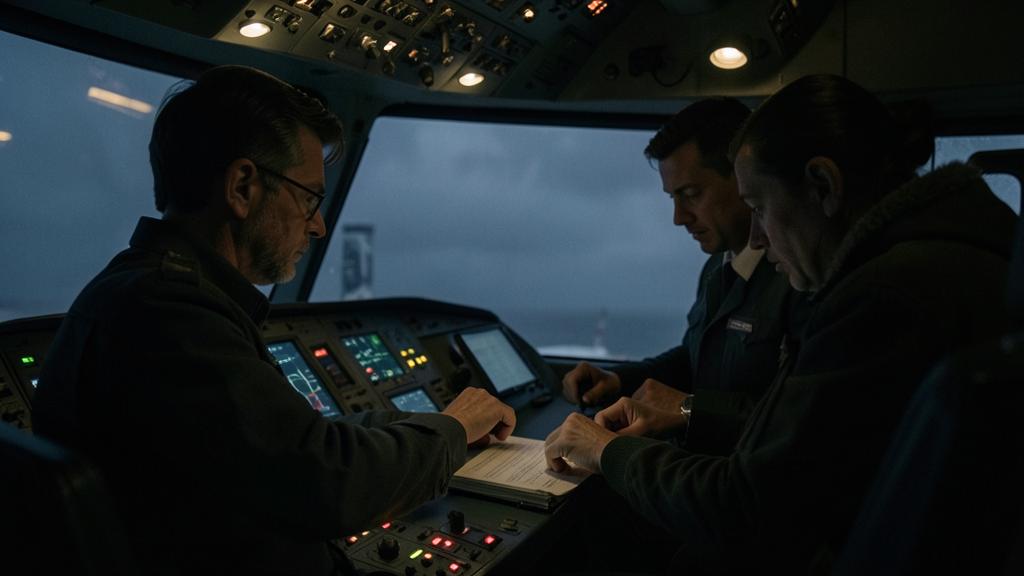
That option exists precisely because the fixed window is a proxy. A long-haul operation whose crews are chronically in an unknown acclimatisation state, or a short-haul operation building repeated early starts, may both be entirely legal and still be accumulating a fatigue debt that no table can see. Conversely, a well-analysed pattern may safely exceed a prescriptive cell. The prescriptive scheme is a floor built for the operator who has no data; the moment an operator has data, it also has an obligation to look at it. How these schemes work out operator by operator is discussed at forums.fl330.com.
The practical takeaway for a line crew is narrow and useful. When a roster looks legal but wrong, the productive question is never « how many hours is this? » It is « where does this duty sit on my clock, what state am I acclimatised to, and how many local nights have I actually had? » Those three answers explain nearly every case in which the table and the body disagree.


Leave a Reply
You must be logged in to post a comment.