
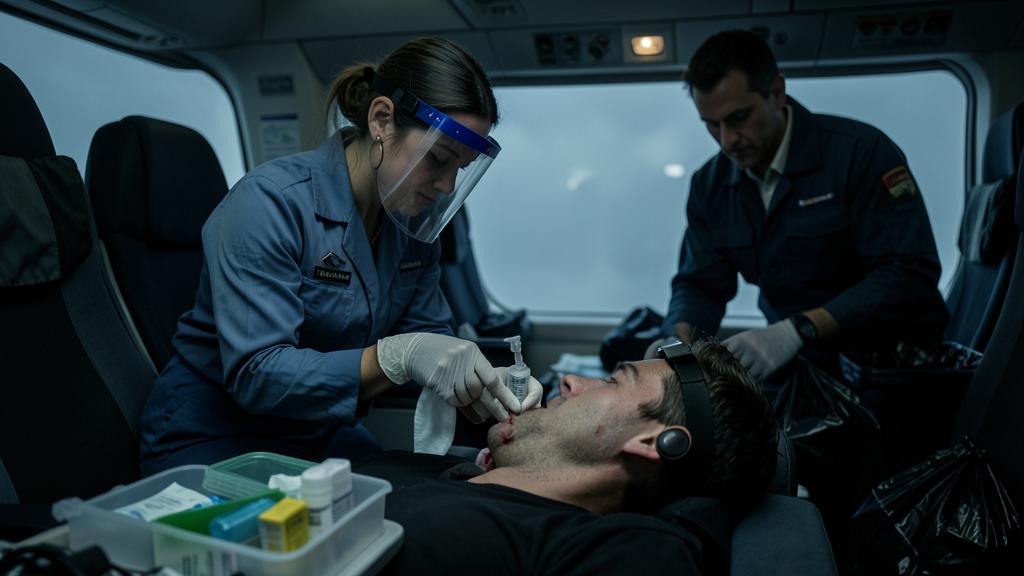
A cabin is designed for eating, sleeping and evacuating. Nothing in it is designed for bleeding. There is no sink you can reach without leaving the casualty, no sharps container, no waste stream that ends anywhere other than a galley cart opened by someone who has no idea what is in it. Protecting the crew during a bleed is therefore not a matter of adding caution to the first-aid drill — it is a matter of organising the space, the roles and the waste before the drill starts, because none of that can be improvised while somebody is holding pressure on a wound.
Universal precautions is a doctrine, not a degree of caution
The principle behind every provision in this area is that all blood and body fluids are handled as though they were infectious, regardless of what is known, believed or assumed about the person they came from. It is not a maximum level of care reserved for alarming situations. It is the standard level, applied identically to a nosebleed in row 42 and to an obvious trauma.
The reason is practical before it is ethical. A passenger’s answer about their own status is unreliable — many carriers do not know they are carriers — and no crew member is in a position to ask it. Grading protection by what somebody looks like or says produces two failures at once: an inconsistent barrier, and a decision that is discriminatory on its face. One standard for everybody removes both, and removes the deliberation from a moment that has none to spare.
The agents that give the doctrine its weight are the bloodborne viruses: hepatitis B, hepatitis C and HIV. Their transmissibility after a percutaneous injury is not remotely equal, and the ordering matters for how urgently the aftermath is handled — hepatitis B is by a wide margin the most readily transmitted of the three. It is also the one against which an effective vaccine exists, which makes crew vaccination status an occupational health question to settle in advance rather than a question to raise the morning after an incident.
The rule is: treat all blood as if it’s dangerous, no matter what. This isn’t about being extra careful in scary situations—it’s the normal way to do things. Also, you can’t always trust what a passenger says about their health, so one set of rules for everyone keeps things fair and safe.
On a flight from Paris to New York, a passenger in row 12 suffers a nosebleed. The crew immediately puts on gloves, an apron, and face protection—not because they think the passenger has a disease, but because that’s the standard procedure. After the bleed is controlled, they clean the area with special wipes and seal the waste in a biohazard bag, even though the passenger seemed healthy.
| Route | What it looks like at 37 000 feet | The barrier that addresses it |
|---|---|---|
| Contact with intact skin | Blood on hands, armrests, seat covers, uniform | Gloves; washing with soap and running water afterwards |
| Contact with broken skin | A crew member with a cut cuticle or an existing dressing | Cover the lesion before the flight, not after the call |
| Mucous membrane splash | Nosebleed in dry cruise air, coughed blood, vomiting, an arterial bleed | Eye protection and a face barrier, which is the item most often left in the kit |
| Percutaneous injury | A passenger’s lancet or insulin needle, a snapped ampoule, broken glass | A rigid container agreed before the sharp exists; never re-sheathing a needle |
The kit has two jobs, and the second is the one that gets skipped
Provision on board follows the same three-way split: first-aid kits carried for treatment, an emergency medical kit on larger aeroplanes for use by a qualified volunteer, and a universal precaution kit whose purpose is specifically the handling of body fluids and the clean-up afterwards. Where those items live and how many are carried is set by the state of the operator and by the operator’s own approved arrangement, so the useful preparation is knowing your aircraft’s stowage plan rather than a general rule.
What matters more is that the precaution kit serves two distinct phases. During care it supplies the barriers: gloves, an apron, eye and face protection, skin wipes. After care it supplies the clean-up: a powder that gels a liquid spill into a solid mass that can be lifted, a scoop and scraper, absorbent towels, a germicidal disinfectant, and a marked biohazard waste bag.
The second phase is the one that gets abandoned. The emergency is over, the passenger is stable, the cabin wants to sit down and the crew wants to breathe. So a smear on an armrest dries through the turnaround and becomes somebody else’s problem — a cleaner’s, the next passenger’s, or the crew member who grabs that seat back on the walk-through. Treating the clean-up as part of the incident rather than as tidying afterwards is most of the discipline here.
| During care | After care | |
|---|---|---|
| Objective | Barrier between the fluid and the carer, without slowing the care | Remove the fluid from the cabin and contain it |
| Typical items | Gloves, apron, eye and face protection | Gelling powder, scoop and scraper, absorbent towels, germicidal disinfectant |
| Who does it | The designated carer, and only the carer | The carer, still gloved, after the casualty is stable |
| Common failure | Eye protection left in the kit because the bleed looked small | Not done at all, or done with a service cloth and hot water |
| Ends with | Handover or the casualty stabilised | A sealed, marked bag and hands washed with soap and running water |
The order of protection, and the route everyone forgets
Barriers go on in an order and come off in the reverse order, and the reason is simple: the gloves must be the cleanest thing you put on and the first thing you take off. Apron first, eye and face protection next, gloves last. Removing, the gloves come off glove-to-glove and skin-to-skin — pinch the outside of one cuff with the gloved hand, peel it inside out, then slide a bare finger inside the second cuff and peel that one over the first. It takes three seconds and it is the difference between finishing clean and re-contaminating both hands at the end.
The forgotten route is the eyes. Everyone’s mental model of exposure is a needlestick, and the exposure a cabin actually produces is a splash. Cruise air is extremely dry and the cabin altitude is not sea level, which is exactly the combination that produces nosebleeds — the commonest bleed a cabin crew meets, and one that puts a crew member’s face at the same height as the source while they lean in to help. Coughed blood and blood-streaked vomit do the same. If the face is going within arm’s reach of the fluid, the eye protection belongs on the face and not in the kit.
Two details earn their place. Nitrile is preferable to latex where there is a choice: a latex allergy in a sealed tube creates a second casualty. And the uniform is part of the problem — a lanyard, a scarf, long hair or a watch strap all reach into the treatment area, and none of them can be decontaminated afterwards.
The right reflex. Gloves last on, gloves first off, glove-to-glove and skin-to-skin. Then designate a runner who touches nothing and nobody: one crew member on the casualty, one fetching and communicating, one managing the cabin. The discipline that fails is the runner helping « just for a second » with contaminated hands, and it is the act that spreads a contained incident down the length of the aisle.
Working in an aisle: containing at the source
The geometry is unhelpful and it can be improved deliberately. Raising armrests and consolidating the casualty and the mess into a defined footprint costs seconds and turns an unbounded problem into a bounded one. Where the load allows, an empty buffer row does more for the eventual clean-up than any product in the kit.
Contamination travels on hands and on shoes. A crew member who walks the cabin in contaminated footwear converts a one-row clean-up into a full-length one, and nobody notices until the aircraft is on stand. Designating a single lavatory as the dirty one, and a clean route to and from it, keeps that traffic on a known path — and gives the crew somewhere to wash with running water, which alcohol gel does not replace once there is visible soiling.
Turbulence is the variable nobody controls. A rough patch during an active bleed distributes a contained mess and turns a carer kneeling in the aisle into an injury of their own. Telling the flight deck that first aid is in progress is not a courtesy: it lets the commander weigh a level change or a route offset, and it front-loads the information a diversion decision would need.
Sharps: the only injury with no partial version
Sharps arrive from more directions than crews expect. A diabetic passenger’s lancet or insulin pen. A glass ampoule from the emergency medical kit, snapped by a volunteer doctor working fast. A broken bottle. Whatever equipment a responding professional brought with them.
Two rules carry almost all of the risk. Never re-sheath a needle — a large share of occupational needlestick injuries happen during re-sheathing, to people who were being careful. And agree who takes custody of the sharp before the sharp exists, because a volunteer doctor will hand it to whoever is nearest, and whoever is nearest will be holding something else.
Most cabins carry no sharps container. The substitute must be rigid, puncture-resistant, sealable and marked, because whoever opens that stowage is entitled to know. A drinks can is not a sharps container. Once sealed, it is handed over hand to hand with a spoken description — never left in a galley to be discovered.
The trap. The person injured is usually not the person who treated. It is the crew member tidying afterwards, or the cleaner on the turnaround, reaching into a seat pocket or a waste bin where something was put down « for a second » during the emergency. Account for every sharp before the incident is declared over.
The waste has to go somewhere, and someone else opens that bag
Contaminated material ends its journey in a galley cart, and the person who opens that cart at the other end did not consent to the risk and cannot see what is inside. That single fact should determine how the waste is packaged: double-bagged, sealed, marked as biohazard, and reported both verbally to the senior cabin crew member and in writing in the cabin log so that the handover is not dependent on one person’s memory at the end of a long duty.
Two destinations are wrong and both are used. Biological waste does not go into the general cabin waste, which on some types is compacted and can breach a bag. And it does not go into a lavatory or the lavatory service system, which is serviced on the ground by people working to a different procedure and expecting different contents.
Service resumption belongs to the same question. Meal service should not run across a contaminated area, and hands that were gloved still need washing with soap and running water afterwards — gel removes neither the soil nor the doubt.
When a crew member is exposed: the clock, and the details that leave with the passenger
The immediate care is simple and worth knowing by heart because it happens while everybody is still busy. Skin: wash with soap and running water. Do not scrub, and do not apply disinfectant or bleach to skin. There is no evidence that squeezing a puncture wound helps, and it may worsen the tissue damage. Eyes: irrigate copiously with water or saline, remove contact lenses, irrigate again.
Then the clock, which is the part that gets missed. Post-exposure management for HIV is time-critical and measured in hours rather than days, and hepatitis B management is also time-sensitive and depends on the exposed person’s vaccination status. So the first decision after a significant exposure is not whether it was serious enough to mention — that judgement is not the crew’s to make — but who is told, immediately. The operator’s ground medical advisory service can be reached through the flight deck in flight, and its advice can legitimately change the destination.
The administrative act that cannot wait is capturing the source passenger. Name, contact details, seat number, and whether they are willing to be approached about testing. Once that passenger has disembarked and cleared the border they are effectively unreachable, and a name on a manifest is not a contactable person. This is the single most time-sensitive piece of paperwork in the whole sequence, and it has to be done by someone while the aircraft is still on stand.
| When | Action | Why it cannot wait |
|---|---|---|
| Immediately | Wash skin with soap and water, or irrigate eyes copiously | Reduces the inoculum; no substitute later |
| Within minutes | Tell the senior cabin crew member and the commander | The decision to seek ground medical advice is not the exposed person’s alone |
| In flight | Contact the ground medical advisory service through the flight deck | Post-exposure prophylaxis is measured in hours; it may bear on the destination |
| Before disembarkation | Record the source passenger’s identity and contact details | After the border they are unreachable; the manifest is not enough |
| Same duty | Occupational injury report and cabin log entry | Occupational health reporting runs separately from aviation occurrence reporting; both may apply |
| Handover | Sealed, marked waste and any sharps passed over by hand, described aloud | The receiving party cannot see the contents |
Cleaning the aeroplane is an engineering decision too
What the crew does in flight stabilises the situation; it is not a decontamination. The proper clean is a ground activity, and it has a technical dimension that cabin crew are well placed to trigger and nobody else is.
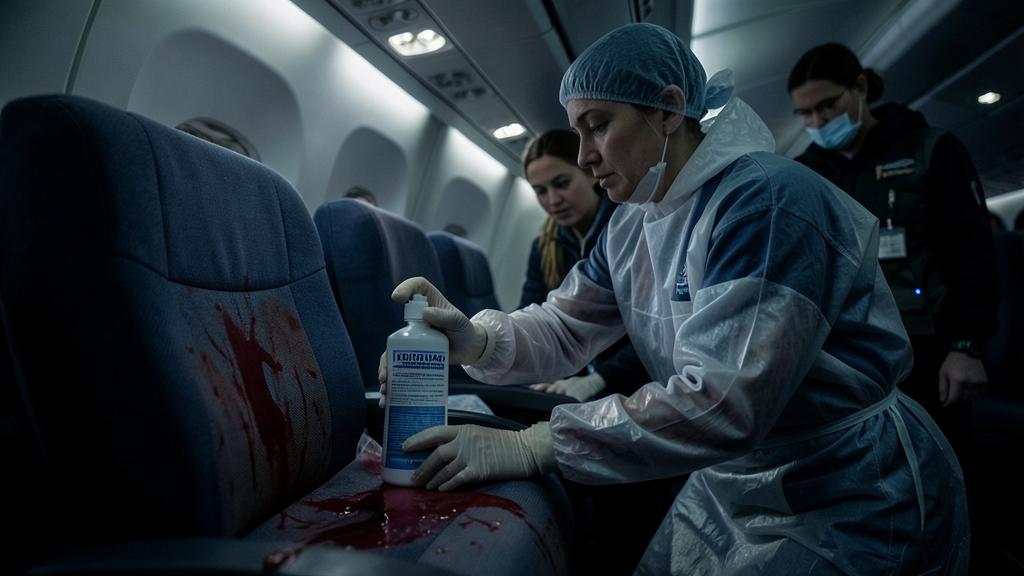
Disinfectants are not interchangeable on an aircraft. Household bleach on a cabin floor or in contact with structure is a corrosion problem rather than a cleaning solution, and the products that may be used are those the maintenance documentation permits. Using something else can turn a hygiene incident into a maintenance finding.
Soft furnishings absorb. A soaked cushion or seat cover is generally a replacement rather than a cleaning job, and fluid that reached the carpet may have migrated beneath it to a floor panel where no cleaner will look and where it becomes both a corrosion and a hygiene issue. Anything more than a smear is worth reporting to maintenance and not only to the cleaning contractor: that report decides whether the next sector departs with a properly restored cabin. Recurrent syllabi cover this phase with very uneven depth, and where it is thin the gap shows in the clean-up rather than in the treatment — which is why both halves belong in recurrent training, not just the bandage.


Leave a Reply
You must be logged in to post a comment.