
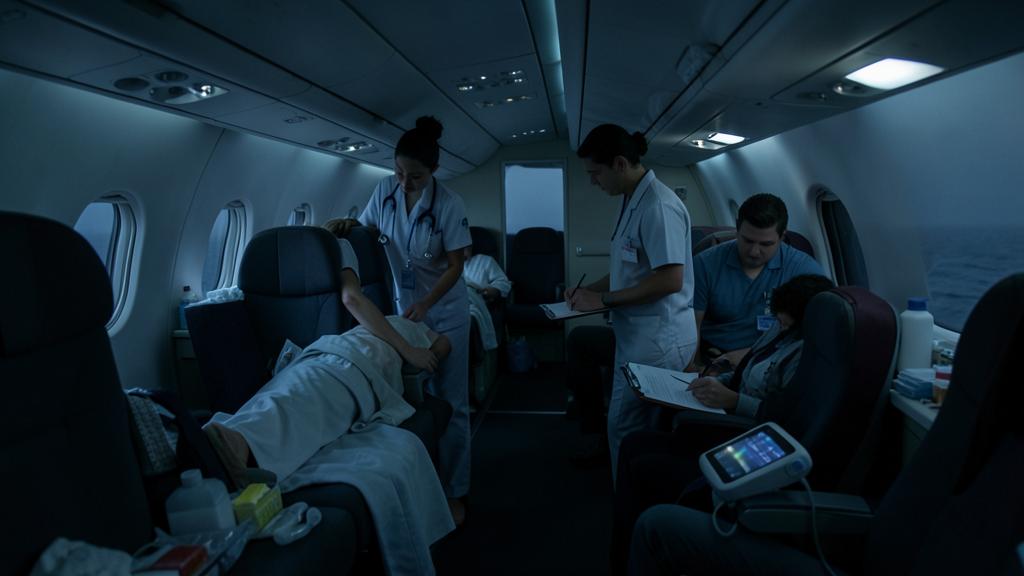
Middle of the night, oceanic sector, the nearest usable airfield more than an hour away. A passenger in the rear row stops responding; resuscitation begins without delay, ground medical assistance is on the line, and a moment comes when there is nothing left to try. At that instant the cabin changes its job: it stops treating and starts keeping watch. Everything done in the remaining hours — where things are placed, what is touched, what is written and what is said — will be re-read by an authority that was not on board.
Ascertaining is not declaring
No crew member declares a death, and the distinction is not a matter of careful wording. The finding that produces legal effects belongs, depending on the State, to a licensed physician or a public officer, and it is made where the aircraft lands. Even a physician who happens to be a passenger, however useful their clinical opinion, does not necessarily practise in the jurisdiction concerned: they give an opinion, they do not issue an enforceable act from the neighbouring row.
The consequence is one of vocabulary, and therefore of record. Writing « death » in the cabin report is writing something one has no authority to write, and unknowingly fixing a time that others will later rely on: insurer, notary, investigating authority. The wording that holds up is descriptive and nothing more: passenger unresponsive, no signs of life found, resuscitation efforts stopped at such a time on medical advice, body placed at such a seat at such a time. This wording also protects the crew, who will not have to defend a classification they were not entitled to make.
The authority of the commander over the conduct of matters on board comes from an old international instrument, the one dealing with offences and certain other acts committed on board aircraft. They decide, they order, they do not certify. The distinction becomes very concrete on arrival, when an agent asks for « the time of death »: one gives the time resuscitation efforts were stopped and the time of the first finding of no response, not a time no one on board had the authority to establish.
The crew can’t declare a death—only a doctor or official on the ground can. The crew must describe what happened without saying “death,” to avoid legal problems later.
On a Boeing 787 flying from Tokyo to Paris, a passenger collapses. After 45 minutes of resuscitation, the crew stops at 03:15 UTC. The crew writes in the log: “Passenger unresponsive, no signs of life at 03:15 UTC, resuscitation stopped at 03:15 UTC, body moved to seat 42A at 03:20 UTC.” No mention of “death” is made.
Stopping resuscitation: a decision no one takes alone
The stop is never based on a single criterion but on a bundle of factors described in the operations manual, one that must be citable without reading it: persistent absence of signs of life despite properly conducted and prolonged resuscitation, a defibrillator repeatedly advising no shock, advice from ground medical assistance, concurring advice from a volunteer physician whose identity and qualification have been recorded, and finally the crew’s physical limit. Chest compressions held by two people, in a narrow aisle, on a vibrating floor, cannot be continued for hours without degrading the rest of the flight, including the ability to handle a second event.
The decision belongs to the commander, on advice. This is not a formality: a decision taken by exhausted consensus leaves no usable record and puts everyone in an awkward position. Two references should be noted at the very moment, because they will be untraceable later: the case number opened by ground medical assistance, and the contact details of the volunteer physician together with the nature of their qualification. These two lines are worth more, on arrival, than a page of reconstructed narrative.
The trap. Wanting to « tidy up » the equipment. The defibrillator retains a record of what happened: rhythms analysed, shocks delivered, timestamps. Resetting it, changing its battery to make it available again, or removing the electrodes for the sake of tidiness means destroying the only objective piece of evidence in the file and, should the context turn suspicious, erasing a finding. The device is set aside, as is, marked unavailable.
Choosing the place before lifting
The first reflex is to move the body; the right one is to decide where, and to move it only once. Stiffness sets in, handling quickly becomes difficult for two people, and a body that has been moved three times is a body whose original position no one can describe any more. The choice is governed by three constraints that do not carry equal weight: the evacuation route first, service next, and finally other passengers’ view of it.
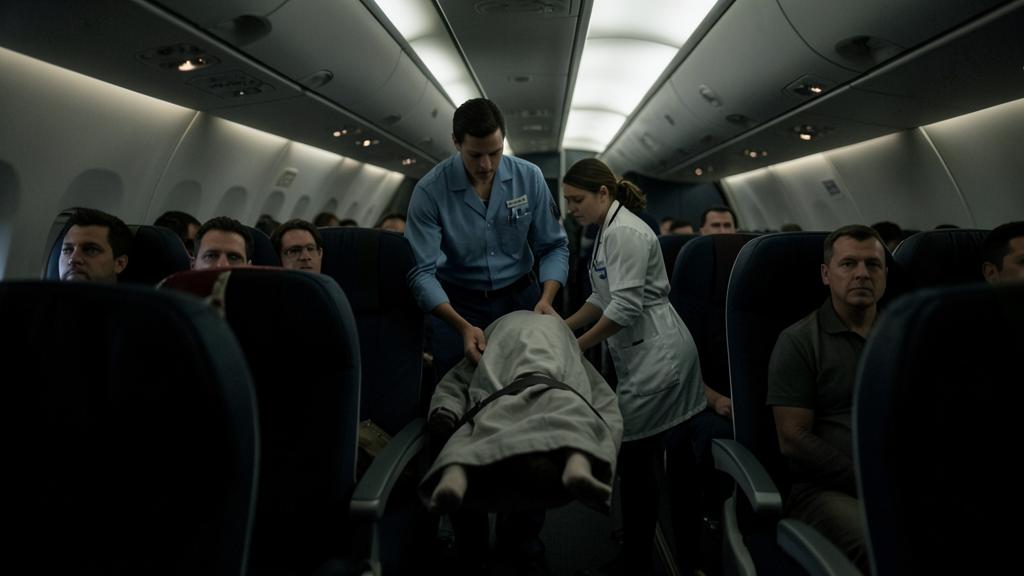
The seat remains almost always the best answer, because it is a certified place: seatbelt fastened, seatback upright for landing, occupant restrained in case of turbulence. A whole free row is preferred, at the rear, away from exits and galleys, and it is covered without being wrapped up. Some long-haul operators carry a cover intended for this; failing that, a blanket suffices and creates no difficulty later. If moving neighbouring passengers becomes significant, the information goes forward to the flight deck: cabin load distribution has been calculated.
What is ruled out is justified by a mechanism, not a matter of convenience. The lavatory is a cramped space someone will have to be extracted from under degraded conditions, and tying it up deprives the cabin of a facility for the rest of the flight. The galley floor is a place of passage, service and cart movement. The crew rest bunk isolates effectively, but it removes a bunk from people who must remain fit for duty, and makes the space unusable for the rest of the rotation. The areas around exits and the aisle are out of the question: the evacuation demonstration on which certification rests assumes clear paths, and nothing is placed there, even temporarily.
The right reflex. Decide on the row, reseat the neighbours and prepare the route before touching the person. Note the original location and the time of the move, use enough people, and do not do it again: a single, decided move is worth more than three improvised ones.
| Location | Evacuation route and service | Findings and dignity | Usual reservation |
|---|---|---|---|
| Free row at the rear, seatbelt fastened | No obstruction as long as it stays away from exits and galleys | Stable position, body covered, belongings kept in close proximity | Requires available seats and a single handling operation |
| Original seat, neighbours reseated | No obstruction, but ties up a row in an occupied zone | Nothing has been moved, so nothing needs to be justified | Difficult to sustain in the middle of a family or very dense zone |
| Crew rest bunk | Clears the cabin, but removes a bunk from a crew that must remain fit for duty | Satisfactory isolation, awkward access for the authority on arrival | Often ruled out by manuals, and by the rest of the rotation |
| Galley floor, lavatory, exit clear area | Direct obstruction of service and the exit route | No dignity, painful extraction once stiffness has set in | To be ruled out, even temporarily |
Personal effects, or the part that gets argued over
Nothing is searched. The rule is short and constantly put to the test: the ground quickly asks for an identity, and a helpful crew feels like preparing the way. The inventory is done by two people, without opening what is closed: hand baggage retrieved from its place, a pouch left closed, contents not itemised, everything gathered and sealed, noting the original seat. What is worn stays worn. Removing a wedding ring, a watch or a chain means moving a finding and exposing oneself to a suspicion that nothing will later dispel.
The trap. Looking for the passport. Emptying a jacket pocket or opening a bag to « help the ground » turns a helpful crew into the last people to have handled a deceased person’s belongings, without a qualified witness and without a mandate. If identity is requested before arrival, it is taken from the boarding list and the seat number, never from the person’s belongings. The authority will open them itself, and that is exactly as it should be.
The travelling companion is not a custodian. Nothing is handed to them before the authority intervenes, even if they ask, even if it is a phone that keeps ringing. They are, however, given the choice of staying seated nearby or being placed elsewhere, and a crew member is assigned to check on them regularly, otherwise they will spend the flight alone among passengers who know nothing.
Informing without announcing
Nothing is said over the PA. A general announcement adds nothing, spreads in distorted form and makes the rest of the flight unmanageable. Information is given individually, to the immediate neighbours, in one sober sentence with no medical qualification, and these passengers are reseated as a priority, using a higher class of service if need be: they have seen the resuscitation and should not have to finish the flight next to the seat concerned.
Service resumes. The classic mistake is to suspend it out of respect: a cabin stripped of its bearings and left in silence becomes more anxious, not more dignified, and an idle crew dwells on what it has just done. Service is also what allows crew to pass regularly near affected passengers without appearing to do so on purpose. Those who led the resuscitation, for their part, move to another position and do not stay in the area.
There remains the passenger who films. The crew has no power of seizure, and pretending otherwise creates a second incident: they ask for the filming to stop, explain it in one sentence, and if the refusal persists, they note the seat and report it on arrival, where others have authority. They do, however, note the names and seats of passengers sitting nearby: the health authority may later request a list of contacts.
Diverting helps the patient not at all, and the file a great deal
Once resuscitation efforts have stopped, landing sooner no longer saves anyone: a diversion only relocates a case file, and it relocates it to a State whose procedures and timelines are unknown. The body will stay there for as long as the local jurisdiction takes to deal with it, repatriation will have to be organised from a place where the operator has neither a station nor a local contact, and several hundred passengers will find themselves at an unplanned airport with a crew soon running out of duty time. Continuing to a planned destination, where assistance is in place and formalities have been anticipated, serves the family as much as the operation.
This reasoning is reversed in four cases, and it is worth being able to name them: real doubt about the finding, suspicion of a communicable disease that exposes the cabin and requires health notification before arrival, a context suggesting the involvement of a third party, or a cabin that has become unmanageable. The decision does not belong to the cabin, but the cabin supplies the three elements on which it is based: the clinical state and the medical advice obtained, the actual state of the cabin, and the ability to hold the situation until arrival.
| Element assessed | Favours continuing | Favours a diversion |
|---|---|---|
| Solidity of the finding | Concurring medical advice from the ground, no signs of life found | Persistent doubt, no advice obtained, inconclusive signs |
| Health risk | Nothing suggests a communicable disease | Suspicion of transmission, health notification to prepare |
| Context of the event | No indication of third-party involvement | Scene to preserve, judicial authority to be notified as soon as possible |
| State of the cabin and crew | Calm cabin, a place found, service resumed | Unmanageable cabin, crew insufficient or severely affected |
| Follow-up on the ground | Known station, local contact on site, formalities anticipated | Unplanned airport, local procedures unknown, likely to be held over |
Logging while it is still remembered
The account degrades quickly, and it degrades in a predictable direction: times get smoothed, the order of actions becomes rationalised, everyone remembers having done what should have been done. Yet this is precisely the timeline the authority will later reconstruct. A raw note, written on the fly on whatever comes to hand, is worth more than an elegant report drafted two hours later.
The right reflex. Open a sheet from the very first finding and write on it only times in universal time, in the order events occur, even if it is illegible. The clean report is then drafted from it afterwards, and the raw sheet is kept: it is time-stamped, it has not been reconstructed, and that is what gives it its value.
- Time and position at the first finding of no response, seat concerned.
- Start and end times of resuscitation efforts, persons who conducted them.
- Reference of the case opened by ground medical assistance, identity and qualification of the volunteer physician.
- Equipment used, and the state in which it was left.
- Original location, location chosen, time of the move and persons present.
- Inventory of the effects, not itemised but sealed, with two signatures.
- Names and seats of passengers seated nearby.
- Everything that was touched, and why.
The advance message is sent through the operator’s own channels, not in the clear over a frequency: the content is private and its disclosure serves no purpose for air traffic control, except when a risk to public health must be reported before arrival, a case provided for by the international health regulations and reflected in the health section of the general declaration for the aircraft. On arrival, depending on the State concerned, the alert goes to the police, the judicial authority, the medical service or the health authority, and this list changes from one country to another.
The order of disembarkation belongs to the State of landing, and it is not uniform: at some stations, passengers disembark normally and the authority then boards; at others, everyone remains seated until it arrives, doors closed. The crew does not decide and prepares for both scenarios, with a short announcement ready for each. What never varies is that neither the body nor the effects leave the aircraft before the authority does.
What to go and check in your own documentation
Three questions are ones for the manual rather than a colleague, and they are asked before the rotation, not during it. Who is authorised to request that resuscitation efforts be stopped, and on whose advice, at this particular operator. Which locations the manual allows, and which it expressly forbids, since some explicitly rule out the crew rest bunk while others permit it. In what form the inventory is expected: dedicated form, seal provided on board, number of witnesses required. These three answers are not improvised over the ocean.
Two grey areas remain, and it is better to know them than to discover them. The interplay between the State of registry and the State of landing, when the event occurs over the high seas, is not settled on board yet determines where the file will be handled. And the status of the volunteer physician varies from country to country: their opinion is sought, their liability is a matter that is not settled in flight. The best one can do is thank them, note their contact details and have them sign nothing.
What remains is the least written-about question of all: the crew’s fitness to carry on with the return sector after having led a resuscitation that failed. This is not a matter of abnormal procedure but of the operator’s policy on support and replacement, and it is prepared in advance. For anyone sitting a type rating or a proficiency check, what is expected is in any case never to quote a text: it is to run through the chain, from the finding to the handover, without hesitating over who decides what. The FL330 training programmes treat this sequence as a flight-deck/cabin coordination exercise, which is exactly what it is.
The applicable regulations, the operator’s approved documentation and the instructions of the State of landing take precedence over this article, which describes a mechanism and not a procedure; in the event of any discrepancy, the operations manual prevails.
Questions fréquentes
Can a crew member declare a passenger's death in flight?
No. No crew member has the authority to establish a death, and the crew works on the notion of presumed death. The finding that produces legal effects is made on the ground, by a licensed physician or a public officer of the State of landing. On-board documents therefore record facts and times: first finding of no response, resuscitation efforts stopped on medical advice.
Should the flight divert as soon as a death is presumed on board?
No, because once resuscitation efforts have stopped, a diversion no longer helps medically. It relocates the case to a State whose procedures and timelines are unknown, complicates repatriation, and grounds the aircraft and its passengers. Four situations justify one nonetheless: real doubt about the finding, suspicion of a communicable disease, a context suggesting third-party involvement, or a cabin that has become unmanageable.
Can the person be placed in the lavatory or on a crew rest bunk?
The lavatory should be ruled out: the space is cramped, later extraction becomes very difficult once stiffness has set in, and the cabin loses a facility for the whole flight. The rest bunk isolates well but removes a bunk from a crew that must remain fit for duty, and makes the space unusable for the rest of the rotation; many manuals prohibit it. The reference solution remains a free row of seats, away from exits and galleys, seatbelt fastened.
What happens to personal effects and the passport before arrival?
Nothing is searched and nothing is opened. The effects are gathered by two people, closed and sealed, noting the original seat and with two signatures; whatever the person was wearing stays in place. If the ground requests an identity, it is taken from the boarding list and the seat number, never from the deceased’s belongings, which the authority will open itself.
Should all passengers be informed of what has just happened?
No, a general announcement adds nothing and is immediately distorted. Only the immediate neighbours are informed, individually, in one sober sentence with no medical qualification, then reseated as a priority. Service then resumes normally: suspending service adds no dignity, it creates diffuse anxiety and leaves the crew with nothing to do.
How does disembarkation of the other passengers work on arrival?
This depends entirely on the State of landing: at some stations, passengers disembark normally before the authority boards; at others, everyone must remain seated, doors closed, until it arrives. The crew does not decide on its own and prepares for both scenarios, with a short announcement ready for each. In all cases, neither the body nor the effects leave the aircraft before the authority intervenes.


Leave a Reply
You must be logged in to post a comment.