
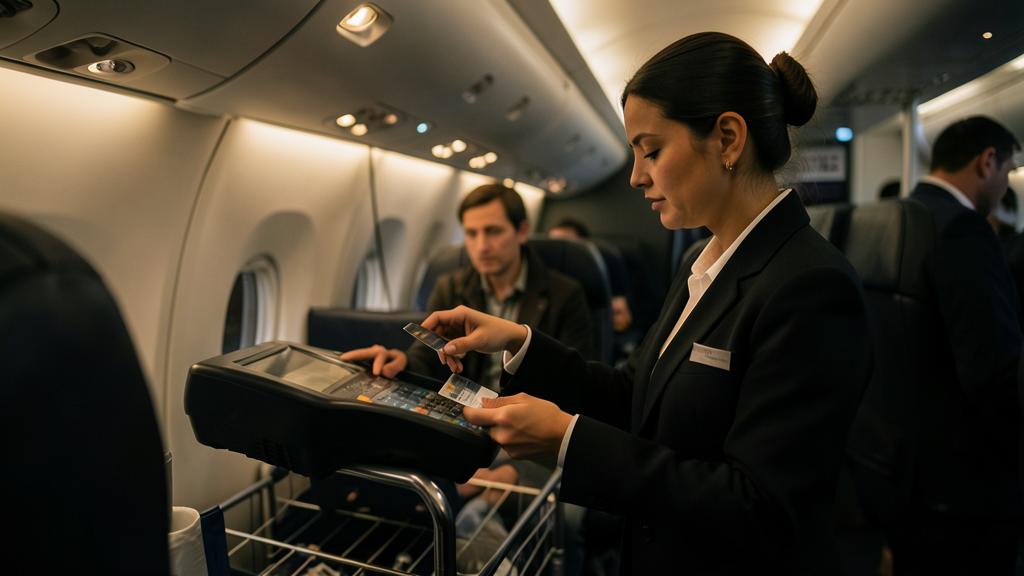
Onboard retail is the one part of the cabin service where the aircraft’s connectivity, or the lack of it, dictates the order in which rows are served. A terminal that cannot ask an issuer for permission changes three things at once: when the sale can happen, what a decline actually means, and how many separate reconciliations have to agree at the end of the flight. None of that is a payments problem. It is a service design problem that lands on the crew.
The trolley is not the constraint — the authorisation is
Offline payments change everything. Ask a cabin manager what limits the number of rows served per minute and the answer is usually the aisle, the trolley, or the galley. On a short sector with a full sales load, it is none of those. It is the seconds spent per transaction, and those seconds are set by what the terminal has to do before it can say yes.
A terminal with a live link to an acquirer runs a conversation: the card is read, a cryptogram is generated, the request goes up through whatever satellite or air-to-ground path the aircraft has, an issuer somewhere decides, and the answer comes back. On the ground that round trip is measured in a couple of seconds. In the air, over a shared and congested link, it is measured in whatever the link gives you that day — and the crew member is standing in the aisle for the duration, with the trolley blocking the row and the passenger watching a spinner.
A terminal with no link at all does none of that. It decides locally, in milliseconds, using rules loaded before departure. That is faster, and it is exactly why the offline mode survives on aircraft that could technically be connected: the fleet is mixed, the link is not guaranteed, and a service flow that only works when the satellite cooperates is not a service flow. It is a hope.
The consequence is worth stating plainly: the fastest configuration is the one in which nobody has checked whether the money exists.
Offline payments are faster because the terminal doesn’t wait for a bank’s approval. But this means the airline takes the risk if the payment fails later.
On a 90-minute flight with 150 passengers, an offline terminal processes 30 transactions per minute, while an online terminal may only handle 10 due to delays in satellite communication.
What « offline » actually means at the terminal
Offline acceptance is not a lawless mode. The chip card and the terminal between them carry enough machinery to make a defensible local decision, and understanding that machinery is what turns a crew member from a button-presser into someone who can explain a refusal.
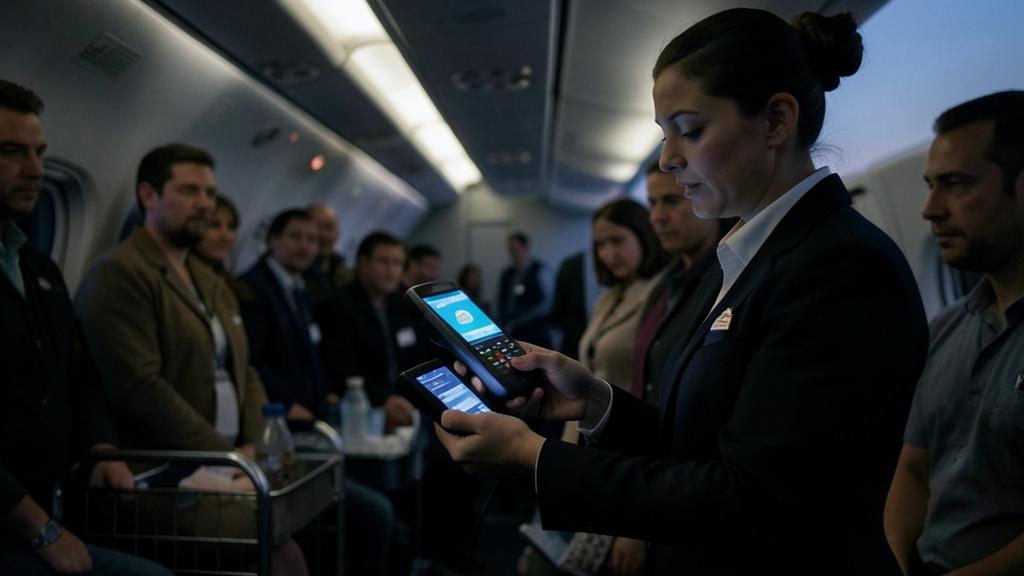
Three mechanisms do the work. The first is card authentication: the chip proves cryptographically that it is a genuine card issued by a real issuer, without anyone contacting that issuer. This is what makes offline acceptance possible at all, and why a keyed number or a stripe swipe is a fundamentally weaker transaction: there is nothing to verify.
The second is terminal risk management: a floor limit above which a transaction should not be approved locally, a random-selection element, and velocity checking. Velocity checking is the interesting one, because the counter lives in the card, not the terminal. The chip counts how many consecutive transactions it has approved without an issuer ever being consulted, and past a limit the issuer set, it asks to go online — which, here, it cannot. A card that has run several offline purchases without once being taken online can be refused for that reason alone, whatever the state of the account.
The third is the stop list, sometimes called a hot list or exception file, loaded onto the terminal before departure. It is a list of card numbers the acquirer already knows to be bad. It is only as current as the last synchronisation, which is why the terminal that was not docked overnight is a real operational item, not an IT detail.
When none of those trigger, the terminal approves and stores the transaction. The batch is submitted for authorisation later, on the ground, when the terminal reconnects. That deferral is the whole design, and it is where the risk sits.
| Configuration | Decision made by | Time at the seat | Who carries an unpaid sale |
|---|---|---|---|
| Live link, real-time authorisation | The card issuer, in flight | Link-dependent, and variable | The issuer, within the scheme rules |
| Offline with chip authentication, floor limits and stop list | The card and the terminal | Effectively instant | The operator, in most cases |
| Keyed number or stripe, no chip read | Nothing, in substance | Slow, and error-prone | The operator, almost always |
The trap. An offline approval is not a payment. It is a promise to try later. A crew that has been told « the terminal accepted it » will treat the sale as closed, and the passenger will be long gone by the time the batch is rejected on the ground. The commercial department knows this and prices it in; the crew is rarely told, and then cannot explain why the same card behaves differently on two consecutive flights.
Reading a decline in the aisle: four different messages
Four refusal types exist. The single most useful thing a cabin crew member can carry into the aisle is the knowledge that a decline is not one event. There are at least four, they have different causes, and only one of them says anything about the passenger’s bank balance — which, in offline mode, is precisely the one that cannot occur.
A stop-list hit means the acquirer already flagged that card. A velocity refusal means the chip has reached its own offline ceiling. A floor-limit refusal means the amount is above what the operator is willing to accept unverified. A read failure means the chip, the contactless antenna or the terminal is at fault. In offline mode there is no « insufficient funds », because nobody asked. Saying « your card was refused » therefore blends four unrelated situations into a sentence the passenger will hear as an accusation.
The service consequence is a scripted response, and it should be scripted: it happens standing up, in a narrow space, with an audience. The useful script separates the machine from the person: the terminal could not complete the transaction on this card, here is a second attempt, here is an alternative means of payment, and here is what happens if none of it works. What happens if none of it works is a policy decision the operator must have made in advance — release the goods against a voucher, or withdraw them. Leaving that decision to a crew member in an aisle guarantees inconsistency between crews and complaints that are impossible to arbitrate afterwards.
| Cause | What it means | Second attempt worth making? | What to say |
|---|---|---|---|
| Stop list | The card is already flagged by the acquirer | No, on the same card | Offer another card or another means of payment |
| Offline velocity limit reached | The chip’s own counter, unrelated to the account | No, on the same card | Say the card needs to connect to its bank, which it cannot do here |
| Above the floor limit | The amount exceeds what may be accepted unverified | Only if the sale can be legitimately split | Explain the ceiling, not the passenger |
| Read failure | Chip, antenna or terminal fault | Yes — re-seat the card, try contact instead of contactless | Attribute it to the equipment, because it is the equipment |
The order of service an offline terminal imposes
Service flow changes. Once the payment is understood as the slow step, the service sequence follows almost mechanically, and it is not the sequence most cabins run by habit.
Anything free should be distributed before anything sold: it moves fast, it establishes contact with every row, and it keeps the sales pass from carrying two rhythms at once. Pre-ordered and pre-paid items belong on their own pass, because they carry no transaction at all and are limited only by walking speed. Then the paid pass, which stops at every row that wants something.
Within the paid pass, the practical lever is the position of the terminal relative to the trolley. One terminal shared between two crew members turns the trolley into a queue with one server. Two terminals, each bound to a named seller identity, roughly double the throughput and — more importantly — make the end-of-flight reconciliation attributable. A single shared identity produces a sales log that nobody can be asked about.
The other lever is the order in the aisle. Taking the payment first and handing the goods after is slower for the individual passenger but faster for the cabin, because the crew member is never holding hot liquid while a terminal thinks. It is also the configuration in which a refusal has not yet been converted into a service recovery problem.
The right reflex. On a short sector, count backwards from the cabin-secure call rather than forwards from the seatbelt sign. Decide how many rows the sales pass can realistically finish, and start the pass at the row that guarantees the cabin ends up served evenly rather than the front two-thirds served and the rear apologised to. The rear of the cabin is where the same rows are cut off flight after flight, and it shows up in the satisfaction data long before anyone connects it to the terminal.
Turbulence, sterile phases and the transaction left open
Interrupted sales are tricky. An offline terminal holds an in-progress transaction in a state that is neither cancelled nor completed. A turbulence call that interrupts the trolley mid-sale leaves that state hanging, and what happens next depends on the terminal’s timeout, the crew member’s memory, and whether the goods have already changed hands.
The rule that survives contact with reality is simple: an interrupted transaction is a cancelled transaction. Restart it from zero when service resumes. The alternative — trying to recover a half-finished sale twenty minutes later, from memory, with the trolley now three rows further back — produces double charges, and a double charge on an offline batch is discovered by the passenger’s bank statement rather than by the airline.
The same applies to the descent. Terminals have to be stowed and secured like everything else, and a sale accepted at the last moment before cabin secure is a sale whose receipt was never handed over. Operators that treat the terminal as a piece of cabin equipment with a stowage position and a securing check have fewer disputes than those that treat it as a handbag item.
Closing the accounts: three reconciliations, not one
Three reconciliations exist. « Closing the flight » sounds like a single act. It is three separate agreements that have to hold, and confusing them is the reason bar shortages take weeks to investigate.
The first is stock against sales: what left the galley must equal what was sold plus what came back. The second is money against sales: cash counted plus card transactions recorded must equal the value of what was sold. The third — the one only offline environments have — is card transactions recorded against card transactions ultimately authorised. That third reconciliation happens on the ground, hours or days later, and is invisible to the crew unless someone deliberately reports it back.
That feedback loop matters more than it looks. A crew that never learns how many of its offline approvals were eventually rejected has no reason to take the floor limit seriously. A crew that sees the figure, aggregated and without blame attached to individuals, understands instantly why the limit exists.
| Reconciliation | Compares | Closed when | Normally visible to the crew? |
|---|---|---|---|
| Stock | Loaded goods against sold plus returned | Before handover | Yes |
| Value | Cash plus recorded card sales against sales value | Before handover | Yes |
| Settlement | Recorded card sales against sales actually authorised | Days later, on the ground | Rarely, and it should be |
Cash still exists, and it is the harder half
Cash handling is complex. Card-only cabins get most of the attention because they are the direction of travel, but a large share of the world’s onboard retail still takes cash, often in more than one currency, and cash has none of the offline terminal’s saving graces.
Cash cannot be declined, which removes one problem, and it cannot be traced, which creates several. It needs a float in the denominations nobody plans for. It needs a rate card, and a rate card that is not refreshed becomes a slow commercial loss or a passenger dispute depending on which way the currency moved. Running out of coins mid-cabin is a service failure that no goodwill repairs.
It also needs a chain of custody. Wherever a bag of mixed currency passes between named individuals, an unrecorded handover turns any later discrepancy into something nobody can be held to. Crews resent counting procedures until the first time a shortage is investigated and the record is what protects them.
Where card data must never go
Data security is critical. One rule has no operational nuance and no local variation: card numbers are never written down, never photographed, never repeated aloud, and never stored anywhere but inside the terminal. The old carbon imprinter is gone for a reason. A crew member who copies a number onto a service form to « process it later » has created a data breach, and the fact that the intention was helpful changes nothing about the consequences for the operator.
The corollary is that manual key entry, where a terminal still allows it, produces the weakest possible acceptance — no chip authentication, no cardholder verification — and is the configuration in which the operator carries the entire loss.
What training usually misses
Training gaps exist. Onboard sales training tends to be built around the product catalogue and the terminal’s button sequence. Both are learnable in an hour and neither is where the difficulty is.
The difficulty is in the three things nobody drills: explaining a refusal to someone who has just been embarrassed in front of their row; deciding, correctly and identically to every other crew member, what happens when no payment works; and understanding why the answer to « can I just take it and pay online later? » is no. Those are conversations, not procedures, and they are best rehearsed the way any awkward conversation is rehearsed — out loud, with a colleague playing the difficult version of the passenger.
The second gap is the fleet. When some tails are connected and some are not, the same crew member runs two different services in the same week, and nothing on the terminal tells them which one they are in. Making the mode visible — on the terminal, in the briefing, on the loading paperwork — costs nothing and removes an entire class of confusion. Crews comparing notes on the FL330 forums describe the same pattern across very different operators: the procedure is fine, the ambiguity about which procedure applies today is what breaks it.


Leave a Reply
You must be logged in to post a comment.