
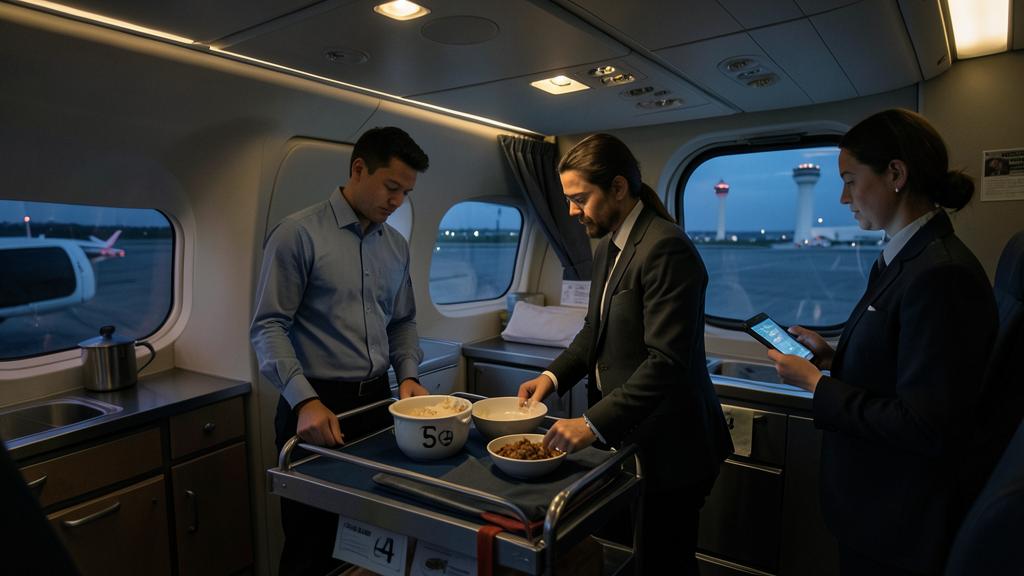
Between the moment a passenger selects a special meal on a booking screen and the moment a cart is winched into a rear galley, the request changes hands at least four times and crosses three or four separate information systems. Each handover has its own cut-off, its own message format and its own owner, and each one can drop the request silently. When the tray is not there, the cabin has minutes to establish which link failed, because the answer determines what can honestly be offered instead — and because a substitution that is fine for one code is unacceptable for another.
Four handovers, and four ways to lose a tray
The chain is worth walking through once in the order it actually runs, because the vocabulary used at each stage is the vocabulary you will need on the interphone.
It starts in the reservation. A special meal is a special service request attached to the booking record, carrying a four-letter code and a status. That status matters enormously and is almost never visible to the cabin: a request that has been entered but not yet confirmed by the carrier is not the same thing as a confirmed one, and only the confirmed one has any chance of producing food.
From reservation, the request travels to departure control in the passenger list messages that build and then update the flight’s passenger data. In parallel, the catering order goes to the supplier: an initial count some days out, then a firm figure at a cut-off, then in most operations a final adjustment closer to departure. The cut-off is a commercial decision by the carrier, commonly around a day before departure and often longer for meals prepared by an outside supplier, and it is among the most common reasons a genuinely requested meal never existed as an object.
The supplier then produces, labels and loads. Labels normally carry the code, the passenger name and a seat number. The load is placed according to a loading instruction that says which cart, which galley and which position. The unit is delivered to the aircraft, checked against a delivery document, and that document is signed on board. Only after all of that does the meal become the cabin’s problem — or, more accurately, only then does the cabin get the first opportunity to notice it is missing.
The special meal request goes through multiple steps, and each step can fail. If the meal isn’t there, the cabin must quickly find out where the process broke down to offer the right solution.
What the code actually promises
The four-letter codes are an industry standard, but what a carrier delivers against each one is not. Knowing the difference between codes that describe a preference, codes that describe an observance and codes that describe a medical constraint is what allows you to build an honest recovery rather than an improvised one.
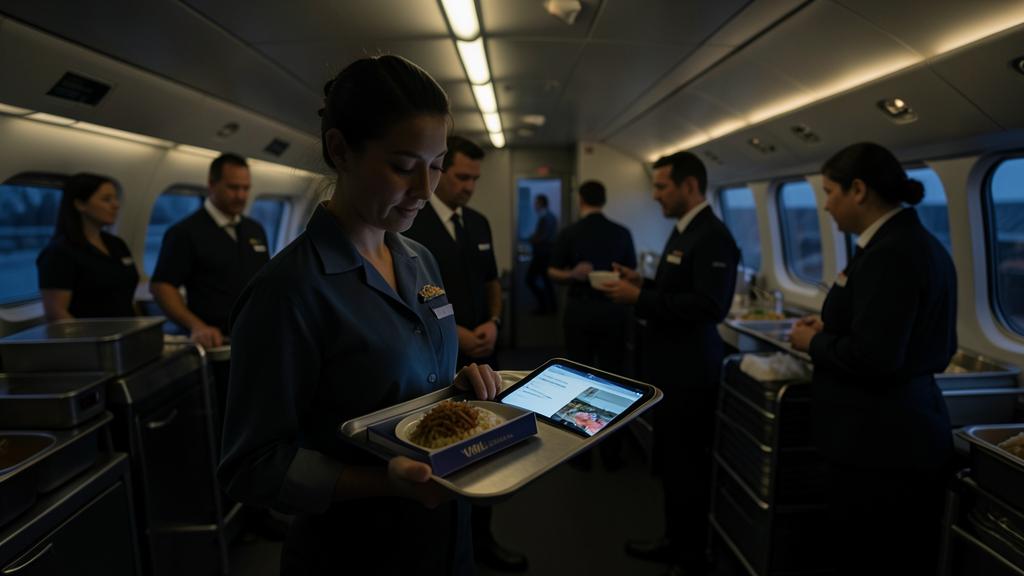
| Code | What it designates | Nature of the requirement | Can it be improvised on board? |
|---|---|---|---|
| VGML | Vegetarian, no animal product at all | Ethical or dietary | Yes, if every component is verified from its own label |
| VLML | Vegetarian, dairy and egg permitted | Ethical or dietary | Yes, with the same verification |
| AVML | Indian-style vegetarian | Cultural and dietary | Partly; the diet can be met, the expectation less easily |
| HNML | Non-vegetarian Indian, no beef | Observance | Only within strict limits |
| MOML | Prepared to halal requirements | Observance, tied to preparation | No; preparation cannot be reconstructed on board |
| KSML | Prepared to kosher requirements, sealed | Observance, tied to preparation and to the seal | No; an unsealed substitute is not a substitute |
| GFML | Prepared without gluten-containing cereals | Medical | Only from verified labelled items |
| DBML | Controlled carbohydrate content | Medical | Partly, with informed passenger choice |
| NLML | Low in lactose, or lactose-free depending on the carrier | Medical | Only from verified labelled items |
| BLML | Low-irritant, for digestive conditions | Medical | Partly |
| CHML | Portioned and presented for a child | Practical | Yes, and usually well |
| BBML | Infant food | Practical, sometimes critical | Rarely; depends entirely on what is loaded |
The fourth column is the one to internalise, because it converts a service failure into a decision. For a preference code, you have something real to offer. For an observance code, the honest answer is that the specific requirement cannot be met and the passenger should be told so plainly and early. For a medical code, the answer is governed by what can be read off a label, not by what looks safe.
The trap. Offering a plated main course « without the sauce » to a passenger with a gluten or lactose requirement. Nobody on board knows what is in the sauce, the roux, the marinade or the stock, and removing a visible component does not remove a hidden ingredient. If it cannot be read from a label, it cannot be promised.
On a domestic A320 flight, a passenger with a GFML (gluten-free) request is given a regular meal with the sauce removed. The passenger later discovers the sauce contained wheat, causing a reaction. The crew had no way to verify the sauce’s ingredients, making the substitution unsafe.
Where the chain breaks, and what each break looks like from the cabin
Almost every missing special meal fits one of a small number of patterns. Recognising the pattern in the first two minutes is what makes the search efficient and the explanation credible.
| Where it fails | What happened | How it presents on board | Evidence to capture |
|---|---|---|---|
| Booking | Requested after the catering cut-off | Nothing loaded, and nothing on the loading paperwork either | Passenger states when they requested it |
| Booking | Requested but never confirmed by the carrier | Same as above; passenger is certain they asked | Booking reference, and the status if the crew can see it |
| Rebooking | Passenger re-accommodated from another flight; the request did not follow | Passenger holds a boarding pass reissued the same day | Original flight number and the reissue |
| Aircraft change | Catering ordered for a different galley configuration or delivered to the wrong stand | Meals present but positions do not match the loading instruction | Registration, and the discrepancy against the loading plan |
| Supplier | Short-shipped, or an outside-supplied sealed meal delivered late | A note or a gap on the catering delivery document | The document itself, and whether the shortfall was annotated before signature |
| Loading | Loaded in a different cart, galley or oven position | The meal is on board and nobody has found it yet | Where it was eventually found |
| Labelling | Seat number on the label no longer matches; passenger was reseated at check-in | A tray with a code and a name that nobody claims | The label as printed against the actual seat |
| Service | Delivered to the wrong passenger earlier in the service | The tray existed and is gone | Which row it went to |
Two of those rows are worth pausing on. Re-accommodation is the most under-appreciated failure in the whole chain: when a passenger is moved from a cancelled or delayed flight, service requests do not always carry across, and the passenger has no way of knowing that. Everything they experienced told them the request was in place. And the seat-number mismatch is the reason a good search does not stop at the seat map — a tray labelled for seat 34C, with a passenger who was moved to 41H at the gate, is present, correct and unclaimed while a crew member is telling a passenger it was never loaded.
The search before the apology
The order matters. Apologising first and searching afterwards produces two conversations instead of one, and the second is worse than the first. Establish the facts, then speak.
- Read the catering paperwork. The delivery document and the loading instruction between them say what was ordered and where it should be. If the shortfall was annotated on delivery, you already know the answer and it is not a search problem.
- Search every galley, not the one the plan names. Special meals are small, individually wrapped and easily placed in the wrong cart. Check the other end of the cabin before concluding anything.
- Check the dry stores and the non-obvious stowages. Sealed outside-supplied meals in particular are often stowed apart from the main carts, precisely because they must not be opened.
- Match by name and code, not by seat. Then reconcile against the actual seat allocation, which may have changed after the labels were printed.
- Confirm what the passenger actually needs. Ask directly whether the requirement is medical, religious or preference. The code is a proxy; the passenger is the source. This one question changes what you may offer.
Five steps, and in practice under ten minutes on a narrow-body. Doing them before the service starts, rather than when a tray fails to arrive at a specific seat, is the single largest improvement available — and it is entirely within the cabin’s control.
The right reflex. Reconcile special meals against the loading paperwork during boarding, before the doors close. A shortfall found before departure can sometimes still be fixed by the caterer; the same shortfall found at top of climb can only be managed.
Triage: observance, medical need, preference
Once you know which of the three you are dealing with, the response almost writes itself.
| Nature | What is acceptable | What is not | What to say |
|---|---|---|---|
| Religious observance | Another sealed meal of the same certification, if one is on board; otherwise verified items that raise no question | An improvised plate, or a substitute described as « close enough » | That the specific requirement cannot be met on this flight, said early and without hedging |
| Medical constraint or allergy | Items whose full ingredient list can be read on board, chosen with the passenger | Anything unlabelled, and any assurance about a component you cannot verify | What you can read from labels, and what you cannot vouch for |
| Dietary preference | An assembled alternative built from the standard load | Nothing served at all, on the grounds that the correct meal is absent | What the alternative consists of, before you bring it |
| Infant or child | Whatever the load genuinely contains; hot water and assistance | Improvising infant nutrition | Exactly what is available, immediately, so a parent can plan |
One additional practical point on allergies. Carriers differ widely in what they undertake — some make cabin announcements, some create buffer rows, some accept a passenger’s own food, some do none of these — and none of them can guarantee an allergen-free cabin. The correct answer is your own operator’s procedure, said as your operator’s procedure, not a personal interpretation of what is safe.
Building the recovery
A recovery is not a tray. It is three things delivered in order: an early acknowledgement, an honest inventory, and a choice given to the passenger.
Early acknowledgement. Go to the passenger before the service begins. The failure is far easier to accept when it arrives as information than when it arrives as an absence. It also converts the passenger from a person who was forgotten into a person who is being dealt with, which is most of the emotional distance you are trying to close.
Honest inventory. Say what is genuinely on board and relevant: the labelled items, the sealed snacks, bread, fruit, whatever the load actually contains. Do not construct an offer you cannot deliver, and do not describe an alternative in flattering terms — the passenger will see it.
The choice. Let the passenger decide from the inventory. A person with a dietary constraint has usually managed it for years and knows better than the crew what works. Removing that decision, however well intentioned, is the part that people describe afterwards as having been treated as a nuisance.
Two things to handle carefully. A meal from another cabin may be available and may be exactly right, but whether it can be offered is an operator policy question, not a crew judgement — ask. And crew meals are not a free resource: quite apart from leaving a colleague unfed for the remainder of a long duty, many operators require the operating pilots to eat different meals precisely so that a single contaminated batch cannot affect both. Taking a flight deck meal to solve a cabin problem can defeat a deliberate safety provision. Ask before you touch it.
Writing it down so it stops happening
The report is not administrative overhead. It is the only mechanism that distinguishes the failure modes, and the causes listed in the table above demand completely different corrections — a cut-off policy change, a rebooking process fix, a supplier performance conversation, or a loading instruction correction. A report that says « SPML missing » supports none of them.
A usable entry contains: flight, date and registration; the code and the passenger’s booking reference; whether the meal appeared on the loading documentation; whether the delivery document was annotated; where the search looked and what it found; and what was served instead. Six lines. That is enough for the catering performance analysis to attribute the failure correctly, and enough for customer relations to answer the passenger’s letter without writing back to ask the crew what happened.
It is also worth logging the meals that were loaded but not found until late, because they are invisible in every other data source. They look like a supplier failure in the statistics and are in fact a loading or labelling failure, and they are the cheapest of all to fix.
What you can and cannot promise
Passengers frequently ask, in the moment, what they are entitled to. The honest answer is more limited than they expect, and giving it accurately protects both the passenger and the crew member.
A missing special meal is not covered by European passenger rights legislation on denied boarding, cancellation and long delay: that instrument addresses disruption to the journey, and food appears in it only as care during a delay. Nor is it a matter for the international conventions on carrier liability, which deal with death and injury, baggage and delay. What governs it is the carrier’s own conditions of carriage and its commercial policy. That means the remedy is a company decision, and it is not the cabin’s to grant.
So the correct form of words is procedural rather than generous: the failure will be reported, here is the reference, and customer relations will respond. Promising compensation you cannot authorise creates a second failure that lands on a colleague weeks later, and it is remembered more sharply than the missing meal was. Practitioner discussion of how different operators handle these cases can be found on the FL330 forums.
The underlying professional point is simple. The passenger did not lose a meal; they lost confidence that a commitment made at booking would be honoured. What restores it is not the substitute plate. It is being told early, being told accurately, and being given a choice — which the cabin can supply on every flight, including the ones where nothing edible for that passenger was ever loaded.


Leave a Reply
You must be logged in to post a comment.