
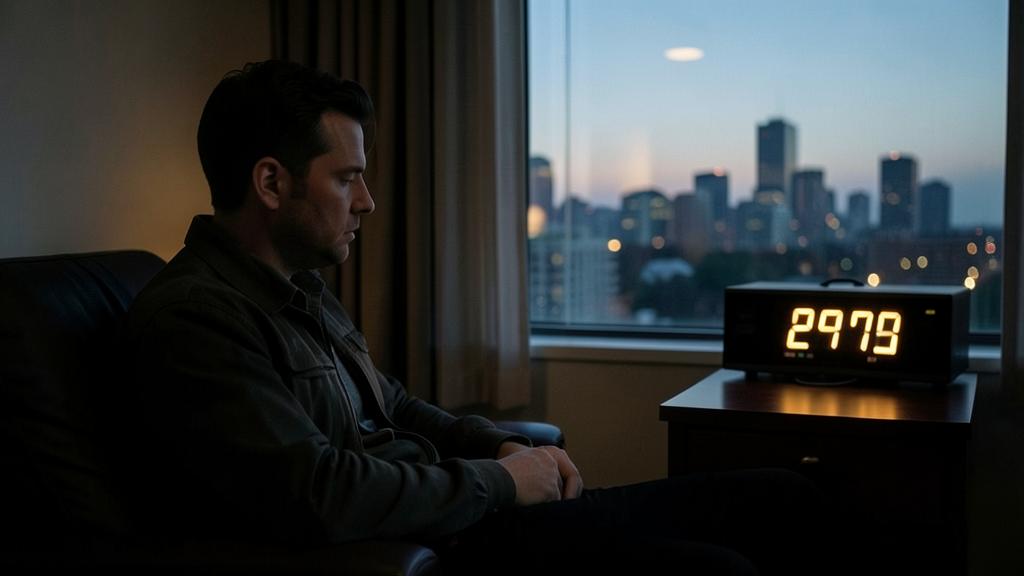
A rest period is a legal quantity: so many hours, in a suitable place, with a sleep opportunity. Whether any sleep actually happens inside it is a biological question, and biology answers to the body clock rather than to the roster. On a single transmeridian rotation the two usually agree. Over a run of them they come apart, and the crew member who has not decided in advance which clock to live by ends up living by neither. This is what the choice really consists of, and which strategy survives repetition.
Two different meanings of the word acclimatised
European flight time limitations use acclimatised as a defined term with a precise consequence. A crew member is treated as acclimatised to a particular time zone band, and that band determines where the window of circadian low sits for the purpose of calculating the maximum flight duty period. The window of circadian low itself is fixed by the rules at the period between two and six in the morning, expressed in the time zone to which the crew member is acclimatised — not in local time at the departure aerodrome, and not in the crew member’s own subjective time.
The rules also provide for the case where the answer is unknown. Above a certain combination of time difference and elapsed time since reporting, a crew member is no longer deemed acclimatised to anywhere in particular, and a reduced set of maximum duty values applies instead. The scheme is deliberately conservative: it does not try to model the individual, it simply stops claiming to know.
Physiology means something narrower by the same word. The circadian system is entrained by light and re-entrains slowly. The commonly quoted approximation is on the order of one time zone per day when travelling eastward and somewhat faster westward, with wide individual variation. That rate is the whole problem. A rotation that crosses six or eight zones and turns round inside two days does not give the clock enough time to move, whatever the roster says about rest.
Your body clock adjusts to time zones slowly, and rules assume you’re either fully adjusted or not at all. If you’re in between, the rules don’t help much.
A crew flying from London to Tokyo (9 hours east) with a 2-day layover will struggle to fully adjust their body clock to local time, leaving them in a “no-man’s-land” between time zones.
Why the clock moves slower than the aeroplane
The internal day is a set of rhythms — core body temperature, cortisol, melatonin, alertness, digestion — normally locked together and locked to the light-dark cycle. A time zone shift breaks the lock with the outside world first, and then the rhythms drift apart at different speeds. That intermediate state is where most of the symptoms live: waking at three in the morning fully alert, and feeling flat in the middle of the local afternoon.
Two structural facts follow. Eastward travel requires the clock to advance, the harder direction, because the free-running human period is slightly longer than twenty-four hours; delaying is easier than advancing. And the difficulty does not scale smoothly: beyond roughly half the day, an eastward shift can sometimes be achieved more easily by letting the clock delay through the remaining hours instead. None of that is under the crew member’s control. What is under control is the target — whether to try to move the clock at all.
The two strategies, and the question that chooses between them
There are only two coherent plans for a layover, and the failure mode is trying both. The first is to stay anchored to home base time and treat the destination as a place you happen to be standing in. The second is to shift deliberately to local time and pay the adaptation cost up front. Everything else is drift, and drift produces the worst of both.
The question that selects between them is not the size of the time difference. It is the length of the layover relative to the time the clock would need. The common recommendation in operational fatigue guidance is that short layovers should be flown anchored to base time and long layovers should be adapted to local time, with the crossover commonly placed somewhere around two to three days. The exact figure varies between sources and between individuals; the principle does not.
| Stay on base time | Shift to local time | |
|---|---|---|
| Suits | Short layovers, quick turnarounds, a return duty that falls in base-time daylight | Long layovers, several local nights available, a return duty in local daytime |
| What you do on arrival | Sleep on base-time night regardless of local time; blackout the room; ignore local meals | Seek daylight at the right end of the local day; eat on local time; resist the early nap |
| What it costs | Sleeping in local daytime, in noise and light; social isolation; no local daylight | Two or three degraded days; a clock that then has to come back at home |
| What it protects | The window of circadian low stays where the roster expects it; return duty is flown near your own biological day | Sleep quality and quantity during a long stay; alertness at destination |
| Fails when | The layover stretches and nobody re-plans | The rotation ends before adaptation completes, so you fly home on a clock aligned with nowhere |
Under repetition, the asymmetry sharpens. A crew member flying a series of short transmeridian rotations with brief layovers is far better served by defending a single stable anchor than by attempting a partial shift on each trip. Each partial shift leaves the clock somewhere between two zones, and the next rotation starts from that intermediate position rather than from a known one. Over a month the anchor holds; the partial shifts accumulate into a clock that is aligned with no schedule at all.
Light is the lever; everything else is a nudge
Light is the dominant time cue, and its effect depends entirely on when it arrives relative to the internal night. Light received in the hours before the core body temperature minimum — roughly late in the subjective evening and the first part of the subjective night — delays the clock. Light received after that minimum, in the subjective early morning, advances it. The temperature minimum itself sits a couple of hours before habitual wake time, so it moves with the person and with the shift already achieved.
That gives a rule with a warning attached. Getting the timing right accelerates adaptation; getting it wrong actively pushes the clock the wrong way, which is why the instinctive behaviour on arrival — walking out into the daylight because it is daytime — sometimes makes an eastward adaptation worse.
| Goal | Seek light | Avoid light | Common mistake |
|---|---|---|---|
| Delay the clock (typically westward) | Late in your subjective day, before your internal night begins | Your subjective early morning | Sleeping through the local evening and losing the delaying light |
| Advance the clock (typically eastward) | Your subjective morning, after the temperature minimum | Your subjective late evening and first part of the night | Bright daylight on arrival that lands before the minimum and delays instead |
| Hold the clock still (anchoring) | At your usual base-time morning, artificial light if necessary | Any strong light during your base-time night | Treating the room as somewhere to be rather than a light-controlled space |
The practical implications are unglamorous: a room that can be made genuinely dark, a sealing eye mask, ear protection, and a screen policy for the hour before sleep. On a layover, the hotel room is not accommodation — it is the only instrument the crew member controls.
Sleep you can actually get
Consolidated sleep at the wrong circadian phase is difficult, and the honest plan accepts that and builds around it rather than hoping. Three patterns do most of the work.
- Anchor sleep. A block of several hours placed at the same clock time every day of the rotation, whichever zone you are in, with the remainder of the sleep taken opportunistically. The fixed block gives the circadian system something stable to hold on to and limits the drift that repetition otherwise produces.
- Split sleep. Two shorter periods rather than one long one. Total sleep obtained across a split is often greater than what a single badly-timed block yields, even though each piece is shorter.
- Prophylactic napping. Sleep taken before a duty rather than in response to fatigue during it. A short nap, kept well under half an hour, generally avoids waking out of deep sleep. A longer nap yields more recovery but carries a period of sleep inertia afterwards, which has to be planned around rather than discovered on the flight deck.
In-flight rest belongs to the same family. Where an augmented crew and a rest facility are available, the extension of the flight duty period that they permit is granted against the quality of the facility, and the classes are graded accordingly, from a flat bunk in a separate compartment down to a seat in the cabin with a defined minimum recline. The rest is worth what the facility is worth, and the rules price it that way.
The right habit. Decide the anchoring strategy before the rotation starts, write down the intended sleep blocks in base time and in local time side by side, and treat that plan as part of the flight preparation. A plan made in the hotel lobby after twelve hours of duty is made by the most fatigued version of yourself.
The chemistry that helps and the chemistry that lies
Caffeine is a genuine countermeasure with a specific profile. Its effect builds over roughly half an hour and its elimination half-life is commonly quoted at around five hours, with substantial individual variation. That number is the whole planning rule: a dose taken to cover the end of a duty is still measurably present at the start of the sleep period that follows, and it degrades that sleep even when the person falls asleep easily. Placing caffeine deliberately — early in the duty, and not in the final hours — buys alertness without borrowing from the recovery.
Alcohol is the mirror image. It shortens sleep onset and then fragments the second half of the night, suppressing the rapid-eye-movement sleep that recovery depends on. It is a very effective way to sleep badly for eight hours and believe you slept.
Melatonin sits in a different category again. Its regulatory status varies widely between states, from prescription medicine to over-the-counter supplement, its use is a matter for the aeromedical examiner and for the operator’s policy rather than for a colleague’s advice, and its effect depends heavily on the timing of the dose. It is not a sleeping tablet and it is not a substitute for light management. Any medication question in this area belongs with an aeromedical examiner, not with a crew room recommendation.
What the rest period gives you, and what it does not
The European scheme sets minimum rest away from home base at not less than the length of the preceding duty period, or a fixed minimum, whichever is greater, and requires that the crew member be given an opportunity for a defined period of sleep, with travelling time and other physiological needs accounted for. Minimum rest at home base is longer. These are floors, and they are floors expressed in hours.
An hours-based floor cannot tell you where the hours fall. Ten hours straddling the local afternoon, at a phase where the circadian system is actively promoting wakefulness, yield less sleep than a shorter period placed at the right phase. That gap between the legal quantity and the biological yield is precisely the space that a fatigue risk management process is meant to occupy, and it is why the same roster can be compliant and unsound at the same time.
| Fixed by the rule | Left to the plan |
|---|---|
| Minimum duration of the rest period | Where in the circadian day it falls |
| Suitable accommodation and a sleep opportunity | Whether the room can be darkened and quietened |
| The two-to-six window of circadian low, in the acclimatised zone | Which zone the crew member is actually adapted to |
| Reduced maxima in an unknown acclimatisation state | The anchoring strategy that produced that state |
| Cumulative duty and rest limits over the month and the year | The pattern of directions flown inside them |
Planning a rotation instead of a night
The single change that most improves outcomes over repeated transmeridian flying is to move the planning unit from the night to the rotation. Before departure, three things are decided: the anchor, the sleep blocks, and the recovery on return. The anchor is base time or local time, chosen from the layover length. The sleep blocks are written in both time references so that neither is lost. The recovery is a deliberate re-entrainment at home, because the return leg is also a time zone crossing and it is the one crews most often treat as free.
Direction matters in the sequencing too. Where a bidding system offers a choice, keeping successive rotations in the same direction is generally kinder than alternating. Where it does not, the anchoring strategy has to absorb the alternation — another argument for defending base time over short trips.
What the operator owes and what the crew member owes
The division is clear once stated. The operator owes rosters built with the circadian consequences considered rather than merely the arithmetic; accommodation genuinely capable of supporting sleep in daylight; a fatigue reporting route that costs the reporter nothing; and a fatigue risk management process that collects real data — sleep records and validated subjective scales — instead of relying on a bio-mathematical model alone. Those models predict group averages and are useful; they do not measure anybody.
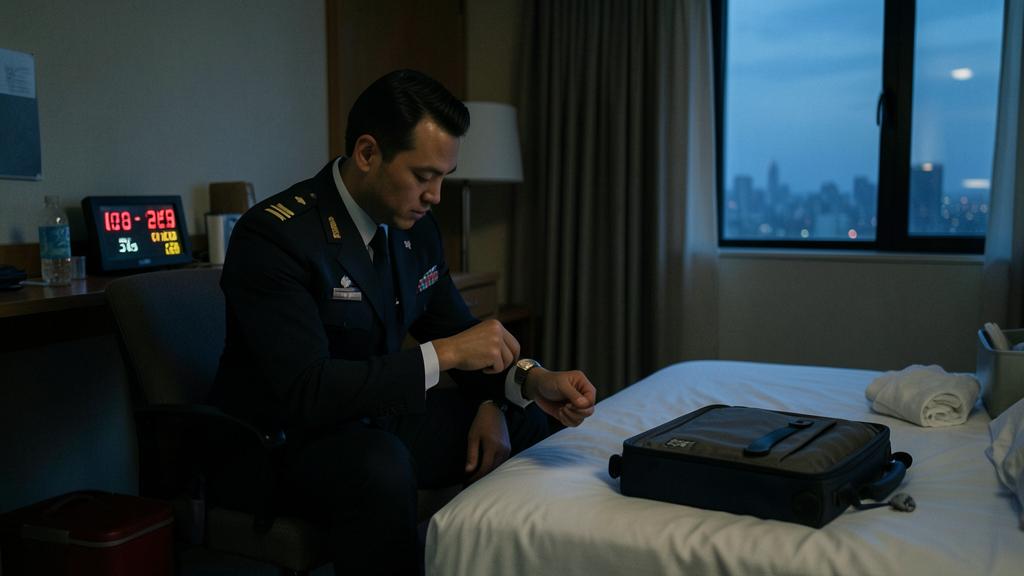
The crew member owes the use of the rest period for rest, an honest declaration when the result is inadequate, and the discipline of an anchoring plan made in advance. Fatigue reporting is the mechanism by which the gap between the legal quantity and the biological yield becomes visible to the people who build the roster; a rotation that is quietly unsurvivable and never reported is, from the planning department’s point of view, a rotation that works. Crews comparing how different operators handle transmeridian patterns will find the discussion running in the crew forums at FL330 forums.
The trap. Treating a compliant rest period as a sufficient one. The rules fix a duration and a place; they cannot fix a phase. A rest period that falls at the wrong point in your circadian day is legal and will still leave you short, and the only person in a position to notice in advance is you.


Leave a Reply
You must be logged in to post a comment.