
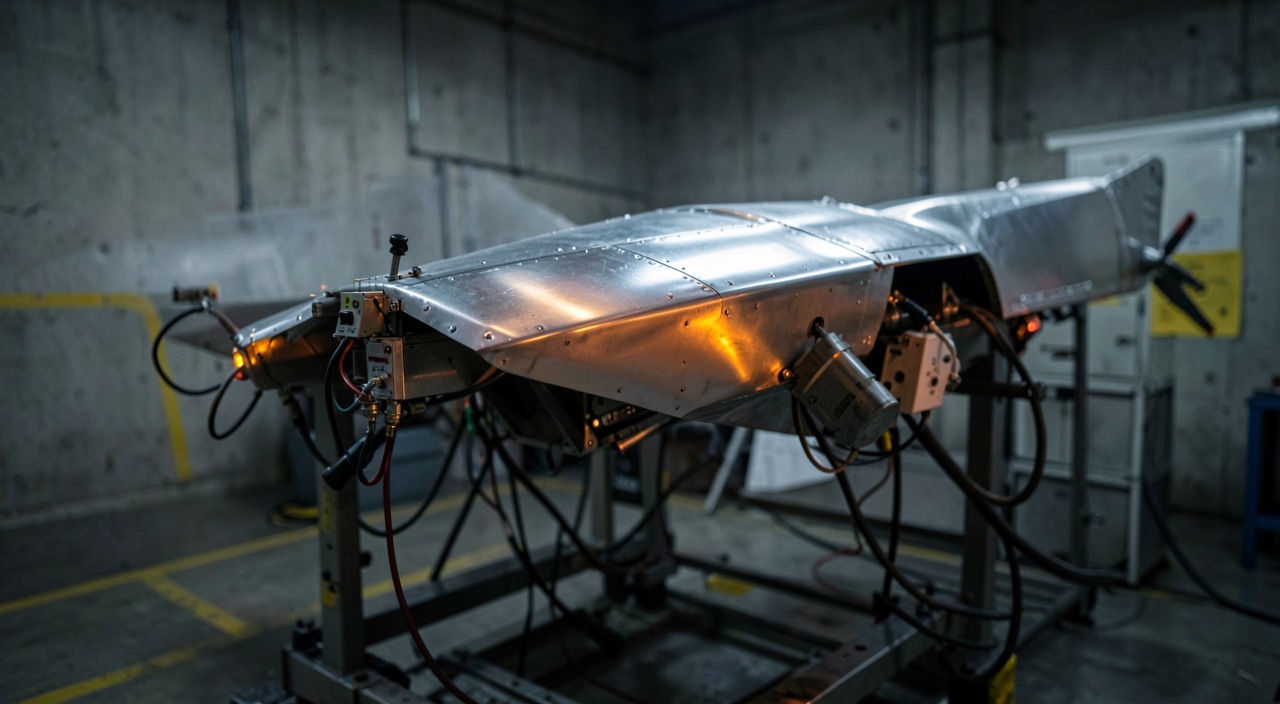
At the booth, everything works: the calculator responds, the mockup comes to life, the business engineer mentions an imminent entry into service. A few years later, the fleet is still unmodified — and no one lied. Between a demonstrator displayed at a show and the first executable work card online lies a path that the exhibition aisle does not reveal: modification classification, approval pathway selection, equipment qualification, airworthiness maintenance instructions, and workshop industrialization. Following this path step by step allows determining where the time actually goes — and knowing what to ask an exhibitor to seriously date a schedule.
What a demonstrator demonstrates — and what it conceals
A trade show demonstrator proves one thing and one thing only: the function exists. The sensor measures, the actuator moves, the interface displays. This is already considerable — years of research are condensed in this showcase — but the proof is rendered under conditions chosen by the presenter: hall temperature, clean electrical power, repeated scenario, operator who knows the manipulation by heart. On the technology readiness scale, the steps that matter — the representative environment, then the operational environment — remain ahead.
What the demonstrator conceals is precisely what the certification file must state. The full environmental domain: extreme temperatures, vibrations, power variations, electromagnetic compatibility, humidity, or icing depending on the installation zone. Failure cases: not what the system does when it works, but what the aircraft does when the system fails. Traceability: each requirement linked to evidence, each test tied to an identified configuration. And the longevity of the evidence: airworthiness maintenance instructions, change management, and production deviation handling.
A demonstrator shows that a technology works in perfect conditions, but certification requires proving it works in all real-world scenarios, including extreme weather, power failures, and system malfunctions. It also needs detailed documentation showing how every requirement is met.
An aircraft manufacturer might showcase a new ice detection system at a trade show, working perfectly in a controlled lab environment. However, to certify it, they must prove it functions correctly at -40°C, during turbulence, and when power fluctuates—conditions a demonstrator never tests.
| Dimension | Trade show demonstrator | Certified retrofit |
|---|---|---|
| Objective | Convince: show the function | Prove compliance with a certification baseline |
| Environment | Conditions chosen by the exhibitor | Full domain: temperature, vibrations, electrical disturbances |
| Hardware | Off-the-shelf components, one-off prototype | Frozen definition, qualified equipment |
| Software | Demo code, freely iterated | Assurance level linked to the severity of possible failures |
| Traceability | Optional | Each requirement linked to evidence, each test to a configuration |
| After failure | The demonstration is restarted | Failure cases analyzed, documented, covered by procedure |
- Hardware components used in a demonstrator often fail environmental tests and must be replaced with qualified versions.
- Demo software is rewritten to meet strict safety standards, as it must handle real-world failures.
- Certification is a second development phase, not just a finishing touch, and often takes longer than the initial prototype.
The hardware itself rarely survives the transition. The off-the-shelf components that sufficed for the prototype do not pass environmental qualification; the demo software, written to converge quickly, does not meet the development assurance objectives associated with the severity of failures it can cause. The certifiable upgrade is not a finishing touch: it’s a second development, conducted under different constraints than the first, and often longer.
The approval pathway is chosen before the schedule
Before any costing, a question structures the rest: who carries the modification, and by what pathway? The first fork is the classification. A modification with no appreciable effect on masses, center of gravity, structural strength, reliability, or operational characteristics may be classified as minor and follow a streamlined procedure. Anything affecting a system with a potential safety impact falls into the major category — and this is the case for almost all technologies that merit a booth.

The second fork identifies the carrier. If the type certificate holder integrates the technology, it treats it as a major modification to its own file: it has access to design data, models, and test means. If a third party carries it, it aims for a supplemental type certificate: it must establish compliance within its scope without the manufacturer’s file, thus reconstructing the interface data it needs — identification tests, aircraft measurements, framed analysis of the existing. This is one of the most underestimated items in the schedule.
| Criterion | Type certificate holder | Supplemental type certificate |
|---|---|---|
| Design data | Full access to the type file | Interfaces to be reconstructed by tests and measurements |
| Certification baseline | That of the type, supplemented if needed | Defined for the modification scope |
| In-service documentation | Integrated into the manufacturer’s line | Second documentary line, maintained by the holder |
| Interest for the operator | Documentary continuity over the aircraft’s life | Open competition, often more reactive on a given fleet |
For the operator, the choice is not neutral. A supplemental certificate opens competition and can be faster on a given fleet; it creates in return a second documentary line — flight manual supplements, airworthiness maintenance instructions, in-service monitoring — to reconcile with the manufacturer’s line throughout the aircraft’s life.
The proof of compliance: where the schedule goes
The certification program describes what will be proven and how: calculation, test, similarity with an already approved definition, design review. Each requirement of the certification baseline receives its compliance means, and the whole is discussed with the authority before the first proof. This staff work is discreet but conditions everything: a poorly chosen compliance means is discovered months later, when the authority refuses the submitted proof.
Then comes the equipment qualification, the longest post in most programs. Environmental qualification standards impose test sequences — thermal cycles, vibrations, power variation resistance, electromagnetic compatibility, fluids, or salt fog depending on the installation — conducted on hardware conforming to the final definition. A failure during the sequence sends the design back, and the sequence restarts. Add the lab backlogs: some test benches are booked long in advance, and a missed slot is rarely caught up quickly.
Ground and flight tests close the loop: representative installation, wiring routing and electrical segregation, behavior in real environment, human factors for what affects the crew. In parallel, the documentation is built — flight manual supplement, maintenance data, airworthiness maintenance instructions — because it is part of the compliance, not the finishing.
Certification involves proving that a system works in all conditions, not just ideal ones. This includes extreme temperatures, vibrations, and power fluctuations. If a test fails, the design must be fixed and tested again, which can take months.
A new avionics system for an Airbus A320 must pass 1,000 hours of vibration testing at -55°C to 70°C. If it fails at 60°C, engineers must redesign it, requalify it, and retest—delaying certification by 6 months.
Until the runway edge light, every in-service equipment carries behind it a qualification sequence: this proof, invisible on the finished product, is what separates the showcase from the certified.
The definition freeze, the most expensive moment of the program
After the definition freeze, the project’s economy is reversed. Before the freeze, an iteration costs an iteration; after, each definition deviation replays qualification tests and reopens the safety analysis — hence a configuration discipline that surprises those used to prototyping.
The trap: dating the entry into service based on the demonstration. A system that works at a show is halfway to nowhere: its hardware is not qualifiable as is, its software does not have the required assurance level, its compliance data does not yet exist. Committing to workshop slots — reserved immobilizations, planned teams — before the modification approval exposes to immobilizing aircraft without an executable file, and no contractual clause compresses a qualification sequence.
From approval to the work card: the last mile
The modification approval does not yet make anything executable online. A service bulletin or application document describing the incorporation, kits produced under production approval with their release certificates, specific tooling, spare parts procurement — including for layovers. On the operator’s side, the modification enters the documentary system: amendment of the maintenance program, integration of airworthiness maintenance instructions, update of the minimum equipment list from the carrier’s data, information or training of crews and mechanics if procedures change.
The executable work card — the real finish line — exists only when everything preceding it is in place: approved data that underpin it, parts and tooling at the aircraft, a mechanic trained to sign it. It’s a chain, and the chain advances at the speed of its slowest link: a delayed kit or an MEL not amended blocks a modification approved for months.
The right reflex: at a booth, ask for the plan, not the brochure. Five questions date a schedule better than any demonstration: which approved design organization carries the modification; by what pathway, type file or supplemental certificate; what certification baseline and compliance means are agreed with the authority; where is the environmental qualification of the equipment; do the airworthiness maintenance instructions exist at least in draft form. Precise answers signal a product; vague answers, a demonstrator.
The workshop in a flying fleet
The service bulletin’s effectiveness then faces divergent configurations: accumulated prior modifications, different avionics standards depending on the delivery year, aged wiring whose condition is only discovered upon opening. Each gap between the assumed aircraft and the real aircraft is addressed by a technical question to the file carrier, and these back-and-forths pace the workshop more surely than the displayed man-hours.
Upon opening, the real aircraft catches up with the assumed aircraft: aged wiring and divergent configurations pace the workshop more surely than the displayed man-hours.
Before committing: what is verified, and what remains gray
For those considering a retrofit spotted at a show, verification begins in their own documentation: does the maintenance organization’s scope cover the work; does the maintenance program know how to accommodate the new instructions; is the targeted fleet within the announced effectiveness, including prior modifications. Three answers that do not depend on the exhibitor, and that are obtained before any negotiation.
A gray area remains: access to interface data on recent aircraft, where integrated architectures make reconstruction by a third party more difficult than ever — the power balance between type certificate holders and supplemental certificate holders is replayed file by file. And for those preparing for a qualification or recruitment interview, this path is a reading grid: knowing how to explain why the qualification of an equipment weighs more than its development, or what separates an approval from an executable work card, immediately places the candidate among those who have seen a program up close.


Leave a Reply
You must be logged in to post a comment.