
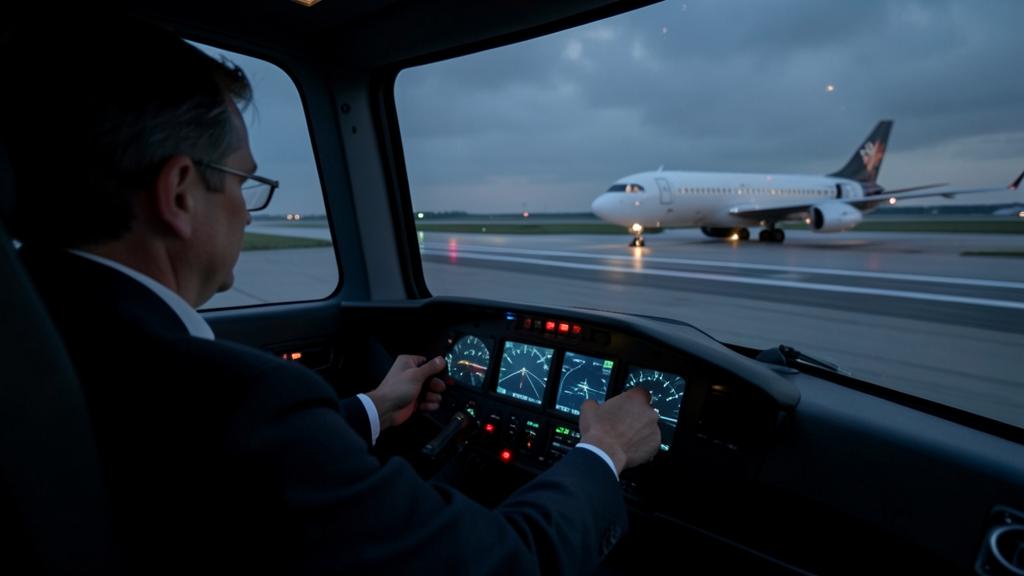
Most pilots know that three takeoffs, approaches, and landings in a simulator can restore a lapsed 90-day recency. Far fewer can explain why the same device is accepted without question for instrument work and rejected for a single route sector, or why a type rating flown to the last detail in a full-flight simulator still ends with supervised landings in the real aircraft. The limit is not arbitrary, nor is it budgetary. It follows a single line of reasoning about which skills decay, how they decay, and what signals a device can be validated to reproduce.
Recency is a decay problem, not an attendance problem
A recency requirement is not a reward for attendance. It exists because performance in a skill degrades as a function of time since the last practice, and because that degradation is invisible from the outside — including to the pilot in question, who typically retains knowledge that a task exists long after losing fluency in performing it under load. The regulator’s problem is that it cannot measure an individual’s decay curve, so it substitutes a proxy: a fixed interval and a minimum count of repetitions.
The important consequence is that different skills decay along different curves. Procedural and declarative material — flow patterns, memory items, limitations, fault logic, the order in which things are done — degrades quickly and restores quickly, because it is essentially rule-based. Perceptual-motor skills tied to real-world sensory signals — judging the flare, holding a centerline in a gusty crosswind, feeling the onset of a skid on a contaminated surface — degrade more slowly, but are signal-dependent: they only restore with practice against signals that match the real ones closely enough. Everything that follows about simulator substitution is a consequence of that division.
Some skills, like checklists, fade fast and come back quickly with practice. Others, like landing in crosswinds, fade slower but need real-world practice to return fully. Rules let simulators replace some practice, but not all.
Three different things called « currency, » and only one of them is recency
Most of the confusion in crews comes from collapsing three separate legal objects into one word. They have different owners, different clocks, and different rules about what a device can do for them.
| Layer | What it is | Typical clock | Device substitution |
|---|---|---|---|
| License-level recency | A minimum of recent takeoffs, approaches, and landings before carrying passengers | A rolling window counted backward from the flight | Explicitly admitted in a full-flight simulator representing the type or class |
| Rating validity | The class, type, or instrument rating, revalidated by a check and, for some ratings, by experience | A fixed expiration date, with a defined window before it in which the check can be performed | The competency check is usually performed in a qualified device; the experience element generally is not |
| Operator qualification | The operator’s own competency verification program, line checks, and recurrent training | Recurrent periods established in the operator’s approved program | Training and checks are device-based; line checks are not |
A pilot can have a perfectly valid type rating and still not be able to take off, because the 90-day recency has lapsed. The converse is also possible. The two clocks do not communicate with each other, and neither is fixed by fixing the other.
Where the regulation says the device can substitute
In the European licensing framework, the recency rule requires a defined minimum of takeoffs, approaches, and landings within the 90 days prior to carrying passengers, and states that these may be performed either in an aircraft of the same type or class or in a full-flight simulator representing that type or class. The substitution is written into the rule itself; it is not a concession granted case by case. For night passenger transport, there is an additional condition that at least one of those repetitions must have been performed at night, unless the pilot holds a valid instrument rating.
Rating revalidation follows a different logic. For multi-pilot type ratings, revalidation is based on a competency check performed within a defined window before expiration, combined with a requirement to have flown a minimum number of route sectors in the type — or, alternatively, a single route sector flown with an examiner. The competency check may be performed in a qualified device; the route sectors may not. That pair is the clearest statement of the principle available anywhere in the rules: the check verifies the skill, and the sectors verify exposure to the operational environment. The regulation treats them as different things and refuses to let one buy the other.
Single-pilot class ratings show the same architecture from another angle. Revalidation may be based either on a competency check or, for some classes, on experience: a minimum number of hours in the class within the year preceding expiry, of which a proportion as pilot in command, a minimum number of takeoffs and landings, and a refresher training flight with an instructor. Here too the hours must be flown; the device does not generate them.
The trap. Assuming that « the simulator counts » is a general property. It is a specific permission, granted requirement by requirement, and generally conditioned on the device level and the device representing the real type or class. A session in a device not qualified for the purpose may be excellent training and legally worth nothing toward recency.
Not all devices are « the simulator »
The word covers a range of machines whose certification standards differ enormously, and a rule that admits one does not admit the others. The European certification specification for aircraft devices recognizes full-flight simulators at several levels, flight training devices, flight navigation and procedures trainers, and basic instrument training devices, each qualified against its own test guide. Internationally, the trend expressed in the fidelity-based device framework is to stop naming boxes and start specifying, task by task, the fidelity required to train that task.
The highest levels of full-flight simulator carry a motion platform, an aerodynamic and systems model validated against flight test data, and a visual system qualified for daytime, twilight, and night operations. These are the levels that an authority will accept for conversion training that dispenses with aircraft flight, and are what a rule has in mind when it allows takeoffs and landings to be credited.
What the device reproduces to a validated standard
The case for substitution is strong and worth stating positively, because the device is not a compromise in all dimensions — in several it is frankly superior to the aircraft.
- Failures and abnormal states that cannot be safely induced in flight: engine failure at decision speed, hydraulic and electrical failures, smoke and fumes, unreliable airspeed, dual failures with interactive consequences.
- System behavior and the crew’s mental model of it, tested at the exact moment the model matters.
- Procedural discipline: flows, calls, checklist sequence, task sharing, control transfer.
- Crew coordination and communication under time pressure, with the ability to freeze, reposition, and repeat — none of which the aircraft offers.
- Low-visibility operations, where real conditions occur too rarely and unpredictably to be trained in line.
- Instrument flying, where the essential signals are in the instruments and the instruments are the same instruments.
That last point explains why instrument work is the least controversial area of substitution in all jurisdictions. When the relevant sensory input is a screen, a device that reproduces the screen faithfully is reproducing the task faithfully. The transfer is almost complete.
What it does not reproduce, and why the rule stops there
The limits are equally specific, and each of them maps to a class of skill that the rules refuse to credit.
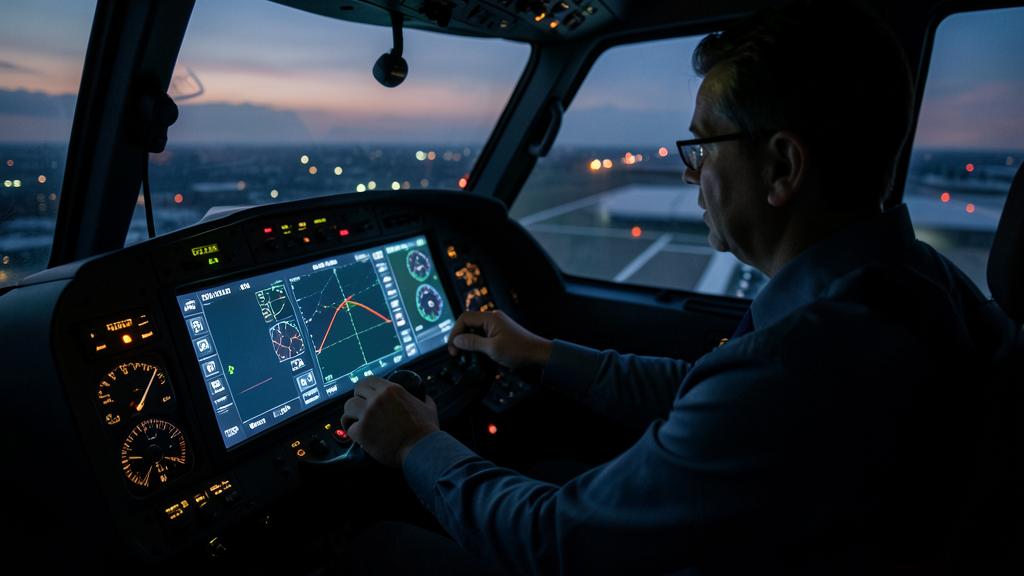
An A320 pilot training in a Level D simulator can practise an engine failure at V1, and under EASA rules the three take-offs and landings required for recency can also be performed in such a simulator. What it cannot fully reproduce is the real surface friction or gust structure: the motion system replicates initial acceleration cues, not everything the aircraft feels.
| Signal or condition | Fidelity in a high-level device | Consequence for substitution |
|---|---|---|
| Instrument indications and system logic | Essentially exact; validated against manufacturer data | Full substitution, uncontroversial |
| Motion onset cues | Good for the first moments of an acceleration; the platform then washes out and sustained acceleration is simulated by tilt | Adequate for recognition, not for prolonged maneuvers |
| Visual cues in the flare | Limited by the field of view and by the delay between control input and image response, both limited by the qualification standard | Landings creditable for recency; the operator still adds supervised line landings after conversion |
| Aerodynamics beyond the validated envelope | Extrapolated rather than measured; devices used for this training are required to show the instructor when the simulation has left the validated region | Stall training is admitted, but the rules limit what can be taught outside the validated region |
| Surface friction, gust structure, real contamination | Modeled, but not variable in the way a real surface is | No substitution for exposure; the operational environment stays with the route sectors |
| Consequence and genuine surprise | Absent by construction: the pilot knows the session is a session | The reason why startle and surprise are trained by scenario design rather than assumed |
The consequence gap deserves a sentence of its own, because it is the one thing no engineering budget can close. A pilot in a device knows that the worst outcome is a debrief. That knowledge changes the physiological activation, and physiological activation is a substantial part of what makes real abnormal events difficult. Modern training design works around this with unannounced scenarios, distraction, and realistic time pressure, but the workaround is a mitigation and everyone involved knows it.
The useful habit. After a session, separate what you practiced into the two categories deliberately: rule-based tasks that the device restored correctly, and signal-dependent tasks where the device gave you a rehearsal rather than a repetition. The second list is what deserves attention in your next real sector.
Training without flight time: the frontier drawn in its purest form
Conversion to a new type without flying the aircraft at all is the strongest possible endorsement of a device, and is granted under strict conditions: a device qualified at one of the levels the authority accepts for the purpose, a candidate with the required prior experience in comparable aircraft, and a specifically approved course. Even here, however, the sequence does not end with the skill test. The pilot then flies a defined number of takeoffs and landings in the real aircraft under supervision, within a limited period after the check, before operating normally.
Read carefully, that is the entire doctrine in one procedure. Everything that can be validated against data is done in the device, including all the fault work that no one would fly. What remains is the half-dozen repetitions against real signals, real surfaces, and real consequences — and the regulator refuses to let a Level D machine buy those, no matter how good it is.
The two systems count differently
Anyone who holds licenses on both sides of the Atlantic has to maintain two different mental models, because the structures are genuinely dissimilar rather than simply numbered differently.
| Element | European approach (Part-FCL, Part-ORO) | U.S. approach (14 CFR Part 61, Part 121) |
|---|---|---|
| Instrument privileges | Maintained by a periodic competency check with a fixed expiration date, commonly flown in a device | Maintained by a rolling count of recent approaches, holding, intercepting and tracking, which may be completed in qualified devices |
| Landing recency | A minimum of takeoffs, approaches, and landings in a rolling window, creditable in a full-flight simulator of the type or class | A comparable rolling requirement, with device credit allowed subject to conditions in the rule |
| Maintenance non-compliance | The rating expires on a fixed date; restoration follows a defined renewal path, which may require evaluated training | Privileges are suspended until the rolling requirement is met again; the certificate itself does not expire |
| Operator-specific path | Alternative training and qualification programs, approved on the basis of evidence, may restructure the standard requirements | Advanced qualification programs serve the equivalent function |
The practical difference that catches people is the nature of the clock. A rolling count can be repaired the day before a flight; a fixed expiration cannot be repaired retrospectively at all. Pilots moving to a European operation from a rolling-count background discover this once, at a cost.
Managing your own recency, rather than discovering it
Three habits keep this from becoming an administrative emergency. Tracking the three layers separately, because they expire independently and no single date covers them all. Confirming, before a session you intend to count for something, that the device is qualified for that purpose and represents your type or class — the session is booked by the operator, but the consequence of a discrepancy falls on the license holder. And treating experience elements as non-buyable: route sectors, class hours, and supervised landings exist precisely because they are the part no device generates, and need to be scheduled in a timeline rather than found in one.
Operators who build or review their own conversion and recurrent programs will find that the same logic maps directly into course design; the training-side material collected at formations.fl330.com follows the distinction between validated tasks and exposure requirements throughout.


Leave a Reply
You must be logged in to post a comment.