
On the eve of an audit, a training manager opens the file of an experienced cabin crew member: the periodic check is up to date, the annual signature impeccable — but the last real fire drill dates back thirty-four months. Compliant, or not? It all depends on how the program reads its own cycle. Cabin crew periodic training is not an annual date that repeats: it’s a two-hand clock, one turning every year, the other every three — and it’s the second that catches poorly designed programs.
Two hands on the same clock
The periodic program overlaps two rhythms that practice often confuses. The first is the annual base: everything that must remain available in immediate memory returns every year. Locating and handling emergency equipment on each operated type, hands on the real or representative equipment; normal and emergency procedures; evacuation; safety; first aid; dangerous goods according to the performed function; and a crew resource management section. Annual does not mean identical: the topics of CRM, in particular, rotate from year to year, and it is the complete cycle that must cover the whole set.
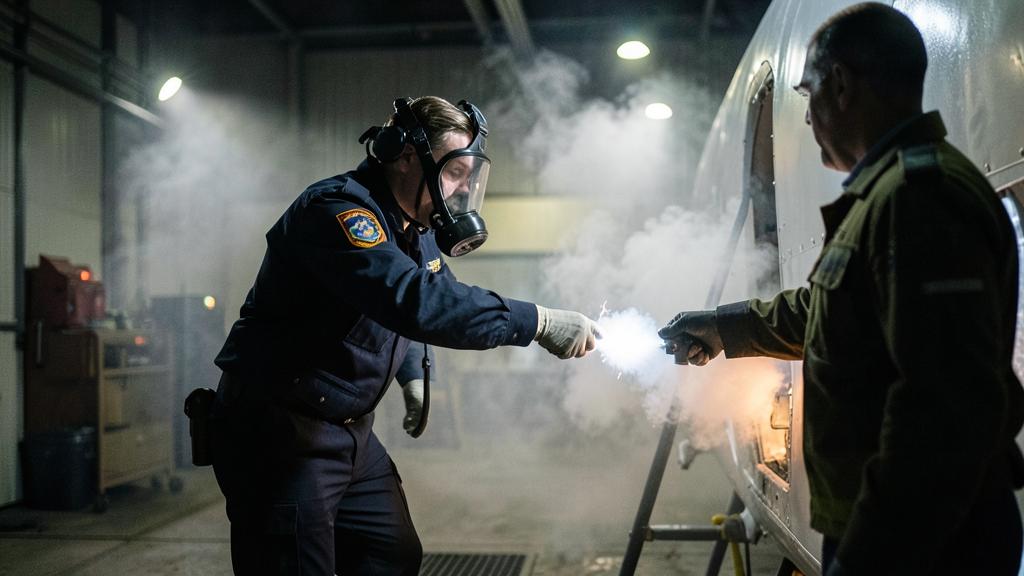
The second rhythm includes the heavy practical workshops: real fire, actual door opening, inflated life jacket, pyrotechnics. These gestures do not return every year, but their return is limited: the same workshop must not exceed three years between two real executions. This long periodicity is not a gift to operators; it reflects the cost of the means — fire benches, smoke chambers, door mock-ups, consumable equipment — that no center can mobilize for each crew member every year.
Cabin crew training has two parts: yearly reviews of theory and basic skills, and practical drills (like fire extinguishing) that happen every three years. The three-year limit is a maximum, not a target. If a crew member hasn’t done a drill in three years, they’re not properly trained.
An Airbus A320 crew member completes their annual training in January 2024, covering emergency procedures and CRM. Their last fire drill was in November 2020. By January 2024, the fire drill is 38 months old—over the three-year limit. The program is out of compliance, even if the annual check was done on time.
The point the practitioner must keep in mind: three years is an upper limit, not a cruising rhythm. A program that treats the cycle as a tolerance — «we have three years to do it» — mechanically creates the drifts that the rest of this article details.
What the word «real» requires
In the cycle workshops, the requirement is not to have «covered the topic»: it is to have performed the gesture. Effectively extinguishing a real or representatively simulated fire with an extinguisher of the same type as the one on board. Putting on the protective breathing apparatus and working in a smoky environment, not watching someone do it. Actually opening each type of exit, in normal and emergency mode, on the aircraft or on a representative mock-up. Inflating a life jacket, not mimicking it. Handling pyrotechnic signaling devices — real or fictional, but in hand.
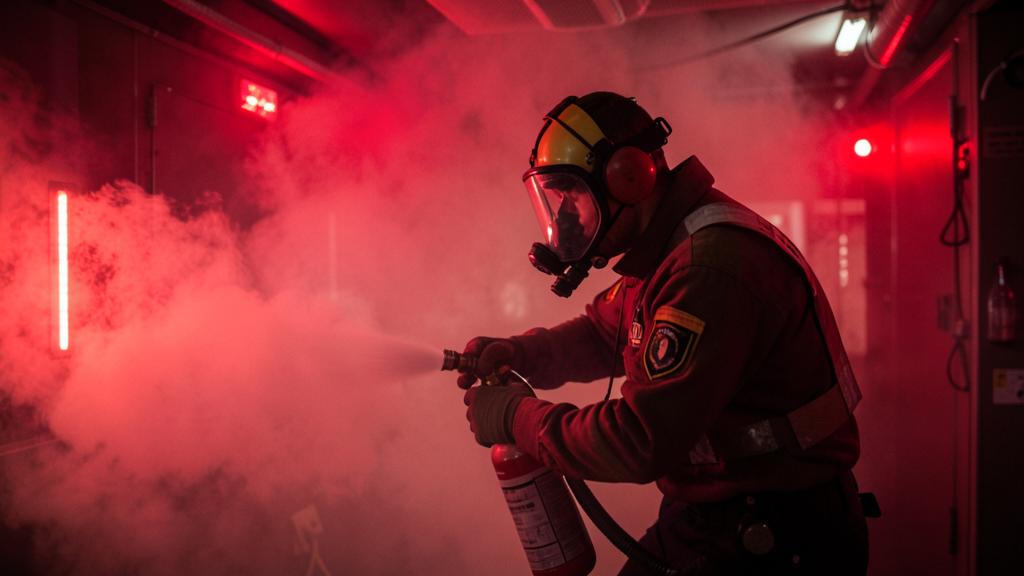
The reason is summed up in one sentence: in a situation, the available gesture is the one that has been performed, not the one that has been seen. Declarative knowledge is reactivated by reading; a motor sequence under stress — triggering a life jacket’s inflation, arming an exit, putting on a PBE whose hood resists — is only reactivated by physical repetition. This is exactly what the cycle structure reflects: what is read is reviewed every year, what is done is repeated at limited intervals, and it is verified.
| Element | Rhythm | Required form | What the file must show |
|---|---|---|---|
| Locating and handling emergency equipment | Every year | Review and handling, type by type operated | Date, aircraft type, associated check |
| Emergency procedures, evacuation, safety, first aid | Every year | Theory and classroom or cabin mock-up exercises | Date and module content |
| Crew resource management (CRM) | Every year, rotating topics | All topics are covered within the cycle | Topic covered in each iteration |
| Fire and smoke | At least once per three-year cycle | Real extinguishing with representative equipment; use of PBE in a smoky environment | Date of the last real pass, workshop by workshop |
| Emergency exits | Three-year cycle | Actual opening of each type of exit, in normal and emergency mode | Date by exit type and by aircraft |
| Life jacket and pyrotechnics | Three-year cycle | Actual inflation of the life jacket; handling of real or fictional devices | Date of the last real gesture |
The anniversary window: passing early without losing anything
The validity of the periodic check is counted in calendar months, and its renewal mechanism deserves to be understood precisely, because it drives all the scheduling. A check taken in the last part of the validity period — the window — opens a new validity counted from the expiration of the previous one, not from the day of the exam. In concrete terms: passing a few weeks early costs nothing, and the anniversary date remains stable from year to year.
A check taken before the window, on the other hand, makes the counter start from the day of the exam. Each early pass shifts the expiration date backward, desynchronizes the crew members of the same intake, and complicates the planning of the cycle workshops, which are often aligned with the same sessions. The window is therefore not an accessory flexibility: it is the tool that allows smoothing the load of the training centers without eroding anyone’s validity.
The good reflex. Schedule the check in the window, never before it, and set the date of the next one when the previous one ends: an expiration date is managed as a slot that you choose, not as a deadline that is discovered in the last review of expirations.
Lost module: two situations that have nothing to do with each other
A lost module — illness on the day of the fire session, canceled session, overloaded planning — is not in itself a serious event. As long as the element’s expiration date has not been reached, it is a rescheduling: the operator reschedules, in priority, and the validity remains intact. Still, the missed module must be detected, which requires individual tracking by workshop, and not just a global control date per crew member.
Past the expiration date, the regime changes. There is no longer «recovery»: the crew member cannot be scheduled as a required cabin crew member, and the return goes through the requalification process described in the operator’s documentation — typically the repetition of the concerned elements followed by a new check. An important nuance for the future of a career: it is the qualification with the operator that lapses, not the cabin crew member certificate itself, which depends on another regime.
Third situation, often confused with the first two: prolonged interruption of activity during an intact validity. Beyond a duration that the regulation frames and the manual details — the order of magnitude is six months —, the resumption goes through refresher training, distinct from the periodic cycle and that does not replace it. A still valid check says nothing about the freshness of the gestures of someone who has not flown in months.
Fixed blocks or sliding reading: the almost six-year gap
Here is the reading trap announced at the beginning. «Once per three-year period» can be read in two ways. The fixed block reading divides the calendar into successive periods and requires a pass in each. It seems rigorous — and allows the unacceptable: a fire workshop performed in the second month of a block, then towards the end of the next block, places almost six years between two real extinguishments, without any box on the tracking sheet turning red.
The sliding reading looks at the interval, not the boxes: for a given crew member and a given workshop, never more than thirty-six months between two executions. It is the one that corresponds to the objective of the rule — maintaining the gesture — and it is the one that an individual calendar by workshop naturally produces. The question to ask your own program is simple: does the tracking calculate intervals, or mark periods?
The trap. A tracking sheet that marks «done / to do» per three-year period can be green from start to finish while letting the real interval of a workshop stretch beyond reason. If your tool does not know how to show, for each crew member, the date of the last real pass of each workshop and the current interval, it does not follow the cycle: it hides it.
What the competence file must prove
The date of the last periodic check says almost nothing. What the file must allow reconstructing is, for each crew member: the date of the last real pass of each cycle workshop, type by type when the element depends on the aircraft — a large exit is not armed like that of a single-aisle —, the CRM topic covered in each iteration, and the trace of the associated checks. The auditor who knows where to look does not calculate averages: he looks for the maximum interval, the least-trained crew member, the oldest workshop.
For those operating several types, the mechanics multiply: the elements linked to the aircraft are tracked by type, with their own expiration dates, while the general base and the CRM are partially shared. It is precisely because this load grows quickly that the number of types that the same crew member can serve is limited — and that the file must remain readable type by type, not merged into a single line.
Three verifications to make this week
File in hand, three questions are worth asking. How does your manual define the cycle — by blocks, or by sliding interval? What does it provide, in black and white, for the lost module before and after the expiration date? And does your individual tracking know how to produce, by workshop and by type, a date of the last real pass? The gray area remains the first question: the reading of the cycle is not harmonized everywhere, and a file judged compliant in one operator may not be in the next. All the more reason, for the crew member — and for those preparing for a training manager position, for example through a dedicated training program —, to keep a detailed copy of their workshop history with each employer change: a new operator will make them repeat everything that cannot be proven.
These lines describe a general mechanism for analysis purposes: the applicable regulation, its means of compliance and the approved documentation of your operator prevail over this article, and in case of divergence, only this documentation is valid.


Leave a Reply
You must be logged in to post a comment.