
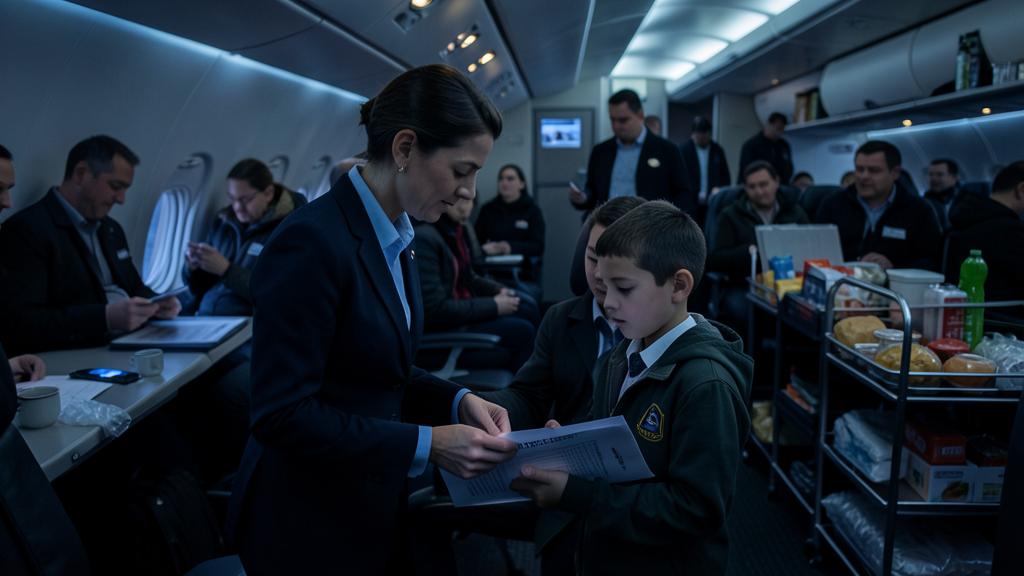
An aircraft carrying nine unaccompanied minors, eleven infants and four child restraint systems is crewed by exactly the same number of cabin crew as the same aircraft with none of them on board. The minimum is a function of installed seats; the service plan is a function of seats and sector length. Neither knows anything about who actually booked. The work that mix creates is real, largely mandatory, and absent from every plan the crew is handed. Counting it, and agreeing out loud where the service is allowed to give way, is what turns a silent overload into a managed one.
The crew complement knows nothing about who is on board
Under the European rules, the minimum number of cabin crew is derived from the number of passenger seats installed — one crew member per fifty passenger seats installed, or fraction of fifty, with the detail set out in the Part-ORO cabin crew rules and in the operator’s approval. The FAA reaches a comparable result through the seating-capacity bands of its own operating rules. The two systems differ in wording and in the reduced-crew provisions they allow, but they agree on the essential point: the number is a property of the aircraft, not of the passenger manifest.
That is a deliberate design. The minimum exists to evacuate the cabin, and evacuation capability has to be certain before anyone knows who will be sitting in the seats. Nothing is wrong with the rule. What is wrong is treating the resulting number as if it were also a staffing calculation for the service, because the service load is not a property of the aircraft at all.
The commercial plan makes the same assumption twice. Galley timings, bar runs, duty-free windows and pre-arrival service are built from seat count and block time. A flight with a heavy family load is planned identically to a flight of business commuters. The difference between them is absorbed, silently, by a crew given no additional minutes and no instruction about what to drop.
So the variable load has no slack allocated to it. It is taken from somewhere. Usually it comes out of the discretionary service, which is the right answer arrived at by accident. Sometimes it comes out of the checks that were never discretionary, which is the failure worth naming.
The number of cabin crew is based on how many seats the plane has, not on who is actually flying. This means extra work from families or unaccompanied kids isn’t planned for, and crews have to improvise.
Counting one unaccompanied minor properly
An unaccompanied minor is not a small passenger. It is an item of custody the operator has legally accepted, with a documented chain that begins at the check-in desk and closes only when a named adult signs at the far end. The acceptance ages, the ratio caps and the fee structure are operator decisions and vary widely; the custody obligation does not vary at all.
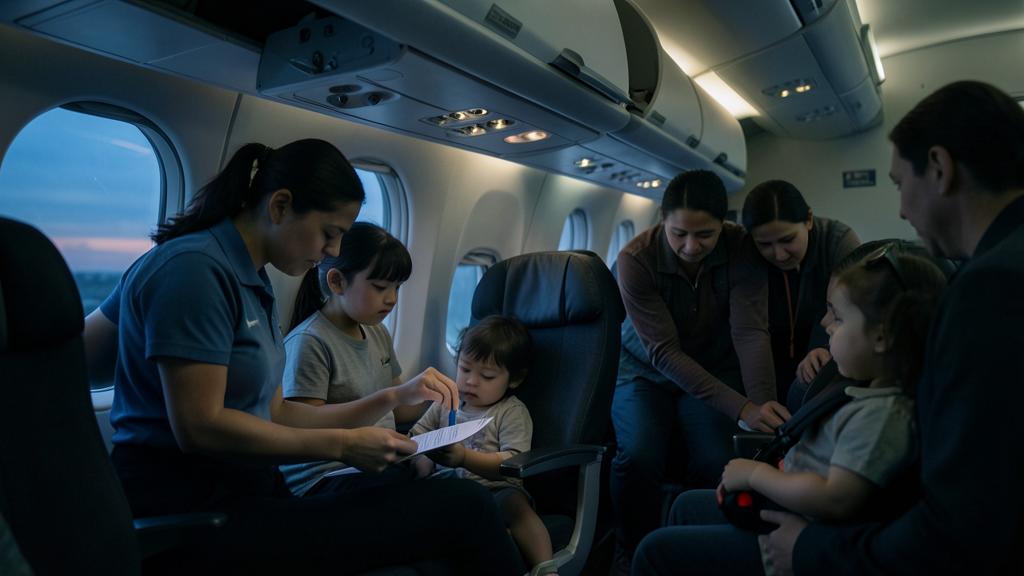
The useful exercise is to count mandatory contacts rather than to estimate minutes. Contacts can be counted from the procedure itself, without a stopwatch and without a survey, and the count is what collides with the timeline. Minutes are yours to measure, because they depend on your cabin, your galley layout and your crew.
| Phase | Contact | Discretionary? | Transferable? |
|---|---|---|---|
| Pre-boarding | Handover from the ground agent: identity, documents, receiving adult, signature | No | Senior only |
| Boarding | Seating, stowage of the document pouch, individual safety briefing owed to a special category passenger | No | Named crew member |
| Boarding | Introduction: who to call, where that person will be, how to call them | No | Named crew member |
| After take-off | First check once the cabin is released | No | Yes |
| Cruise | Meal or snack service, at the operator’s defined point in the sequence | Timing only | Yes |
| Cruise | Lavatory supervision, each occurrence | No | Yes |
| Cruise | Periodic welfare checks at the operator’s interval | Interval only | Yes |
| Descent | Secure the child, retrieve and check the pouch | No | Yes |
| Disembarkation | Hold the child until the cabin is clear | No | Named crew member |
| Disembarkation | Handover to the ground agent, signature, count closed | No | Senior only |
Ten contacts is the floor, for a child who needs nothing. Two lavatory trips, one spilt drink and one bout of travel sickness put it at fourteen. Nine unaccompanied minors on a medium-haul sector therefore generate somewhere between ninety and a hundred and thirty individual contacts, half of which can only be made by a named crew member or the senior, and that same half falls inside the two windows already saturated: boarding and disembarkation.
Run your own timing against that count. If a contact averages ninety seconds — a figure you should measure rather than believe — nine minors consume more than two crew-hours per sector, on a flight where the roster added not one crew-minute. That is the number worth putting in front of a rostering or commercial team, because it is arithmetic rather than opinion.
The right reflex. Count the mix aloud at the pre-flight briefing and put it on the seat map: minors, infants, child restraint systems, bassinets, passengers with reduced mobility. A number said out loud before the doors open is the only version of this workload that anyone else can act on.
On an Airbus A320 with 180 seats, the minimum crew is 4. With 9 unaccompanied minors, that’s 90-130 extra contacts. At 90 seconds each, that’s 2.25-3.25 hours of extra work—unplanned but mandatory.
Families are a different shape of load, not a smaller one
A family does not need custody. It needs seats that satisfy constraints the booking system did not apply, and it needs them in the four minutes before the last passenger boards.
Several of those constraints are hard safety rules and are not open to negotiation at the gate. Infants must be seated with the accompanying adult, and one adult can be responsible for only one infant. The number of infants per row is limited by the oxygen masks available in the passenger service unit above it: the unit normally holds at least one mask more than the seats below it, that spare is the only supply a lap-held infant has, and the exact count is a property of the type and the configuration. Special category passengers, minors included, must not be seated where they would impede access to an exit or the evacuation of others, which rules out the exit rows and, on many types, the rows immediately adjacent. Child restraint systems must carry an acceptable approval marking and must be fitted in a permitted seat, in the orientation the approval allows.
Here the European and American rules genuinely diverge, and it is worth knowing which side of the divergence you are on. The supplementary loop belt used routinely for lap-held infants across European operations is not permitted in operations conducted under the FAA rules, where the infant is either held or restrained in an approved device. Crews operating a mixed network are not being inconsistent when the briefing changes; the applicable rule changes.
| Item | Nature | Who can change it |
|---|---|---|
| Infant seated with its accompanying adult | Safety rule | Nobody |
| One infant per adult | Safety rule | Nobody |
| Infants per row limited by oxygen masks available | Safety rule, type-dependent | Nobody |
| No minors or infants in exit rows | Safety rule | Nobody |
| Child restraint approval and orientation | Safety rule | Nobody |
| Individual briefing of the accompanying adult | Safety rule | Nobody |
| Bassinet position allocation | Finite resource | Ground and crew, before boarding closes |
| Family seated together beyond the infant rule | Commercial | Operator policy, gate, crew goodwill |
| Order of meal service | Service | Crew, openly |
| Pre-boarding of families | Service and flow | Ground, by agreement |
The individual briefing owed to an adult travelling with an infant is the item most often compressed into a nod. It carries three pieces of information the adult will not derive under stress: the brace position with an infant, the order in which oxygen masks are fitted — the adult’s own first, which is counter-intuitive and therefore has to be said — and the evacuation instruction to carry the child and leave everything else. Thirty seconds, per family, and it is not discretionary.
The able-bodied passenger arithmetic
Evacuation planning quietly assumes a supply of able-bodied passengers, particularly near the exits, to open doors, hold slides and help others clear. Certification demonstrations are conducted with a defined mix, and it is not the mix on a half-term charter.
Do the subtraction for a real booking. A family of five with two infants supplies zero able-bodied passengers: the two adults are each committed to carrying a child, and the older child is a person to be moved. Five bodies to clear, two to be carried, none available to help anyone else. Multiply by the number of such bookings and the assumed reservoir near the over-wing exits can disappear entirely without a single line changing on the load sheet.
This is also why the re-seating problem is more dangerous than it looks. When a family arrives split across the cabin, the only adjacent free seats late in boarding are very often the exit row, precisely because those seats are the ones nobody was allowed to allocate. The pressure to solve a visible problem with the visible empty seats is real and it points the wrong way.
The trap. The last free pair of seats during boarding is usually in the exit row. Re-seating a family there solves the family and breaks the exit. The exit row assessment — able, willing, unencumbered, able to understand the instructions — is a check, not a formality, and it is the check that a departure-time delay is most likely to erode.
Where the load actually lands
The mix does not spread itself evenly across the sector. It piles up in the two phases that were already full, and it leaves the cruise, the only elastic part of the flight, comparatively untouched.
| Phase | Fixed work | Flexible work | Pressure |
|---|---|---|---|
| Boarding | Stowage, counts, exit row assessment, doors | Minor handovers, family re-seating, restraint checks, bassinet fitting, individual briefings | Departure time |
| Taxi and climb | Secure cabin, safety demonstration | First minor check, comfort of distressed children | Sterile phase |
| Cruise | Service, rest rotation, security checks | Meals, lavatory escorts, welfare checks, comfort | Elastic |
| Descent | Secure cabin | Pouches, secure minors, brief adults again | Short and fixed |
| Disembarkation | Doors, cabin clearance, security search | Minors held to the end, families last, custody signatures | Turnaround |
Read the table as an instruction rather than a description. Anything from the boarding row that can be moved into the cruise row should be moved deliberately, at the briefing, and not discovered at the gate. Anything that cannot be moved — custody handovers, briefings, restraint checks — is an argument for boarding earlier or for a cap on the mix, which are decisions above crew level and which only get made if the crew reports the collision.
Prioritising out loud
The service will give somewhere. The only question is whether it gives where the crew agreed or where the pressure happens to fall. Publishing a priority order before the doors close costs one minute at the briefing and turns a silent failure into a managed one.
Three tiers cover it. The first tier never slides: individual safety briefings, exit row assessment, restraint approval checks, custody handovers, cabin secure. These are not service, and no delay justifies compressing them. The second tier slides in form but never in fact: welfare checks on a minor may lengthen their interval when the cabin is busy, but they do not stop; a child’s meal may come late, but it comes, and the child is told when. The third tier slides freely and openly: the second bar run, duty-free, the pre-arrival extras. Announcing that the third tier has been dropped is a professional act; letting it evaporate while the first tier quietly absorbs the pressure is not.
Ownership matters as much as order. Give the minors to one named crew member and redistribute that person’s share of the standard service at the briefing, when there is time to think, rather than at hour two, when there is not. A crew that has already agreed who covers the aft galley when the minor in row 30 is airsick does not have to invent an answer while a trolley blocks the aisle.
Telling passengers is part of the priority scheme, not a courtesy attached to it. A family told plainly that their meal will follow the tray clearance, with water offered now, costs one contact. The same family left to wonder generates three call bells and an unhappy conversation. The most expensive thing in a busy cabin is an unanswered question, and it is the cheapest thing to prevent.
Making the load visible after the fact
None of this changes until the workload appears in a system. Rostering, ground operations and the commercial team see the flight through the data the flight produces, and a mix that defeated the service plan produces no data at all unless someone enters it.
Two channels do the job. The voyage or post-flight report should carry the mix as a number, not a comment: minors carried, infants carried, restraints fitted, re-seatings performed, briefings given. And where the mix routinely made the timeline unachievable, that belongs in a safety report rather than in a complaint, because the thing being reported is a planning assumption that does not hold, not a bad day. Operators that cap minors per sector or per crew member have at least made that number explicit and arguable; where no cap exists, one still appears — improvised, at the gate, by whoever is standing there. Crews comparing how their operators handle this will find the discussion under way at the FL330 forums.
The underlying point is simple enough to state in one line and hard enough to act on that it is worth repeating. The rules set a minimum crew for evacuating an aircraft, and that minimum is correct. Nothing in that number, or in the service plan built on top of it, accounts for the passengers who cannot brief themselves, cannot evacuate themselves, and cannot be left. That work is not optional, so it has to be planned, counted and prioritised out loud.


Leave a Reply
You must be logged in to post a comment.