
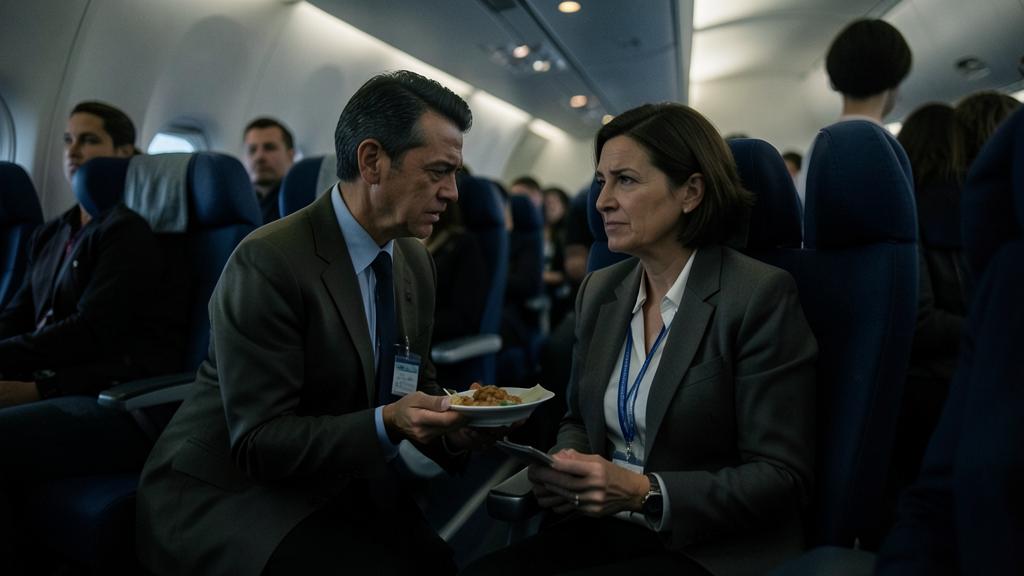
A complaint raised at seat 24C is not one thing. It is an emotional event happening now, in front of other passengers, which the cabin crew own completely — and it may also be a claim with a commercial and sometimes legal life that will run for weeks after the aircraft has been cleaned. Cabin crew own the first entirely and only a fraction of the second. The damage done in cabin service recovery rarely comes from crews who refuse to help; it comes from crews who close, on board and in good faith, something that was never theirs to close, leaving customer service to withdraw a promise a passenger has already been given.
Two objects behind one conversation
The first object is the incident: something failed, and a passenger is unhappy about it in the cabin, right now. This object has a short life and a clear owner. It responds to acknowledgement, to being believed, and to visible action. Handled well, it is finished before the aircraft lands and generates nothing downstream.
The second object is the claim: an assertion that the airline owes the passenger something. It has a much longer life, it is answered in writing by a department with access to the booking, the operational record and the applicable rules, and it may be governed by an external regime the cabin has no visibility of. The passenger experiences both objects as a single grievance and expresses them in a single sentence. The crew’s job is to separate them silently, close the first, and route the second without damaging it.
This is why the instinct to “sort it out here so it doesn’t become a problem” is often precisely wrong. Settling the incident is right. Settling the claim on board is usually beyond the crew’s information, not their goodwill.
A complaint is two things: the immediate problem (the incident) and the potential demand for compensation (the claim). Crews must handle the incident on board but must pass the claim to the ground, where it can be properly assessed.
A passenger complains about a missing meal. The crew apologizes and provides an alternative (closing the incident). If the passenger asks for compensation, the crew notes the request and directs them to customer service (passing the claim).
The sorting test, in four questions
A workable criterion has to be applicable in twenty seconds, standing up, with a service in progress. Four questions do it, and a single failure sends the matter to the ground.
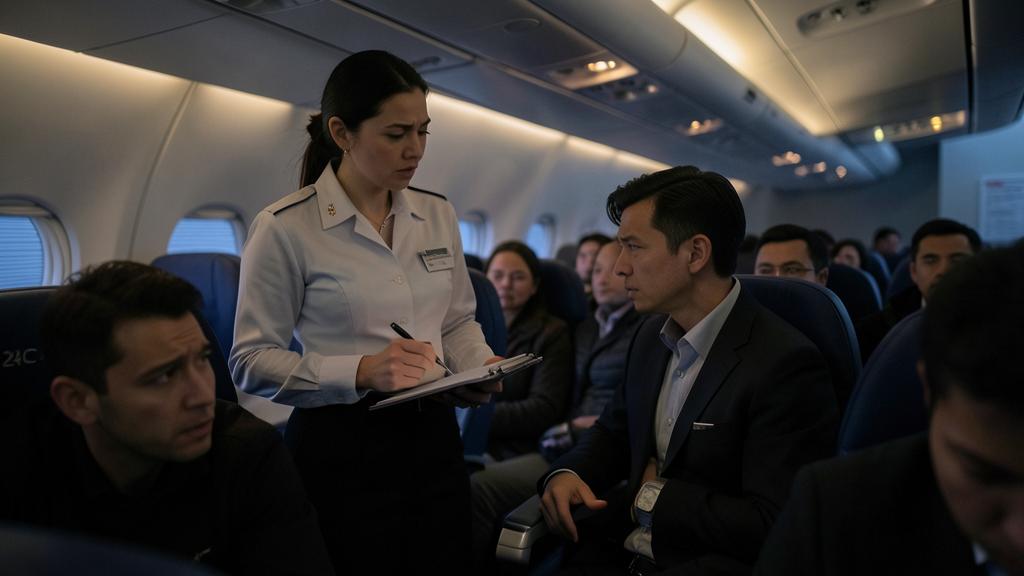
Can it be closed now? Not started — closed. If the resolution depends on something happening after the flight, it is not an on-board matter, whatever is offered in the meantime.
Is it complete? A partial fix that leaves the passenger with a residual grievance has not closed anything; it has created a second conversation later, held with someone who was not there.
Is it within my authority and my available resource? Authority is what the operations manual and the customer service policy actually delegate to the rank concerned, not what feels reasonable at the time. Resource is what is physically on board.
Does it leave an expectation? This is the decisive one and the one most often skipped. If the passenger leaves the aircraft expecting anything further — money, a call, a follow-up, a decision — then the matter is open, and it is open at the ground, and the crew’s remaining job is to hand it over cleanly rather than to predict its outcome.
| Situation | Closed on board | Goes to the ground | What must be recorded |
|---|---|---|---|
| Spoiled or missing meal, special meal not loaded | Alternative provided, apology, purser informed | Only if the passenger asks for compensation | Catering shortfall and what was substituted |
| Seat defective, entertainment or power inoperative | Reseating where possible, defect entered in the cabin log | Any request for a refund of a paid option | Seat number, defect, action taken |
| Item soiled or damaged by a service failure | Immediate assistance and apology | The claim for the item itself, always | Description of the item, the passenger’s own words, time |
| Checked baggage reported damaged or missing | Nothing — direct the passenger to the counter before leaving the airport | Entirely, and with urgency | That the passenger was directed to the counter |
| Delay, missed connection, cancellation consequences | Information and care as instructed by the operator | Entitlement, rebooking outcomes, compensation | Information actually given, and when |
| Conduct of another passenger | Managed as a cabin safety matter under the applicable procedure | Any follow-up the passenger wishes to pursue | The safety report, separately and factually |
| Allegation against a crew member | Nothing — acknowledge, do not investigate | Entirely, through the operator’s channel | The allegation, verbatim, without comment |
What genuinely closes in the cabin
The list is shorter than crews expect and more powerful than they credit. Almost everything that closes on board closes because of three ingredients, not because of a giveaway.
Acknowledgement without qualification. “That should not have happened” closes more complaints than any voucher, provided it is said about something that genuinely should not have happened. It costs nothing and cannot be withdrawn by the ground.
Being believed. Complaints escalate at the moment the passenger concludes they are being managed rather than heard. Repeating the substance of the complaint back accurately is the cheapest de-escalation available.
Visible action. The action matters less than its visibility: a defect actually entered in the log in front of the passenger, a purser who comes to the seat, a substitute produced. What is remembered afterwards is usually whether something happened, not whether it was adequate.
Notice what is absent from the list. None of these commits the company to anything, none creates an expectation, and none can be contradicted later by a department with better information.
The right reflex. Before saying anything that begins with “we will”, ask silently who the “we” is. If the sentence commits a department that is not on the aircraft, replace it with what you will do — record it, pass it on, give the channel — and with what the passenger should do. A crew member’s promises are only safe when they are about the crew member.
What always leaves the aircraft
Certain categories cannot be assessed in the cabin because the information required is not on board, and sometimes because the applicable regime is not the airline’s to interpret at a seat.
Anything involving money — refunds, compensation, reimbursement of expenses — belongs to the ground, because entitlement depends on the operational record, the fare conditions and, in Europe, on the passenger rights regulation, whose application turns on facts the cabin does not hold. Crew should not state whether compensation is due, in either direction. Saying that it is due creates an expectation the file may not support; saying that it is not due may be wrong and will be quoted back.
Baggage is the category where an on-board misstep does real harm. Claims for damaged or delayed checked baggage on international carriage fall under the Montreal Convention regime, which imposes short filing deadlines counted from the moment the baggage is delivered or placed at the passenger’s disposal; domestic carriage is governed by national law and the conditions of carriage, with deadlines of its own. Either way, the only correct on-board action is to send the passenger to the baggage counter before they leave the airport, and to say so plainly. A reassuring “call customer service tomorrow” can cost the passenger their claim.
Medical events, injuries and anything with a physical consequence go to the ground through the reporting channel, not through the service channel, and the crew’s contribution is the factual report. So do allegations against a crew member: acknowledge, record verbatim, do not investigate, do not defend the colleague, do not editorialise. And anything concerning special assistance that failed — a wheelchair that did not arrive, an unaccompanied minor procedure that broke down — is a service-quality matter with obligations attached, and it needs the written trail.
The commercial gesture and its half-life
A gesture is not a gift; it is a company decision taken at a seat by a crew member with partial information. It has three failure modes and all three are avoidable.
The unrecorded gesture. Something is given, nothing is written. The passenger writes in afterwards and mentions it. Customer service either has no trace and appears to doubt the passenger, or takes their word and loses the ability to calibrate anything. Either way, the gesture that was supposed to close the matter has become evidence in it.
The over-promise. The passenger is told that compensation will follow, or that the airline “will look after” a cost. When the file is assessed on its merits and the answer is different, the passenger is not simply refused — they are contradicted. The second grievance is reliably worse than the first, because it is now about the airline’s honesty rather than about a spoiled meal.
The anchoring gesture. A generous gesture given for a minor failure sets the passenger’s expectation for the next one, and, once it is described publicly, for other passengers. Consistency is worth more to a customer service function than generosity, because inconsistency is what generates the escalations that cost the most to answer.
| What the crew does | What the passenger understands | What customer service inherits |
|---|---|---|
| Gives something, records nothing | The airline has acknowledged fault | An undocumented admission and no calibration |
| Says compensation will follow | A decision has been taken in their favour | Either an unbudgeted payment or a contradiction |
| Names an amount or a type of redress | A figure has been agreed | An anchor that any lower answer now insults |
| Refuses without explanation to end the conversation | The airline is not interested | A claim about crew attitude, harder to resolve than the original |
| Gives the correct channel and records the facts | Someone is dealing with it | A file that can be answered on its merits |
The trap. “I’ll make sure you’re compensated.” It is said to end an uncomfortable exchange and it converts a service failure into a credibility failure. The crew member cannot make sure of it, will not be present when the answer is given, and will never learn what the answer was.
The report is the handover
Whatever is handed over travels in a written entry, read later by someone who was not on the flight, has no cabin context and must reply in writing to a person who is already annoyed. That reader needs facts, timings, names and the passenger’s own words — and specifically does not need the crew’s assessment of whether the complaint is justified.
The distinction matters more than it sounds. An entry that says a passenger “was aggressive about a meal” tells the reader nothing usable and colours the file. An entry that says what was ordered, what was loaded, what was offered instead, what the passenger asked for and what was given, lets the reader answer without guessing.
| Weak entry | Why it fails downstream | Usable entry |
|---|---|---|
| “Passenger unhappy with service” | No fact to answer, no seat, no time | Seat, sector, the failure, the time, the action taken |
| “Complaint unjustified” | Prejudges a file the writer cannot assess | What the passenger stated, in their words, without comment |
| “Gave a gesture to calm the situation” | What, of what value, on whose authority? | Item given, quantity, rank authorising, time |
| “Told them to contact the airline” | Which channel, and did they get it in writing? | Channel given, in what form, and any deadline the passenger was told about |
When the passenger wants a decision before landing
Some passengers will not accept a referral, and the pressure is real: the exchange is public, other passengers are listening, and the crew have a service to finish. Three things hold.
- First, the position does not change under repetition — a referral that becomes a concession after the fourth request teaches every observer how the system works.
- Second, escalation within the crew is a legitimate and useful step: the purser arriving is itself the visible action that closes many incidents, and the commander’s involvement is reserved for matters that touch the conduct of the flight rather than the quality of the service.
- Third, there is a boundary beyond which this stops being a complaint at all. When behaviour becomes disruptive, the framework changes: it is no longer a service matter subject to negotiation but a cabin safety matter with its own procedure and its own reporting obligation, and it should be handled and written up as such — separately from the service complaint that may have started it.
What the operator owes the crew
Crews get this consistently right only when the system supports it, and three supports are frequently missing.
A single, unambiguous referral channel, given to the passenger in a durable form rather than recited. A published gesture authority by rank, stating what may be given and for what, so that crew are not improvising a company policy at a seat. And a feedback loop: crews who never learn how a referred file was answered will drift, over-giving or under-giving according to temperament, because they have no calibration. A quarterly summary of outcomes for referred cabin complaints does more for consistency than another briefing on empathy.
The underlying principle is unglamorous and holds everywhere. The cabin closes experiences; the ground closes claims. A crew that keeps that line clean protects the passenger’s claim as much as the airline’s position, and, unlike a gesture, that protection cannot be withdrawn later by someone else. Operators and crews comparing referral practice and gesture policy will find the discussion on the FL330 forums.


Leave a Reply
You must be logged in to post a comment.