

Calling in fatigued takes about ninety seconds. What follows takes months, passes through at least four separate record systems, and ends — if the operator is doing its job — in a change to a pairing that nobody will ever connect back to the call. Or it stops at the first step, gets coded as sickness, and quietly reappears eighteen months later in an attendance review. This is the full chain: who hears the declaration, what it writes down, how the data is actually used, and the specific mechanisms that make people decide not to pick up the phone.
The declaration is an obligation, not a courtesy
The starting point is often misread, including by the people making the call. Reporting oneself unfit through fatigue is not a favour granted to the operation, nor an escape hatch that has to be justified. It is the discharge of a duty that sits explicitly on the individual crew member in every modern regulatory system.
ICAO Annex 6 frames fatigue management as a shared obligation: the State and the operator set duty limits and manage fatigue as a safety risk, while the crew member is required not to perform duties when they know they are fatigued or otherwise unfit. The EASA flight time limitation rules, Subpart FTL of Part-ORO, carry the same structure — prescriptive limits addressed to the operator, plus a stated responsibility on the individual crew member not to operate when fatigued. The United States arrives at the same place by a different route, with an explicit fitness-for-duty affirmation built into the Part 117 flightcrew rules that apply to passenger operations conducted under Part 121.
Two consequences follow, and they matter for everything downstream. First, a roster that is legal is not, by that fact, safe: the prescriptive limits are population-level boundaries, not a statement about the individual who slept badly. Second, because the duty is personal, nobody else can discharge it. A crewing controller who talks a crew member back onto the aircraft has not taken over the responsibility — they have simply obscured who exercised it.
The first ten minutes: who takes the call, and what they must not do
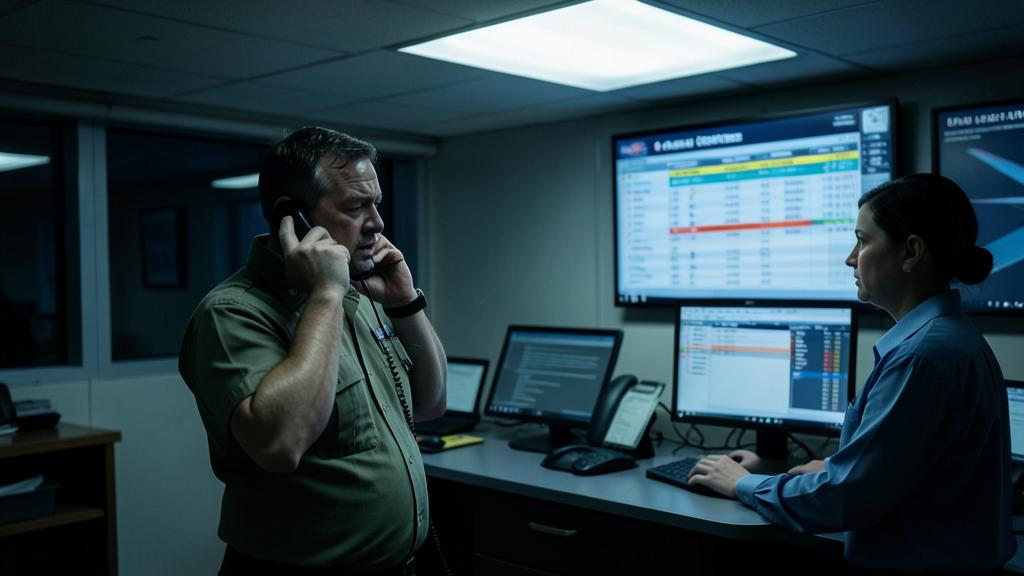
The declaration almost always lands with crewing or operations control. This is the structural weakness of the whole chain, and it is worth naming plainly: crewing is a resourcing function measured on coverage, not a safety function measured on risk. The person answering the phone has a gap to fill and a clock running, and the clock is the only part of the problem that is visible to them.
The behaviours to watch for are not malicious. They are the natural output of that incentive. The most common is partial negotiation — could you do the first sector and we’ll release you at the outstation? — which asks the crew member to renegotiate a judgement about their own alertness with someone who did not sleep their night. The second is delay: the call is left informal until a replacement is found, so the time of the declaration migrates. The third is recategorisation at source, where the agent enters the absence under whichever code causes them the least friction.
What the procedure should require is narrow and testable. The declaration is recorded at the moment it is made, under a category the crew member states, with no requirement to justify it beyond identifying it as fatigue. Any discussion of partial operation happens only if the crew member raises it. And the crew member is told, on the call, which code has been applied — because that single piece of information determines nearly everything that happens afterwards.
The trap. The cost of the declaration is immediate, visible, and attributable to a named person: a standby activated, a delay, possibly a cancellation. The benefit is an event that did not happen, and no one will ever know which one. Every incentive in the system is shaped by that asymmetry, and no amount of safety-culture messaging survives a process that leaves it in place.
When a pilot calls in fatigued, they’re doing their job—but the system often treats it like a problem. The first person who answers the call usually cares more about filling a gap than safety, which can lead to pressure or bad coding. That’s why pilots might hesitate to make the call in the first place.
A crew member on an Airbus A320 rostered for an early duty period declares fatigue at 0400, after a night in which they could barely sleep. The crewing agent, under pressure to cover the flight, suggests flying only the first sector to a hub 1.5 hours away. The crew member declines, but the agent records it as « sickness » instead of « fatigue », which later affects the crew member’s attendance record.
Sick, fatigued, unfit: three words that are not interchangeable
Many operators still run fatigue through the sickness channel because it is the channel that already existed. That decision has consequences far beyond bookkeeping, and it is the single most common reason a fatigue reporting scheme produces no usable data.
| Declaration | What it asserts | Who evaluates it | Where the record belongs |
|---|---|---|---|
| Sick | A medical condition, temporary or otherwise, affecting fitness | The individual under self-certification rules, then a physician, and the aeromedical examiner if prolonged | Medical and absence records; potentially the medical certificate file |
| Fatigued | A transient state of reduced alertness caused by sleep, time awake, circadian phase or workload | The individual, then the fatigue risk management process on an aggregated basis | Fatigue reporting and safety data — not the medical file |
| Unfit, other | Any other reason the crew member cannot safely operate, including medication, personal circumstance, or the effects of a preceding event | The individual, with operator procedures determining the follow-up | Depends entirely on the cause; the code must not default to sickness |
Fatigue is not an illness. Treating it as one imports the entire apparatus built for illness — return-to-work interviews, absence trigger points, occupational health referral — and applies it to someone who did exactly what the rules require. It also corrupts the data in both directions: the safety department sees a fatigue reporting rate near zero and concludes the roster is benign, while the human resources dashboard sees absence and concludes the individual is unreliable.
The paper trail: four systems, four different readers
A single declaration can generate entries in four distinct places, and confusing them is a recurring source of grievance. They are separate systems with separate purposes, separate readers and, critically, separate legal protections.
| Record | Created by | Purpose | What it should never be used for |
|---|---|---|---|
| Roster event | Crewing, at the time of the call | Operational: replacement, duty accounting, pay | Performance assessment of the individual |
| Fatigue report | The crew member, usually within a set window after the event | Feeding the fatigue risk management process with sleep history, time awake, pairing and roster context | Disciplinary action, absent the exclusions that apply to any protected report |
| Occurrence report | The crew member, where fatigue actually affected an operating flight | Mandatory occurrence reporting to the authority under the applicable scheme | Anything outside the purposes the reporting regulation permits |
| Absence record | Human resources, from the roster event code | Contractual: pay, entitlement, attendance management | Receiving fatigue declarations at all, if the operator has done this properly |
In the European system, the protection attaching to reported information comes from the occurrence reporting regulation, Regulation (EU) No 376/2014, which restricts the purposes for which that information may be used and shields the reporter from prejudice by the employer — with the carve-outs for wilful misconduct and for a manifest, serious disregard of an obvious risk. Note that the regulation covers the voluntary reporting system an organisation is required to operate as well as the mandatory channel. What it does not necessarily reach is a form that never entered either: a fatigue declaration taken down by crewing, or a fatigue questionnaire held only in a rostering or fatigue-management database, may sit outside the scheme, and then whatever protection it carries comes from the operator’s own just culture policy and, where one exists, the collective agreement. Knowing which channel you are writing into matters as much as knowing what to write.
From one call to a trend: what the data is actually for
Fatigue risk management runs on prediction plus verification. The prediction comes from rostering rules and, increasingly, from bio-mathematical models that estimate alertness from duty timing, sleep opportunity and circadian phase. Those models are calibrated on populations; they output an expectation, not an observation.
The declaration is one of the very few genuine observations the system receives. It is the point where the model says a pairing should be tolerable and a human being says it was not. That is precisely why the individual event matters less than where the events cluster: three unrelated crew members declaring on the same rotation, the same standby-to-early-report transition, or the same return from a multi-sector day through the window of circadian low is a signal about roster construction, and roster construction is the only thing the operator can actually change at scale.
Useful analysis therefore normalises. A raw count of declarations tells you almost nothing, because it moves with fleet size, seasonality and staffing levels. The meaningful quantities are rate per thousand duties, distribution across pairings rather than across individuals, and the relationship between declarations and the roster features that were supposed to prevent them — consecutive early starts, night duty density, standby call-out patterns, the length of the layover as opposed to the length of the rest period on paper.
The trap, again. A falling fatigue reporting rate is presented in management reviews as an improvement. It is equally consistent with the collapse of trust in the scheme. Neither reading can be settled from the number alone: it has to be triangulated against roster metrics, absence data, safety reports mentioning tiredness, and what people say in confidential surveys. An operator that celebrates the drop without doing that triangulation has stopped measuring fatigue and started measuring silence.
Fatigue reports help airlines adjust rosters to prevent tired pilots. But if pilots stop reporting because they fear punishment, the data becomes useless. A drop in reports might look like progress, but it could just mean pilots are too scared to speak up.
An airline notices three pilots declare fatigue on the same long-haul route with a 6-hour layover. Analysis shows the layover is too short for proper rest, so the roster is adjusted to add an extra hour. Later, fatigue reports drop—but confidential surveys reveal pilots still feel tired, just don’t report it anymore.
What actually deters the call
Ask why crew members operate while knowing they should not, and the answers are consistent across fleets, countries and licence types. They are also almost entirely structural — which is the good news, because structures can be redesigned.
| Deterrent | How it works | What removes it |
|---|---|---|
| Loss of pay | Where a large share of earnings sits in sector or duty pay, the crew member personally funds the safety decision | Treating a fatigue declaration as duty for pay purposes; the precise treatment depends on the contract and national law |
| Attendance triggers | Fatigue coded as absence accumulates towards a threshold that generates a formal process months later | A distinct code, structurally excluded from attendance management |
| The phone conversation | Negotiation at the moment of least cognitive and emotional resource, with the party holding the operational pressure | A scripted, non-negotiating first response, and a separate channel to a duty safety contact |
| Roster consequences | The lost duty reappears in days off, in the next bidding period, or in standby allocation | Explicit rules on re-rostering after a declaration, published in advance |
| Visibility | Small fleets and small bases; the belief, sometimes correct, that command upgrades and course selection see the record | Aggregated reporting to management, with individual-level access restricted and audited |
| Uncertain protection | Genuine doubt about who reads the report and what may be done with it | A written just culture policy naming the protected channels and the exclusions, agreed with crew representatives |
Note that none of these is addressed by a poster campaign. The crew member’s judgement about whether to call is a rational reading of the incentives in front of them, and it will track those incentives whatever the safety magazine says.
The version that works from the crew room
Operators that get usable fatigue data tend to share a small set of features. There is a dedicated declaration code that is not sickness and not unauthorised absence. The first response is fixed and does not include a counter-offer. Pay is protected, so the decision costs the individual nothing in the moment. The absence system never sees the event. And, most underrated of all, there is a feedback loop: the person who reported is told, weeks later, what changed. Nothing sustains a reporting culture like evidence that reports have consequences other than for the reporter.
The right reflex. On the call, state the category explicitly — « I am declaring myself unfit for duty through fatigue » — give the report time, and ask which code has been entered. In the written report afterwards, supply the facts the analysis actually needs: sleep obtained in the last twenty-four and forty-eight hours, time awake at the moment of the decision, the preceding duties and their timings, commute, and any element of the roster that reduced the sleep opportunity below what the rest period nominally provided. « I was tired » is not analysable. « Four hours’ sleep, awake since 0430, third early in a row » is.
For crew members comparing how different operators handle the code, the pay treatment and the feedback loop, this is one of the subjects discussed most candidly on the FL330 forums, where the differences between fleets tend to be described more accurately than in any published policy.
The one-line version
A fatigue declaration is a measurement. Where it is coded as an illness or an absence, the measurement is destroyed at the moment it is taken, and the operator ends up managing the reporter instead of the roster. Everything else in the chain — the record systems, the protections, the trend analysis, the pairing that eventually gets rebuilt — depends on that first coding decision, made in ninety seconds by someone whose job is to fill the gap.


Leave a Reply
You must be logged in to post a comment.