
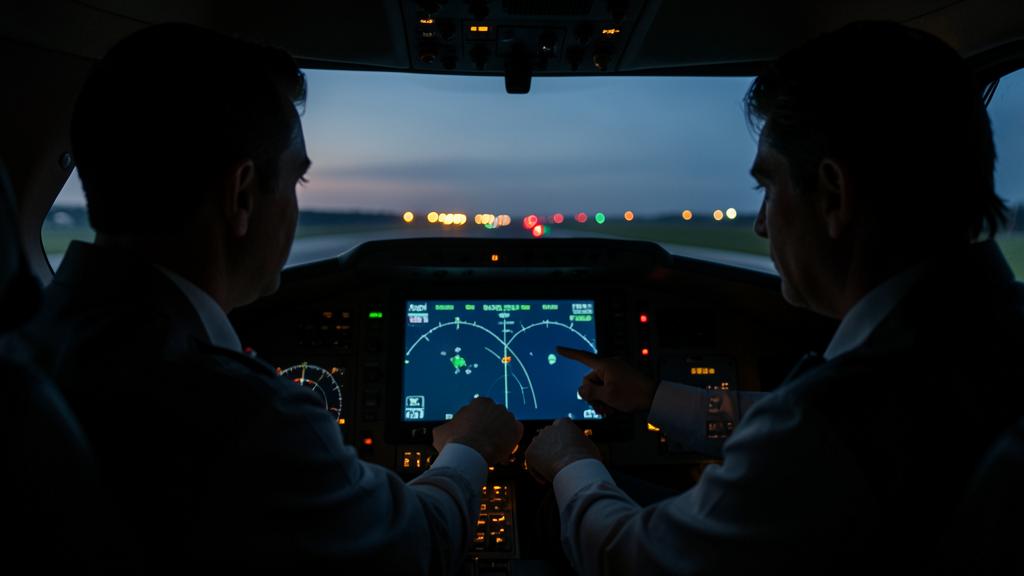
Automation surprise is a technical term, not a description of a feeling. It names a measurable state: the aeroplane is in one mode and the crew believes it is in another. That gap opens quietly, closes slowly, and does its damage in the interval — which is why the counter-measures that work are not exhortations to pay more attention, but procedures that force each transition to be spoken out loud and checked by a second person.
Surprise is a mismatch, not an emotion
Human factors research separates two things that look identical from the outside. Startle is a reflex — brief, physiological, triggered by a sudden stimulus, and largely over within seconds. Surprise is cognitive: the world has stopped matching the model of it that the crew was using, and until a new model is built, everything the crew does is being computed from the wrong premises.
Startle passes. Surprise has to be resolved, and resolving it takes time that a descending aeroplane does not necessarily have. This distinction matters operationally because the two need different responses: startle needs a pause, surprise needs a diagnosis. A crew that treats surprise as something to push through with more effort will keep acting on the model that has already failed.
The classic formulation of the problem, which has survived decades of hardware change, is a set of three questions a crew ends up asking about a system it does not understand at that instant: what is it doing now, why is it doing that, and what will it do next. All three are questions about mode.
Automation surprise happens when the plane’s system is in one mode, but the pilots think it’s in another. This gap can cause problems because the pilots might act based on the wrong assumptions. The solution isn’t just to pay more attention, but to use procedures that make sure both pilots check and confirm each mode change out loud.
During a descent, the autopilot might switch from altitude hold to vertical speed mode without the pilots noticing. If they assume it’s still in altitude hold, they might not react correctly to the plane’s descent rate, leading to a potential altitude deviation or overshoot.
The mode lives in one place, and it is small
On a modern flight deck there is exactly one authoritative statement of what the flight guidance system is doing: the mode annunciation across the top of the primary flight display. Not the flight director bars, which show orders and not intentions. Not the flight plan page, which shows what was requested. Not the selected values in the control panel, which show what was asked for, and which stay exactly where they were when the system stops honouring them.
Two design realities follow. The annunciation is physically small and sits at the edge of where the eye naturally travels during manual and instrument scanning. And with rare exceptions, a mode change produces a visual cue only — a brief box or a colour change lasting a few seconds — with no aural component. A system that can change its own behaviour announces that change through the least salient channel available to it.
Four ways an aeroplane changes mode without being asked
Not all unexpected transitions have the same cause, and the counter-measure differs by family. Grouping them is the fastest way to make the phenomenon teachable.
| Family | What happens | Why the crew misses it | What catches it |
|---|---|---|---|
| Commanded but unexpected | A crew action produces a mode the acting pilot did not intend | The action felt correct; the result is not checked against the annunciation | Callout by the pilot monitoring, not by the pilot who acted |
| Automatic reversion | The system abandons a mode whose conditions are no longer met and falls back to a default | Nothing was pressed, so nothing is expected to have changed | Scanning the annunciation at every configuration or target change |
| Indirect change | An entry elsewhere alters what an already engaged mode will do | The engaged mode name does not change, only its behaviour | Verifying the target, not just the mode name |
| Protection engagement | An envelope or performance protection takes precedence | The aeroplane appears to disobey; the crew fights it | Recognising the protection, then removing its cause |
The second and fourth families are the difficult ones. In an automatic reversion, no crew action preceded the change, so the ordinary human cue for checking a result — having just done something — is absent. In a protection engagement, the aeroplane is behaving correctly and the crew’s model is wrong, which is the hardest situation for a crew to concede in real time.
Why the eye does not catch it
Perception is driven by expectation. A crew that believes the aeroplane is capturing a vertical path will read the annunciation and see the mode it expects, particularly under workload, particularly at night, and particularly when the annunciation is a short abbreviation whose neighbours differ by one or two letters. This is not carelessness; it is how visual sampling behaves wherever it has been measured.
Compounding it is the structural problem named decades ago in the human factors literature as the irony of automation: automating the manual task leaves the human with the monitoring task, and monitoring for rare events is the activity at which human performance is worst. The better the automation, the rarer the event, and the less prepared the monitor.
The trap. Concluding that the answer is more vigilance. Vigilance decays as a function of time and event rarity, and no briefing changes that curve. Every counter-measure that has actually worked converts a visual event into a verbal one, or moves the check from one person to two.
What the delay costs
The damage from mode confusion is rarely done by the mode itself. It is done by the time between the transition and its detection, because during that interval the aeroplane is managing energy according to a rule the crew is not applying.
The two currencies are flight path and energy. A vertical mode that is not the one assumed produces a path deviation that grows linearly and is usually visible. A thrust mode that is not the one assumed produces an energy deviation that grows silently — nothing on the flight path looks wrong until speed reaches a limit, by which time the correction required is large. That asymmetry is why an unnoticed thrust or speed mode is the more dangerous of the two, and why it returns so persistently in the accident reports on automation.
It is also why the recovery question is ordered. The first action is not to diagnose the mode. It is to establish that the flight path and the energy state are acceptable, by hand if necessary, and only then to find out what the system was doing.
The counter-measure that works: make the transition audible
The standard operating procedure that addresses this is the mode annunciation callout, and its effectiveness depends on details that are easy to erode.
It has to be verbal, because that converts a low-salience visual event into a high-salience auditory one for both crew members. It has to cover every change, not only the ones judged significant, because judging significance requires already understanding the transition. It has to be cross-checked, so that the person calling and the person confirming are not the same person. And it has to be timed to the change rather than to a phase of flight, so that a reversion nobody commanded is still called.
The renaming of the non-flying seat from pilot not flying to pilot monitoring was not cosmetic. It defined monitoring as the primary duty of that seat rather than as what is left over, and mode annunciation is the concrete expression of it.
| The question | What answers it | What does not answer it |
|---|---|---|
| What is it doing now? | The mode annunciation, read and spoken | The flight director bars, the selected values, memory of what was pressed |
| Why is it doing that? | The condition that triggered the transition — configuration, target, protection | An assumption that the system is faulty |
| What will it do next? | The armed mode, the active target and the energy trend | The flight plan as filed or as briefed |
The ladder down, and why fighting the system is the wrong move
When the aeroplane is not doing what is wanted, the professional response is not to work out why while it continues. It is to reduce the level of automation until the crew is at a level it fully understands, fly the aeroplane there, and diagnose afterwards.
| Step | What you keep | What you have removed |
|---|---|---|
| Change the mode deliberately | Autopilot and autothrust | An unwanted mode, if you are certain which one |
| Disconnect the autopilot | Flight director guidance and autothrust | The system’s authority over the flight path |
| Take the flight directors out of view | Autothrust, raw navigation data | Guidance orders you no longer trust |
| Disconnect the autothrust | Manual thrust, raw data | Every automatic input to the flight path |
Two cautions belong with that ladder. It is a sequence, not a menu — going straight to the bottom in a high-workload phase substitutes one problem for another. And it presupposes recent manual handling practice, which is the argument for hand-flying in benign conditions that is otherwise easy to dismiss as preference.
The right reflex. Announce the level you are moving to, out loud, before you move to it. Reducing automation without saying so creates a second mode confusion on top of the first, this time between the two pilots.
Briefing the transitions before they occur
Most of the transitions that surprise crews are predictable, which means they can be named in advance. A useful approach briefing does not recite the chart; it states which modes will be used, at which point each one is expected to engage, what will be armed, and what the aeroplane will do if the expected capture does not happen.
Three moments repay this attention in almost every operation: the transition from a level segment to a descent path, the transition from lateral navigation to a final approach mode, and the go-around, where thrust, configuration and mode change simultaneously and where the geometry can differ from what the crew rehearsed. A briefing that names what should appear on the annunciation at each of those moments turns detection from a discovery into a comparison, which is a far faster cognitive operation.
What the rules now require
The regulatory response has arrived on three fronts, and it is useful to know which one owns which part of the problem.
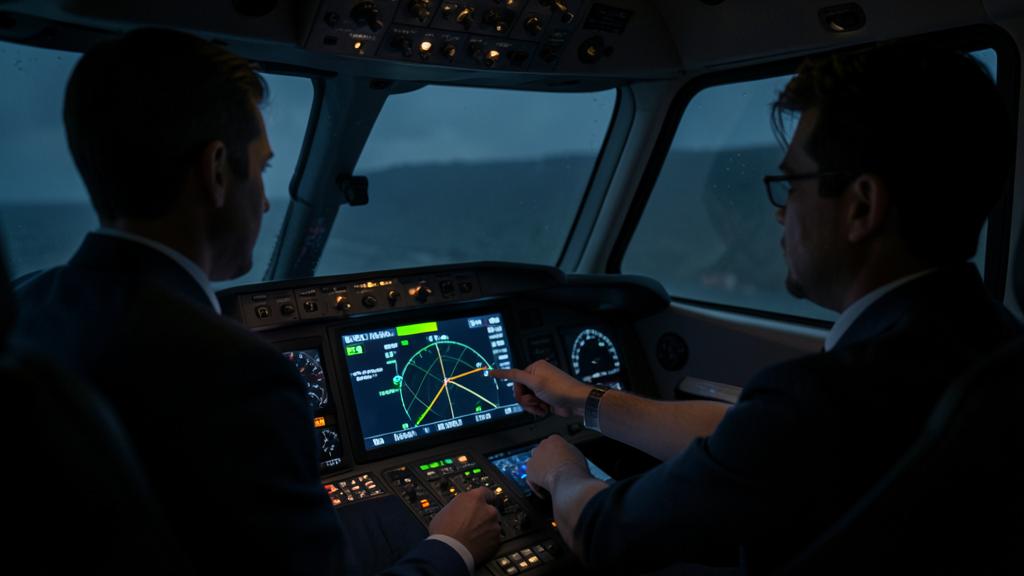
- Design is addressed in the large aeroplane certification codes, which now contain a dedicated requirement on the design of installed systems and equipment for use by the flight crew — intended to make error less likely and detection more likely — alongside a separate requirement governing flight guidance systems and their annunciation. That is where salience, mode indication and the avoidance of unannounced behaviour live.
- Training is addressed through the competency framework in ICAO’s training provisions, where flight path management using automation is a named competency assessed in its own right rather than folded into general handling. Evidence-based approaches to recurrent training explicitly build scenarios around unexpected transitions instead of rehearsing known failures.
- Startle and surprise are addressed through upset prevention and recovery training, which EASA made a required element of professional pilot training. The point of introducing genuinely unexpected events in the simulator is not to teach a recovery technique — it is to give crews experience of the cognitive state itself, so that recognising it costs less time on the day.
None of the three works without the others. A well-designed annunciation that nobody calls is still small; a callout discipline applied to a system whose behaviour was never briefed still leaves the crew asking what it will do next. Material on competency-based recurrent training is available at the FL330 training centre.


Leave a Reply
You must be logged in to post a comment.