
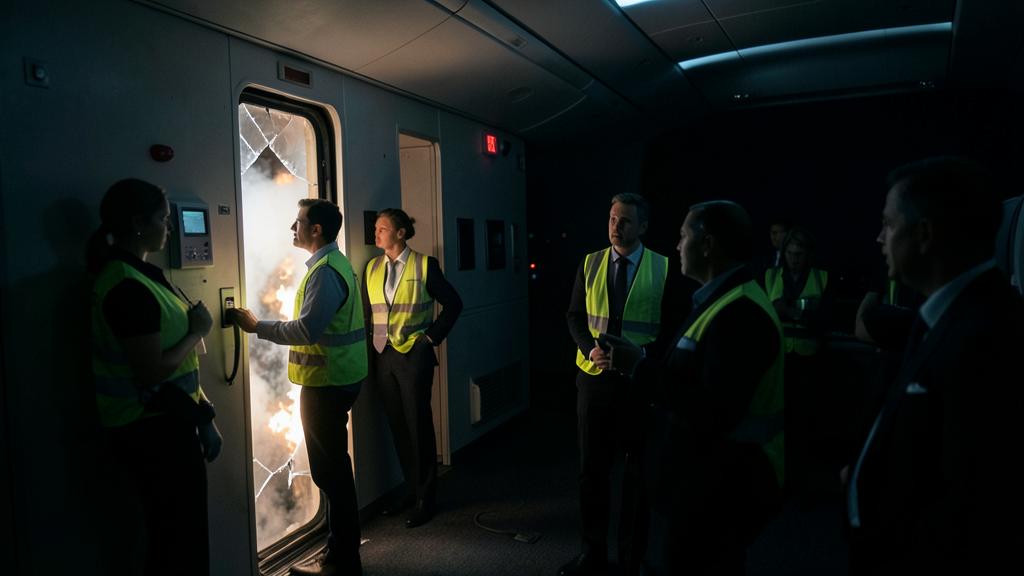
An evacuation ordered by the commander and an evacuation started by a cabin crew member are not two versions of the same decision. They are two different events, built on different information, failing in different ways, and carrying their consequences in opposite directions. Every operations manual names both. What separates them is not courage and not seniority — it is a short list of conditions that has to be checked while the aeroplane is still moving to a stop and the interphone is not being answered.
Two events that share one word
In the commanded case, the flight deck decides, the decision travels down a chain that has been rehearsed hundreds of times, and the cabin executes a procedure it knows by heart. The alerting signal or the public address call arrives, the senior cabin crew member repeats it, each crew member goes to an assigned exit, assesses the conditions outside, opens or blocks, and starts the flow. Everything about that sequence is designed around one assumption: someone with the whole picture has already weighed the alternatives.
In the cabin-initiated case, that assumption is gone. A cabin crew member is deciding on the basis of what can be seen from a jump seat, without knowing whether the engines are running, whether the aeroplane is clear of the runway, whether fire services are thirty seconds out, or whether the flight deck is silent because it is incapacitated or because it is working a checklist that is about to make everything survivable.
Both are legitimate. Both are in the manuals. But they are not interchangeable, and the second one is the one that has to be justified afterwards, in writing, against the conditions the operator has published.
Why the command normally sits in the flight deck
The commander holds the decision not because of rank but because of coverage. The flight deck has the systems synoptics, the fire and overheat indications, the engine parameters, the radio, and the position of the aeroplane on the aerodrome. It knows whether the aeroplane has stopped, whether the parking brake is set, whether the engines have been shut down, whether fuel is being pumped overboard, and whether the tower has just reported a fire on the right side that nobody in the cabin can see because the smoke is going the other way.
It also holds the alternatives. An evacuation is one option among several, and the others — a precautionary disembarkation by stairs, a rapid deplaning at the gate, remaining on board with the doors closed while the fire service applies foam — are usually invisible from the cabin. A cabin crew member who sees a serious problem sees a reason to evacuate. The commander sees the same problem alongside three ways of dealing with it that do not put two hundred people onto a taxiway at night.
What the cabin knows that the flight deck cannot see
The asymmetry runs both ways, and this is precisely why the cabin retains an initiative at all. Nobody in the flight deck can see the cabin. The flight deck cannot smell the smoke, cannot see flame through a window, cannot see a wing that is no longer where it should be, cannot see water rising over the seat rails, and cannot see that the aft cabin has become unbreathable while the forward cabin is still clear.
| Element of the situation | Normally visible from the flight deck | Normally visible only from the cabin |
|---|---|---|
| Engine running or spooling down | Yes, directly | Only by sound and by looking out |
| Position on the manoeuvring area, runway occupancy | Yes | No |
| Fire indication in an engine or the hold | Yes | No |
| Fire service en route, tower report of external fire | Yes, by radio | No |
| Flame or heavy smoke inside the cabin | No | Yes |
| Structural failure visible through a cabin window | Rarely | Yes |
| Water entering the cabin after a ditching or overrun | No | Yes |
| Cabin becoming untenable — heat, fumes, visibility | No | Yes |
Read that table in the direction that matters operationally. The cabin holds a small number of very specific facts, and every one of them describes a cabin that is already killing people. That is not an accident of drafting. The conditions under which an operator permits a cabin-initiated evacuation are, almost without exception, exactly the conditions that only the cabin can observe.
The flight deck and cabin each have blind spots. The flight deck sees technical data but not flames in the cabin. The cabin sees smoke or water but not engine status. A cabin-initiated evacuation is only justified when the cabin detects an immediate, deadly threat that the flight deck can’t see.
On a Boeing 737 at a runway overrun, the cabin crew smelled smoke and saw flames through a window. The flight deck was silent, possibly working a checklist. The cabin initiated an evacuation because the aircraft was at rest, the cabin was filling with smoke, and no command was received after repeated interphone attempts. This followed the operator’s manual exactly.
Silence is not an instruction
The hardest part of this is not the catastrophic case. It is the ambiguous one: the aeroplane has stopped, something has clearly gone wrong, and the interphone rings unanswered.
An unanswered interphone has several explanations, and they lead to opposite actions. The flight deck may be running a memory item or a checklist and deliberately not answering — the standard doctrine of not interrupting a crew during a critical phase applies to the interphone as much as to anything else. The interphone itself may have failed, or the handset may have come out of its cradle. The crew may be incapacitated. Or the flight deck may already have decided that no evacuation is required and be waiting for the fire service before communicating anything at all.
The trap. Treating silence as a delegation of authority. Silence carries no information about the state of the aeroplane. It only tells you that a communication path is not working, which is a reason to try another path — the second interphone station, the flight deck door, the emergency call — not a reason to open a door.
The conditions that convert silence into initiative
Operators word this differently, but the structure is consistent across manuals, and it is worth learning as a structure rather than as a sentence. Three things generally have to be true at once, and none of them alone is enough.
First, the aeroplane must be at rest, or clearly not going to move again. Starting an evacuation from a moving aeroplane is a way of putting people under a fuselage. Second, a condition must exist that makes remaining on board more dangerous than leaving — not merely alarming, but genuinely life-threatening within the time it would take to establish contact. Third, contact with the flight deck must have failed after a real attempt, not after one unanswered call.
| Situation in the cabin | Supports cabin-initiated evacuation | Why |
|---|---|---|
| Fire in the cabin that is not being controlled | Yes, with the aeroplane at rest | Cabin becomes untenable faster than contact can be re-established |
| Dense smoke or fumes making the cabin unbreathable | Yes, with the aeroplane at rest | Incapacitation of occupants precedes any command |
| Obvious structural break-up of the fuselage | Yes | The protective shell no longer exists |
| Water entering the cabin | Yes | Exit availability is being lost by the second |
| Heavy smoke outside a window, aeroplane intact | No, report and wait | The flight deck may know the fire is being fought |
| Passengers standing up and shouting | No | Panic is a cabin management problem, not an evacuation trigger |
| Severe overrun, cabin intact, no fire | No, report and wait | Disembarkation options may be far safer than slides |
| Loud noise, hard landing, unfamiliar attitude | No | None of these describes an untenable cabin |
Assessing the exit before committing to it
Whatever set the evacuation in motion, the decision at each door is separate, individual, and non-delegable. The crew member at that exit assesses the conditions outside before the door moves: fire, obstruction, the attitude of the aeroplane, the height of the sill above the surface, whether the slide will land on something, whether an engine on that side is still turning.
Two properties of this moment deserve to be stated plainly. It is the last reversible point — once a door with an armed slide begins to open, the slide deploys and the exit is committed. And the assessment is not a formality: an exit that is unusable has to be blocked and the flow redirected, physically and loudly, against a crowd that is already moving towards it.
The right reflex. The order is always assess, then operate. A slide deployed into fire or against an obstacle does not merely waste an exit; it removes an exit that the ninety-second logic assumed you would have, and it sends people towards it anyway.
The price of an evacuation that was not needed
An evacuation is itself a hazardous manoeuvre, and it is not a neutral default. Slide injuries are a normal outcome of a real evacuation rather than an exceptional one, and they are not always minor — fractures, dislocations, friction burns, and the injuries produced when someone at the bottom of the slide does not clear it. Beyond the slide there is jet blast, live movement areas, fuel on the ground, cold, darkness, and a group of people with no protective clothing, some of whom will be carrying cabin baggage they were told to leave.
None of that argues against evacuating when it is required. It argues against evacuating when something else would have worked, and it explains why operators write three distinct procedures rather than one.
| Precautionary disembarkation | Rapid deplaning | Evacuation | |
|---|---|---|---|
| Typical trigger | Technical or security concern, no immediate danger | Developing threat, time available | Immediate danger to life on board |
| Exits used | Normal doors, stairs or bridge | Normal doors, stairs or bridge | All usable exits, slides deployed |
| Slides | Disarmed | Disarmed | Armed and deployed |
| Cabin baggage | Usually permitted | Left behind | Left behind, enforced |
| Expected injuries | None | Few | Routine, sometimes serious |
| Reversible | Yes | Largely | No |
The ninety seconds, and what that figure actually assumes
The number everyone quotes comes from certification. Under the large aeroplane airworthiness codes on both sides of the Atlantic, a type above a defined seating capacity — in practice every airliner — must be shown capable of evacuating its maximum certificated occupancy within ninety seconds, in darkness or with darkness simulated, using no more than half of the exits, typically those on one side.
What matters professionally is the list of things that demonstration does not include. No fire, no smoke, no fumes. No injuries and no incapacitated passengers. Nobody stopping to open an overhead bin. Volunteers briefed and physically able, drawn according to a prescribed age and gender spread. A cabin crew at the strength required for the type, fully fit and expecting the event. Crucially, half the exits are unavailable by design of the test — so the margin that some people imagine the ninety seconds contains has, in fact, already been spent.
The operational reading is simple. The ninety seconds is a design target for the aeroplane, not a promise about your evacuation. It tells you that exit availability, aisle flow and baggage discipline are the three variables that dominate the outcome, because they are the three the demonstration holds at their best case.
The accident record supports the same reading. At Manchester in August 1985, a fuselage that remained essentially intact on the ground became unsurvivable for a large number of occupants in the time it took to reach the exits, and the investigation drove a long programme of work on cabin survivability — access to overwing exits, interior materials, escape path lighting and smoke protection were all re-examined in its wake.
Designing the silence out of the problem
The best moment to deal with an unanswered interphone is long before it happens, in the pre-flight briefing between the commander and the senior cabin crew member. That briefing is where the operator’s conditions stop being a paragraph and become a shared expectation: what signal will be used, what the crew should do if it does not come, how long to persist on the interphone, and what the commander wants reported and when.
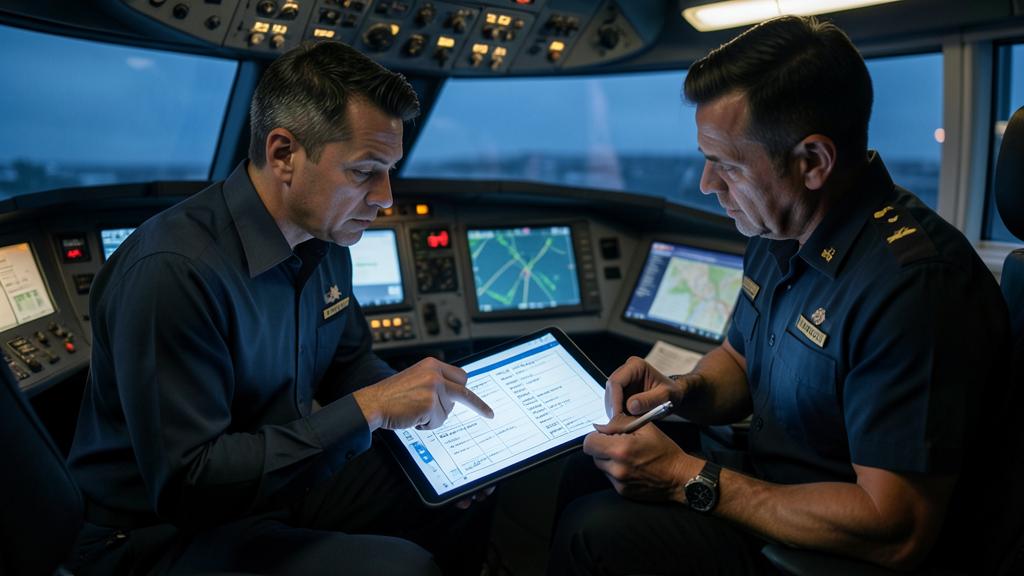
- Agree on a clear signal for “stand by, no evacuation” to avoid ambiguity.
- Brief the cabin crew on how long to wait before escalating silence.
- Use standard formats for reports to compress information into seconds.
- Ensure the flight deck acknowledges critical cabin reports.
The same applies to the reverse channel. A cabin crew member who reports a specific observation — location, what is burning, whether it is spreading, whether it is inside or outside — gives the flight deck something to decide with. A report that the cabin is frightened gives it nothing. Standard formats exist precisely to compress that into seconds, and the briefing is where a crew agrees to use them.
Finally, the flight deck can remove the ambiguity cheaply. An interphone call that says only stand by, no evacuation, remain seated costs three seconds and converts a silence with several meanings into a single instruction. Crews that make that call habitual almost never have to ask what an unanswered handset meant.
The right reflex. If you are in the flight deck and cannot yet decide, say so. The cabin does not need an answer, it needs to know that the question was heard.
Cabin crew building or refreshing this material will find further discussion in the professional threads on the FL330 forums, where the wording that different operators use for cabin-initiated evacuation is compared side by side.


Leave a Reply
You must be logged in to post a comment.