
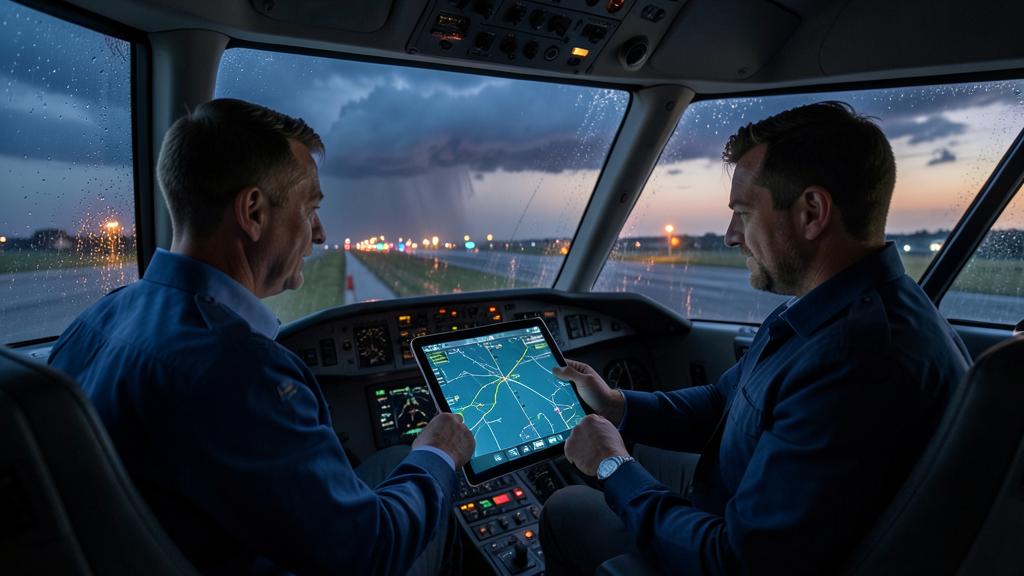
“Weather, terrain, traffic.” The briefing lasted forty seconds and could have been recorded once and replayed forever: nothing in what was just announced sets this flight apart from yesterday’s. It is the most common flaw in flight preparation, and it costs nothing — until the day the threat nobody named forces a fast, low decision with no fallback plan.
A Threat Is Not a Danger — It Is What Makes This Flight More Costly
The vocabulary of threat and error management is more precise than the way it is commonly used. A threat is an event or condition that lies outside the crew’s influence, that increases the operational complexity of the flight, and that must be managed to preserve margins. An error is a crew action or omission that departs from intention or procedure. An undesired aircraft state is a position, speed, configuration, or attitude that significantly reduces those margins. The three follow one another, but the sequence is never inevitable.
What this vocabulary contributes is a distinction that the word “danger” blurs: a threat is not dangerous, it is costly. It consumes attention, time, and options. A wet runway does nothing on its own; it removes braking margin, it forces a calculation, it narrows the choice of exits, and it suddenly makes a few knots of excess speed on short final expensive. Taken in isolation, none of an ordinary day’s threats poses a problem. It is their concentration within the same minute that does.
A second distinction matters even more. Threats fall into three families according to what preparation can do about them: those that can be anticipated, because they appear somewhere in the flight documents; those that arise, because no document announced them; and those that are latent, because they are lodged in the system well before the flight and cannot be seen from the flight deck. The whole work of preparation consists of growing the first family at the expense of the second. It does not consist of eliminating threats: no amount of preparation erases a crosswind.
A threat is not a danger itself, but something that makes the flight harder. It forces pilots to use more time and attention, which can lead to mistakes. Some threats can be predicted from documents, others appear suddenly, and some are hidden in the system. Good preparation means spotting as many as possible before takeoff.
On a Boeing 737-800 landing at an airport with a 2,000-meter runway in wet conditions, the crew must calculate a 10% increase in landing distance. If they also have a tailwind of 8 knots, this adds another 15%. The runway suddenly becomes too short, forcing a go-around. The threat wasn’t dangerous by itself, but the combination of wet runway and tailwind made it costly.
The Test for a Threat List: It Must Be Wrong Tomorrow
A list that fits any flight carries no information. That is the only test that matters, and it is easy to apply: reread what you just announced and ask whether it would have been different on yesterday’s leg. If the answer is no, it is not preparation, it is a ritual — and a ritual never triggers, because it names nothing to watch for.
A usable threat comes in four parts, and two are almost always missing. First the statement, dated and located: not “the weather,” but the line of convective activity that, at the expected arrival time, will be at the edge of the forecast window. Then the consequence, expressed in what it takes away: how many minutes, which option lost, which margin eaten into. Then the countermeasure, with who executes it — a countermeasure with no owner is executed by no one. Finally the observable and its threshold: what will be seen if the threat materializes, and the value at which the plan changes. The two parts that are usually missing are the last two, and those are precisely the ones that drive action.
The opposite failing is just as sterile: the exhaustive list. Fifteen announced threats are worth zero retained threats, because nothing ranks them and the flight deck’s working memory cannot hold fifteen. Three to five, chosen deliberately, are worth more. The selection criterion is not imagined severity but the product of two quantities: the probability that the threat will actually materialize on this flight, and the cost of handling it late rather than early. This product sorts better than intuition, because it pushes down unlikely catastrophes and pushes up certain annoyances.
| Source | Ritual statement | Usable statement | Triggering observable |
|---|---|---|---|
| Terrain | “watch the terrain” | runway in use at arrival time shorter than the main one, high-speed exit closed, required distance recalculated at arrival weight | required distance exceeds available distance with the braking action actually reported |
| Weather | “weather to monitor” | convective line at the edge of the forecast window at our arrival time, arriving via the exposed sector | arrival sector still occupied when descent is due to begin |
| Aircraft | “we have a deferred item” | deferred item that removes exactly the capability needed for the planned approach if visibility drops | forecast visibility falling below the minima of the only remaining available approach |
| Crew | “recent crew” | less effective cross-monitoring: both seats are new to the terrain and the working language is no one’s native tongue on the frequency | a deviation called out by one seat gets no response from the other |
Terrain, Weather, Aircraft, Crew: Four Sources That Do Not Read the Same Way
Terrain
What matters is almost never the figure printed on the chart. A runway length says nothing until it is checked against the required landing distance at the expected weight, on the expected surface condition, with the expected braking action and the exit you actually intend to use. Three points deserve to be searched for systematically because they are hard to discover in flight: the published go-around gradient, and the fact that an emergency procedure after engine failure, where one exists, generally does not follow the published go-around; the cold-temperature altitude correction, which shifts minimum altitudes exactly where terrain does not forgive mistakes; and the category the operator has assigned to the aerodrome, with the familiarization it requires of the commander. On the ground, the same rigor applies: hot spots, intersections where a clearance is expected, the single taxiway where a U-turn is not possible.
Weather
A forecast gives a window, not an instant. The useful question is therefore not “what weather is forecast” but “at our time, are we in the middle of the window or at its edge,” because the edge is where the forecast is wrong. Two pieces of information deserve to be requalified before use. A braking action report has an author, a time, and a runway portion: all three matter, and a report that is already an hour old on a runway where it is snowing is no longer data, it is a memory. A crosswind value, meanwhile, is compared against three distinct figures that get confused: the value demonstrated in certification, the limit set by the operator, and the effective limit once surface condition is taken into account. Finally, deicing fluid holdover time is consumed in the queue, not at takeoff: it is a threat whose clock runs while you watch it.
Aircraft
A deferred item is not “something broken.” It is a modified procedure and consumed redundancy. The right question is not “is it acceptable for departure” — the answer is yes by construction, otherwise the aircraft would not be dispatched — but “does this item intersect the approach we are planning.” Equipment deferred with no consequence in clear weather can remove exactly the capability that would be needed on arrival if visibility drops, and that intersection is only visible by reading the item and the approach together. Two other points deserve the same scrutiny: differences between airframes of the same fleet, avionics standard or thrust rating, which shift thresholds thought to be known by heart; and extra fuel, the one countermeasure that can be decided almost for free on the ground and that cannot be manufactured in flight.
Crew
This is the source people allow themselves to name the least, because it seems to put people at fault. It puts no one at fault: it describes a level of redundancy. Two pilots new to the type, a commander freshly checked out with a first officer who does not know the terrain, a working language that is no one’s mother tongue on the frequency — in each of these cases, the cross-monitoring that makes the flight deck safe is less effective than usual. This is offset by making callouts more explicit and crewing the leg accordingly, which is a preparation decision, not a judgment. In single-pilot operations, this reasoning no longer holds: there is no second seat to notice the deviation, and the countermeasure shifts to what was written before the flight — a threshold noted on the preparation sheet stands in for the callout that would otherwise be made to someone. This is the case where anticipation stops being a comfort and becomes the only redundancy available. Fatigue follows the same logic: it is not a moral failing, it is a state that must be declared, because once declared it becomes a manageable threat instead of a hidden variable. The flight deck is not alone either: the cabin crew hold information they only pass on when asked, and when that question is asked is itself part of preparation.
Timing Costs More Than the Threat Itself
A flight’s threats are not evenly distributed. They are concentrated for the most part in the same window, between top of descent and landing — exactly where the workload is already highest. A list that merely enumerates does not see this phenomenon. The same list laid out on a timeline shows it immediately: several items demand attention within the same handful of minutes.
It is this collision, not the threat taken in isolation, that produces most errors. The practical consequence is that anticipation is not a mindset but an operation of relocation: nothing is removed, what can be moved earlier is moved earlier. The arrival briefing before top of descent rather than in the middle of it. Landing performance calculated with the expected parameters before it is needed. Aerodrome information taken early, then reviewed. The cabin secured before the turbulent layer, not during it. None of these actions removes a threat; each moves it out of the window where it would have added up with the others.
This means accepting a higher workload at a moment when nothing forces it, which is counterintuitive and costs discipline. It is also the one place where preparation produces an effect directly observable on the flight deck.
The trap: a carefully built briefing feeds plan continuation bias. The more effort a plan has cost, the harder it is to abandon, and the crew that has just spent twenty minutes building an arrival is the one that will find it hardest to discard it once the condition it rested on has changed. A thorough briefing is therefore not in itself a protection against obstinacy: it is an ingredient of it, unless it explicitly names what would invalidate it.
Saying the Threat Out Loud Lowers the Cost of Intervening
The product of a briefing is not the transfer of information. Both pilots have read the same documents, and reciting what the other has already read teaches no one anything. The real product is twofold: a shared mental model, and above all, a lower cost of intervening.
This second effect is the most underrated. A threat named before the flight turns a subsequent go-around into the execution of an agreed plan, instead of a challenge addressed to the other seat. This is not a matter of politeness: what is at stake is the delay between the moment a pilot sees something and the moment they say it, and that delay grows whenever speaking up also means disavowing a plan. Naming the threat on the ground removes that second burden, and only that one.
This is where the value of a pre-decided threshold comes from. A decision made at the instant the threat materializes is made under the day’s highest workload, with the most effort already invested in the plan under way, and the least time available. The same call, stated on the ground, is made with none of those three constraints. It still has to be sayable, meaning it must carry a value, an observable, and an owner. “If the reported braking action drops below what our performance requires, we divert” can trigger. “We’ll keep an eye on braking” never triggers, because there is no identifiable instant at which one stops keeping an eye on something.
The right habit: revisit each threat as it becomes current, not only at the briefing. Two sentences suffice — restate the observable, restate the threshold. A threshold stated thirty minutes earlier and never revisited behaves as if it had never been stated, because it is not memory that triggers a countermeasure, it is attention paid to the right parameter at the right moment.
What the Crew’s List Cannot Reach
A threat list only sees what is visible from the flight deck at the moment it is built. The rest exists nonetheless, and often weighs more heavily: the rotation that placed this crew on this leg, the turnaround time that assumes no delay occurs, the chart whose ambiguity only surfaces under pressure, the procedure written for a different fleet variant, the same item deferred on the same aircraft week after week. These threats cannot be briefed and cannot be fixed in flight. They must be reported.
A useful report is not an incident story. It is the description of a condition, of what it cost in time and attention, and of what would have made it a non-event. Written this way, it feeds the one thing the crew cannot produce on its own: aggregation. A chart ambiguity reported once is an anecdote; reported by a dozen crews, it is a chart-amendment case file.
All this still has to be checked against one’s own documentation, the only source that carries authority. Four points are worth verifying by name, because they vary from one operator to another: the briefing standard, which states what must be announced and in what form; the stabilized approach criteria and the cases where a go-around is mandatory rather than discretionary; aerodrome categorization and the familiarization it entails; and finally crew pairing restrictions, which sometimes rule out precisely the combination one was about to treat as a simple threat to be announced.
A gray area remains that no one fills: nothing states how many threats a crew can actually hold at once. The operator’s standard sets a form, not a capacity, and the gap between the two is settled in flight, by feel. For anyone preparing for a command upgrade or a line check, this is precisely where the evaluation happens: what is observed is not the recitation of a list, but discrimination — three threats retained, the reason for that choice, and what had been decided in advance. The scenarios in the FL330 training programs work on exactly this skill, and the debriefs shared on the FL330 technical forum show it is the longest one to acquire, well after mastery of the procedures.
The applicable regulation, the operator’s operations manual, and the aircraft’s approved documentation take precedence over this article, whose purpose is to explain a mechanism, not to substitute for them.
Questions fréquentes
What exactly is the difference between a threat and an error?
A threat is an event or condition outside the crew’s influence that increases the complexity of the flight: a contaminated runway, a deferred item, unfamiliar terrain. An error is an action or omission by the crew itself that departs from intention or procedure. The distinction is operational: a threat is managed with a prepared countermeasure, an error is detected and corrected through cross-monitoring. Confusing the two leads to looking for someone to blame where a countermeasure was needed instead.
How many threats should be announced at the briefing?
Three to five, deliberately selected, are worth more than an exhaustive list. Beyond that, nothing is ranked and the flight deck’s working memory cannot keep up: fifteen announced threats behave like none at all. The selection criterion is not imagined severity but the product of the probability that the threat materializes on this flight and the cost of handling it late rather than early. What is left out of the briefing does not disappear: it stays written in the preparation, simply not armed.
Is fatigue a threat or a fitness issue?
Both, depending on its degree, which is exactly why it must be declared. Below the threshold that makes someone unfit, fatigue is a threat like any other: it reduces available capacity and the speed at which deviations are detected. Declared, it becomes manageable — tasks are moved earlier, callouts are made more explicit, crewing is adjusted for the leg. Undeclared, it remains a hidden variable that degrades cross-monitoring without anyone knowing why.
Should the briefing be redone when the situation changes?
What has changed should be revisited, not everything restated. A threshold stated thirty minutes earlier and never revisited behaves as if it had never been stated, because it is not memory that triggers a countermeasure but attention paid to the right parameter at the right moment. Two sentences are usually enough: restate the observable and restate the value. If the condition the plan rested on has disappeared, it is the plan that needs revisiting, not just the briefing.
Does a threshold announced on the ground actually commit the crew?
It has no regulatory value by itself, but it changes the nature of the decision that follows. A decision made the instant the threat materializes is made under maximum workload, with a great deal of effort already invested in the plan under way and little time available. The same call, stated on the ground, is made without any of those three constraints, and it turns a subsequent go-around into the execution of an agreed plan rather than a disavowal of the other seat. Thresholds imposed by the operator, on the other hand, apply regardless of what was announced.
How can you tell if your threat list is any good?
Apply two tests. First: would this list have been different on yesterday’s leg? If not, it carries no information and will not trigger. Second: does each announced threat carry an observable, a value, and an owner? A threat with no observable cannot be noticed, a threat with no value cannot be crossed, and a countermeasure with no owner is executed by no one.


Leave a Reply
You must be logged in to post a comment.