

An aircraft lands with a damaged landing gear. No one is injured, and the aircraft reaches the parking area under its own power. Three hours later, power has been restored, a technician has run an integrated test to understand an alarm, the aircraft has been refueled, and it has taken off for the next leg. None of these decisions were faulty: everyone did their job. Yet almost nothing remains of what an investigation would have wanted to read. Here’s what the operator protects in the first hours, in what order, and by what ordinary actions the most common traces disappear.
“Don’t touch anything” only covers half the problem
The rule is known to everyone and it is correct: at an accident site, nothing moves. It only has the flaw of designating the best protected place in the entire affair. A wreck is sealed, guarded, and placed very early under the control of the competent authority according to the rules of the concerned State, and the metal does not degrade quickly. What disappears in the first hours disappears elsewhere: in a recording loop that continues to run, in a fuel tank that is being emptied, in a server that applies its purge rule at midnight, in the memory of a crew that is left to discuss among themselves in the rest area.
The second blind spot lies in the role. The operator is not the investigator, and the distinction is not only procedural: it separates two types of actions. A preservation measure freezes the state of something without consuming it—cutting off a power supply, immobilizing an aircraft, sealing a vial, sending a freeze order. An investigative act, on the other hand, consumes what it examines: powering up a bay to read a fault code, removing a computer, draining a circuit. The first is expected of the operator, the second is outside their remit until the investigative authority has spoken.
This boundary is easy to state and difficult to maintain, because an investigative act looks very much like a normal maintenance action. No one in a hangar considers that an integrated test is a destructive operation; yet, on an aircraft that has not been destroyed, it is the most frequent cause of evidence loss. The useful question is therefore not whether the operation is authorized, but whether it is reversible.
The operator must freeze evidence without altering it, while investigators may need to examine and potentially destroy it. The key is to avoid actions that erase data, even if they seem routine.
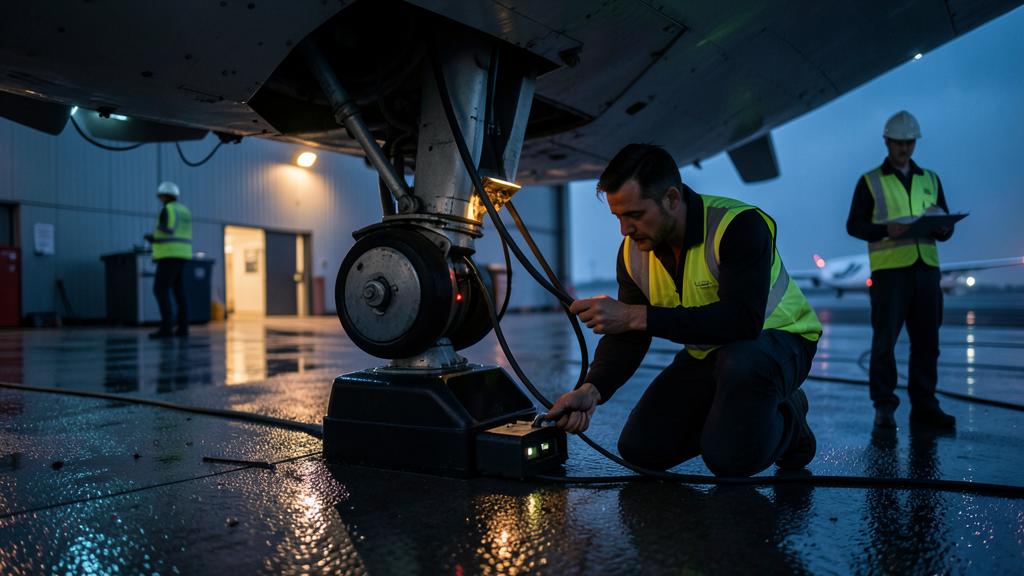
On an Airbus A320 with a landing gear issue, a technician runs an integrated test to clear a fault code. This test erases the fault memory, which could have been critical for investigators. The test was routine, but it destroyed evidence.
Classify by lifespan, not by importance
The natural reflex is to start with what seems most important: the recorders, the debris, the aircraft documentation. That’s the wrong criterion. In the first hours, the order of priority is not set by the probable value of a trace, but by the clock that concerns it. An essential but stable trace can wait several hours without damage; a secondary but volatile trace is lost forever.
Four clocks run in parallel, and they do not have the same speed or visibility. Recording loops overwrite the old with the new, mechanically, without anyone deciding anything. Physical degradation carries away the samples, the ground traces, the frost, the tire marks: a downpour is enough. Human memory, on the other hand, does not erase itself, it reorganizes—and it does so all the faster as the witnesses talk to each other, hear an external version, or sleep poorly. Administrative purge cycles, finally, are the most complete and the least visible, because they are written in a contract or a protocol that no one reads on the day in question.
The following classification sorts by window of action and not by importance: the order of work it gives is not that of intuition.
| Trace | What erases it | Useful window | Conservatory action |
|---|---|---|---|
| Cockpit voice recorder track | The loop, as long as the recorder remains powered | The minutes that follow | Cut off the power, note the time and the author |
| Recorded flight parameters | The following steps of the aircraft | The flights of the day | Immobilize the aircraft, refuse to tow it |
| Fault memories of the computers | The power-up and the integrated test | The first technical intervention | Prohibit any non-vital power-up |
| Airport video surveillance images | The overwrite loop of the airport operator’s system | A few days, depending on the installation | Written request for preservation, dated |
| Fuel, oil, deicing fluid | The consumption and dispersion of the batch | A few hours | Sample in duplicate, seal, label |
| State of the site: marks, frost, light debris | The weather, the traffic, the cleaning | The first downpour or the night | Photograph with scale before any movement |
| Crew and witnesses’ memories | The discussion among themselves, fatigue, external accounts | The first hours | Individual, written, strictly factual collection |
| Voice and trajectory data | The service provider’s retention cycle | Variable, never guaranteed | Preservation request relayed by the authority |
The recorders: the only thing to do in the minute
A recorder records as long as it is powered. This sentence contains the entire problem. On an aircraft that has landed and is taxiing, the event is not erased by the accident: it is erased by the taxiing, by the auxiliary power unit that is running at the parking stand, by the post-flight checks, by the ordinary minutes that follow. The cockpit voice recorder track is the most exposed, its loop typically being on the order of two hours on many aircraft in service, thirty minutes on the oldest, and significantly longer on the most recent generations. The flight data recorder is more generous, on the order of a long day of operation, but an aircraft that takes off again consumes this reserve in a few legs.
Hence a single reflex, and it is mechanical: as soon as the safety of people and the aircraft allows it, cut off the power supply to the recorders via the circuit breaker identified in the operator’s documentation, then note who did it and at what time. This action does not need to be arbitrated or escalated for validation: it is a preservation measure, reversible, and its cost is zero. On the other hand, attempting to extract the data oneself is not. Reading a recorder is an investigative act, which is carried out at the request of the authority and with its means; an improvised extraction at the very least exposes the data to a challenge on the integrity of the medium.
The same reasoning applies to everything that records in a loop, on board and on the ground: quick access recorder, on-board maintenance systems, non-volatile memories of computers, airport video devices. None of these media is protected by access restriction; they are protected by operational restriction, i.e., by the immobilization of the aircraft and the refusal of any power-up that is not essential to safety.
The documentary freeze, and the purges it must reach
The most profitable action of the first hour does not take place on the field: it is a written order, short, issued by a person specifically designated in the emergency plan, which suspends any destruction, modification and automatic purge concerning the aircraft, the crew, the flight and the period in question. It does not need to be elegant or exhaustive. It needs to be dated, traceable and sent quickly.
Its internal scope is obvious: maintenance information system, technical logbook, flight preparation files, weight and balance, refueling, turnarounds and flight times, training and control files. Two points are regularly forgotten. The flight data analysis program, first: it relies on a protection protocol that provides for rapid de-identification and destruction of raw data at the end of an agreed period, and if this protocol does not explicitly address the case of the event, the suspension of the purge becomes a negotiation at the worst time. Write access, next: a maintenance file that remains modifiable during the opening of the investigation loses part of its evidentiary value, even if no one has modified it.
But most of the perishable traces are not with the operator. They are with third parties who have no reason to keep them and a contract that allows them to destroy them.
The right reflex: a single written freeze order, sent before any analysis. A pre-written page in the emergency plan, whose list of internal and external recipients is already filled in and kept up to date, transforms a long coordination into a few minutes of sending. The indicator that counts is not the quality of the text’s drafting, but the time between the notification of the event and the acknowledgment of receipt from the last external recipient.
On site: nothing moves without a trace
Three reasons, and only three, justify moving something before the arrival of the investigators: save a life, remove a new danger—spilled fuel, fire, accumulated energies, pyrotechnic devices, pressure bottles, composite dust—or remove the wreck from imminent destruction, tide, traffic, weather. Everything else waits, including what hinders operations.
When the movement is justified, it is paid for by a trace: photograph before any movement, with a scale and a fixed reference in the frame, position noted, then a line in the register indicating who, when and why. An object moved without a trace is no longer evidence, it is noise, and it will waste more time for the investigation than it would have taken to photograph it.
The rescue services, on the other hand, will cut, force and move: that is their mission and it takes precedence. The useful act of the operator is not to hold them back, but to collect their description while they are still on site—what door was forced, what structure was cut, what equipment was removed, in what order and at what time. This memory is as perishable as the others, and no one will think to ask for it three days later.
The chain of custody, finally, is not a legal formality: it is a single register, kept by a designated person, one line per object, with a seal and a label bearing the date, the place and the author of the sample. An operator who does not have this register from the first day will never have it, and the objects they have recovered in good faith will become unusable for lack of being able to say where they come from.
Two investigations, one site
On the same wreck, two logics meet that do not pursue the same goal. The safety investigation, conducted by an independent authority, seeks causes to prevent and does not attribute fault or responsibility. The judicial procedure seeks to establish responsibilities. In many States, the scene comes under the control of the judicial authority while the safety investigator has a right of access to the elements: both work on the same object, with different rules and sometimes incompatible schedules.
The operator does not arbitrate between them and does not have to. Its rule of conduct is in three points: respond to both, precisely trace what is handed over, to whom and when, and never let an original leave without a receipt. The point of contact must be unique, otherwise two services will answer differently to the same question on the same day—and that contradiction never goes away.
| Safety investigation | Judicial procedure | |
|---|---|---|
| Purpose | Understand to prevent | Establish responsibilities |
| Who conducts | Independent investigative authority | Judicial authority of the State |
| Relationship to the wreck | Right of access to elements and data | Control of the scene and the seals |
| What the operator hands over | Available data, documents and persons | What is required, against receipt |
| Use of the information | Prevention, without attribution of fault | Building a file |
| Pace | Findings, then public report | Schedule specific to the procedure |
A practical consequence little anticipated: everything that the operator writes in the first hours will exist for a long time and will be read later, in a framework that it does not choose. Internal notes, coordination emails and tracking tables are intended to record facts—times, people, actions, observed states. Technical hypotheses have no place: they are useless at this stage and age poorly.
What the operator does not do
The list of abstentions is shorter than that of actions, and more difficult to maintain, because each line resembles a service rendered to operations.
- No independent technical investigation. No integrated test, no erasure of fault codes, no removal of computers, no draining or purging of circuits, no washing, no towing beyond the strictly necessary.
- No collective debriefing of the crew. The collection is individual, written, factual, as quickly as the state of the persons allows, and separated from any disciplinary process. A sharing of memories creates a single account and destroys without return the independence of the testimonies.
- No technical hypothesis made public. The communication of the first hours concerns the persons and the established facts, never the causes or the supposed chronology.
- No disposition of the aircraft or the parts. No return to service, no return to the lessor, no repair, no return of components under warranty as long as the authority has not released what it retains.
The trap: the aircraft that returns intact. A serious incident without visible damage does not trigger any preservation reflex, because it does not look like an event. The aircraft continues its program and the parameter loop is rewritten in a few legs; the first troubleshooting intervention erases the fault memories to check if the fault returns; the suspect part goes to the supplier under warranty and sometimes leaves the territory before the classification of the event is finalized. Then only the memories and the logbook remain.
This case of the event without apparent damage is the one where the loss is the most complete, precisely because no strong signal comes to interrupt the routine. It is not treated by a reminder of vigilance: it is treated by giving a duty officer the power to immobilize an aircraft without having to demonstrate, within the hour, that the event will actually be classified as serious.
What to check in your emergency plan
Five questions are resolved by reading the emergency plan and reveal its essence. Who, by name and reachable at night, has the power to issue the freeze order without prior hierarchical validation? Is the list of external holders of traces written, up to date, and do the contracts include a clause allowing the request for preservation? Does the flight data analysis program protection protocol explicitly provide for the suspension of purges in case of event? Is the recorder circuit breaker known to the crew and ground personnel without opening a manual? And who holds, on each base and each stopover, the chain of custody register and the means to seal?
A gray area remains, and it does not close. The classification of an event—accident, serious incident, incident—is generally decided several hours after the facts, often after consultation. The perishable data, on the other hand, die in minutes. Waiting for the classification to preserve means preserving only the obvious accidents, i.e., those where preservation brings the least. The only tenable rule reverses the order: preserve first, classify later. The cost of the error is not symmetrical—a few hours of immobilization on one side, a definitive loss on the other.
For those on duty, this is the point to work on in priority: these actions are not improvised at 3 a.m. The exchanges between practitioners on the forum FL330 give a useful idea of what others have written in their own plan, and what they had to correct after an exercise.
The applicable text, the instructions of the safety investigation authority, and the operator’s approved documentation prevail over this article, which describes a mechanism and not a binding rule.


Leave a Reply
You must be logged in to post a comment.