
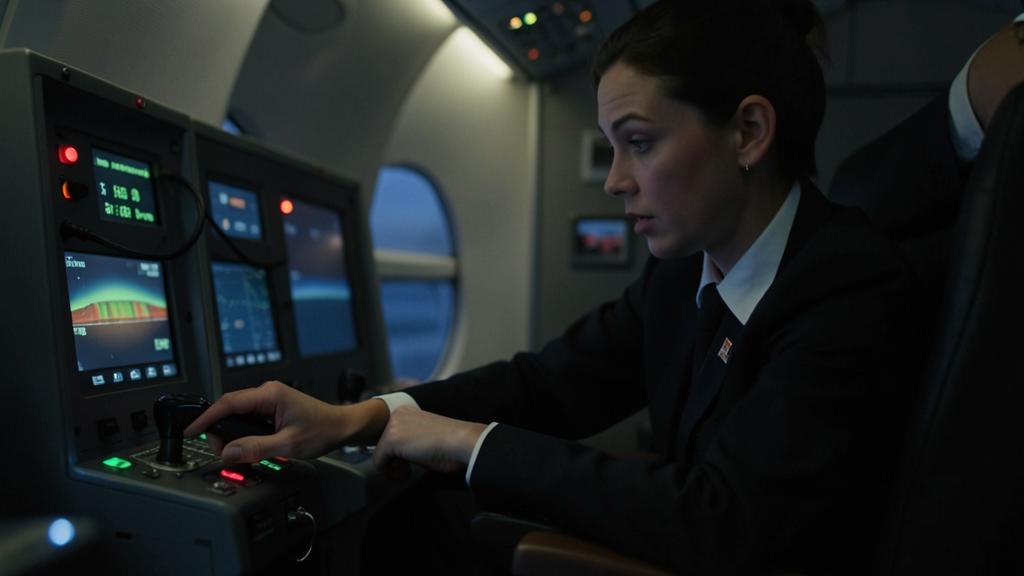
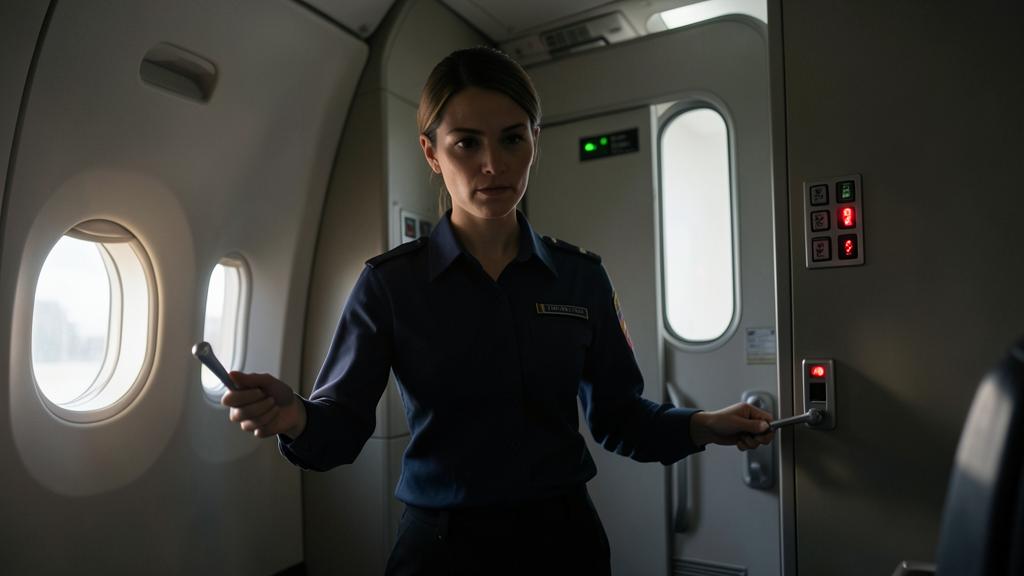
A cabin crew member with several years on one type and a few months on a second one almost never gets the required action wrong: what goes wrong is which hand moves. The arming lever sits in the same place, the indicator window looks like the other one, the sequence starts exactly the same way — right up to the point where the action itself diverges. Interference between two types therefore isn’t addressed by repeating knowledge already acquired, but by breaking the chain precisely where it forks. Here is where it lodges, why it worsens with experience, and what training centres actually do about it.
What transfers, what interferes
Two types don’t stack in the mind like two folders in a cabinet. What is learned settles at three distinct levels. Knowledge, which is recited and checked in writing. The rule, which is applied by telling oneself ‘if this, then that’, and which costs time and attention. Finally the automatism, which runs without passing through consciousness and is triggered by a perceived cue, not by reasoning. The first level poses no problem from one aircraft to another: nobody confuses the number of exits. The third is the only one that interferes, because it carries no label of origin: an automatism does not know which aircraft it was acquired on.
Interference moreover, does not appear wherever two types differ. It requires a precise condition: that the triggering cue be the same while the expected action diverges. Where everything differs, the body finds no purchase and attention remobilises itself — one searches, and therefore thinks. Where the lever sits at the same height, with the same grip, but pushes instead of pulls, nothing gives warning. Hence a result that runs against intuition: two closely related types are more treacherous than two unrelated types, and a variant of the same type, handled with a light differences course because the procedure’s structure is shared, sometimes deserves more vigilance than an entirely new aircraft.
The rest of the time, resemblance works in the crew’s favour: the logic of cross-checking, the discipline of the callout, the rhythm of a departure preparation all carry over without effort. The aim, therefore, is not to prevent transfer, but to isolate the minority of actions for which it leads to error.
The brain learns procedures in three ways: knowing facts, following rules, and acting automatically. The danger comes from automatic actions, because they don’t know which aircraft they belong to. When two types look similar but require different actions, the brain can mix them up, especially if you’ve flown one type much more than the other.
On an Airbus A320, the door arming lever is pulled to arm, while on a Boeing 737, it’s pushed. Both levers are in the same place and look similar. A crew member who mostly flies the A320 might automatically pull the 737 lever, which would fail to arm the door, delaying an evacuation.
The four areas where confusion takes hold
Doors come first, by a wide margin. Arming follows two very different design principles: on some equipment, a bar is released and then engaged into floor pins, a physical, visible action that leaves a trace; on others, a lever flips an internal mechanism and nothing visibly moves except an indicator. Cross-checking therefore does not bear on the same thing. Added to this are the direction in which the lever operates, the meaning of the colour shown in the indicator window — red means armed on one type, it signals the position to move away from on another — the weight and travel of the door leaf, hence the body position and the use of the assist handle, and finally the slide principle: inflation on opening or an emergency lanyard, one lane or two, forming a raft or not. Overwing exits add a third family of actions, spanning the removable window to be jettisoned, the hinged hatch, and the exit fitted with a slide.
Oxygen comes next, with a particularity: it isn’t the action that differs, it’s the number of steps. Some portable cylinders offer a choice of flow rate, others a single fixed-flow outlet; someone coming from equipment with two outlets looks for a selector that doesn’t exist, while someone coming from the other simply takes whatever flow rate is delivered. The same pattern applies to the smoke hood: the generator is triggered by donning it on some models, by a separate action on others, and endurance is fixed by the equipment — the mental countdown is therefore not transferable.
Interphone is the most treacherous area because the error there is immediately public. The emergency link to the flight deck is obtained, depending on the installation, by a dedicated key, by a code dialled on the handset, or by a prolonged hold. Dialling the other type’s code may produce nothing at all — a loss of seconds — but may also open a cabin announcement, broadcasting to passengers what was meant to stay between crew members. The return signalling diverges just as much: number of chimes, colour and location of the call light, and the distinction between a call from a colleague and one from the flight deck. An identical sound signal that does not indicate the same origin is exactly the capture configuration.
Evacuation and firefighting, where the operator generally standardises terminology and standard commands — but the equipment itself is not harmonised: location of the alarm control, whether or not it can be triggered from the cabin, and the type and position of the extinguisher assigned to each station. An identical verbal instruction then points to a different geography.
| Area | What appears identical | What diverges | Cue to point out before acting |
|---|---|---|---|
| Doors and slides | Lever position, hand grip, cross-check sequence | Direction of operation, arming principle, meaning of the indicator colour, weight and travel of the door leaf, type of slide | The indicator window and its legend, never the handle alone |
| Portable oxygen and smoke hood | Cylinder shape, valve opening, pressure check | Whether a flow-rate choice exists, how the generator is triggered, endurance fixed by the equipment | The outlet actually used and the value read on the pressure gauge |
| Interphone and flight deck call | Handset, keypad, location at the work station | Code or key that reaches the flight deck, code that goes out as a public announcement, return signalling | The legend printed on the handset, reread before dialling |
| Alarm and firefighting | Terminology and standard commands harmonised by the operator | Location of the alarm control, whether or not it can be triggered from the cabin, extinguisher assigned to the station | The station check carried out at boarding |
The trap: treating colour as a procedure, and the variant as a detail. A red indicator does not necessarily carry the same meaning from one manufacturer to another, nor sometimes from one generation to another within the same manufacturer: here it indicates the armed state, there it signals the position to move away from. Whoever has memorised ‘red means armed’ rather than the displayed legend carries a false rule from one aircraft to another. The same mechanism applies to the variant: because the differences course is shorter, one concludes that the gap is minor, whereas it is precisely the closeness of everything else that makes the divergent point invisible.
Why the risk rises as experience rises
Seniority never distributes flights equally. Rostering, base, fleet and seniority almost always produce a dominant type and a minority type, and the gap widens over the years. Yet automatism is not built by elapsed time but by repetition: the type flown several times a week quickly reaches the depth at which the action stays correct despite noise, fatigue and stress, whereas the one that comes back only once a month, or even more rarely, plateaus at the level of the rule, the level that requires telling oneself what one is doing. When the two chains start the same way, it is the deeper one that wins out. Seniority, which is reassuring about everything else, therefore precisely aggravates this imbalance.
Three circumstances tip this balance of power the wrong way. Stress, first, which narrows attention and pushes towards the most readily available response; that is exactly the definition of the dominant chain. Fatigue and night flying, next, which cost at the level of the rule without costing anything to the automatism, thus disadvantaging the minority type. Changing aircraft mid-duty, finally: the first leg after a switch is the one where perceptual priming remains that of the previous aircraft, and where the hand was confirmed in its habits only a few hours earlier. These three circumstances readily stack up towards the end of a night rotation.
What differences training does, and what it doesn’t
The regulatory framework is consistent: initial safety training, type-specific training, adaptation to the operator’s methods, then differences training and familiarisation when an aircraft is added or equipment changes, the whole maintained by periodic training covering each type operated. The European regulation on air operations further caps the number of types on which the same cabin crew member may be operational, and grants an additional allowance only with the approval of the competent authority, where the equipment and safety procedures are close enough and the operator demonstrates that it controls the risk of confusion. The logic of the text is indeed that of interference, not that of workload.
The fact remains that how one teaches matters more than how much is taught. Presenting the second type as a self-contained block produces, in the mind, a second complete procedure that closely resembles the first: the trainee comes out with two nearly superimposable sets and no signal at the points of divergence. Contrastive teaching does the opposite — the two pieces of equipment side by side, only the diverging points addressed, the error produced in the classroom so that it stays there. It is shorter, but it presupposes a differences table kept up to date and revised with every fleet change.
| Criterion | Sequential teaching | Contrastive teaching |
|---|---|---|
| What is presented | The complete procedure of the second type, as a self-contained block | Only the pairs where the cue is shared and the action diverges, shown side by side |
| What the trainee takes away | A second, closely resembling procedure, with no signal at the forks | A map of the forks and the cue that signals each one |
| Where the error appears | In line operations, under stress, on a point never identified as divergent | In the classroom, on the point addressed, hence observable and correctable |
| What it requires of the operator | Course time, partly spent on what is already known | An up-to-date differences table and two pieces of equipment available together |
What the classroom does not do, however, is rewire the action. Knowledge of the differences is acquired sitting down; perceptual discrimination is acquired standing up, in front of the equipment, by repeating the recognition of the cue before the action. A course that lists without letting people touch leaves the practitioner with a list they can recite and a hand that will keep moving towards the other type.
Disambiguating: placing a cue before the action
All the effective countermeasures come down to a single operation: inserting, between the situation and the action, an element that belongs to only one type. As long as the chain runs from situation to action without a detour, it forks unwitnessed. As soon as an explicit cue must be recognised and named, the action drops back down from the level of automatism to that of the rule, where the error becomes visible again to the person making it. Automatism is not eliminated — it is made to pay a toll.
Four devices put this principle into practice, under varying names, at operators that carry several types. Spoken pointing, first: the hand stops on the indicator, the index finger points to it, the mouth says what it reads before the action begins. The briefing callout of the type and its differences, next, limited to three or four turning points so it stays in memory — an exhaustive list is not learned, it is filed away. The station check at boarding, carried out action by action rather than with a sweeping glance, serves as perceptual re-priming and is worth more than rereading documentation. Finally, anchoring on a unique cue: one does not memorise ‘the lever’ but ‘the square-window lever’, that is, the element the other aircraft does not have.
The right reflex: the hand stops on the indicator, not on the handle. Before any arming, disarming or opening action, point to the indicator, read the displayed legend and announce out loud the type, the mode and the door — in that order. The benefit is structural: the automatic chain can no longer run to completion without passing through an element that belongs to only one aircraft. The same reflex applies to the handset, whose legend is reread before dialling, never the other way round.
What to go and check for yourself
Five points vary from one operator to another and are read in one’s own approved documentation rather than in a memory of a course. What the operations manual requires as a callout and as a cross-check at door-mode changeover, and whether that wording is genuinely common to the types operated. What the differences table retains, whether it exists in a usable form or is reduced to two safety manuals placed side by side. How exposure per type is tracked, separately from currencies: an up-to-date currency says nothing about the number of weeks elapsed since the last flight on the minority type. The internal rules on changing aircraft mid-duty and on returning after an extended absence. Finally, the notification pathway: an action started and then stopped is only spontaneously reported if experience feedback has shown that it serves to correct the ambiguity rather than to point a finger.
The grey area is right there, and it is a stark one: nothing requires measuring exposure relative to the types carried, even though that is the only indicator that speaks to capture risk. A tracking system that knows only currency dates will declare compliant a crew member whose one of the two automatisms has gone cold. For someone preparing to add a type or return to an aircraft rarely flown, the expectation has shifted accordingly: what must be demonstrated is no longer the recitation of a procedure, but the ability to name one’s own forking points, to say which cue signals each one, and to carry out the recognition before the action in front of equipment untouched for weeks. This reasoning is worked on in training, and inter-aircraft differences tables are usefully compared on the forum.
The applicable regulation, the operations manual and the safety manuals specific to each type operated prevail in all circumstances over this article, whose purpose is to explain a mechanism, not to serve as a procedure.
Questions fréquentes
How many aircraft types can a cabin crew member operate at the same time?
The European regulation on air operations caps this number and makes any exceedance conditional on the approval of the competent authority, which is granted only if the equipment and safety procedures of the aircraft concerned are close enough and the operator demonstrates that it controls the risk of confusion. The exact figure and the conditions are set out in the applicable text and in the operations manual, which may be more restrictive. In practice, the constraint that actually bites is not the cap but exposure: two types carried in very unequal proportions already pose a problem that three well-balanced types do not.
Is a variant of the same type less risky than a second type?
Often the opposite. The differences training applicable to a variant is lighter because the procedure’s structure is shared, but it is precisely that shared structure that creates the condition for interference: the perceived cue is identical and only the action diverges. A slide with one lane instead of two, an arming lever operating in the reverse direction, or an overwing exit that changes principle are enough to produce a capture error, whereas an entirely different aircraft forces one to search, and therefore to think.
What should you do if you notice you have started the other type's action?
Stop the hand before the action is completed rather than correcting after the fact, return to the indicator, reread the displayed legend, then announce out loud what you are about to do: verbalising brings the action back down to the level of the rule and cuts the automatic chain. Then report the event through the operator’s notification pathway, even if it had no consequence. It is this kind of report that feeds the differences table and gets the ambiguity corrected for everyone.
Is periodic training enough to keep two types in good order?
It maintains currency, not necessarily the reliability of the action. Periodic training does cover each type operated, but it is spaced out, whereas interference depends on the relative freshness of the two automatisms, and therefore on the roster. A crew member who is perfectly current may not have operated the minority type’s door for several months. This is why tracking exposure per type, separate from tracking currencies, is the only indicator that speaks to the real risk.
How do you build a differences list that is useful rather than exhaustive?
An exhaustive list is not learned, it is filed away. A useful list keeps only the pairs where the perceived cue is the same and the action diverges, ranked by consequence: door arming and opening, triggering of emergency equipment, emergency call to the flight deck. Three or four points stay in memory and can be recalled at the day’s briefing; beyond that, one falls back into the document nobody rereads.
Is changing aircraft mid-duty a particular moment of risk?
Yes, and it is the most exposed moment of the day. The first leg after a switch is the one where perceptual priming remains that of the previous aircraft, on which the hand has just been confirmed in its habits a few hours earlier. The station check carried out on board, action by action and out loud, serves precisely as re-priming: it re-establishes the set of cues for the type about to be flown before the first demand arrives.


Leave a Reply
You must be logged in to post a comment.