
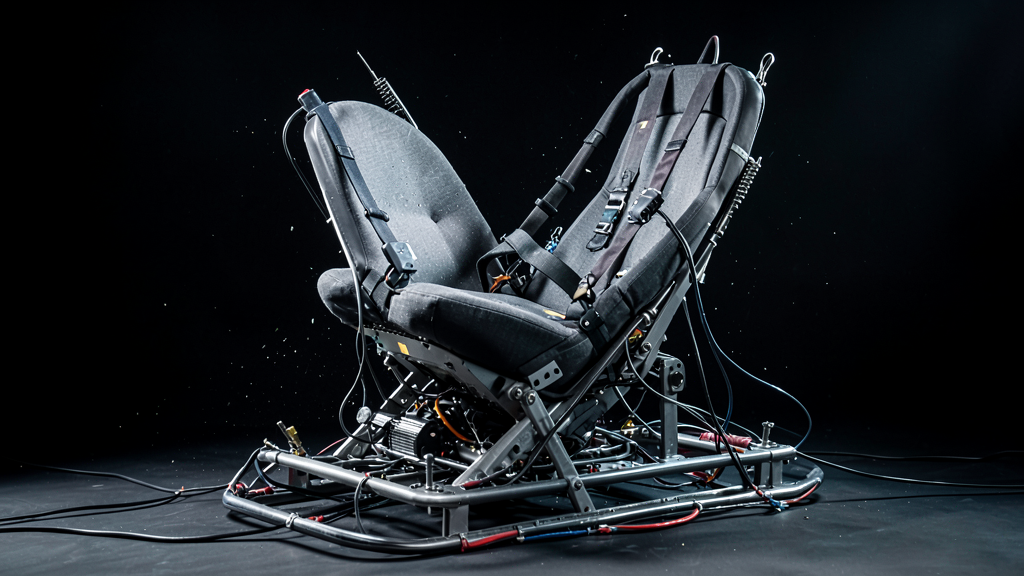
On a show stand a seat is a shape, a fabric and a lighting scheme, and a salesperson who can tell you what it weighs. On an aeroplane it is load-path hardware that has been decelerated on a sled, set on fire in three different ways, environmentally qualified, then argued about with an authority for longer than it took to design. The distance between the two is not marketing. It is a test chain, and it is why the seat you photographed at the show may not carry a passenger for another two years.
What the stand is actually showing you
Most of what appears at an interiors show is a styling buck: correct geometry, representative trim, and underneath it a structure never intended to be certified. That is not deception, it is sequencing. Industrial design converges in months; structural qualification converges in years, and against a target — a type, a certification basis, an installation — that the buck deliberately does not commit to yet.
The useful questions on a stand are therefore never about the fabric. They are about which article was tested, at what pitch, against which amendment level, on which airframe, and whether the parts on display came from the material lots that were burned. A supplier who answers those without looking anything up has a product; one who answers with a delivery date has a rendering.
Two pulses, and what each one is really asking
The centre of the exercise is the dynamic test. The emergency landing dynamic conditions — CS-25.562 in Europe, 14 CFR 25.562 in the United States, with equivalents in the smaller-aeroplane and rotorcraft codes — require the seat and its restraint to face two separate sled pulses, not one.
In the first, the seat is mounted pitched relative to the sled so that the deceleration passes largely down the occupant’s spine, because a survivable impact usually arrives with a large vertical component. In the second, predominantly longitudinal, the seat is yawed relative to the direction of travel: the question is whether the structure stays attached and the occupant stays inside it when the load is asymmetric. The yaw is the part people underestimate — a seat that is beautifully strong in pure fore-and-aft loading can fail a yawed pulse because the load path it was designed around no longer exists.
The longitudinal test adds a deliberately distorted floor. Where the seat is attached through floor rails or fittings, the paragraph requires adjacent rails or fittings to be misaligned from one another in pitch, with one of them also rolled: in a real impact the floor deforms first, and the seat has to survive being bolted to something bent. Many programmes meet their real problem there, in the fittings rather than the frame. Applying the same misalignment to the vertical test is a conservatism, not a requirement.
| Test | Geometry | What it is asking | Typical failure it exposes |
|---|---|---|---|
| Predominantly vertical pulse | Seat pitched relative to the sled | Does the occupant’s lumbar spine survive the vertical component? | Cushion and pan energy absorption, seat pan collapse behaviour |
| Predominantly longitudinal pulse | Seat yawed relative to travel | Does the structure stay attached and the occupant stay restrained when the load is asymmetric? | Track fittings, diagonal bracing, restraint anchorage |
| Longitudinal pulse, misaligned floor | Adjacent rails or fittings out of parallel, one rolled | Does it still work when the floor has already bent? | Fitting bind-up, leg splay, loss of a load path |
Note what the sled does not prove. It proves this seat, in this configuration, with this restraint, on this floor geometry. Change one of those and you are at best in a similarity argument, at worst back in the queue for a sled slot.
The sled tests check if a seat can protect a passenger in a crash. The first test simulates a vertical impact (like a hard landing), and the second tests sideways forces (like a skid). If the seat passes, it’s safe—but only for that exact setup. Change the seat angle, floor, or restraints, and you might need to test again.
On an Airbus A350, a seat tested at 16 g forward with 10° of yaw and a deformed floor (10° of pitch and roll) passed all dynamic tests. But if the airline later reduced the seat pitch from 31 to 29 inches or added a heavier monitor to the seatback, the head strike condition would need revalidation—even if the seat itself was unchanged.
The pass criteria are about the occupant, not the seat
The dynamic test is not scored on whether the seat survived. It is scored on what happened to the anthropomorphic test dummy sitting in it — which is the conceptual jump that separates people who have run a seat programme from people who have read about one.
The transport-category paragraph limits head injury, compressive load through the lumbar spine, and the loads carried by upper torso straps where fitted; the codes for smaller aeroplanes and rotorcraft add a femur load limit the transport-category ones do not. It also requires the belt to stay on the pelvis rather than riding onto the abdomen, the seat to remain attached even if it deforms, and nothing to come loose in a way that would block egress or injure an occupant. A seat can emerge visibly intact and fail, or visibly deformed and pass — deformation that absorbs energy is the point, not a defect.
The head injury criterion is where cabin layout collides with structure. The limit bites where head contact can occur, so the question becomes whether a strike is possible at all — which depends on pitch and on what is mounted on the back of the seat ahead: a monitor bezel, a literature pocket, a tray table latch, a hard edge added late by the industrial designer.
The trap. A seat is not certified « at a pitch range » in the abstract; its head strike condition is substantiated for defined installation conditions. Reduce the pitch after approval, or change the item mounted on the seat back in front, and you have changed that condition — which is how a reconfiguration that looked like a scheduling exercise becomes a re-substantiation exercise.
Where a clear head path cannot be shown, the answers are a breakover seat back, a redesigned back panel, or an inflatable restraint — each a design change with its own qualification tail, and the reason cabin designers fight over the last inch ahead of a bulkhead or an exit row.
Fire: three different questions asked of the same material
Flammability is where the naive mental model — « is it fireproof? » — does the most damage. The codes do not ask one question about cabin materials. They ask several, each with its own apparatus, each answering a different part of an in-flight or post-crash fire scenario, and a material can comfortably pass one and fail another.
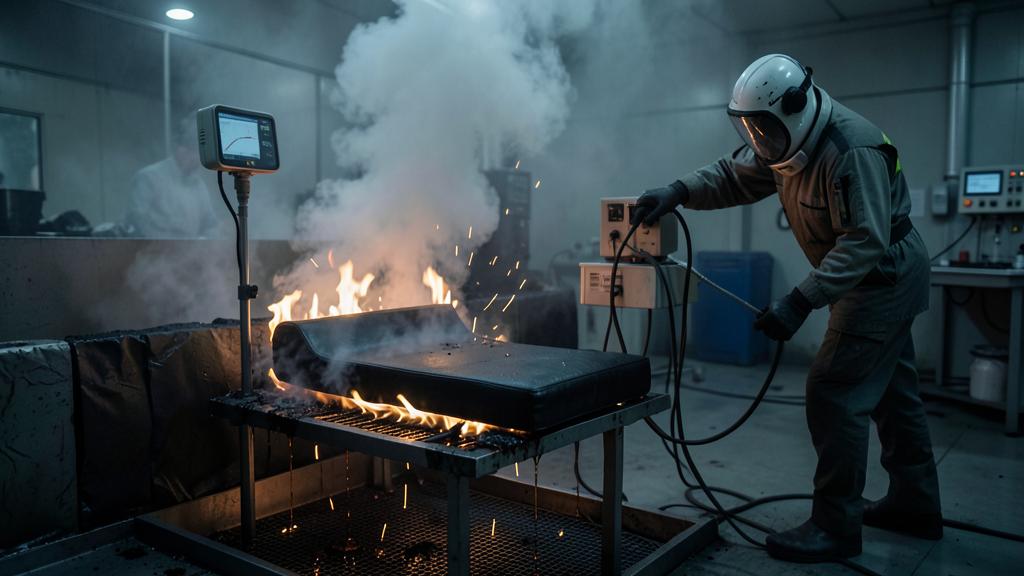
Upholstery, trim, webbing and small parts face a vertical flame test with a defined application time, scored on burn length, on how long they keep burning once the flame is removed, and on whether they drip flaming material. Cushions face a different animal: an oil burner test standing in for a post-crash external fuel fire, scored on burn length and mass loss. That test is why fire-blocking layers exist, and why a cushion cannot be reupholstered with a fabric bought elsewhere without re-testing — the qualification covers foam, blocker and dress cover as a system.
The third family applies, in larger aeroplanes, to the big non-metallic items the rule actually lists — ceiling and wall panels, partitions, galley structure, large cabinet walls, stowage compartments: heat release rate and smoke density. These ask how much a surface feeds flashover and how fast it makes the cabin unbreathable, not whether it ignites. Seats as such are not on that list, which is why the boundary matters in a premium cabin: a tall shell with a door starts to look like a partition or a monument. Settle that applicability with the authority at the start, because settling it at the end means re-tooling a composite part.
| Question being asked | Typical test family | What is tested | What a failure costs |
|---|---|---|---|
| Will it ignite and keep burning? | Vertical flame test, defined application time | Dress covers, webbing, trim, small parts | Change of fabric or supplier; usually recoverable |
| Will it survive an external fuel fire long enough for evacuation? | Oil burner test on the cushion assembly | Foam, blocker and dress cover as a system | Cushion redesign; blocks the whole shipset |
| How much does it feed flashover and smoke? | Heat release and smoke density on large listed panels | Partitions, large trim panels, monuments, suite shells where they qualify | New composite tooling; the schedule killer |
The right reflex. Ask which material lots the test articles came from, and how production lots are controlled against them. Flammability qualification is only as good as its traceability: a resin reformulation upstream, announced or not, undermines the report the approval rests on.
Everything electrical on the seat is a second programme
A modern seat is a distributed electrical system: actuators, control units, in-seat power, lighting, often the entertainment head-end wiring. That content is qualified against the environmental standard used for airborne equipment — temperature and altitude, vibration, humidity, shock, power input quality, emissions and susceptibility, lightning-induced transients — per equipment, per installation, at defined categories.
Two consequences programme plans routinely miss. The electrical content brings its own approval path and often its own design approval holder, so the seat vendor is integrating somebody else’s qualified box and owning the interface. And anything electrical is a potential ignition and smoke source inside the cabin, which returns it to the fire argument by another door: wiring separation, protection, a lithium cell charging at the seat.
Where software is involved, the effort scales with the criticality assigned to the function, not with the number of lines: an actuator that can move a berth into a position blocking egress is not the same problem as a reading light.
Approval is two approvals, and they are not the same document
The article and the installation are approved separately, and confusing them is the commonest misreading of a supplier’s claim.
The seat itself is usually approved as an article against a technical standard order — the seating systems standard in the FAA system, its European equivalent in the EASA one. That approval says the article was designed and is produced to a defined minimum performance standard. It does not say the seat may be fitted to your aeroplane.
The installation is approved at aircraft level, by the type certificate holder or by a design organisation through a supplemental type certificate or a change to type design. That is where floor and track loading, egress, emergency lighting sightlines, the head strike condition at your pitch, the cabin crew’s view and compatibility with the aeroplane’s certification basis are examined. A seat can hold a valid article approval and still be unfittable to a particular airframe.
| Article approval | Installation approval | |
|---|---|---|
| Approves | The seat as a product, to a minimum performance standard | This seat, in this layout, on this aircraft type |
| Held by | The seat manufacturer | The type certificate holder or a design organisation |
| What it does not cover | Whether it may be fitted to your aeroplane | Whether the seat itself was ever properly qualified |
| Typical way it goes wrong | Undocumented material or supplier change | Reconfiguration that quietly changes the tested condition |
The cabin around the seat has its own rulebook
Seats sit inside constraints that have nothing to do with seats. Access to exits, passageway widths to and between them, the assist space at an exit, the reach and view required from the cabin crew station, emergency lighting and floor path marking, the position of oxygen masks and their drop pattern: together these shape a layout of passenger accommodations more than pitch does.
Above all there is evacuation capacity. The number of occupants an aeroplane may carry is bounded by what has been demonstrated, or accepted by analysis against a demonstration, not by how many seats physically fit — which is why a seat that unlocks another row is worth a great deal to an operator and a great deal of work to an authority.
The physical envelope matters too. Rails have fixed pitch increments and the floor beneath them an allowable load per fitting, so a lighter seat spread over the same tracks can still exceed a local limit if the load is concentrated differently. Weight per passenger across a full shipset is a real fuel argument, but it is only comparable between seats certified to the same conditions.
Why the calendar, and not the drawing, sets the entry-into-service date
Ask any programme manager where the time goes and the answer will not be design. It is a sequence of gates that cannot be parallelised past a certain point.
- Test article build. Sled articles must be representative: production-intent tooling, production-intent materials, traceable lots. Building one is a manufacturing programme in miniature.
- Sled slots. Qualified dynamic test facilities are few and booked well ahead, and a failed run is not repeated the next morning: it is analysed, the article is redesigned, and you rejoin the queue.
- Fire test lots. Burn tests are quick; their traceability is not.
- Installation approval. Aircraft-specific, so a seat approved on one type restarts a meaningful part of the argument on the next.
- Line fit versus retrofit. A seat going down the airframer’s line must be in that airframer’s catalogue, with its own industrial and quality acceptance. Retrofit avoids that gate and buys downtime on a revenue aeroplane instead.
- Rate readiness. The chronic problem is not certifying one seat but delivering thousands on time. Certification unlocks the aeroplane; industrialisation unlocks the fleet.
None of those gates is visible from the stand, which is why the gap between a well-received design and a seat under a passenger is counted in quarters rather than weeks. Operators who plan retrofits around a show announcement learn this once. The industrial side of cabin programmes runs as a standing discussion on the FL330 forums.
What to ask on the stand
- Which article was dynamically tested, and was it production-intent in structure, materials and fittings?
- At what pitch was the head strike condition substantiated, and what does it assume is mounted on the seat back?
- Which certification basis and amendment level, on which types, and who provides the installation approval?
- Is the cushion qualified as a system, and what happens if we change the dress cover?
- Who holds the environmental qualification of the electrical content, and what is the traceability chain from test lots to production lots?
- What is the delivery rate, not the delivery date?
None of them is hostile. They separate a programme with a plan from a programme with a photograph — and each will be asked eventually by someone with the authority to stop the aeroplane.


Leave a Reply
You must be logged in to post a comment.