
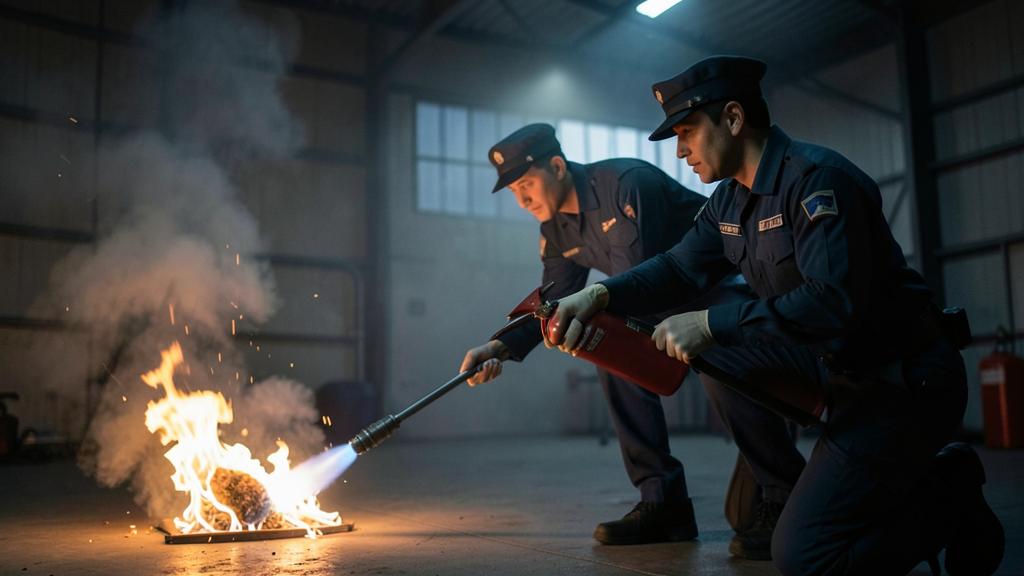
An online module validated the day before, without a single mistake, and the next morning the first extinguisher of the session is discharged from too far away, nozzle held too high, jet aimed into the flames rather than at their base. The periodic safety and survival training has this peculiarity: part of its content transfers perfectly onto a screen, and the other part does not transfer at all. The dividing line has nothing administrative about it — it comes from two kinds of memory that do not wear out at the same rate.
Two memories, two curves
What a cabin crew member must keep current falls into two families that have almost nothing in common, except appearing on the same training programme.
The first is declarative: the location of a piece of equipment, the contents of a kit, the wording of an announcement, the list of cases requiring a call to the flight deck, the latest change to a procedure on lithium batteries or on restraint devices. It can be stated, so it can be written down, so it can be tested by a question. A remote module serves it very well — better, in fact, than an annual day in the classroom, because it allows spaced repetition, and spaced repetition is exactly what fixes verbal knowledge in place.
The second is procedural: the force to apply on an assist handle, the range of a movement, the tempo of a sequence, the posture that lets someone hold an extinguisher without stepping back, the way to don a smoke hood without tearing off one’s glasses. It cannot be stated: a movement can be described, but it cannot be transmitted by describing it. It is built through execution and correction, and it decays on a clock of its own.
The problem fits in one sentence. The two curves do not fall together, and it is the higher one that gets measured. The module score stays excellent while the movement dulls, and nothing in the training file signals it.
Some knowledge, like facts and procedures, stays sharp with online training. But skills like handling equipment or working in smoke need real practice. The problem is that online tests show good results, while real skills fade without practice.
On an Airbus A320, a cabin crew member trained remotely might know the sequence to open an emergency door but fail to apply the right force to unlock it under stress. The door’s assist mechanism engages unexpectedly, and the crew member hesitates, losing precious seconds in an evacuation scenario.
The items that no module can carry
A periodic training programme mixes items of very different natures. Three questions are enough to sort them. Does the movement require an effort whose value cannot be estimated from memory? Is it performed under degraded perception? Does it involve another crew member? A single positive answer takes it out of remote learning.
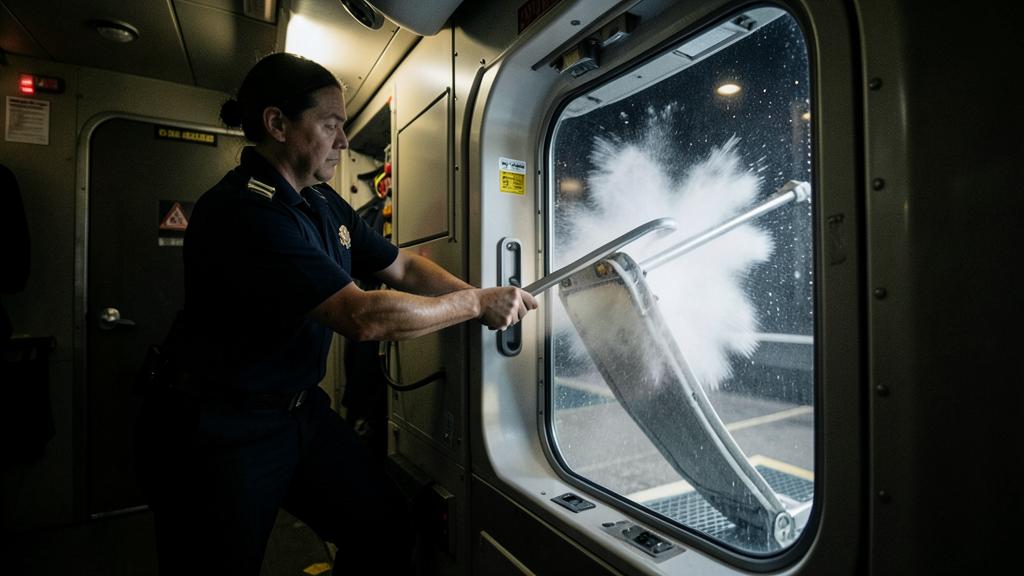
The door and the slide
A cabin exit is, first of all, a mass. The mode selector and its guard, the exact travel of the handle, the force needed to unlock it, taking back control when the assist mechanism kicks in and the door moves faster than the arm pushing it: none of this is information, all of it is calibration. Someone who has watched the animation twenty times knows the sequence; they do not know the moment when they have to let go.
Deploying the slide adds a second lesson. It produces a noise and a blast of air, it occupies a volume that must have been cleared, it requires standing clear of its path, and it is irreversible: it is probably the only movement in the job that cannot be tried a second time. The body only learns it by seeing it go once.
Finally, the outside check through the door viewing window is never generic. The height of the window, the field it opens onto, the portion of wing, engine or landing gear visible through it change from one type to another and sometimes from one variant to another. A module illustrated with a standardised computer-generated view does not train that particular gaze.
Fire, smoke, and reduced vision
The protective smoke hood is a textbook case. Putting it on takes a few seconds, without a mirror, often in a cluttered aisle; the neck seal catches, long hair gets caught, glasses pose a problem that each person solves in their own way and which must have been solved beforehand. Once on, it changes everything: the field of vision narrows and blurs, hearing drops, the resistance to inhalation changes the breathing rhythm, gloved hands lose dexterity. One does not train for these conditions by reading about them — one trains for them by living through them.
The extinguisher follows the same logic. Its weight, the way it is held, the shortness of its discharge, the attack distance, the need to aim at the base and sweep, the requirement to stay able to step back: each of these is a motor parameter, none of them is a statement. In the session, the agent used and the fire presented are not always those found on board — an accepted and documented compromise, which shifts the movement slightly but preserves the essential: posture, distance, tempo, and the realisation that a discharge ends much faster than one imagines.
Smoke, finally, removes the visual landmarks on which everything else relies. Moving crouched along a row while counting reference points, finding a handle blindly, keeping contact with a crew member: these are hand skills, not pieces of knowledge.
Water, the life jacket, and the raft
The life jacket is fastened without looking at it, strap passed and tightened over a uniform, and it is inflated after leaving the aircraft, never before — a sentence everyone can recite and which pool drills regularly disprove as soon as the movement comes too early. Wherever the operator has access to a body of water, the rest is learned all at once: hauling oneself out of the water without a foothold, righting a capsized raft, helping someone who cannot manage it. The effort is brutal, the wet clothing is heavy, and the order of actions matters less than the ability to produce them.
Another person’s body
Depth of compressions, rate, full release between two compressions: three variables that no one estimates correctly without feedback from a manikin. To this must be added clearing an obstructed airway, placing someone in the recovery position, and moving an unconscious person along a narrow aisle lined with fixed armrests. The real weight of a body has no pedagogical equivalent, and it is what dictates the technique used.
| Exercise family | Physical variable absent from the module | Defect observed cold in session | What remote learning usefully prepares |
|---|---|---|---|
| Emergency exit and slide | Mass of the door, force to unlock, taking back control when the assist mechanism engages, blast of the deployment | Body poorly positioned in the door’s travel, hand that does not let go at the right moment, hesitation over the selector guard | Order of actions, criteria for an exit being unusable, associated announcements |
| Fire, smoke, hood | Reduced and blurred field of vision, lost hearing, resistance to inhalation, weight and short discharge time of the extinguisher | Attack from too far away, jet into the flames rather than at their base, communication abandoned as soon as the hood is on | Fire classification, available agents, alert loop to the flight deck, lithium battery cases |
| Ditching, life jacket, raft | Weight of wet clothing, absence of a foothold, effort to haul oneself out or right the raft, bulk of the inflated jacket | Jacket inflated too early inside the cabin, strap poorly fitted, buckle searched for by sight instead of being fastened blindly | Location and contents of equipment, sea evacuation sequence, survival equipment |
| First aid gestures | Depth and rate of compressions, full release, real weight of a body to be moved | Compressions too soft or too fast, pressure maintained between compressions, back exposed while moving the person | Decision tree, contents of the kits, diversion criteria and communication with the ground |
Why a screen does not recharge a movement
Four mechanisms are enough to explain the asymmetry, and each has the merit of pointing to what would be needed to correct it.
- Learning without an error signal. A multiple-choice question validates a statement; it says nothing about a hand. A motor programme only progresses by comparing intention with result, which requires a sensor: the instrumented manikin, the resistance of the door, the actual position of the jet, or failing that, the eye of an instructor. Without a sensor, the trainee repeats their own flaws while believing they are training.
- Encoding carries the conditions of learning with it. Knowledge acquired seated, calmly, at one’s own pace, in comfortable light and with the ability to go back is retrieved best under those same conditions. The real event offers none of them. The closer the training context resembles the context of use, the more faithful the transfer — which is the technical reason training happens in a noisy cabin rather than in a lecture hall.
- Under load, only automatism survives. Attention narrows and working memory shrinks as soon as the pressure rises. What remains available is whatever has been repeated enough to no longer consume any of it. Any item that still requires a deliberate recall then goes into direct competition with the decisions that must be made — and it is the decisions that suffer.
- Reading time is elastic, real time is not. A module can be paused, reread, resumed the next day. A door does not wait, an extinguisher discharge cannot be rewound. Only a session that imposes its own tempo trains someone to work within a time they do not choose.
| Dimension maintained | Remote module | Session with equipment | Visible sign of decline |
|---|---|---|---|
| Declarative knowledge (locations, sequences, updates) | Excellent, and better than the classroom if repeated in short doses | Costly: using the classroom for this wastes a scarce resource | Wrong answer to a direct question, rare and easy to detect |
| Motor calibration (force, range, tempo) | None: no error feedback on the movement | The only valid medium, provided repetition continues until reproducible | Movement right in sequence but wrong in force or distance |
| Degraded perception (smoke, hood, noise, darkness) | None: describing conditions is not experiencing them | Essential, including for discovering one’s own limits | Loss of bearings, movement stops as soon as vision blurs |
| Crew coordination (orders, flow, cross-checks) | None, even in virtual classroom: speech there is sequential | The only setting where simultaneity exists | Order stated rather than commanded, duplication and blind spots |
| Tolerance to load (imposed tempo, noise, urgency) | Weak: the reader controls their own pace and can reread | Real, if the session imposes tempo and injects degradations | Falling back on step-by-step reasoning where automatism should take over |
What never repeats itself alone
An evacuation is not the sum of individually successful movements. Command by voice is itself a motor act: producing a short order, audible over an alarm and an entire cabin talking at once, repeated without running out of breath, requires breath, posture and positioning that are not trained anywhere else. No one shouts at home. A crew member who has not given a full-voice order in a year will not give one in full voice on the day it matters — they will say it, and it will not be heard.
Then come redirecting a flow toward another exit, announcing a blocked exit so that it reaches those already heading toward it, cross-checking the arming of doors, taking back control of a passenger who stops to retrieve luggage, coordinating between the two ends of the cabin when the service intercom no longer works. None of these acts repeats on its own. A virtual classroom hands out speaking turns one at a time; a training cabin imposes simultaneity, and simultaneity is precisely what makes the exercise difficult.
It is also the only setting in which one discovers who takes charge. The theoretical division of roles is written down; the actual division depends on where someone is standing in the cabin at the moment of the event, on who sees what through their window, and on who has already started acting. A group exercise reveals these shifts; an individual module ignores them by construction.
Periodicity, certification, and what the record actually proves
The European framework runs on two clocks. The first is annual: the periodic training and its associated check are repeated within a twelve-month window, together with the usual rules on end-of-month carryover and early renewal, which allow getting ahead of schedule without losing the benefit of the due date. The exact wording of that carryover is found in the applicable text, not in a habit of the operation. The second is slower: a subset of exercises, those requiring equipment and physical movement, is spread over a multi-year cycle of roughly three years, with the operator setting their order within its approved programme.
This structure is not a matter of convenience: it acknowledges that a movement is costly to maintain and that not everything can be redone every year. It does, however, have a direct consequence that is better faced head-on — for a given practical item, the real interval between two executions by the same person can approach the entire length of the cycle, and that interval is not offset by the online module covering the same subject.
As for the record, it proves exactly this: that a person followed a programme, on a given date, and that a checker judged them compliant that day. It says nothing about the state of things today. The distinction is not pedantic — it is the one that separates compliance from readiness, and it is the one that should guide the reading of a file before a sensitive crew pairing.
The trap. « Current » is not « ready. » A complete file, a validated module and a check signed within deadline describe compliance, not instantaneous readiness. The most frequent case is that of a sub-fleet variant whose exit does not operate like the training device, while the online module illustrates it with the same image as the rest of the type: the person answers every question correctly and discovers the difference on the aircraft, door in hand.
Designing the split rather than enduring it
The right reflex. Start the session with the movement, cold. Before any briefing, have the item performed once, without any prior reminder, and note what is missing: that is the only honest measure of decline, and it indicates where to spend the following minutes. Between sessions, the silent walk-around before each flight remains the only maintenance available — touching the actual opening, looking through the actual window, pointing to the equipment rather than reciting it.
One sorting rule is enough to organise the rest: can the item be assessed by a question answered in words? If so, it goes down to remote learning and is repeated in short doses throughout the year. If not, it goes up to the classroom, and classroom time — the most expensive resource in the system — is reserved for it entirely.
The defects observed all stem from a violation of this rule. The day that opens with an hour and a half of slides already seen online. The workshop where the whole session watches a single person put on the hood. The single exercise, succeeded on the first try and never repeated — yet a movement performed successfully once is not a movement learned, it is at best a movement discovered. The debrief, finally, that comments on the theory because it is easy to comment on, rather than on the hand, which requires having watched.
A dense session looks more like this: a cold measurement, individual repetition until the movement is reproducible without thinking about it, injection of degradations — a blocked exit, an undeployed slide, an extinguisher empty before the end, a crew member out of action — then a debrief on what the hand actually did. The preparation courses that pay off are the ones that adopt this split explicitly, and that write it into the programme rather than leaving it to each instructor’s judgement.
What to check in your own records
Three checks are worth doing on your own file, regardless of what the schedule says. The first: which items your operator classifies as practical, on which device, and where you stand in the cycle — not the class average, your own position. The second: is the training device representative of the variants you actually operate — exit type, selector, viewing window, slide? The third: the granularity of the record. A blanket « passed » makes it impossible to know which specific movement you have not performed for almost an entire cycle.
Two grey areas remain. Virtual reality, first: it recreates the scene, the layout, the sequence, and even part of the load remarkably well; it recreates neither the mass, nor the resistance, nor the heat, nor the breathing discomfort. It shortens discovery time and frees up equipment time, which is already a great deal; it does not replace the object itself. Its status depends entirely on the device’s acceptance within the approved programme, and that acceptance is examined case by case. Then, returning after a long absence: does the refresher training required before resuming line duty include practical items, or only a theoretical update? The answer is found in the operator’s programme, not in a habit of the operation.
For anyone preparing a certificate or changing operator, the consequence is clear: a recent record elsewhere does not exempt someone from the new operator’s practical programme, because it is that operator’s aircraft, variants and procedures that define the expected movement. Discussions among practitioners on the forum show, moreover, that the surprise rarely comes from the theory — almost always from a handle that does not fall where the hand expected it.
On all of these points, the applicable regulation, the training programme approved by the authority, and the operator’s documentation take precedence over this article, whose purpose is limited to explaining the mechanism that makes certain exercises irreplaceable.
Questions fréquentes
Can an online module replace part of periodic training?
Yes, for the declarative part, when the operator’s approved programme provides for it: locations, kit contents, announcement sequences, procedure updates. No for the practical items, which require equipment, observed execution and immediate feedback on the movement. The split is not left to free choice: it appears in the programme submitted to the authority.
Are all practical exercises redone every year?
Periodic training is annual, but not all of its practical elements are repeated at every session. A subset of exercises requiring equipment is spread over a multi-year cycle whose order the operator sets. The only way to know where you stand is to check your own record item by item, not the class schedule.
Does virtual reality count as practical training?
It depends on the device’s acceptance within the operator’s approved programme, examined case by case. Technically, a headset recreates the scene, the layout and the sequence, but neither the mass of a door, nor the heat, nor the resistance to inhalation under a hood. It makes excellent preparation, which frees up equipment time, rather than a substitute.
Does a current training file prove today's readiness?
No. It certifies that a programme was followed on a given date and that a checker judged the person compliant that day. Motor readiness, on the other hand, degrades between two executions, without anything in the file indicating it. That is why a cold measurement at the start of a session yields more than rereading the record.
How can a movement be maintained between two sessions?
The silent walk-around before each flight is the only maintenance actually available: touching the opening, looking through one’s own door window, physically pointing to the equipment rather than reciting its list. Detailed mental rehearsal of a sequence also helps, particularly for the order of actions. Neither one recharges motor calibration, but both slow its drift.
What changes with a change of operator or sub-fleet?
A recent record with another operator does not exempt someone from the new operator’s practical programme, because it is that operator’s aircraft, variants and procedures that define the expected movement. A variant added to the fleet triggers differences training whose scope depends on the discrepancies found in exits and equipment. Those discrepancies are precisely what a generically illustrated module does not show.


Leave a Reply
You must be logged in to post a comment.