
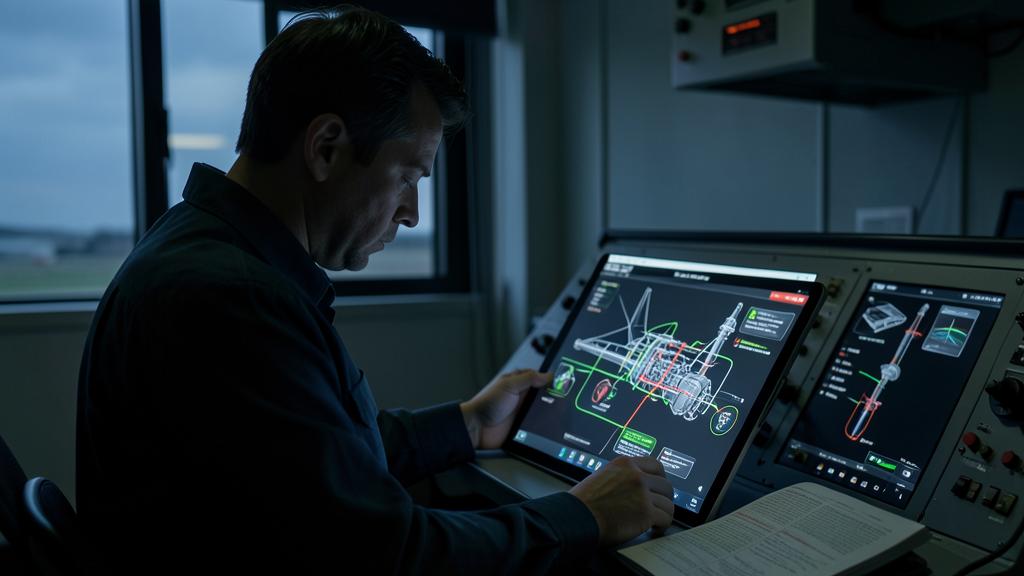
Systems teaching moved to the screen faster than any other part of a type course, and for good reasons: it is cheaper, it scales, and a well-built module explains an electrical architecture better than a tired instructor with a whiteboard marker. What it does not do is teach the order in which you interrogate that architecture when something is failing. The gap is not a quality problem that a better module would close. It is structural, it is known, and the approved course is supposed to be built around it.
What a distance module is approved to replace
A type rating course is not a single block of teaching. It is a course specification approved for a named ATO, on a named type, describing which elements are theoretical, which require a flight simulation training device, and which require the aircraft. Under the EASA framework, that specification lives in the organisation’s training manual, and the authority approves it as a whole. Distance learning does not enter as a general permission; it enters as an approved method for specific parts of the theoretical element of that specific course.
This matters more than it sounds. When a school advertises a course as partly online, the question is never whether distance learning is allowed in the abstract. It is which elements of that course specification the authority accepted as deliverable that way, and what the manual commits the organisation to doing in exchange: tutor availability, progress monitoring, the conditions under which a candidate is declared to have completed the module. The permission and the obligations arrive together.
The practical elements never move. Drills, crew procedures, abnormal handling and anything examined on a device stay on the device. That boundary is not an opinion about pedagogy; it is what the course specification says, and an ATO that quietly slides material across it is training outside its approval.
The right reflex. Ask for the course specification, not the brochure. The document that matters names the elements, the hours and the delivery method for each, and it is the same document the authority approved. A school that will not show it is telling you something.
What the screen teaches better than a classroom
The honest case for distance systems teaching is strong, and dismissing it is a mistake pilots of a certain vintage make routinely.
Architecture is the clearest win. A hydraulic system is a graph: sources, consumers, isolation points, and the paths that survive when a node is lost. A good module lets you walk that graph at your own pace, hide and reveal layers, and go back three times to the same junction without asking anyone. A classroom presents the graph once, at the speed of the median student, and the person who needed the fourth pass does not get it.
Repetition is the second win, and it is underrated. Systems knowledge decays; the screen is available at 22:00 in a hotel room the week before the check, and the classroom is not. Spaced revisiting is exactly what long-term retention of declarative material requires, and distance delivery is the only format that makes it cheap.
The third is diagnostic honesty. Embedded questions tell a candidate that they do not know something before the instructor does. In a classroom, a nodding student and an understanding student are indistinguishable, and both stay silent.
Distance learning excels at explaining how systems work, but it can’t teach you how to react when something fails in real time. It’s like having a perfect map but no practice driving in traffic.
A pilot studying the A320 hydraulic system on a screen can review the schematic of the blue and green systems at their own pace, but when a real hydraulic failure occurs in the simulator, they might struggle to quickly locate the correct isolation valve because they’ve never physically interacted with the panel layout.
What it misses, and why the gap is structural
The failure mode is not that candidates learn less. It is that they learn a different thing, and the difference only shows up under load.
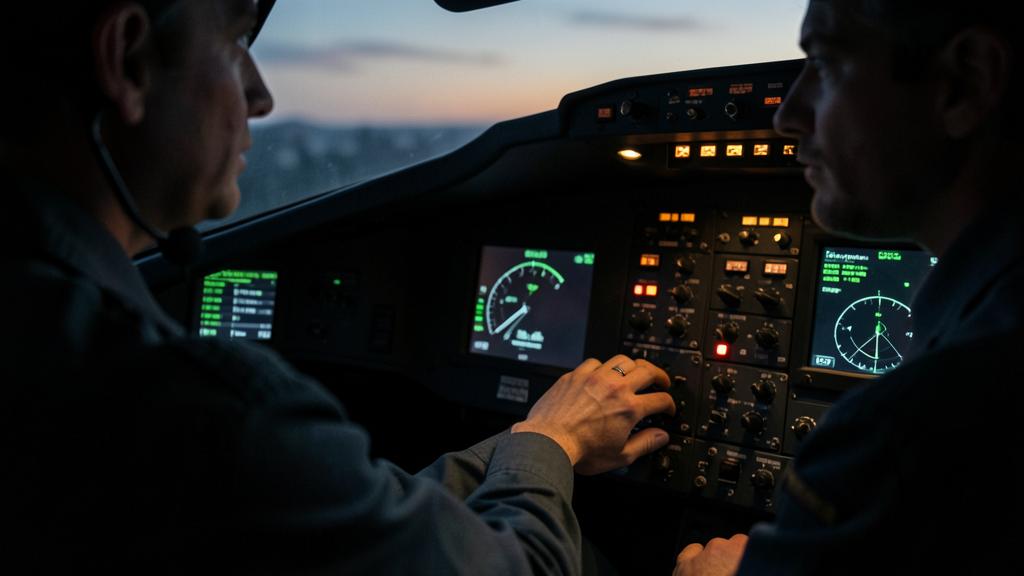
Screen-taught systems knowledge is organised by system. The aircraft does not fail by system; it fails by symptom. What arrives is a light, a message, a smell, a handling change, and the competence required is to move from that symptom to the right system, in the right order, while flying. That translation is the skill, and it is not the one being trained when a module walks you through hydraulics from source to actuator.
Second, the flight deck is a physical place. Where a switch is, whether it is guarded, what your hand passes over on the way, which panel forces you to break your scan: none of that survives a schematic. Candidates who learned only on a screen frequently know exactly what to do and take three seconds too long to find where to do it.
Third, and least discussed: a classroom produces negotiated meaning. Someone asks a question based on a wrong model, the instructor hears the wrong model in the question, and corrects it for everyone. A distance module cannot hear the question that was not asked. Misconceptions that a room would have caught in ninety seconds survive intact into the simulator, where they cost a session.
| Object of learning | Distance module | Needs a room, a device or the aircraft |
|---|---|---|
| System architecture and normal logic | Strong: self-paced, revisitable, layered | Little added value |
| Failure logic and reconfiguration | Adequate for the reasoning | Required for the sequencing under time pressure |
| Symptom-to-system translation | Weak: modules are organised by system | Device work, scripted symptoms |
| Control and panel geography | Very weak: no motor memory | Flight deck, fixed-base device, procedures trainer |
| Memory items and drills | Can rehearse the words | Device: the trigger and the timing are the skill |
| Crew coordination around a failure | Not addressable | Full-flight device with a real other pilot |
| Detecting a candidate’s wrong mental model | Only what the question bank probes | Instructor listening to how the answer is built |
Attendance: what gets measured and what it proves
Every distance course claims to monitor attendance. Almost none of them monitor what the word implies. The mechanisms in use measure presence of a session, not presence of a person, and they are worth ranking honestly because an operator auditing a training record needs to know what each line actually establishes.
Time-on-module counters are the weakest. They record that a page was open. Sequencing locks, which prevent moving forward until the previous element is completed, are better because they impose an order but still say nothing about engagement. Embedded checkpoints that must be passed to progress are the first mechanism that measures anything cognitive, and their value depends entirely on whether the question bank is large enough that answers cannot circulate.
Scheduled tutor contact is the strongest single mechanism, and the one most often cut for cost. A synchronous session with an instructor who asks open questions establishes, in twenty minutes, more about a candidate’s actual state than a term of logged hours. It is also the only mechanism that catches the wrong mental model described above.
| Mechanism | What it proves | What it does not prove |
|---|---|---|
| Time-on-module logging | A session was open for a duration | That anyone was reading it, or who |
| Sequencing locks | Elements were taken in the approved order | That any element was understood |
| Embedded progress checkpoints | Correct answers were produced | Independence, if the bank is small or shared |
| Scheduled synchronous tutorials | Engagement, reasoning, identity | Nothing about the unattended hours |
| Supervised final examination | Identity and unaided knowledge at one moment | How the knowledge was acquired or retained |
| Instructor progress reports | A named person’s professional judgement | Only as good as the contact time behind it |
The trap. A training file thick with logged hours and green checkpoints can be entirely empty of evidence that the candidate was ever assessed by a human being. When a course goes wrong in the simulator, that is the file an operator will read, and it will not explain anything.
Assessment: progress tests, the final exam, and who signs
Distance delivery changes how teaching is done. It does not change who is accountable for declaring the candidate ready, and confusion on that point is common enough to be worth stating plainly.
For a type rating under the EASA system, the theoretical knowledge examination is run by the ATO itself, under conditions its approved manual defines, and the organisation’s head of training carries the responsibility for the standard. This is different from the airline transport pilot licence theoretical examinations, which are conducted by the competent authority. Candidates who did their ATPL theory sitting in a supervised authority exam hall sometimes assume the type theory works the same way, and it does not: the school is examiner and teacher at once, which is exactly why the approval of the course specification and the oversight of the organisation matter so much.
The FAA arranges this differently. There is no equivalent authority-run theoretical examination sequence for a type rating; the theoretical element is largely folded into the oral portion of the practical test, conducted by an examiner. Training centre approval under the relevant part carries the equivalent quality burden. When a course is marketed to an international audience, check which system’s paperwork it produces, because a certificate that satisfies one authority is not automatically accepted by the other.
The type rating case: where the device takes over
On a type course, the handover point between screen and device is the single most informative thing about the course design.
A well-built course sends candidates to the first device session already fluent in architecture, so the session can be spent on sequencing and coordination. A badly built one uses the first device sessions to finish the systems teaching that the modules did not land, and the effect compounds: device time is the expensive, fixed, unrecoverable resource, and every hour spent explaining a bus tie is an hour not spent practising the thing the skill test examines.
The observable symptom is a course where early device sessions run long, instructors improvise ground briefings, and the published syllabus starts slipping in the first week. Candidates read this as intensity. It is usually a distance element that under-delivered.
Reading a distance course before you commit
Three questions separate a serious distance element from a repackaged slide deck, and none of them require an instructor’s judgement to ask.
- First: how many hours of scheduled contact with a named instructor does the course include, and is that contact synchronous?
- Second: is progression gated by anything other than time, and how large is the question bank behind the gates?
- Third: what happens when a candidate fails a progress checkpoint twice — is there a defined remedial path, or does the system simply let them try again until the answer sticks by attrition?
The third question is the most revealing. A course with no remedial path is not assessing; it is filtering for persistence. Operators reviewing training providers, and candidates paying for their own type ratings, get more from that one answer than from any amount of interface polish. A school that has built a remedial path answers at once, because it has one. A school that has not will describe the interface. Discussion of specific providers and their contact-hour policies is the kind of thing that circulates on the FL330 forums long before it reaches any official review.
| Signal | Reads as | Usually means |
|---|---|---|
| Named synchronous tutor hours in the specification | Reassuring | The organisation budgeted for instruction, not just content |
| Progression gated only by elapsed time | Flexible | No assessment before the final exam |
| Early device sessions overrunning | Intensive course | Systems teaching did not land on the screen |
| Defined remedial path after a failed checkpoint | Bureaucratic | Someone actually reads the progress data |
| Question bank size never disclosed | Normal commercial reticence | Answers may circulate between cohorts |
What the screen will never carry
The stable conclusion, after a decade of these courses, is narrow and worth holding onto. Distance learning is excellent at building the map and useless at teaching the route. It gives a candidate a correct, revisitable model of how the aircraft is put together, which is genuinely more than most classrooms achieved, and it leaves entirely untouched the competence of moving from a symptom to a decision with a colleague, in sequence, in the time available.
That is not a deficiency to be engineered away by better software. It is a description of two different kinds of learning, one of which requires another person and a device. A course that understands the split spends its screen time well and arrives at the simulator ready. A course that pretends the split does not exist spends its device hours teaching hydraulics, and everybody notices in week three.


Leave a Reply
You must be logged in to post a comment.