
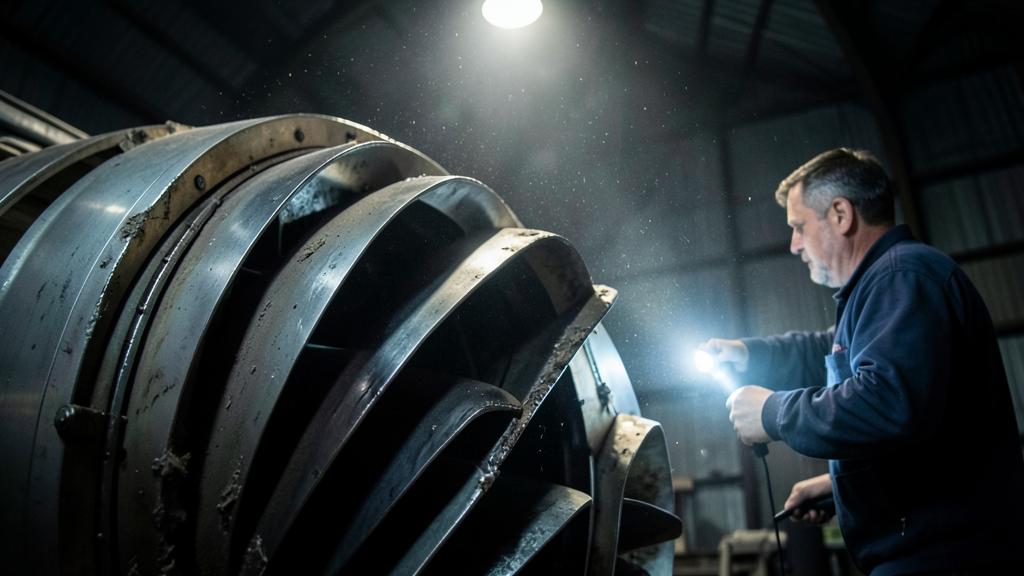
In a desert network the engine rarely fails. It simply arrives at the shop earlier than the plan said it would, carrying an exhaust gas temperature margin that has been quietly eaten by particles smaller than a human hair. Sand does not do one thing to a turbine, it does three, and the three have different cures. Confusing them is how an operator ends up washing a compressor that was never the problem, while the real damage accumulates two modules further aft in a place no water reaches.
Three mechanisms, one invoice
Ingested mineral dust attacks a gas turbine in ways that are easy to lump together and expensive to confuse. Fouling is the adherent film of fine material that builds up on aerofoil surfaces, changing their roughness and effective shape. Erosion is the physical removal of metal by hard particles striking at high relative velocity. Deposition in the hot section is what happens to the fraction of dust that survives the compressor, melts in the combustor, and re-solidifies on cooler surfaces downstream.
Only the first is reversible by cleaning. The second is permanent — the metal is gone. The third is worse than permanent, because it changes the thermal behaviour of parts that were designed with a very small temperature margin. An operator who treats a dusty network as a washing problem is addressing roughly a third of the mechanism and paying for the rest at the shop visit.
The compressor: erosion is a geometry problem
Quartz, the dominant mineral in most desert sand, is harder than the titanium and nickel alloys used in compressor aerofoils. That single fact governs everything that follows, and it is why erosion-resistant coatings extend blade life rather than remove the problem. A particle arriving at a rotating blade does not bounce off politely; it removes material, and it removes it where the relative velocity and the impingement angle are highest.
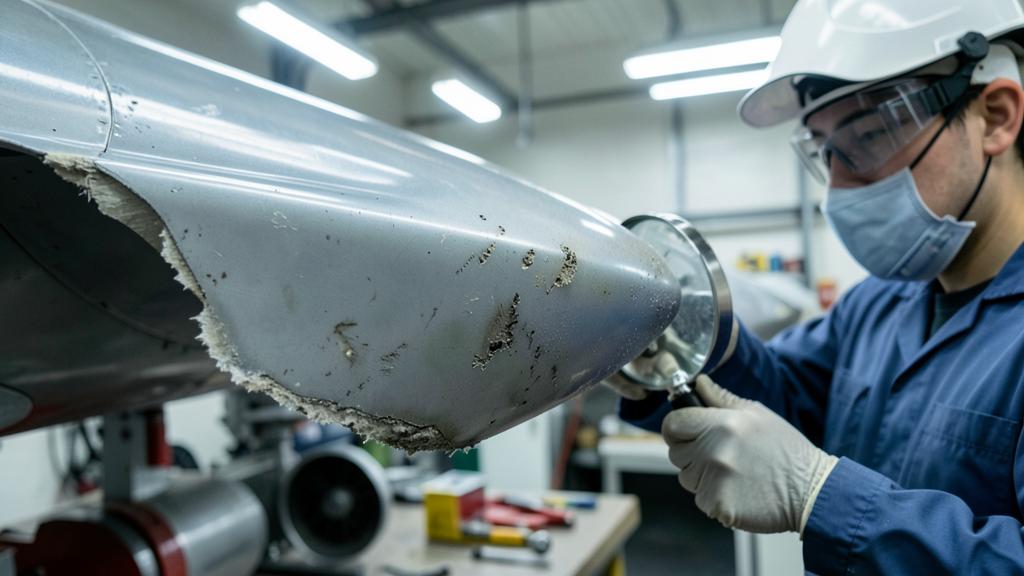
The result is not uniform thinning. It is a change of shape. Leading edges become rounded and blunt, which raises profile loss and moves the point at which the boundary layer separates. Trailing edges thin and can become ragged. Chord is lost at the tips, and the running clearance between the blade tip and the casing opens up. Each of these is small on its own; together they reduce the pressure rise the stage delivers for the work put into it.
The consequences show up as a chain. Less pressure rise per stage means the compressor must be run harder for the same core flow. Efficiency loss appears as higher fuel flow for a given thrust, and — this is the part that determines when the engine comes off the wing — as a higher turbine temperature for a given thrust. Increased tip clearance also costs surge margin, which is the quantity the control system relies on to survive transients, crosswinds and rapid accelerations.
| Where it acts | What the particle does | What the monitoring data shows |
|---|---|---|
| Fan and low-pressure compressor | Coarser grains cut leading edges, blunt profiles, open tip clearances | Slow drift in fuel flow and low-rotor speed for a given rating |
| High-pressure compressor | Fine fraction erodes later stages; adherent film also fouls surfaces | Rising core speed and rising exhaust gas temperature for the same thrust |
| Combustor | Fine particles melt; deposits alter the fuel spray pattern and the exit temperature profile | Hot streaks visible at borescope; temperature spread widening |
| High-pressure turbine vanes and blades | Molten silicate wets and infiltrates the coating; cooling holes partly block | Coating loss and discoloration at borescope; margin loss that no wash recovers |
Sand damages engines in three ways: fouling (sticky dust), erosion (physical wear), and hot-section deposition (melted dust clogging parts). Washing only fixes the first. The other two require shop repairs, and ignoring them leads to early engine removals.
A Boeing 737 operating in Dubai with a 4,000m runway at 45°C and full thrust sees its engine’s exhaust gas temperature margin drop 20°C faster than expected. After 10,000 cycles, the engine is removed for performance restoration, costing $2M instead of the planned $1.2M. The issue? Erosion and hot-section deposition, not just fouling.
The hot section: dust that melts
The fine fraction that gets past the compressor does not stay solid. Silicate dusts rich in calcium, magnesium, aluminium and silicon — the family the literature calls CMAS — soften and melt at temperatures well below the gas temperatures a modern high-pressure turbine sees at takeoff power. Once molten, the material behaves like a glass. It wets the ceramic thermal barrier coating on vanes and blades, and it infiltrates the porous, strain-tolerant microstructure that the coating relies on to survive thermal cycling.
When the engine is throttled back and the material cools, it solidifies inside that microstructure. The coating is now rigid where it was designed to be compliant. On the next thermal cycle the strain it cannot accommodate goes into cracking and spallation, and the section of metal it was protecting is suddenly exposed to gas temperatures it was never sized for.
In parallel, the same material partially obstructs film-cooling and impingement holes. Cooling air that no longer reaches the surface it was metered for raises local metal temperature, and every degree of metal temperature costs creep life and oxidation life at a rate that is steeply non-linear. This is the mechanism by which a network flying into blowing dust converts an environmental condition into a hardware condition without ever recording a single engine event.
The trap. A clean compressor at borescope proves nothing about the turbine. Hot-section deposition does not present itself as visible dust; it presents itself as missing coating, as discoloured metal and as a margin that never came back after the last wash. Judging a dusty network’s engine health from the cold section is judging the wrong module.
Exhaust gas temperature margin is the real currency
A newly delivered engine runs its takeoff rating with a gap between the temperature it actually reaches and the certified limit. That gap is the margin, and it is the single most useful number in the whole discussion, because it is what gets consumed. Fouling consumes it and gives some of it back after a wash. Erosion consumes it and does not. Hot-section deposition consumes it and takes coating life with it.
When the margin reaches zero at the hottest, heaviest condition the network actually flies, the engine has to come off. Not because anything broke — because it can no longer produce its certified thrust within its certified temperature limit on a hot day at a high-elevation aerodrome at maximum takeoff mass. That removal is a performance restoration shop visit, and it is the event that a desert network brings forward.
This is why the honest answer to how much on-wing life does sand cost is that no single figure exists. The published intervals for an engine type are built on a reference mission that assumes a particular mix of flight lengths, deratings and ambient conditions. A network flying short sectors into hot, high, dusty aerodromes at full rated thrust departs from that reference in every one of those variables at once. The interval that results is specific to the engine type, the thrust rating, the sector length and the aerodromes flown, and it is derived from the operator’s own trend data rather than read off a table.
What compressor washing actually restores
On-wing washing — water, or water with an approved detergent, injected into the inlet under conditions the manufacturer specifies precisely — is a genuinely effective tool, provided everyone is clear about which of the three mechanisms it treats. It removes the adherent film. It recovers the part of the efficiency loss that was fouling, and with it a part of the margin and a measurable part of the fuel burn.
It does not restore eroded geometry, because there is nothing to restore: the metal left with the sand. And it does not clean the turbine: the procedure is written for the compressor, and hot-section deposits are not a soluble film but material that melted and bonded to the surface. A few engine types have a manufacturer-approved turbine rinse under narrowly defined conditions; many do not, and the engine manual is the only authority on the question.
| Mechanism | Reversible? | What treats it | How you recognise it |
|---|---|---|---|
| Fouling | Yes | On-wing compressor wash on a defined schedule | Drift that recovers as a step after each wash |
| Erosion | No | Shop visit; blade replacement or blending within limits | Drift that washing no longer recovers; falling wash effectiveness |
| Hot-section deposition | No | Shop visit; coating and cooling-passage restoration | Margin loss with normal compressor condition; coating loss at borescope |
| Handling deterioration | Partly | Rigging, seal and clearance work at shop visit | Surge margin symptoms disproportionate to the efficiency loss |
The good reflex. Before adding washes to the schedule, look at whether the previous ones produced a step recovery. A wash programme is the correct answer to fouling and an expensive placebo against erosion. If the step is shrinking wash after wash, the deterioration has moved from the film to the metal, and the decision in front of you is a workscope decision, not a cleaning decision.
Life-limited parts are counted in cycles, not in dust
One distinction saves a great deal of confused planning. The certified lives of rotating life-limited parts — discs, spools, shafts — are expressed in cycles in the airworthiness limitations section of the type certificate holder’s instructions for continued airworthiness. Those lives are mandatory, and they are not shortened by an abrasive environment, because they are fatigue lives driven by the load and thermal cycles the part actually sees.
What an abrasive environment changes is when the engine is open. A performance-driven removal that arrives earlier than planned lands on a set of life-limited parts that have consumed less of their life than the workscope planning assumed. The operator then faces the classic trade: replace a part with usable cycles left because the engine is open anyway, or close it up and accept a second removal later for the part alone. That decision is economic, not airworthiness-driven, and getting it wrong in both directions is one of the more expensive habits in fleet management.
Where the dust actually gets in
Ingestion is not only an airborne-dust problem. Much of the coarse material that erodes a fan and a low-pressure compressor is lifted off the ground by the engine itself. The inlet generates a ground vortex at low forward speed and high power that is entirely capable of picking material off an unswept surface and feeding it straight in. Reverse thrust re-circulates debris forward, which is precisely why manufacturers publish a speed below which reverse should be cancelled or reduced. Running up on an unprepared surface, taxiing close behind another aircraft, and holding at high power on a contaminated apron all contribute.
Suspended dust is the other half. A dust event does not stay near the surface: plumes reach altitudes that put them squarely in the climb and initial cruise of a short sector, and unlike volcanic ash they have no dedicated advisory centre in the ICAO system. The forecast products that exist — significant meteorological information for widespread dust or sandstorm, model dust forecasts, satellite imagery — are the only warning available, and they are far coarser than what a flight crew would like.
The levers on the interval, and what each one buys
| Lever | What it addresses | Limit |
|---|---|---|
| Derated or assumed-temperature takeoff whenever performance allows | Turbine temperature, therefore the rate at which margin is consumed | Constrained by runway, obstacles, mass and contamination; not always available |
| Scheduled on-wing compressor washing | Fouling only | No effect on erosion or hot-section deposits; needs manufacturer-approved procedure and conditions |
| Ground handling discipline: swept aprons, sealed surfaces, spacing, reverse cut-back | Coarse-particle ingestion at the source | Largely outside the operator’s control at the aerodromes it does not own |
| Inlet particle separators or barrier filters | Direct removal of ingested particles | Practical on helicopters and turboprops; the mass flow of a high-bypass turbofan makes it impractical |
| Tightened borescope and trend monitoring intervals | Detection and workscope planning | Detects deterioration; prevents none of it |
| Route and level choice around forecast dust | Suspended-dust exposure in climb and cruise | Forecast resolution is poor; short sectors may have no usable alternative level |
Of these, the derate is the one with real leverage and the one most often surrendered for schedule reasons. Every degree of turbine temperature not used at takeoff is margin not consumed, and on a network that is already losing margin faster than the reference mission assumed, the cumulative effect over a year of departures is substantial. It is also the lever that costs nothing but discipline.
Who pays: environmental factors in the maintenance contract
None of this stays technical for long. Flight-hour maintenance agreements price an engine on an assumed mission. When the actual mission is hot, short, dusty and flown at full rated thrust, the cost per engine flight hour that the agreement was built on no longer describes reality, and the difference has to live somewhere: in an environmental escalation clause, in an adjusted rate, in exclusions, or — if nobody negotiated it — in a dispute at the first unplanned removal.
The operator’s leverage in that conversation is its own data. Trend monitoring that records margin, fuel flow, core speed and vibration sector by sector, alongside a record of which aerodromes and which conditions were flown, turns an argument about environment into an evidenced description of the mission. That evidence also feeds the maintenance programme itself: continuing airworthiness management under the applicable European rules obliges the operator to keep the programme effective and to amend it when experience says the assumptions no longer hold. A desert network that has never amended its inspection intervals from the generic baseline has not yet used the data it is already collecting.
Engineering and maintenance planning discussions of this kind, including how operators structure their trend thresholds, are a recurring theme in the technical exchanges on the FL330 professional forums.
What the mechanic and the crew each control
The division of responsibility is unusually clean here. The crew controls the thrust setting, the use of reverse below the published cut-back speed, the choice to hold at idle rather than at high power on a dusty stand, and the accuracy of the reports that feed the trend. Maintenance controls the wash programme, the borescope schedule, the workscope decision and the quality of the data. Neither controls the weather or the state of the apron.
What both control is whether the deterioration is understood before it becomes a surprise. An engine that comes off the wing on a planned date at a planned workscope costs a fraction of the same engine removed at an outstation because it could no longer make its takeoff rating on a forty-degree afternoon. In an abrasive environment, the difference between the two is almost entirely a matter of how carefully the trend was read.


Leave a Reply
You must be logged in to post a comment.