

A passenger faints in row 32. Electrodes are placed, an analysis is performed, and the device issues its verdict: « shock not recommended. » This message, often perceived as a failure by many crews, is actually the most common scenario on board, and the one in which the crew’s actions weigh most heavily on the prognosis. Understanding what the device has just decided, and why the only useful response lies in the hands placed on the sternum, changes the quality of all subsequent resuscitation.
What the device actually decides during the analysis
An AED does not measure pulse, blood pressure, or cardiac output. It collects an electrical signal through its electrodes and classifies it. The algorithm examines the amplitude, frequency, and organization of the tracing, and then decides between two categories: rhythms for which shock has a proven effect—ventricular fibrillation, pulseless ventricular tachycardia—and all others. The announcement « shock not recommended » means one thing: the recorded tracing does not belong to the first category. This does not mean the heart is beating, nor that the situation is desperate, nor that the device is failing.
Behind this announcement, two very different electrical realities. First, asystole: no activity, a flat or nearly flat tracing. Then, electrical activity without pulse: an organized tracing, sometimes deceptively normal, but without mechanical ejection—the signal circulates, but the pump does not follow. The device cannot distinguish PEA from an effective rhythm, as it has no access to the pulse. Precisely for this reason, the response never depends on the screen, but on clinical signs: no signs of life, therefore compressions.
The analysis itself has its limits. The signal exploited is of low amplitude, and any movement contaminates it: ongoing compressions, patient handling, turbulence, aircraft vibrations. Hence the instruction not to touch the victim during the analysis, and sometimes prolonged or repeated analyses in turbulent air. This « hands-off » time is the only one the device imposes; all the rest of the time belongs to the crew.
The trap: interpreting « shock not recommended » as « device failure » or « it’s over. » The crew checks the electrodes, replaces them, restarts an analysis, waits for confirmation, and accumulates dozens of seconds without compressions, exactly what the message prohibited. The announcement is not a failure statement: it is an instruction, and must be translated into actions in a few seconds.
The defibrillator only decides if the heart rhythm can be fixed with an electric shock. If it says “no shock needed,” it means either the heart is completely stopped (asystole) or beating without pumping blood (PEA). In both cases, the only thing that helps is chest compressions to keep blood flowing.
On a Boeing 737 at 35,000 feet, a 58-year-old passenger collapses in row 22. The AED is retrieved and placed on the victim. After analysis, it says “shock not recommended.” The crew immediately starts chest compressions. Over the next 15 minutes, the device analyzes the rhythm four times, each time saying “no shock needed.” The crew continues compressions with rotations every two minutes, maintains oxygen flow, and the aircraft diverts to the nearest airport 20 minutes away. The passenger survives with no neurological damage.
Why shock has no effect on these rhythms
The term « defibrillator » perpetuates a persistent misunderstanding: the shock does not restart a stopped heart; it stops an electrically chaotic heart. The shock depolarizes a critical mass of myocardium simultaneously; the anarchic activity of fibrillation stops abruptly, and this induced silence gives an opportunity to the sinoatrial node, or another automatic focus, to take over with an organized rhythm. The entire success of the shock lies in this phrase: chaos is needed to interrupt, and an underlying automaticity capable of restarting.
Asystole meets neither of the two conditions. There is no activity left to silence: shocking an electrically silent myocardium does not create activity, contrary to what cinema has repeated for decades. PEA does not meet the first condition either: the activity is already organized, already synchronous; the problem is downstream—a poorly filled ventricle, an obstruction to ejection, an asphyxiated myocardium. Resynchronizing what is already synchronized does nothing and delays what helps. In both cases, the response is the same: maintain artificial circulation through compressions, oxygenate, and look for a reversible cause.
| Rhythm | What the device sees | What a shock can do | Immediate response |
|---|---|---|---|
| Ventricular fibrillation | Chaotic high-amplitude activity | Interrupt the chaos and let an automaticity take over | Shock at the message, then immediate compressions |
| Pulseless ventricular tachycardia | Rapid and organized complexes, but without ejection | Resynchronize the myocardium | Shock at the message, then immediate compressions |
| Asystole | Absence of electrical activity | Nothing—no activity to interrupt | Continuous compressions, oxygen, organized rescuer rotation |
| Electrical activity without pulse | Organized tracing, sometimes appearing normal | Nothing—the defect is mechanical or circulatory | Continuous compressions, search for a reversible cause |
Why it is the most common scenario on board
Ventricular fibrillation is an early arrest rhythm. Without treatment, its amplitude decreases minute by minute, the tracing becomes finer and degenerates into asystole. The rhythm that the device finds, therefore, indicates mainly one thing: the time elapsed since the collapse.
In flight, this time works against the crew. A significant proportion of arrests are not witnessed but discovered: a passenger asleep on a night flight, an occupant of the lavatory who does not respond, a neighbor who has « slept » too long. Add the inevitable response delay: raising the alert, fetching the device, moving the passenger from their seat onto a hard surface, moving neighboring passengers—in an aisle where people cannot pass each other. By the time the electrodes touch the skin, the fibrillation window has often closed. That is why published series on in-flight cardiac arrests more often find a non-shockable first rhythm: the device arrives after the electrical battle.
Some in-flight arrest mechanisms produce a non-shockable rhythm from the start. Thromboembolic disease, after hours of immobility, typically presents as electrical activity without pulse: the heart beats against an obstacle, in vain. Hypoxemia in a fragile respiratory passenger, worsened by cabin altitude, leads to bradycardia and then asystole instead of fibrillation.
The consequence is worth mentioning: immediate compressions by a witness maintain myocardial perfusion and slow the rhythm degradation—extend the window during which a shock would still have a target. And fibrillation that has become too fine to be classified as shockable may, under quality compressions, recover an amplitude that will requalify it during the next analysis. Discussing the message wastes exactly what could change it.
Compression, the only variable in the crew’s hands
In a non-shockable rhythm, no action available in the cabin replaces chest compressions: it is the only pump left. And its physiology is demanding. Coronary perfusion pressure—that which decides whether the myocardium remains viable—is not established with the first compression: it is built during an uninterrupted series and collapses in a few seconds as soon as the hands are lifted. Each interruption resets the counter; the first compressions of a restart first compensate for the previous pause.
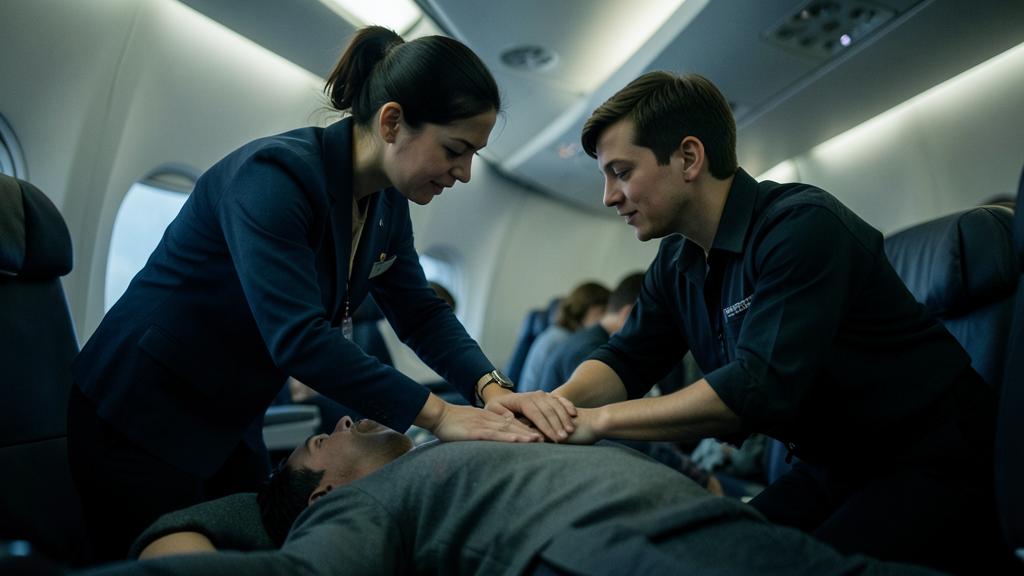
Quality standards are those of international recommendations: a compression rate of 100 to 120 per minute, a depth of 5 to 6 centimeters in adults, a complete chest recoil between compressions—remaining pressed on the sternum prevents filling—and a compressions/ventilations ratio of 30:2 when ventilation is organized. But the decisive parameter remains continuity: the only legitimate « hands-off » time is the one the device imposes for analysis.
Then there is the silent enemy: fatigue. Compression depth degrades within a few minutes, long before the rescuer feels it—they keep the rate but lose the centimeters. The solution is organizational: rescuer rotations in step with the device, using each analysis pause to change rescuers, and designating the next one during the current cycle, not when the device calls for hands off.
The correct reflex: translate the message into action before commenting. « Shock not recommended » triggers the same motor response as a delivered shock: hands on the sternum, rhythm, counting out loud. The electrodes remain in place, and the device will restart its analysis on its own—the crew does not need to ask or wait with arms crossed.
Organizing the cabin around a prolonged resuscitation
A non-shockable rhythm announces repeated cycles, several rescuer changes, and a diversion decision that must be made: this is managed as a project, not a sprint. The victim is placed on a hard surface—the floor, never the seat—and, if the layout allows, the galley or door area floor offers the space the aisle denies: enough to kneel level with the chest and let the next rescuer get into position without stepping over the current one.
The location of the equipment, however, is reviewed before it is needed: nobody should be searching for the defibrillator, first aid oxygen or medical kit during a cardiac arrest.
The immediate environment is secured: carts braked and secured, area cleared for two rows, neighboring passengers relocated, a crew member dedicated to traffic and communication with the cockpit. Nothing medical here, but a resuscitation collapses more often due to logistics than technique.
As for reversible causes, the cabin offers only one real intervention: oxygen. Hypoxia is the only cause that can be corrected on board, and first aid oxygen is connected as soon as ventilation is organized. Hemorrhage, embolism or tamponade cannot be treated in flight; merely suspecting them adds weight to the urgency of a diversion, and this information must be passed without delay to the telemedicine service. The flight deck, the doctor on the ground and any doctor among the passengers form the decision triangle; the cabin crew feeds this triangle with timed facts—time of collapse, first compression, successive messages from the device.
What to check in your own documentation
The no-shock scenario is the most likely, yet often the poor relation of documentation and training. Three checks are worthwhile. First, the wording of the procedure: some manuals detail the shockable scenario over a page and dismiss the opposite message in a line, although it will occur more often. Then, the written allocation of roles: who compresses, who ventilates, who keeps time and records, who communicates with the flight deck—a resuscitation with four people and no written roles becomes a resuscitation with one. Finally, the protocol for stopping resuscitation: on what recommendation, with what record, by whom—the most uncomfortable gray area of the subject, best read before living through it.
For periodic training, a simple criterion: if all defibrillation scenarios end with a shock followed by a return to consciousness, you are training for the minority case. The scenario that really trains is the one in which the device repeats « shock not recommended » cycle after cycle, and the team must maintain the quality of compressions, reliefs, and communication over time—the situational training format worked by aeronautical first aid workshops, particularly at formations.fl330.com.
These developments describe mechanisms and orders of magnitude, not a procedure. The applicable regulations, current medical recommendations, and documentation approved by the operator—operations manual, cabin safety and first aid instructions, telemedicine assistance protocol—take precedence in all circumstances over the content of this article.


Leave a Reply
You must be logged in to post a comment.