
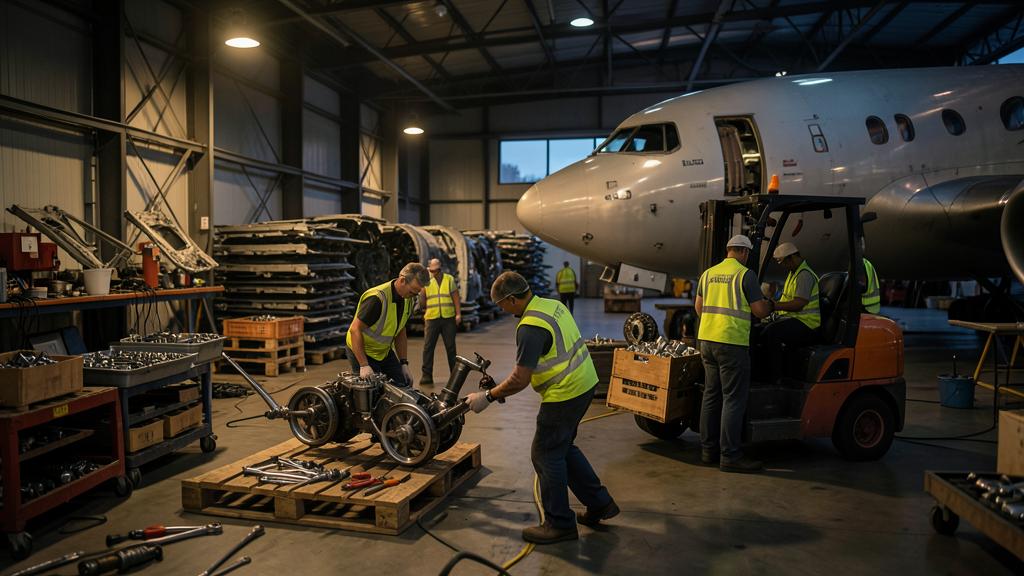
An aircraft arriving at a teardown site looks like a large object made of expensive metal, and almost nothing about that impression survives contact with the quote. The value of a part-out is concentrated in a few hundred serialised items with their own paperwork, their own demand curve and their own remaining life. The airframe they were bolted to is, in commercial terms, a container that has to be paid to be taken apart and disposed of. Understanding a dismantling estimate means understanding why the recovery is that lopsided, and why the metric that matters is never weight.
What a teardown quote actually is
A part-out estimate is not a valuation of an aircraft. It is a forecast of realisable inventory, built line by line from a specific tail’s configuration and records, and it has the structure of a working-capital exercise rather than an asset sale. Three things have to be estimated simultaneously: what can be removed and released as serviceable, what each item will fetch given who currently needs it, and how long the money takes to arrive.
The last of the three is what separates people who have done this from people quoting from a catalogue. A part-out generates revenue over several years as items are sold one at a time into a thin market, while the costs of disassembly, storage, certification and disposal are incurred in the first months. That timing gap is the business, and it is why the same aircraft is worth materially different amounts to a trader buying for stock, to an operator harvesting for its own fleet, and to a lessor recovering an asset at the end of a lease.
It also explains a fact that surprises people outside the trade: the part-out value of an aircraft sets a floor under its market value. When the recoverable inventory is worth more than the aircraft can earn by continuing to fly, the aircraft stops flying, whatever its condition. Age is not what retires airframes. Arithmetic is.
A teardown quote isn’t just about the metal – it’s about the parts that can be reused. The real money is in the rotables (like engines and landing gear), not the airframe. The value comes from selling these parts over time, not from the weight of the whole plane.
A retired Boeing 737-800 might have engines worth $2 million, landing gear worth $500,000, and APU worth $300,000. The airframe itself, though weighing 30 tons, might only fetch $50,000 for scrap metal. The real value is in the reusable parts, not the structure.
Rotable, repairable, expendable: three separate economies
Everything removed falls into one of a few commercial categories, and they behave nothing like each other.
| Category | Typical items | What creates the value | What destroys it |
|---|---|---|---|
| Life-limited parts | Engine discs, drums, shafts, spools | Documented cycles remaining against a published hard limit | Any break in back-to-birth traceability: the part becomes scrap regardless of condition |
| Rotables | Landing gear, APU, actuators, valves, avionics units, wheels and brakes | Repeated repair and return to service, a live installed base, and time remaining to the next overhaul | The type leaving service, or a modification that supersedes the part number |
| Repairables | Panels, fairings, some structural assemblies, interior monuments | Existence of approved repair data and a shop able to apply it economically | Repair cost approaching the price of new, or customer-specific configuration |
| Expendables and standard parts | Fasteners, seals, hoses, brackets | Essentially nothing once removed | Removal labour exceeds any conceivable sale value |
| Raw material | Airframe structure, skins, spars, frames | Commodity alloy price per tonne, improved by segregating alloys | Mixed alloys, contamination, and composite structure with no established recovery route |
The commercial logic of dismantling follows from that table. Value is created by removing, testing and certifying the items in the first two rows, and every hour spent on the last two is a cost. Which is why an experienced disassembly plan is aggressive about the harvest list and indifferent about the remainder: an aircraft is not stripped to the last bracket, it is stripped down the demand list until the marginal item stops paying for the labour to take it off.
Where the money actually concentrates
On most commercial aircraft the engines dominate the recovery, and it is common for the powerplants to be worth more than everything else combined. They are also usually dealt with separately: engines are removed early, and then either leased out on their remaining green time, sold as complete units, or sent for their own teardown, where the life-limited parts are the asset and the rest of the module is dressed material.
After the engines, the landing gear and the APU are the two items that reliably matter. Both are valued on the same principle: time remaining before a mandatory shop event, measured against the cost of that event. A gear assembly with substantial time to its next overhaul is a genuine asset. The same assembly close to overhaul may be worth little or nothing net, because the buyer is really purchasing an overhaul they must pay for, and that shop visit is a large, well-known cost the price has to absorb.
Below that sits a long tail: thrust reversers and nacelle components, flight control actuators and surfaces, air cycle machines and pneumatic components, wheels and brakes, and the avionics. Avionics behave unusually, because their value is driven less by wear than by obsolescence and by mandate. A unit that satisfies a current navigation or surveillance requirement on a type still operating in numbers holds its price; the same unit becomes unsellable the moment a mandate or a retrofit supersedes it, and that transition can be abrupt.
Cabin interiors disappoint almost everyone. Seats, galleys and in-flight entertainment are heavily configured to a specific operator, and the cost of refurbishing them to another customer’s specification, with its own certification and flammability substantiation, usually exceeds what a buyer will pay for used hardware.
The paperwork is the part
Nothing separates a valuable item from an identical worthless one more sharply than its records. A used serviceable component is sold on the strength of a release document issued by an approved organisation — an EASA Form 1, an FAA 8130-3, or both where the organisation can issue a dual release — and on a traceable history back to the aircraft it came from and, for life-limited items, back to manufacture.
| Item type | Documentation required | Consequence if it is missing |
|---|---|---|
| Engine life-limited part | Complete back-to-birth record of accumulated cycles, unbroken from manufacture | No usable remaining life can be claimed; the part is scrapped |
| Rotable component | Release document from an approved organisation, plus the removal record and the aircraft’s history | Sold as « as removed » material at a fraction of serviceable value, or not at all |
| Any part from the airframe | Aircraft records establishing the tail, its utilisation and its maintenance status | Buyers assume the worst; incomplete records are priced as incomplete |
| All of the above | A statement that the aircraft was not involved in an accident, incident or unusual event | The market treats the whole harvest with suspicion, across every line |
This is why the records review happens before the aircraft is touched, and why digitising and indexing the record set is a budgeted line in a serious teardown rather than an afterthought. It is entirely possible to disassemble an aircraft competently and destroy most of its value by failing to prove what came off it.
The trap. A physically perfect life-limited part with a gap in its cycle history is scrap, and no amount of inspection recovers it. Condition can be assessed; accumulated cycles cannot be measured after the fact. Any teardown proposal that has not verified back-to-birth traceability before purchase is quoting a number it cannot support.
Why the structure is not part of the calculation
The airframe is the overwhelming majority of the aircraft by mass and close to irrelevant to the recovery, for reasons that are structural rather than accidental. Primary structure is not a rotable: it is not routinely removed, exchanged or overhauled, so there is no established market, no pool of shops repairing it to a standard, and no population of operators expecting to buy it used. Its condition is difficult to substantiate once separated from the aircraft’s inspection history, and installing it elsewhere generally requires approved data that does not exist for the purpose.
What remains is the metal. Segregated aluminium alloys from a properly managed disassembly fetch more than mixed scrap, and a competent yard does segregate, but the resulting figure is a commodity price per tonne. Against that sits the labour required to cut and separate the structure, which is substantial. On newer types the picture is worse rather than better: composite primary structure has no mature, economically viable recovery route, and disposing of it is a cost line rather than a revenue line.
The practical conclusion is that the scrap value of the hulk exists mainly to offset the final disposal cost of the site. Nobody buys an aircraft for its aluminium.
The cost side, which is never quoted first
Every discussion of a part-out starts with the revenue lines. The costs decide whether the deal was any good.
| Realisation | Cost incurred, mostly up front |
|---|---|
| Engines, sold, leased on green time, or torn down for life-limited parts | Delivery of the aircraft to the site: ferry flight or, for a non-flying hull, road movement |
| Landing gear and APU, priced on time to next shop event | Parking, storage and site fees for the duration of the disassembly |
| Rotable components released as serviceable material | Disassembly labour, tooling and shop capacity |
| Repairables where approved data and a viable shop exist | Inspection, test and certification of every item to be released |
| Segregated alloy scrap from the remaining structure | Draining and disposal of fuel, oils and hydraulic fluid |
| Handling of pressurised and pyrotechnic items: oxygen cylinders and generators, slide inflation reservoirs, extinguishers, batteries | |
| Records review, digitisation and indexing | |
| Warehousing and insurance of inventory until it sells | |
| Final cutting, removal and site clearance of the hulk |
The hazardous-material lines deserve particular attention because they are frequently underestimated by newcomers. An airliner contains a significant population of items that are regulated in handling, transport and disposal, and every one of them has to be dealt with by qualified people under a documented process. None of it produces revenue.
Timing: a part-out is an inventory business
Once disassembly is finished, the operation becomes a warehouse. Demand for any individual part number is intermittent, and the seller is waiting for a specific event somewhere in the world fleet: an unscheduled removal, a shop visit that finds something, an operator unwilling to wait for a new part.
Two consequences follow. First, the realisation curve is long, and a business case that assumes rapid turnover of the whole harvest is wrong. Second, the market can be flooded. When several aircraft of the same type are dismantled in the same period, prices for that type’s used serviceable material fall, precisely when everyone holding stock wants to sell. Timing relative to other teardowns of the same type matters as much as the condition of any individual aircraft.
The right reflex. Evaluate a part-out by the size and health of the type’s remaining active fleet, not by the condition of the aircraft in front of you. Demand for used material comes from aircraft still flying. A well-maintained hull of a type nearly gone from service is worth less than a tired hull of a type with hundreds of aircraft still operating.
What moves the number
Beyond the specific tail, a handful of market conditions determine whether the same aircraft is worth harvesting at all.
- Size and trajectory of the active fleet. Used serviceable material is bought by operators of the type. A large, stable fleet supports prices; a fleet in rapid retirement destroys them, since supply rises while demand falls.
- New-part lead times. When the manufacturer’s supply chain is stretched, an operator will pay a premium for a serviceable unit available now. Used material is, above all, a substitute for waiting.
- Competing sources of supply. Approved alternative parts and approved repair schemes both compete directly with harvested material and cap what it can command.
- Mandates and modifications. A required upgrade can make a part number unsellable overnight, or create sudden demand for the superseding unit.
- Records quality. The one variable entirely within the seller’s control, and the one that most often moves the outcome by an order of magnitude on individual lines.
Who does it, and under what approval
Disassembly for parts recovery is not an unregulated activity, even though the aircraft itself may have reached the end of its certificated life. Components intended for return to service have to be released by an appropriately approved maintenance organisation — Part-145 in the European system, with the equivalent approvals under other authorities — which is why serious teardown operations either hold such an approval or work in partnership with an organisation that does. Environmental and industry practice is separately addressed through recognised best-practice accreditation for disassembly and recycling, which buyers increasingly ask about.

Around that sit the administrative steps that formally end the aircraft’s life: cancellation of registration, surrender or lapse of the certificate of airworthiness, and closure of the continuing airworthiness record with the managing organisation. These are not formalities to be dealt with afterwards. The records handed over with the parts are the ones assembled during that closure, and the quality of that hand-over is, in the end, most of what the buyer is paying for. Operators and traders comparing how different yards handle records and release paperwork will find the subject discussed in the industry sections of the FL330 forums.


Leave a Reply
You must be logged in to post a comment.