
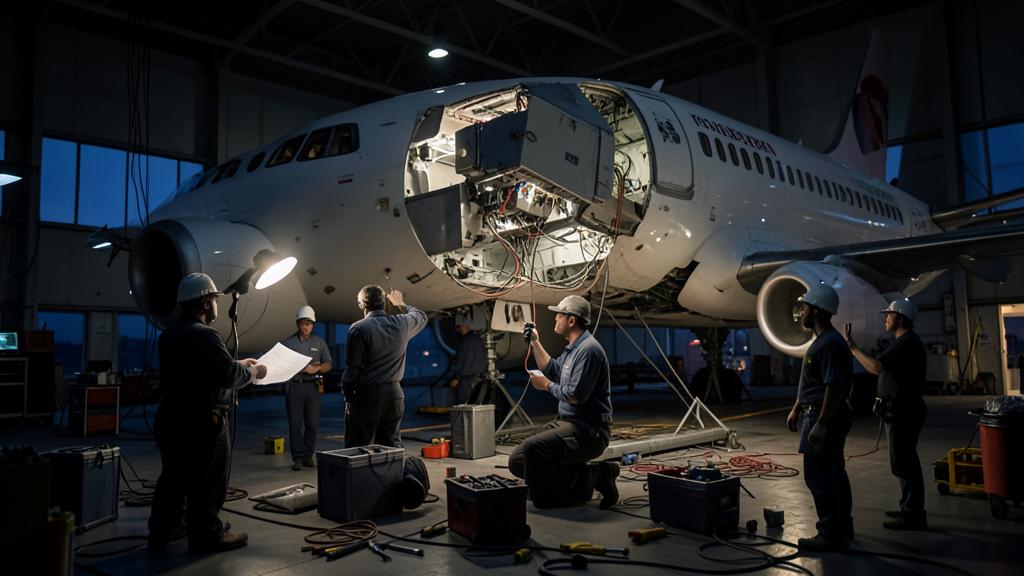
Every retrofit business case opens with the price of the modification, and the price of the modification is almost never what decides the answer. What decides it is the value of the flying the aircraft will not do while the work is done, the scarcity of the slot the work occupies, what the market will pay for the aircraft afterwards, and how many years the operator intends to keep it. Get those four terms right and the quotation becomes a detail. Get them wrong and no amount of precision on the quotation will save the decision.
The modification price is the least interesting number in the file
Ask any fleet planner why a cabin retrofit was cancelled and the answer is rarely that the kit was too expensive. It is that the aircraft could not be spared, that the hangar slot was needed for something with a deadline, that the lessor would not agree, or that the aeroplane was leaving the fleet before the payback landed. All four are cost terms. None of them appears on the supplier’s quotation.
This matters because the quotation is the only number in the file with a decimal point, and numbers with decimal points colonise a discussion. A downtime estimate expressed as « three to five weeks » loses every argument against a firm figure for hardware and labour, even though the range hides more money than the firm figure contains. The first discipline of an honest retrofit model is therefore to force the soft terms into the same units as the hard ones, and to accept that a wide range honestly stated beats a narrow one invented.
Downtime is a revenue line, not a maintenance line
An aircraft in a hangar is not costing you the hangar. It is costing you whatever the network would have earned with it, less the variable cost of operating it — and on a tight fleet that figure is not the average contribution of a tail, it is the contribution of the marginal tail, which is the one that flies the sectors nobody else can cover. If the retrofit removes an aircraft during a peak season, the loss is not a twelfth of the annual contribution for a month out; it is the peak contribution, which on a leisure network can be several times the shoulder-season figure.
Two corrections follow. First, downtime cost is seasonal, and scheduling the work into the trough is often worth more than any negotiation on the labour rate. Second, if the operator holds spare capacity, or can lease in cover, the correct charge is the cost of that cover rather than lost revenue — and those two numbers are usually far apart. A model that uses lost revenue when cover was available overstates the case for doing nothing; a model that assumes cover exists when it does not understates the risk of a slot overrun.
The overrun itself deserves its own line. Retrofit programmes routinely discover corrosion, wiring in a condition the drawings did not predict, or structural repairs that must be assessed before the new provisions can be installed. The first aircraft through a programme is always the expensive one; the learning curve is real and it is steep. A model that prices every aircraft at the price of the last one flatters the programme, and a model that prices every aircraft at the price of the first one kills it.
The real cost of a retrofit isn’t just the price of the work. It’s the money you lose from not flying the plane, the value of the hangar slot, and how much longer you’ll keep the plane. If you don’t account for these, the numbers won’t make sense.
An airline with an A320 fleet plans a cabin retrofit during the summer peak. The aircraft earns €250,000 per month in peak season but only €120,000 in the off-season. If the retrofit takes 4 weeks, the cost is €250,000 in peak season but only €120,000 if done in the off-season. Scheduling matters.
| Counted without argument | Missed, or argued away |
|---|---|
| Kit and hardware | Contribution lost during downtime, priced at the marginal tail and the right season |
| Installation labour and hangar charges | Opportunity cost of the maintenance slot itself |
| Certification and design approval fees | Schedule risk on the first aircraft, and the learning curve across the fleet |
| Ferry to and from the facility | Sub-fleet penalty while the fleet is part-modified |
| Any weight change quoted by the supplier | Cruise drag or weight penalty as an annuity over remaining service life |
| Manuals, training, MEL and mass and balance revisions, spares provisioning | |
| Removal and restoration at lease redelivery, if required |
The shop slot is a scarce asset with its own price
In a market where hangar capacity and licensed labour are the binding constraint, a slot is not a cost, it is an allocation. The right question is not what the facility charges for six weeks but what else those six weeks could have carried — a check that is falling due, a lease redelivery with a hard date, an engine change that will otherwise be done at a premium elsewhere. When capacity is tight, the shadow price of a slot exceeds the invoice for it, sometimes considerably, and that difference belongs in the model.
This is the argument for embodying a retrofit inside a scheduled heavy check, and it is a strong one: much of the access work, the ground time and the return-to-service effort is already being paid for. But it is not free. Adding a modification to a check can lengthen the critical path, and a check that overruns puts the aircraft outside its planned return date with knock-on effects across the maintenance programme. The saving is real, the schedule risk is real, and the model should show both rather than claiming only the first.
The trap. A part-modified fleet is a second fleet. Two cabin configurations mean two seat counts, two crew briefings, two spares holdings, and a commercial promise that only some tails can keep. Dispatch flexibility falls precisely when the network wants it, because the aircraft that can cover the route is no longer any aircraft. Programmes that stretch across several seasons pay this penalty for their whole duration, and it rarely appears in the business case that authorised them.
What a modification does to residual value, and what it does not
The most common error in a retrofit case is to assume that money spent on the aircraft is money recoverable at sale. It generally is not, and the reason is structural: an appraiser values an aircraft in a standard configuration for its type, on the assumption that the next operator will fit its own product. A cabin retrofit that delights your customers is, to the next buyer, a removal cost.
The exceptions are informative. Modifications that preserve access to airspace or markets do protect value, because without them the aircraft is unmarketable in the regions that require them — datalink and ADS-B capability, navigation performance approvals, collision avoidance to the current standard, radio channel spacing. So do modifications that raise capability in a way the market recognises independently of livery: extended range, increased maximum take-off weight, a widely adopted avionics baseline. Cabin trim, seat covers, entertainment hardware and connectivity terminals sit at the other end, and connectivity in particular ages faster than the aircraft.
The practical rule is to split the modification into the part that is a ticket to operate and the part that is a product decision. The first can be defended on residual value. The second must be defended on revenue, and if the revenue case does not stand alone it does not stand at all.
Ownership status rewrites the arithmetic
The same modification on the same aircraft type produces different answers depending on who owns the aeroplane and for how long, because ownership determines who captures the benefit and who bears the reversal.
| Situation | What changes | The term that decides |
|---|---|---|
| Owned outright, long remaining life | Operator captures both the operating benefit and any residual effect | Payback against remaining service life; the case is cleanest here |
| Owned, sale or part-out expected | Only the marketability portion is recoverable | Whether the modification is a ticket to operate or a product choice |
| Operating lease, long remaining term | Lessor consent required; the modification usually accedes to the aircraft | Whether removal and restoration are demanded at redelivery |
| Operating lease, short remaining term | Benefit window shorter than the payback, twice over if removal is required | Remaining term against payback, before anything else |
| Lease extension under negotiation | The modification becomes a bargaining chip on rate and return conditions | What the lessor will concede in exchange for keeping the work |
Two lease points cause more damage than any other. The first is accession: work embodied on a leased aircraft normally becomes part of the aircraft and therefore the lessor’s property, without compensation, unless something was negotiated in advance. The second is the return condition, which may require the aircraft to be restored to its delivery configuration — meaning the operator pays to install and pays again to remove, with a second period of downtime nobody modelled. Both are settled by the lease, both are negotiable before the work and neither is negotiable after it.
The certification path is a schedule risk before it is a cost
An installation needs an approved design. Where the change is classified as major, that means a supplemental type certificate or an equivalent approval under the applicable design rules, and where a supplemental type certificate already exists for the type, the practical question becomes whether it covers your exact configuration — the effectivity of an approval is narrower than the marketing material suggests, and a single non-standard provision from an earlier modification can put an aircraft outside it.
What follows the approval is often underestimated: instructions for continued airworthiness that must enter the maintenance programme, a flight manual supplement, revised mass and balance data, an amended minimum equipment list, updated cabin safety and emergency equipment documentation where the layout changes, and training for both crews and engineers. A cabin change that alters the seating layout can reach further still, because seat count drives cabin crew complement under the European rule of one cabin crew member for every fifty installed passenger seats, or fraction of fifty, and emergency exit provisions constrain what can be installed and where.
None of this is expensive relative to the hardware. All of it is on the critical path, and an approval that arrives late has already consumed a slot.
Costing the option nobody writes down: doing nothing
A comparison between retrofit and replacement is incomplete without the third option, and the third option is not free. Ageing equipment carries a rising dispatch reliability cost that shows up as delays, cancellations, and the crew and passenger consequences of both. Parts obsolescence is the sharper edge: when the original manufacturing sources disappear, the choices narrow to salvaged units, an expensive repair capability, or an unplanned modification later, at a moment of someone else’s choosing rather than yours.
The correct framing is not retrofit against replacement but three cash flow profiles over the same horizon, discounted the same way. Doing nothing generally has the best profile early and the worst profile late; retrofit sits in the middle; replacement is the steepest early and the flattest late. Which one wins is decided almost entirely by where you truncate the horizon — which is to say, by the remaining hold period.
The horizon decides, so fix it first
The remaining hold period is the single most powerful assumption in the model and the one most often left implicit. A twelve-year payback on an aircraft with four years left in the fleet is not a marginal case, it is arithmetic that has already given its answer. Yet the assumption usually sits nowhere in the file, because nobody wants to write down when an aircraft is leaving.
| Remaining hold period | Dominant term | What usually wins |
|---|---|---|
| Under about three years | Downtime and redelivery conditions | Do nothing, or do only what is mandated for continued operation |
| Three to seven years | Slot value and sub-fleet penalty | Targeted retrofit embodied inside a scheduled check, fleet-wide in one season |
| Beyond seven to ten years | Operating economics and obsolescence exposure | Full retrofit, or replacement if the type’s economics are the real problem |
| Undecided | The undeclared assumption itself | Nothing, until the fleet plan commits to a horizon in writing |
The right reflex. Before comparing options, write the remaining hold period on the front page of the file as a committed assumption, with the name of whoever owns it. Then run the comparison at that horizon, and again two years shorter. If the decision flips between the two, the real problem is not the retrofit — it is that the fleet plan has not been made, and no cost model can make it for you.
Assembling a comparison that survives scrutiny
A defensible model has a small number of properties. It compares complete cash flow profiles over one fixed horizon rather than payback periods, because payback rewards the option with the smallest first cheque. It prices downtime at the marginal contribution in the season the work will actually happen. It carries the slot at its opportunity cost, not its invoice. It states the residual assumption explicitly and separates the marketability portion from the product portion. It shows the sub-fleet penalty for the duration of the programme. And it presents ranges where ranges are the truth, with the decision tested at both ends.
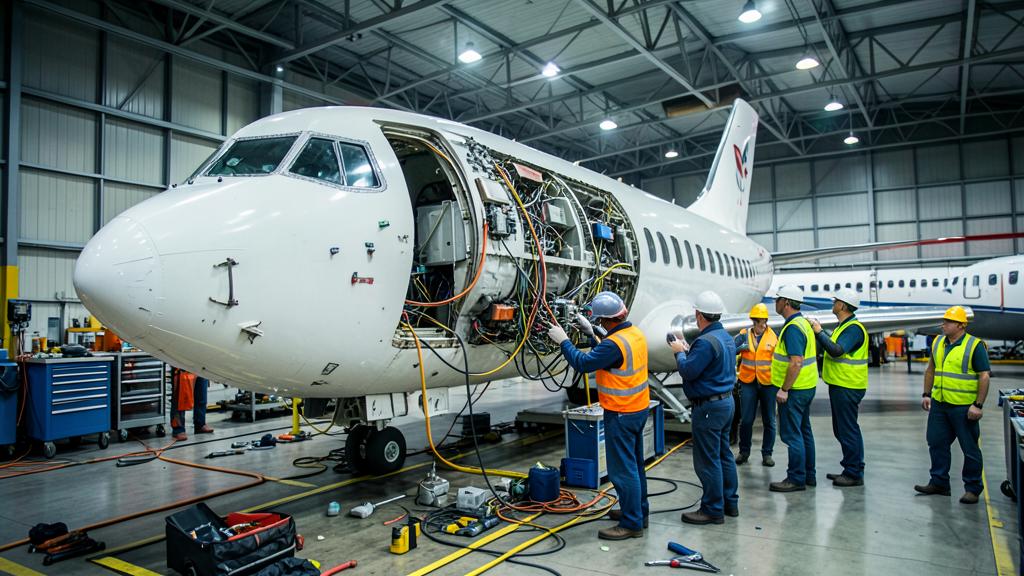
Where replacement is the alternative, the model has to be honest about the transition too. A new type brings delivery slots measured in years, crew conversion, engineering approvals, tooling, simulator access, spares provisioning, and a period during which the operator runs two fleets and gets the economies of neither. Those costs are real and finite, and they are the reason a marginally better aircraft rarely justifies a fleet change on its own. The cases where replacement wins are the cases where the existing type’s operating economics, not its cabin, are the problem — and that is a different question from the one a retrofit was ever going to answer. Fleet planning and maintenance economics are worked through in more depth in the industry modules at FL330 training.


Leave a Reply
You must be logged in to post a comment.