

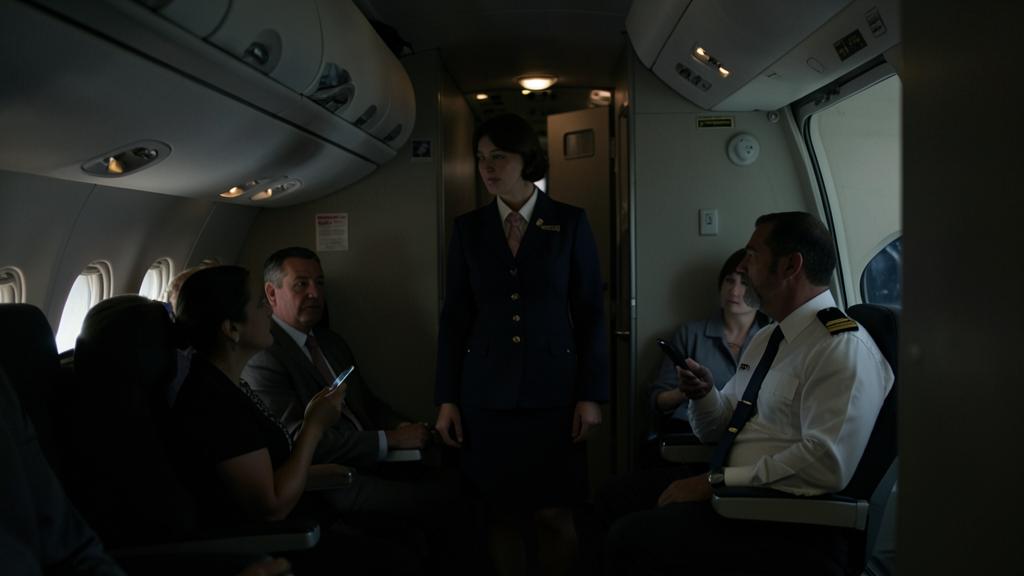
A passenger refuses to return to their seat, voices rise, the neighboring row pulls out a phone. The cabin chief has a few dozen seconds to decide between handling the situation and picking up the interphone. The reflex response — « authority is at the station, so we escalate » — is wrong most of the time, and it costs dearly when applied mechanically. The captain’s authority is not shared, but it does not extend to every cabin gesture either. The question remains: where exactly does the line pass, and according to what criterion?
A last-resort authority, not a detailed authority
The texts applicable to air operations entrust the captain with the responsibility for the conduct and safety of the flight, and the power to give instructions to any person on board. The wording is broad, and that is precisely what leads to confusion: it does not say that he decides everything, it says that no one decides against him. These are two very different propositions.
The first consequence is protective for the cabin crew. As long as a decision remains within the perimeter described by the operator’s approved documentation, it is already covered: the captain does not have to ratify it one by one, and it cannot be blamed on him for having let it happen. The second consequence is more demanding: everything that falls outside this perimeter falls to him, even when the act seems trivial. The useful question is therefore never « is it serious? », but « is it written? ».
The cabin’s mandate does not come from a tradition or a company practice: it comes from the operations manual, which lists what the staff does without asking. Its scope varies from one operator to another, sometimes from one type of operation to another within the same company. A cabin chief who changes employers changes their perimeter, and that’s the kind of detail you discover at the wrong time.
A material constraint has become structural: the cockpit door remains closed. The captain sees nothing of the scene, perceives neither the tone, nor the posture, nor the attitude of the neighboring passengers. He decides based on a third party’s account. The real issue is therefore not the distribution of power, which is clear, but the flow of information: who holds it, in what form it is transmitted, and above all when.
The captain is in charge of the flight, but not every small decision. The cabin crew can handle many situations on their own, as long as it’s in the manual. The tricky part is knowing when to call the cockpit, which depends on the rules and the situation.
On an Airbus A320 at 25°C with 150 passengers, a passenger refuses to sit down. The cabin chief can move them to another seat without calling the cockpit, but if they issue a formal written warning, they must check with the captain first. The warning is irreversible, so it needs approval.
The dividing line follows irreversibility, not gravity
Intuition classifies situations by apparent gravity and escalates everything that impresses. The criterion that works is elsewhere. Separating two passengers who are insulting each other produces a spectacular scene, but the act is entirely reversible: if the assessment was wrong, things are put back in place and nothing remains. Issuing a written warning to a passenger produces no scene, and yet the act is definitive: it creates a record, it commits the operator, it initiates a possible follow-up before an authority. The first stays in the cabin, the second is escalated.
A second criterion overlaps the first: does the act change the assumptions on which the cockpit is reasoning for the rest of the flight? Moving a passenger to an exit row, making a seat unusable, immobilizing a crew member with a person for the rest of the sector — each of these actions changes the cabin that the captain thinks is behind him. None of them are serious in the common sense. All of them must reach him before the approach.
What the cabin chief decides without picking up
The cabin’s own domain is wider than one might think, and it covers almost all of what actually happens on board. Stopping the alcohol service to a passenger, changing someone’s seat, issuing an explicit verbal warning, putting away an object that has become a projectile, redeploying the crew to maintain a presence in a zone, collecting the identity of witnesses: none of this requires a prior call. Most of these actions are in fact the de-escalation itself, and a call to the cockpit in the middle of the sequence interrupts it.
| Decision | Taken by | The flight deck is informed | Reversible |
|---|---|---|---|
| Stopping alcohol service to a passenger | Senior cabin crew member | At the next contact | Oui |
| Seat change, separating two passengers | Senior cabin crew member | If an exit row or load balance is involved | Oui |
| Formal verbal warning | Senior cabin crew member | For information | Oui |
| Issuing a written warning | Senior cabin crew member, after agreement | Before issuing | Non |
| Use of restraint devices | Captain | Before applying | Non |
| Request for authorities to meet the aircraft on arrival | Captain | It is the originator | Non |
| Diversion | Captain | Sans objet | Non |
| Offloading before departure | Captain, on the cabin’s proposal | Before doors close | Yes, for the flight |
A nuance deserves to be noted: refusing to serve alcohol is not a sanction, it is the enforcement of a rule. The texts prohibit admitting or keeping on board a person whose state of intoxication compromises safety. This obligation rests with the operator, but it can only be enforced by the cabin, which is the only one to see. This is the clearest case of a rule written for one and applied by the other.
The useful moment for the call precedes the threshold
When the situation needs to be escalated, the reflex is to call at the moment it becomes unacceptable. It is too late, for a mechanical reason: the captain’s decision is not instantaneous. It requires coordination with the control, often an exchange with the operator, an assessment of the airports and ground resources, and then preparation of the cabin. Notified at the threshold crossing, the cockpit decides after the event.
What the cockpit expects is not a state but a derivative. « He is agitated » allows no decision; « he was sitting and calm ten minutes ago, he is now standing and refusing two successive requests » does. The trend is better than the intensity, because it alone tells what will have to be decided in a quarter of an hour.
The choice of timing is itself a cabin decision, and it is not simple. A call during a phase where the flight crew must remain focused is prohibited except in emergencies, which leaves the cabin chief with the choice between waiting for the end of the phase and considering that the emergency is established. This choice is prepared: the call is formulated before it can be made, it is not written in the interphone.
The right reflex: announce in four steps, always in the same order. What is happening, in observable facts. What has already been tried and what it produced. In which direction the situation is evolving. What is being requested — a decision, an authorization, or nothing but information. The last point is most often forgotten, and it is the one that wastes the most time: the captain spends a minute trying to figure out what is expected of him.
What is only decided in the cockpit, and why
Three families of actions are entirely beyond the cabin’s purview, and it is worth understanding why rather than memorizing the list.
- First, the means of restraint. Restraining a person deprives them of their freedom of movement, which engages the operator on an entirely different level than managing a flight. But the operational argument is even stronger: a restrained passenger is a passenger who cannot evacuate alone. It is therefore necessary to decide where they are seated in relation to the exits, who will free them, with what, at what signal, and to accept that the crew member in charge of monitoring them is removed from their evacuation function. The captain must know this configuration, because it is with it that he will land.
- Then, the diversion, which belongs solely to the captain because it involves the landing weight, the fuel, the suitability of the airport, and the availability of ground resources. The cabin does not propose a diversion; it provides the elements that allow its necessity to be assessed, and it indicates how long it estimates it can hold the situation. The latter information is the most valuable and the rarest to be given.
- Finally, the request for handover to the authorities upon arrival. It is made through an operational message issued from the cockpit, and it has consequences that the cabin does not control: the follow-up depends on the landing location and the rules in force there, and international conventions relating to acts committed on board organize a jurisdiction that is not always the one the crew imagines. A handover is requested, but the applicable law is not chosen.
The trap: improvised restraint with whatever is at hand. A strap, a belt, or a makeshift tie sometimes hold better than expected, and nothing is planned to undo them quickly. The passenger then finds themselves immobilized for landing without anyone having decided on their location, without an identified release method, and without the cockpit knowing that the cabin is no longer in its nominal configuration. The operator’s procedure exists mainly to avoid this situation.
Before pushback, everything is still affordable
There is a window where the heaviest decision remains inexpensive, and it is also the one where the cabin holds almost all the information: boarding. The smell, the speech, the difficulty in finding one’s seat, the aggression towards an escort or towards the ground staff — all of this is visible at the door and nowhere else.
Removing someone at this moment costs a few minutes of delay. After the doors are closed, it is necessary to reopen, remove the person, and retrieve their baggage in the hold for safety reasons. After pushback, it is a return to the parking stand. In long-haul cruising, only diversion remains. The transition between these states is not linear, and the first is by far the most profitable.
In practice, the most costly behavior is not the wrong decision: it is the wait. Hoping that things will calm down is a comfortable position during boarding, because it avoids an immediate conflict and a visible delay. It simply transfers the problem to a phase where it will be paid for without common measure, and where it will have to be resolved with far fewer options.
What to check in your own documentation
None of the above dispenses with opening your operator’s manual, because it is the one that sets the real perimeter. Four points deserve careful reading rather than a cursory glance. The exact enumeration of the actions that the cabin performs without prior agreement, and the wording used: « inform » and « obtain agreement » do not describe the same world. The competence to propose a non-boarding at the door, and the person to whom the proposal is addressed when the captain is still in preparation. The restraint procedure in detail: actual equipment on board, who restrains, who releases, conduct in case of evacuation. Finally, the report: its form, its deadline, and what must necessarily be included for it to be usable after the flight.
A gray area remains, and no documentation really covers it: the passenger who is not yet disruptive but whose state suggests they will become so in three hours. No procedure is triggered by a prediction, and yet that is exactly where the cabin provides the most value. The only available lever is to share the observation early, presenting it for what it is — an anticipation, not a fact — so that the cockpit knows a file is open before it becomes unavoidable.
For those preparing a cabin chief selection or an advanced cabin training, the consequence is direct: a selection jury does not test the recitation of a classification scale, it listens to a brief report and checks if it enables a decision. It is a skill of formulation as much as of judgment, and it is worked on by saying it out loud, not by reading it. Incidentally, the professional forums of the sector show that disagreements between the cockpit and the cabin almost always concern the quality of the information transmitted, very rarely the distribution of powers.
This article describes a general mechanism and does not replace anything: the applicable text and your operator’s approved documentation prevail in all circumstances, including when they distribute decisions differently.


Leave a Reply
You must be logged in to post a comment.