
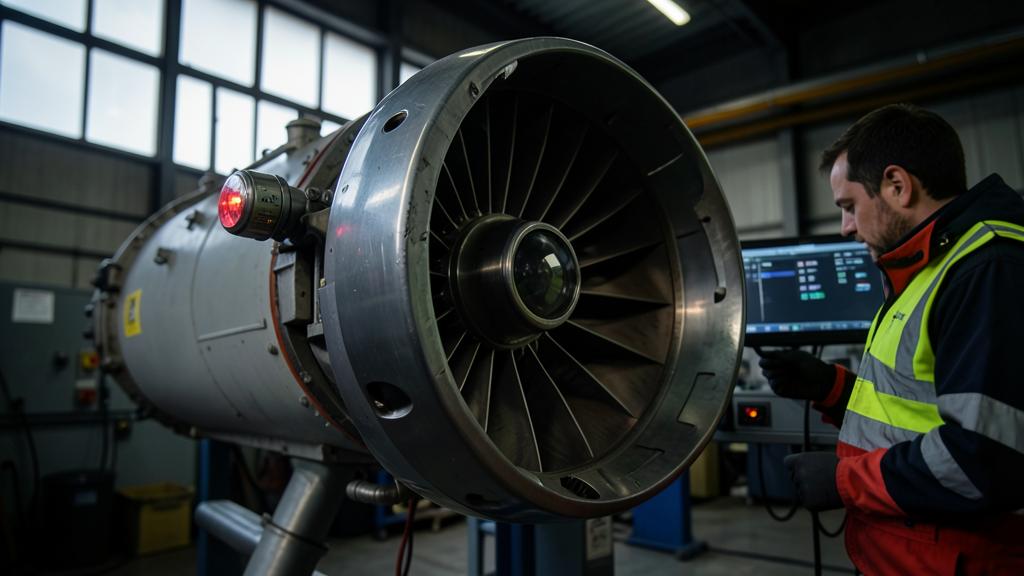
An engine rarely comes off the wing because something broke. It comes off because a number that has been falling for years finally intersects a date that was booked long before anyone could be sure of it. Exhaust gas temperature margin is that number, trend monitoring is what turns it into a forecast, and the shop slot is what turns the forecast into a commitment. Understanding how those three things negotiate with each other explains most of what looks arbitrary about engine planning.
What margin actually measures
Exhaust gas temperature margin is the distance between the temperature an engine reaches at a defined reference condition and the limit certified for that condition. It is not a health index invented by planners; it is the direct consequence of how a turbine engine is rated. The engine is flat-rated: up to a certain ambient temperature it delivers its rated thrust with temperature to spare, and above that point the temperature limit becomes the binding constraint. Margin is how much of that reserve is left.
It falls because the gas path deteriorates. Tip clearances open, seals wear, airfoils erode and become rough, cooling passages foul. Every one of those effects reduces the efficiency with which the compressor and turbine do their work, which means more fuel is needed for the same thrust, which means a higher temperature. The margin figure is therefore a summary of the physical condition of the hot section, expressed in the one unit the flight deck can read.
Two consequences follow immediately. First, margin is condition-dependent: the same engine shows different margins on a cold morning and a hot afternoon, which is why trend systems correct everything to a reference condition before comparing anything. Second, margin loss is invisible to the crew until it is nearly exhausted. An engine with very little margin left flies normally on a cool day and runs into its temperature limit before it reaches rated thrust on a hot one. It is a planning parameter that becomes an operational one only at the very end.
The right reflex. Never read a raw exhaust gas temperature figure as a health indicator. A number is only comparable to yesterday’s after correction to a reference condition, at the same thrust rating and the same bleed configuration. Uncorrected data is the single most common source of false alarms in fleet trend reviews.
Exhaust gas temperature margin is like a buffer zone between normal operation and the engine’s safety limit. As the engine wears out, this buffer shrinks, but it only becomes a problem on very hot days. Planners use this margin to predict when the engine will need maintenance.
An Airbus A320neo with a CFM LEAP-1A engine might have a margin of 30°C at delivery. After 10,000 flight hours, it could drop to 15°C. On a cold day (15°C ambient), the engine runs fine, but on a hot day (35°C ambient), it might hit its temperature limit before reaching full thrust, forcing an early shop visit.
Why the loss is not a straight line
If margin fell at a constant rate, engine planning would be arithmetic. It does not.
A newly delivered or freshly overhauled engine loses margin quickly at first. Clearances that were set tight for build settle out under the first thermal cycles, and a substantial fraction of the eventual loss happens early. After that the curve flattens into a long, roughly linear stretch that is the useful life of the build, and it is this stretch that forecasting works on.
Towards the end, the slope can steepen again, as accumulated clearance loss and seal wear start reinforcing each other: a hotter engine deteriorates faster, and a faster-deteriorating engine gets hotter. Whether an individual engine shows that acceleration clearly depends on the type, the build standard and the environment, which is why serious planning treats the late-life slope as a forecast band rather than a line.
The second reason it is not linear is that deterioration is driven far more by cycles than by hours. Damage accumulates at take-off and in the climb, where temperatures and rotational speeds are highest, not during a long cruise at reduced power. Two engines with identical hours can therefore be in entirely different physical states if one flies short sectors and the other flies long-haul. Short-cycle operations consume margin faster per hour flown, and any fleet mixing both patterns has to plan them separately.
Trend monitoring: shifts, drifts and the noise between them
Engine condition trend monitoring records a set of parameters at a defined point in the flight, corrects them, compares them to a baseline for that engine, and plots the deltas. The parameters are the classic set: exhaust gas temperature, fuel flow, core speed and, depending on the type, vibration and oil consumption. What matters is not any single reading but the shape of the plot over weeks.
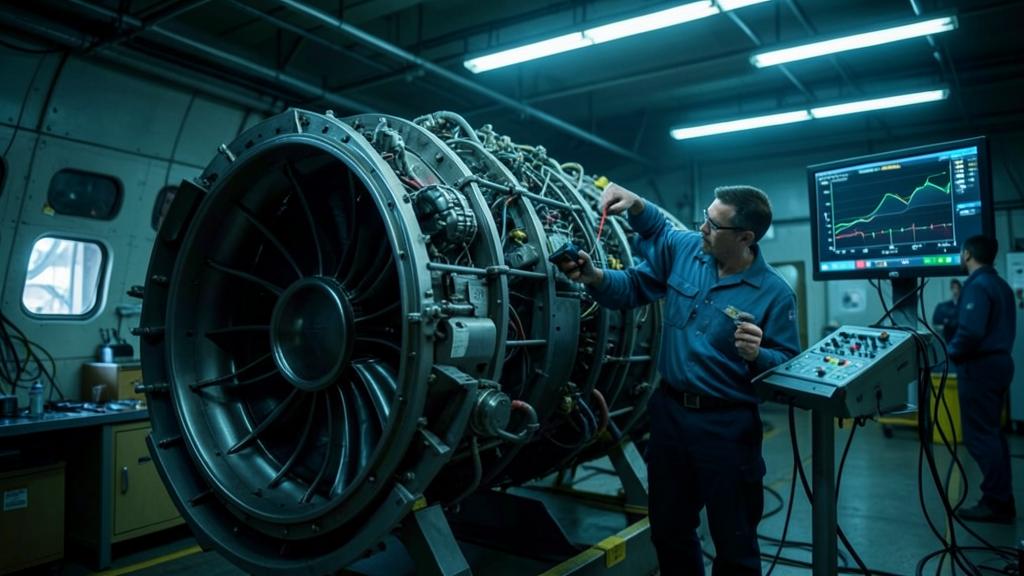
Two shapes carry almost all the information. A step is a sudden displacement of the whole trend, with the slope afterwards unchanged. Steps are events: a bleed valve that stopped closing, a sensor that drifted, damage from an ingestion, a change in how the data is being taken. A drift is a change in slope with no discontinuity, and drifts are deterioration.
Distinguishing the two is the entire skill, because they lead to opposite actions. A step calls for troubleshooting and, usually, a fix that restores the previous line; treating it as deterioration books an unnecessary removal. A drift calls for a revision of the removal forecast; treating it as an event sends technicians hunting for a fault that does not exist while the forecast quietly goes stale.
| Pattern | Typical interpretation | First action |
|---|---|---|
| Step in exhaust gas temperature and fuel flow together, core speed steady | Bleed or air system leak, or handling valve fault | Air system troubleshooting before any engine conclusion |
| Step in exhaust gas temperature alone, other parameters unmoved | Instrumentation or thermocouple harness | Verify the sensing chain before believing the number |
| Slow drift across all gas path parameters | Genuine gas path deterioration | Update the margin forecast and the removal window |
| Drift in fuel flow with margin nearly flat | Efficiency loss without a thermal penalty yet | Economic case for a wash or an earlier workscope |
| Scatter widening with no trend | Data acquisition or reporting condition inconsistency | Fix the data before analysing it |
| Vibration rising with gas path parameters unchanged | Mechanical, not performance | Separate investigation path entirely |
The four reasons an engine comes off
Margin is the most discussed removal driver and rarely the only one in play. In practice four independent clocks run at once, and the removal date is set by whichever one arrives first — with the crucial caveat that a good planner tries to make several of them arrive together.
Performance margin is the first. Life-limited parts are the second and the most rigid: rotating discs, shafts and spools carry a certified cyclic life that cannot be extended by inspection or by argument, and when a part reaches that limit the engine comes off, whatever the rest of it looks like. Hardware findings are the third: borescope inspections reveal blade distress, coating loss or cracking that the manuals treat with their own limits and repeat intervals. Mandatory action is the fourth: airworthiness directives and the service bulletins an operator has elected to embody, each with its own compliance window.
| Driver | What it is measured in | Notice it gives | Negotiable? |
|---|---|---|---|
| Performance margin | Temperature reserve at a reference condition | Long: a forecast built from months of trend | Partly, through derate, washes and routing |
| Life-limited parts | Certified cycles per part number | Exact and known years ahead | No |
| Hardware findings | Borescope observations against manual limits | Short, sometimes immediate | Only within the repeat intervals the manual allows |
| Mandatory action | Compliance window in the directive | As published, often generous | Only by aligning with another removal |
The trap. Optimising a workscope on margin alone produces an engine that is thermally healthy and stops six months later because a disc ran out of cycles. Life-limited part stubs are the one clock that no shop visit can extend, and they have to be read first, not last.
Building the workscope backwards from the next removal
This is where engine planning stops resembling maintenance and starts resembling finance. The shop visit is not designed to restore the engine to new. It is designed to reach a chosen next removal date, and no further.
The logic runs backwards. Choose the interval you want out of this build. Establish which life-limited parts have enough cycles to cover it and which must be replaced to do so. Establish how much margin needs restoring, which determines how deep the module workscope goes and whether the high pressure turbine is refurbished or largely renewed. Then price the result, and check that no expensive new part is being installed with a life that will be thrown away at the next removal.
That last check is the discipline that separates good planning from expensive planning. Installing a part with far more remaining life than the intended interval means paying for life that will be scrapped, or accepting a longer interval than the fleet plan wants. Stub management — deliberately matching remaining lives to the planned interval — is a large part of what an engine fleet manager is actually paid for.
The shop slot is the real constraint
Everything above assumes that when the forecast says the engine should come off, a shop will take it. That assumption has not been safe for some years.
Overhaul capacity for the current generation of engines is booked long in advance, turnaround times have lengthened, and the supply of serviceable parts has been the limiting factor on more than one programme. The practical consequence is that the slot is booked well before the trend forecast is precise enough to justify it. Planning therefore works with a provisional removal window that firms up progressively: a booking made against a forecast, revised at each fleet review, and confirmed when the margin trajectory and the slot converge.
Spare engine cover is the other half of the constraint. An engine removed without a serviceable spare available grounds an aircraft, and lease rates for a short-notice spare are punishing. This is why an operator will sometimes accept a slightly earlier removal than the engine needs, to take a slot that exists, rather than an optimal date with no capacity behind it. From the outside this reads as poor planning. It is the opposite.
What the operator can still move
Between the trend and the slot there is real room to manoeuvre, and the levers are mostly in daily operations rather than in the technical department.
- Reduced-thrust take-off is by far the largest. Deterioration responds very strongly to peak temperature, so the relationship between derate and margin life is far from proportional: modest reductions in take-off thrust, used consistently, extend the life of a build measurably. Any performance department that has quantified this for its fleet will defend the assumed-temperature policy fiercely, and rightly.
- On-wing compressor washing recovers part of the loss caused by fouling, and none of the loss caused by wear. Its value therefore depends heavily on the operating environment: fleets in dusty, coastal or industrial regions see real recovery, and washing schedules there are an economic decision rather than a cosmetic one.
- Routing matters for the same reason. Aircraft rotated deliberately between harsh and benign environments spread deterioration across the fleet instead of concentrating it on the aircraft that happens to live at the difficult base.
| Lever | Mechanism | Recovers or preserves |
|---|---|---|
| Consistent reduced-thrust take-off | Lower peak temperature and speed | Preserves: the strongest single lever, non-linear in effect |
| Compressor wash | Removes deposits from airfoils | Recovers fouling losses only, never wear |
| Fleet routing and base rotation | Spreads erosive exposure | Preserves, at fleet level rather than engine level |
| Sector length mix | Fewer cycles per hour flown | Preserves, where the network allows any choice |
| Module swap or on-wing repair | Targets the deteriorated module | Recovers part of the margin without a full shop visit |
When the date becomes firm
The removal date is not announced; it converges. A provisional window comes out of the trend forecast, a slot is booked against it, and each fleet review either confirms the trajectory or moves the window. It becomes firm when three things agree: the forecast margin at the planned date still leaves an acceptable operational reserve, the life-limited parts cover the interval that the workscope is being built for, and the shop and spare engine are genuinely available on the day.
When one of the three fails, the engine either comes off earlier than it needed to or flies longer than the planner wanted with a shrinking reserve and a borescope schedule to match. Neither is a failure of the system. The system is a negotiation between a physical process that does not care about calendars and an industrial one that runs on nothing else, and the removal date is where the two settle.


Leave a Reply
You must be logged in to post a comment.