
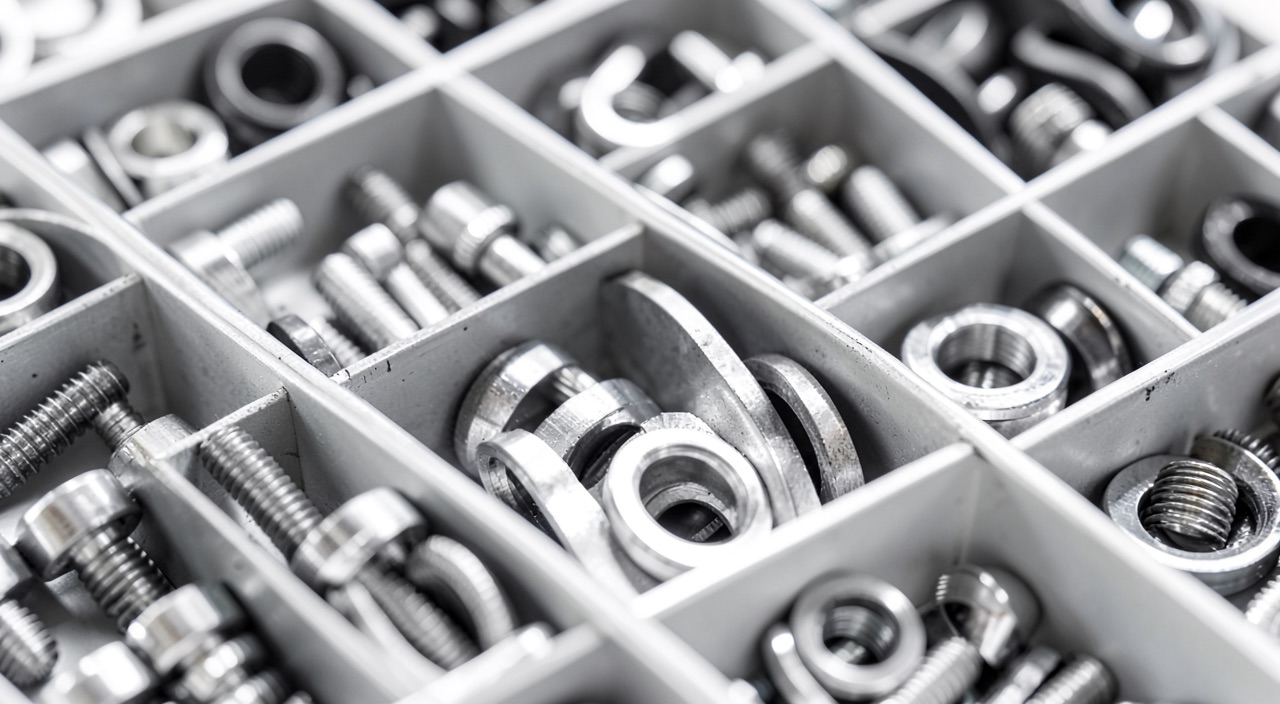
The fuselage section is ready, the operators are at their station, the tooling is calibrated, and nothing happens: a handful of two-centimetre swage collars are missing. The part number is stocked by three distributors, but none of the collars available carries the coating called out by the design definition, and none of them can therefore be installed on this joint. It is not the part that is blocking the line, it is what has been demonstrated with it. This mechanism explains why assembly stoppages cluster on the cheapest components of the aircraft.
The component that weighs nothing in the price and everything in the schedule
A widebody airframe receives on the order of a million fasteners, spread across several thousand distinct part numbers: diameters, grip lengths, head shapes, materials, coatings, installation directions, collar types. Set against the purchase price of the aircraft, the “fastener hardware” line is negligible. Set against the number of places where production can stop, it comes first, far ahead of the large equipment items that everyone monitors.
The reason lies in the way material reaches the station. Stores do not deliver parts, they deliver kits made up for one operation and one only. A kit is either complete or it is not: a joint is either closed or it is not, and a panel that cannot be closed up bars everything that comes after it — sealing, pressure testing, installation of harnesses and pipework, surface protection. A shortage on a single part number does not cost one operation, it costs a queue.
Then comes the decision that does the real damage: letting the work “travel” to a downstream station. The operation will be picked up later, in a position where access is degraded, where the dedicated tooling is no longer available, where protecting the neighbouring parts already installed imposes extra precautions, and where an inspection already signed off will have to be reopened. The cost of a fastener shortage is never the cost of the part: it is the cost of the rework, and it is counted in hours of skilled labour multiplied by the number of units already committed.
Tiny fasteners can halt an entire assembly line because they’re part of a carefully engineered system. If one is missing, the whole production sequence gets disrupted, causing costly delays.
On an Airbus A350, a missing swage collar (part number 12345-678) with the wrong coating stops fuselage assembly. The 2cm part costs $0.50, but the delay costs $50,000 in rework and lost production time.
What “qualified” actually covers, and why it cannot be improvised
Behind a standard number stands a chain of operations, each of which is a separate trade. Material first: an identified melt, a traced bar lot, a controlled composition and inclusion cleanliness, because the fatigue performance of a fastener is decided in part in the metal, before any machining. Then forming, with a rule the industry holds firmly: the thread is rolled after heat treatment, because rolling leaves a residual compressive stress at the thread root that delays crack initiation. Reversing the order produces a part that is dimensionally compliant and permanently inferior.
Then comes surface treatment, which is not decoration: it provides galvanic protection in a mixed stack-up and it sets the behaviour under tightening, since the dry film lubricant governs the relationship between the torque applied and the preload actually obtained in the shank. After electroplating, the part must be baked within a short time to drive off the absorbed hydrogen, failing which it becomes embrittled and fails without warning, sometimes weeks after installation. Finally the lot tests — tensile, shear, hardness, coating adhesion, dimensional inspection — then the documentary release that ties all of this to a lot number.
The point often missed: these steps belong to distinct workshops, approved separately, and a special process is not transferred from one workshop to another by letter. Changing coating shop is not placing an order elsewhere, it is reopening a qualification. What is qualified is therefore never “the part” alone: it is the triplet of design definition, process and lot.
The fastener is not qualified on its own: the joint is qualified too
What the structural substantiation retains is not an isolated part, it is an assembly: a hole, a surface condition, a fit, a fastener and an installation process. The hole counts as much as what is put into it. Its preparation — drilling, reaming, deburring, absence of ovality, roughness — determines the stress state at the edge of the bore, where cracks initiate. An interference fit, or a cold-expanded hole, leaves a ring of residual compression that multiplies the life of the joint without changing anything in its static strength.
That is exactly why substituting on the basis of “equivalent strength” is a false good idea. Two fasteners may show the same allowable tensile and shear loads and give two very different lives, because one fills the hole and the other does not. To this are added the parameters the catalogue does not display in the same place: grip length, which decides whether the shear plane falls on the shank or on the thread; the galvanic couple, which rules out certain steels in contact with a carbon stack-up; wet installation with sealant, which insulates as much as it seals; and finally the collar swage load or the torque-angle law, delivered by calibrated tooling whose certificate is part of the substantiation.
The trap: the distribution catalogue offers an “equivalent” that ticks the diameter, the material and the allowable, but changes the coating, the fit or the grip length. The part installs without difficulty, visual inspection sees nothing, and the discrepancy shows up only in fatigue or in corrosion, years later, on a joint that nobody will reopen before its structural check.
Where the bottleneck actually forms
It does not form in machining. It forms upstream, in the material — titanium alloy, alloy steel and nickel-base superalloy bar, bought by melt lots, with long queues and allocation mechanisms when demand exceeds capacity — and above all in the special processes. The number of surface treatment shops approved for a given specification is small; their capacity is a tank capacity, which does not stretch by adding a shift; and the regulatory framework on hazardous substances, which is pushing cadmium coatings out, has led the sector to requalify entire protection systems, lot testing included.

To this is added the mechanics of production rates. A rate increase does not call for more of one part number, it calls for more of every part number at the same time, and the narrowest step absorbs the whole of the variation. Distributors, for their part, rebuild their stocks at the same moment as the airframers: the demand seen by the fastener manufacturer is therefore more volatile than real demand, which further lengthens the lead times quoted. The warning signal does not appear in the price, which moves little, but in delivery dates confirmed and then pushed back from one order to the next.
| Lever | What must be demonstrated | Who decides | Order of magnitude of the lead time |
|---|---|---|---|
| Replenishment | Nothing technical: lot conformity and traceability | Purchasing and stores | Days to weeks |
| Second source already qualified | That the part number called out is indeed that of the selected supplier, lot by lot | Supplier quality and design office | Weeks |
| Deviation or concession | That the joint remains compliant with its design definition in the specific case addressed, bounded in quantity and in duration | Type design holder | Weeks to months |
| Requalification of a source | Special processes, lot testing, quality system audit, first article inspection | Approved organisation and design holder | Months to quarters |
| Redesign of the joint | New static and fatigue substantiation, effects on neighbouring joints and on mass | Design office, with effect on the documentation | Several quarters |
The workarounds and what they cost
The first workaround is upward substitution: since a fastener is missing, install one that is longer, larger or stronger. The idea rarely survives examination. A longer fastener leaves thread protruding and moves the shear plane; a larger one calls for a bigger hole, hence an edge distance and a pitch that may no longer be met; a stronger one may be stiffer and take up more load than its neighbours in a fastener row, to the detriment of the very joint it claims to reinforce. Not to mention mass, the mass budget and the design definition, which do not follow of their own accord.
The second is the deviation. It is legitimate, on one condition: that it remains what it is, namely a decision bounded in quantity, in duration and in scope, processed by whoever holds the design definition, and closed. The classic drift consists in renewing it until it becomes an unofficial standard that nobody links back to its original substantiation any more.
The third is resequencing: install later, provided the work is marked, traced and closed out. This is where the silliest incidents lodge — a hole left under a temporary fastener, a row of drilled holes closed one fastener short, a missing part that the production system believes installed because the operation was signed off in bulk.
The right reflex: treat the fastener part number as a complete item of design data, never as a catalogue article. That means quoting it with its revision index, the associated installation process and the prescribed tooling, requiring lot traceability on receipt, physically segregating lots in stores as well as at the station, and refusing on principle any part returned from a bin without its identification. A fastener without a lot is not a cheaper fastener: it is a fastener without substantiation.
On the operations and maintenance side: the same part, a different risk
In maintenance, the question changes in nature: it becomes documentary. A fastener may fall into the category of standard parts, fully defined by a publicly available specification and manufactured in conformity with it, in which case the approved data allow its use without an individual release document. It may also be a design part, and then require a release in due form. This status cannot be deduced from the appearance of the part or from its price: it is written in the applicable approved data, and that is where it must be read before installing anything at all.
The second risk is mixing. A well-stocked line bin is a permanent invitation to put back what was not used, to top it up with what looks similar, to draw from it to fix something else. Yet the only thing that distinguishes a conforming fastener from a convincing counterfeit is its documentary chain: geometry can be copied, marking can be copied, material and heat treatment can only be verified in a laboratory, and destructively. Hence the rule of conduct: buy only within a distribution chain whose traceability goes back to the manufacturer, refuse a lot whose documentation is incomplete even if the part looks impeccable, and consider that a part that has left a bin does not go back into it.
That leaves cannibalisation, tempting when an aircraft is grounded for a component worth a few euros. It is not forbidden by nature, it is governed: traced removal, documented condition, donor aircraft picked up in the airworthiness records. What is expensive is not the act, it is the act that is not written down.
What to go and check in your own documentation
Three checks are worth carrying out before the next supply squeeze, because they cannot be done in a hurry. The first is a mapping of the real dependencies: not the list of suppliers, but the list of the special process shops standing behind them. Two distinct suppliers going through the same coating bath do not constitute two sources, and that information does not come up spontaneously from a purchase order.
The second concerns the bill of materials: checking that it quotes the revision and the installation process, and not merely an abbreviated designation carried over from a spreadsheet. The third concerns the status of standard parts, to be confirmed in writing in the approved data rather than assumed from custom. To this the organisation should add a periodic review of open deviations with their closure date: it is the simplest measure of the drift between what has been demonstrated and what is installed.
A grey area remains, and it is better named than skirted: the boundary between standard part and design part is not always drawn the same way from one dossier to another, notably on collars, bushings, washers and blind fasteners. For anyone preparing to take up a post in supplier quality, in airworthiness or in manufacturing engineering, being able to read a traceability record and a special process sheet now counts for more than catalogue knowledge: that is the ground on which line-stoppage decisions are settled.
This article describes a mechanism and does not replace any applicable data: the type design, the specifications it calls out and the approved documentation of the organisation or the operator prevail in all circumstances over what is written here.
Questions fréquentes
Can a fastener be replaced by a part number of the same diameter and the same strength?
No, not on the strength of those two parameters alone. The substantiation of the joint covers a whole that includes hole preparation, fit, grip length, coating and installation process. Two fasteners with the same static allowables can give very different fatigue lives depending on whether or not they fill the hole. Any substitution is a matter for the design holder, not for stores.
Is a washer or a collar a standard part that can be bought freely?
The status cannot be deduced from the appearance of the part or from its price: it is set by the applicable approved data. A standard part is fully defined by a publicly available specification and manufactured in conformity with it; its use is then allowed without an individual release document. If the type design calls out a proprietary part number, the same part in appearance becomes a design part and requires its release. In case of doubt, it is the illustrated parts list and the approved parts catalogue that decide, not the supplier.
Why does a fastener shortage last for months when the part is simple to machine?
Because machining is almost never the limiting step. The bottleneck lies in the material bought by melt lots and above all in the special processes — heat treatment, coating, baking — whose capacity is approved shop by shop and does not expand by adding a shift. Opening a new source means requalifying those processes, with lot testing and audit, which is counted in months.
What is a deviation worth for installing anyway, and how far does it go?
A deviation is a bounded decision: it targets an identified case, a quantity, a duration and a scope, and it is processed by whoever holds the design definition. It does not create a new design rule and is not renewed out of habit. The real risk is drift: a deviation that keeps being renewed ends up working as an unofficial standard that nobody links back to its original substantiation.
How can a single-source dependency that does not show up in the supplier list be spotted?
By going beyond the direct supplier, all the way to the special process shops it uses. Two separately listed suppliers may share the same surface treatment shop or the same material source, in which case the second source is fictitious. This information is obtained through supplier qualification questionnaires and audits, not through purchase orders.
What can really be done about the risk of counterfeit fasteners?
Act on the documentary chain, because the part itself cannot be judged by eye: geometry and marking can be copied, material and heat treatment can only be verified in a laboratory and destructively. In practice: buy only within a chain whose traceability goes back to the manufacturer, refuse any lot with incomplete documentation, segregate lots in stores as well as at the station, and never put back into a bin a part that has left it without identification.


Leave a Reply
You must be logged in to post a comment.