
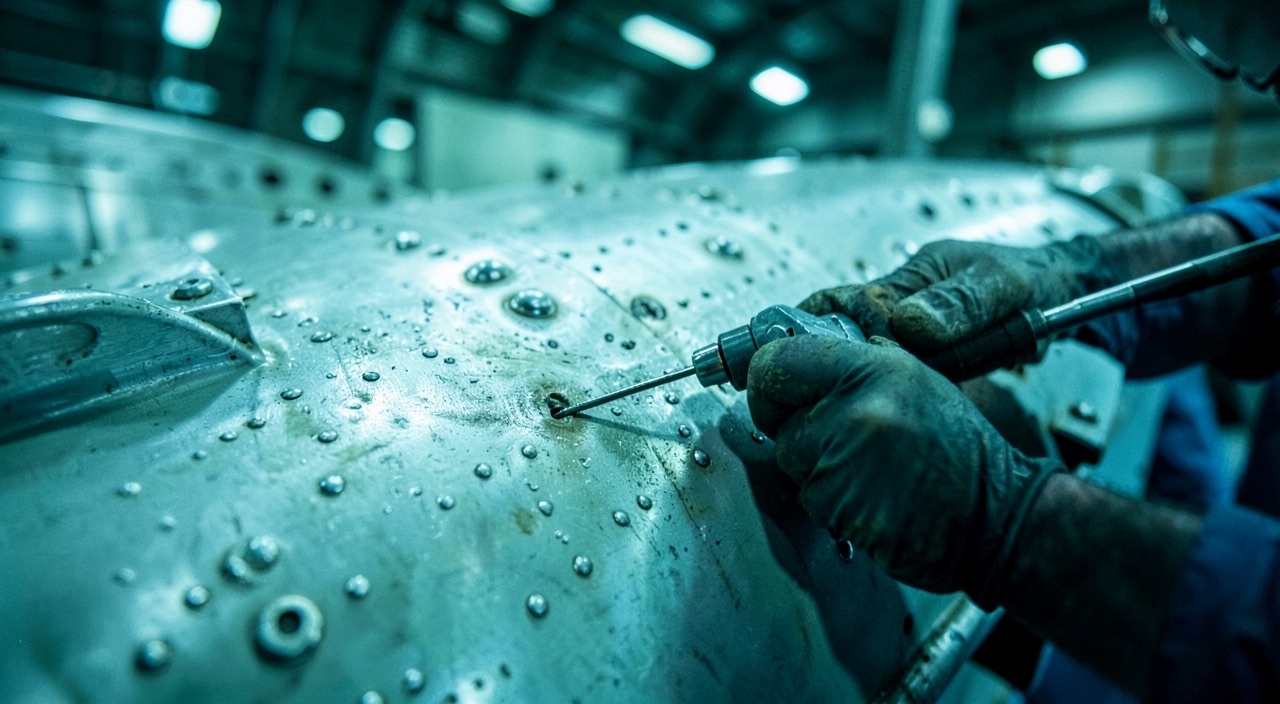
A work card that calls for an eddy current inspection on a row of rivets, every 4,800 cycles, does not come from an engineer’s opinion. It is the last link in a chain that begins with the aircraft’s structural certification, passes through a standardized functional analysis, then through an approved document, before reaching the operator’s maintenance program. Understanding this chain means knowing what can be negotiated and what cannot.
At the source: damage tolerance rather than safe life
Certifying a large aircraft’s structure requires demonstrating that fatigue damage, corrosion, or accidental damage will not lead to catastrophic failure before it is detected. Two philosophies coexist. Safe life retires the part at a fixed threshold, with no intermediate inspection: it is reserved for elements whose failure is not detectable or not tolerable, typically certain landing gear or engine mount components. Damage tolerance accepts the presence of damage and demonstrates that the structure retains enough residual strength for long enough that a scheduled inspection will find it.
All structural maintenance follows from this choice. An inspection interval is not an administrative deadline: it is a fraction of the time it takes a crack to grow from detectable size to critical size. That duration is divided to guarantee at least two opportunities for detection before the critical threshold.
| Aspect | Safe life | Damage tolerance |
|---|---|---|
| Assumption | No damage until the threshold | Damage present, not critical |
| Maintenance output | Mandatory retirement limit | Threshold + inspection interval |
| Margin carried by | Scatter factor on life | Number of detection opportunities |
| Effect of a repair | Generally disqualifying | Local re-evaluation of the program |
| Deferral possible | No | Bounded, and technically justified |
Damage tolerance means inspecting parts to catch cracks before they become dangerous. Safe life means replacing parts before they can fail. Most aircraft use damage tolerance for the main structure.
On an Airbus A320, the wing skin inspection interval is set at 6,000 cycles. This means engineers calculate that a crack will take 12,000 cycles to grow from detectable (1mm) to critical (20mm), and they schedule two inspections in between.
Principal structural elements, and why the list is short
An airframe is not inspected uniformly. The analysis identifies the principal structural elements: those whose failure would contribute to loss of the aircraft. For each one, three sources of degradation are treated separately, because they follow neither the same law nor the same remedy:
- fatigue damage, a function of cycle count and load spectrum — addressed through a threshold and an interval;
- accidental damage, independent of time: runway impact, ground strike, dropped tool — addressed through a zonal inspection, whose interval is not tied to cycles;
- environmental degradation, corrosion and ageing — a function of calendar time and the operating environment, not cycles.
A common analysis error. Counting corrosion in cycles. An aircraft that flies little in a marine climate accumulates environmental degradation without accumulating fatigue. This is why a maintenance program carries thresholds in cycles, in hours, and in calendar time, and why the most restrictive one applies.
Passing through functional analysis
The method for developing maintenance programs proceeds top-down: for each system and each zone, functions are identified, along with possible failures and their effects, and then the task that addresses the effect is chosen — and only if an applicable and effective task exists. One point is often misunderstood: the consequence of a failure drives the nature of the task. A failure that is evident to the crew does not call for the same surveillance as a hidden failure, which requires a functional check task, without which it would remain unknown until a second failure revealed it.
The result of this work is a maintenance review board report, then a planning document published by the manufacturer. This document is not directly binding on the operator: it is the basis from which the operator builds its own program, which it then submits for approval.
The part of the record that is not negotiable
One section of the airworthiness record is exempt from customization: the airworthiness limitations section. It contains the airworthiness limitation items, the critical tasks imposed by certification, and — for modern aircraft — the structural program’s limit of validity, expressed in cycles, beyond which widespread fatigue damage is no longer covered by the original demonstrations.
The limit of validity is not a commercial service life. It bounds the validity of the demonstrations. Operating beyond it requires an approved extension, backed by new substantiation, not a simple fleet-management decision. This is the point that often decides the economic fate of an older aircraft.
From the manufacturer’s document to the operator’s program
The operator — or the continuing airworthiness management organisation acting on its behalf — builds its maintenance program from the manufacturer’s document, adapting it to its own operation: average cycles, environment, configuration, justified interval extensions, additional tasks arising from its own operating experience. This program is approved, periodically revised, and its effectiveness must be monitored: a program that never finds anything is not necessarily a good program.
Three flows then continuously amend it:
- airworthiness directives, mandatory and non-negotiable, which address an unsafe condition identified on the type;
- service bulletins, recommended, whose incorporation the operator decides — unless a directive makes them mandatory;
- repairs and modifications, which can locally create new inspection requirements, to be explicitly incorporated.
What a repair does to the interval
A repair is not neutral for the maintenance program: it locally alters geometry, stiffness, and load path. The manufacturer’s structural repair manual classifies repairs according to their effect on damage tolerance. The simplest are permanent and add nothing to the program. Others are permitted but require an additional inspection, with its own threshold and its own interval, because the original demonstration no longer covers the area. The last category is temporary: it carries a replacement deadline.
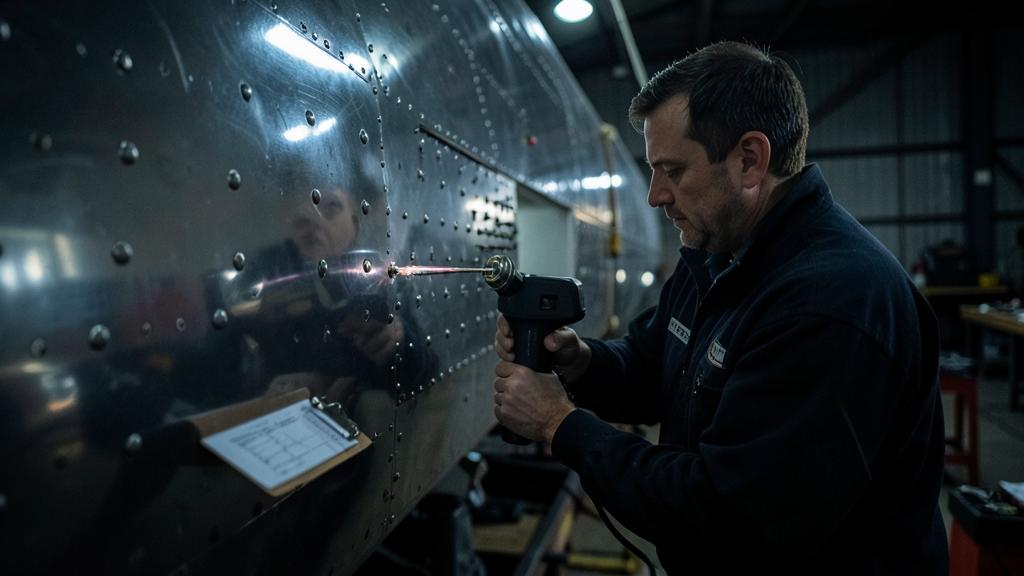
Two practical consequences are regularly missed. First, a repair that calls for an additional inspection must be entered into the program of the specific aircraft concerned, not merely recorded in its file — otherwise the inspection will never take place. Second, several neighbouring repairs do not add their effects linearly: beyond a certain density, the manual refers the case back to the manufacturer, and that opinion becomes part of the airframe’s airworthiness record.
The case of the used aircraft. An aircraft acquired mid-life carries the repair history of a previous operator. Taking over its maintenance program without also taking over the inventory of its repairs and the additional inspections they created is the costliest gap to discover in an audit — because it cannot be fixed with a task, only with a re-evaluation.
How a program is shown to work
An approved maintenance program is not frozen: its effectiveness must be monitored, and that monitoring itself produces decisions. The usual mechanism is a reliability program that tracks, task by task and system by system, the finding rate and the rate of unscheduled failures. Two readings follow from this, symmetrical and both useful:
| Observation | Likely interpretation | Typical decision |
|---|---|---|
| A task never finds anything, across a fleet and over several years | Interval too tight, or task poorly targeted | Justified interval escalation request |
| A task finds something almost every time | Interval too long, or degradation faster than expected | Tightening, and referral back to the manufacturer |
| Failures appear between two visits | The task does not detect what it should | Change of method, not of interval |
| Findings concentrated on one aircraft in the fleet | Local cause: operation, history, repair | Individual handling, no program revision |
This last line is worth remembering: a program is revised on a fleet-wide signal, not on a single aircraft. Confusing the two leads to tightening an entire program for a cause that belongs to one airframe.
The last link: the work card
The task becomes executable once translated into a work card: zone, access, method, acceptance criteria, reference to the applicable documentation, tooling, and signature. This is where most audit findings occur, and they are rarely technical:
- an inspection method substituted without demonstrated equivalence — a detailed visual inspection does not replace a non-destructive test;
- an acceptance criterion copied from an earlier revision of the manual;
- an access panel not properly restored, invalidating the next inspection;
- a signature applied by a person whose licence scope does not cover the task.
The three-question consistency test. For any work card: what certification requirement or analysis does it come from? what damage size must it detect? and how many detection opportunities remain before the critical threshold? If these three answers are not readily available, the task is being applied without being understood, which is the leading cause of a program silently drifting.
What this changes for someone preparing a qualification
A technician who can place a task within this chain argues differently: they distinguish what stems from a certification requirement, what stems from an operator’s choice, and what stems from a local practice. That distinction is what sets an autonomous professional apart from a mere executor — and it is also what an auditor is looking for when asking about the origin of an interval.
The principles set out here are those of the European framework. The regulatory text, the airworthiness limitations section of your type, and your approved maintenance program take precedence over this article.
Questions fréquentes
What is the difference between an airworthiness limitation item and a maintenance program task?
An airworthiness limitation item is imposed by certification and appears in the airworthiness limitations section: it is not customizable. An ordinary maintenance program task follows from the functional analysis and can be adapted by the operator, with justification and approval.
Can the interval of a structural inspection be extended?
For a task derived from the functional analysis, yes, with technical justification and within the scope of the program’s approval. For a task imposed by the airworthiness limitations section, no. This distinction is the first thing to establish before any extension request.
Why is an inspection interval shorter than the time it takes a crack to propagate?
Because several detection opportunities must be guaranteed. The duration between detectable size and critical size is divided so that at least two inspections fall within that window: a single opportunity would leave no margin in case of a missed inspection or a missed detection.
Can a detailed visual inspection replace a non-destructive test?
Not without a demonstrated equivalence. The method is chosen for the damage size it can detect; substituting a less sensitive method effectively increases the detectable size and invalidates the interval calculation.
What does a structural program's limit of validity mean?
It bounds, in cycles, the validity of the damage tolerance demonstrations with respect to widespread fatigue damage. It is neither a commercial service life nor an airframe retirement limit: operating beyond it requires an approved extension, backed by new substantiation.


Leave a Reply
You must be logged in to post a comment.