
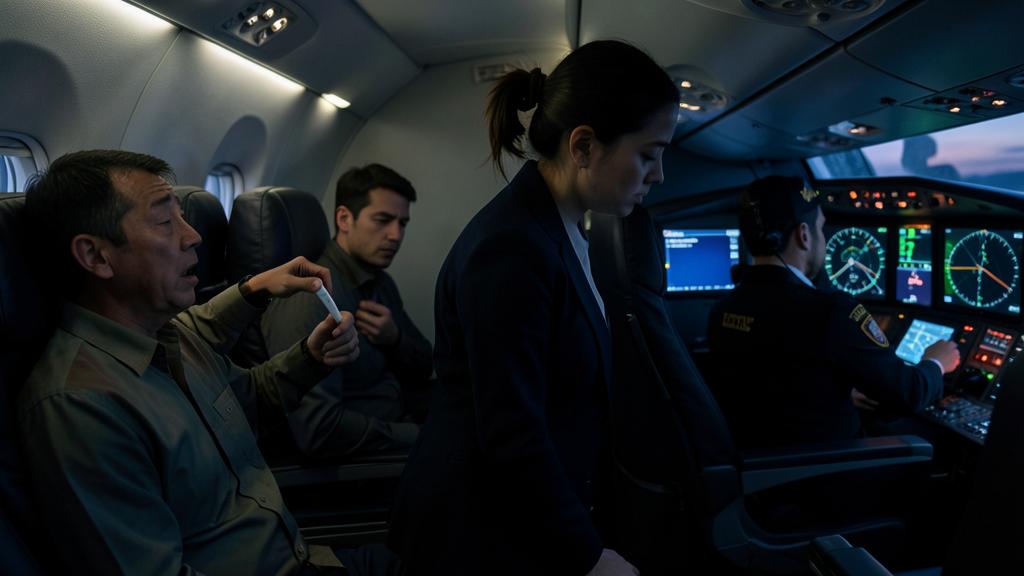
Three hours before arrival, a febrile passenger vomited for the second time, and their seat neighbor requests a seat change. From what moment does this isolated patient become a “suspected case” according to health regulations? What exactly triggers the message the crew will transmit to air traffic control? And on what criteria will the destination authority establish the list of passengers to recall tomorrow? The mechanics are more precise than one might think — and they start in the cabin.
A suspected case is defined by observable signs, never by a diagnosis.
The general framework comes from the International Health Regulations: States commit to detecting and reporting events that may constitute a public health emergency, and points of entry — including airports — constitute the first line of defense. But on board, no one makes a diagnosis. Neither the cabin crew, nor the pilot in command, nor even the passenger doctor who responds to the call has the means to confirm a transmissible disease. The operational definition of a suspected case is based on what a crew can observe without equipment.
The references converge on the same combination: a manifest fever — typically around 38°C, or a visibly febrile passenger if no thermometer is available — associated with at least one sign compatible with transmission: persistent cough, respiratory difficulty, repeated vomiting or diarrhea, skin rash, bleeding or bruises without trauma, or recent confusion. A simply febrile passenger is not a suspected case; a febrile passenger who has been coughing nonstop for the last two services is.
On-ground telemedicine assistance, when available to the operator, helps qualify the situation and adjust first aid measures. But it does not replace the notification chain: it is the cabin observation that informs the pilot in command’s decision, and it is the pilot in command who sends the message.
A “suspected case” is not a diagnosis but a set of visible symptoms (like fever + coughing). Crews don’t need medical tools – they just look for these clear signs to decide if they need to alert authorities. This keeps things simple and fast, even without doctors on board.
On a Boeing 737 from Paris to New York, a passenger in seat 12A develops a 38.5°C fever and persistent cough 2 hours before landing. The crew observes these signs, declares it a “suspected case”, and notifies the pilot, who then contacts the control tower. This triggers the health protocol at JFK before the plane even lands.
The notification: a radio chain that reaches its destination before the doors open.
The mechanism is regulated by the ICAO annex dedicated to facilitation: the pilot in command notifies air traffic control, before arrival, of any suspected case of transmissible disease on board; air traffic control passes it to the competent authority of the destination aerodrome, which alerts the health services. The health section of the aircraft’s general declaration then formalizes the observation in writing. There is no universal phraseology dedicated to this message: it is sent in plain language, and the expected formulation — what to say, to whom, in what order — is specified in the operator’s manual. It is a point to know before needing it.
What the notification gains is time on the ground while the aircraft is still in flight. Alerted in time, the health authority prepares the reception: adapted parking position, the health team boarding before anyone disembarks, instruction to remain seated, passenger locator forms ready to hand out. If the case is detected late — or not notified at all — the same situation leads to a degraded scenario: passengers dispersed in the terminal, contact tracing reconstructed from memory, measures expanded as a precaution.
| Notification in flight. | Mention only upon arrival. | |
|---|---|---|
| Message sender. | The pilot in command, via air traffic control. | The operator or the station, afterward. |
| Written support. | Health section of the aircraft’s general declaration. | Declaration reconstructed afterward. |
| Reception at destination. | Health authority alerted, boarding before disembarkation. | Improvisation, passengers often already dispersed. |
| Contact tracing. | Fixed cabin plan, list compiled on-site. | Uncertain reconstruction, perimeter expanded as a precaution. |
| Cost for operations. | Short and controlled immobilization. | Heavier measures, aircraft and crew grounded longer. |
The exposed proximity: where the two-row rule comes from, and when it applies.
The question everyone asks upon arrival — who was sitting next to the patient? — has a more structured answer than it seems. For diseases transmitted by droplets, contact tracing protocols classically include passengers in the same row as the case and those in the two rows immediately in front and behind. This perimeter is not arbitrary: it follows the air circulation in the cabin.
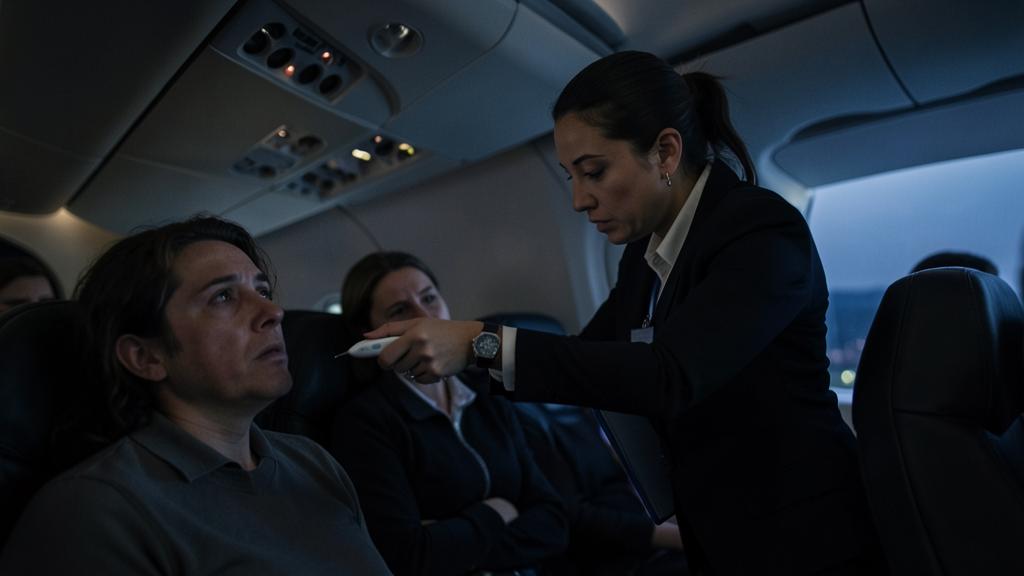
What the air circulation allows us to assert.
The air conditioning enters through the ceiling, descends along the walls, and is extracted at floor level: the circulation is organized in transverse loops, section by section, and not in a longitudinal flow that would sweep the cabin from front to back. The recycled fraction passes through high-efficiency particle filters, and the complete renewal of the air generally occurs several dozen times per hour — much more than in most buildings. Consequence: for droplet transmission, significant exposure remains a matter of immediate proximity and duration. This is what the two-row rule translates; it is also why, for tuberculosis, international recommendations only activate contact tracing on long flights, beyond a duration of approximately eight hours.
The air in planes doesn’t flow front-to-back like you might think. It comes from the ceiling, goes down the sides, and gets sucked out near the floor – all in small sections. This means if someone is sick, only people sitting right near them (within 2 rows) are usually at risk. The air is also filtered constantly, which helps keep everyone safer.
On an Airbus A320 from London to Barcelona (2h15 flight), a passenger in 18C develops a fever and cough. The crew identifies this as a “suspected case” and notifies the pilot. At destination, health authorities only need to trace passengers in rows 16-18-20 (the case’s row plus 2 rows in front/behind) because the air circulation limits exposure to this immediate area.
Where the perimeter is expanded.
The rule is broken in three situations, and the crew is the only witness to all three. First, mobility: a case that has made several trips to the lavatory, or neighbors who have changed seats, invalidates the geometric perimeter — it is the actual movements that count, not the booked seat map. Then, the mode of transmission: a truly airborne agent, such as measles, may justify extending the list beyond the two rows, to the entire cabin. Finally, the crew itself: the personnel who have served the area or provided care are exposed by function, regardless of their position in the plan.
| Transmission mode. | Suggestive case. | Typical perimeter. | Priority measure in the cabin. |
|---|---|---|---|
| Droplets. | Febrile cough, flu-like syndrome. | Same row and two rows in front and behind. | Source mask, distance. |
| Airborne (fine particles). | Suspected measles, tuberculosis on long flights. | May extend much further, to the entire cabin. | Isolation, filtered recycling maintained. |
| Contact and faecal-oral transmission. | Vomiting, persistent diarrhea. | Immediate neighbors and anyone exposed to surfaces. | Dedicated lavatories, gloves, waste management. |
| Vector (bite). | Fever upon return from an endemic area. | No neighborhood to trace. | Notification, no separation measures. |
The trap: relocating without recording. Moving the case or their neighbors without noting the original and new seats destroys the central tool for contact tracing: the cabin plan. Once passengers are dispersed in the terminal, no one can reconstruct who was sitting next to whom — and the authority then expands the list of exposed persons as a precaution, sometimes to the entire cabin. A correct relocation protects; an unrecorded relocation worsens the situation.
The right reflex: freezing the cabin plan as soon as suspicion arises. Patient’s original seat, freed seats, reassignments, lavatory visits, crew member who entered the area and when: two minutes of notes in flight save hours of reconstruction on the ground and avoid recalling passengers who were never exposed.
What the cabin can really do: isolate, designate, trace.
On-board isolation is always a compromise with the seats. When there are free seats, immediate neighbors are moved instead of the patient — making a vomiting passenger cross the cabin exposes more people than leaving them in place — and a buffer row is created. A curtain, even symbolic, marks the limit for everyone. Dedicated lavatories, closed to other passengers, cut the most common transmission route for digestive cases. And service is suspended in the area.
Only one crew member enters the perimeter: the designated cabin crew member, preferably one who has already been in contact with the patient — exposures are not multiplied. The universal precaution kit provides the essentials: gloves, mask, protective apron, absorbent for liquids, bags for biological waste, surface disinfectant. The mask goes first to the source — on the patient, if they tolerate it — before going to the neighbors. And air recirculation is not cut off: the filters work for the cabin, not against it.
The third action, often neglected, is documentary: recording the times, actions taken, materials used, and concerned seats. This report, more than any other, will determine the quality of the health response on the ground.
Upon arrival: the authority boards, and the crew becomes a source of data.
If the notification has worked, disembarkation does not begin when the doors open. The health team boards, assesses the patient, decides their orientation, and the measures applicable to the other occupants: simple information, distribution of passenger locator forms to fill out before leaving the aircraft, or more restrictive measures depending on the suspected pathogen. The instruction to remain seated requested from passengers is not heavy-handedness: every minute the cabin plan remains exact simplifies everything that follows.
The cabin plan annotated by the crew then becomes the key document: it is what turns a theoretical perimeter into a named list. Matching seats to identities and contact details goes through the operator, in an official channel — data protection does not allow any improvisation, and it never falls to the crew to transmit named lists on their own initiative. This is followed by the aircraft’s disinfection according to applicable recommendations and, a point often forgotten, the follow-up of the crew itself: cabin crew members exposed are included in the contact list just like the neighbors, and the follow-up of their symptoms in the following days is part of the response.
What to verify in your documentation.
The topic is not reviewed on the day it occurs. Five checks are worth doing in advance, manual in hand: where the health notification procedure is located and what wording your operator expects you to use with air traffic control; who fills out the health section of the general declaration and where the form is on board; what is exactly in the universal precaution kit on each of your aircraft types and where it is stored; whether passenger locator forms are on board or arrive with the authority; and through which channel the operator transmits passenger data to a health authority that requests it.
A gray area persists, and it is better to know it than to deny it: the neighborhood perimeter is not a number engraved in a single regulation. The two rows are a working base derived from international recommendations, which each authority adapts to the pathogen, the flight duration, and the circumstances — and which a health crisis may redefine in a few weeks. What does not vary is the raw material: an accurate cabin plan, recorded movements, and early notification. For those preparing for a qualification or a position in flight safety, the contagious case scenario is a complete case study of cabin–station–ground coordination, and it is worked on in advance, in continuous training, not in a real situation.
The references given here describe the mechanism, not its procedure: the applicable texts, the requirements of the competent health authority, and your operator’s approved documentation take precedence over this article for any operational decision.


Leave a Reply
You must be logged in to post a comment.