
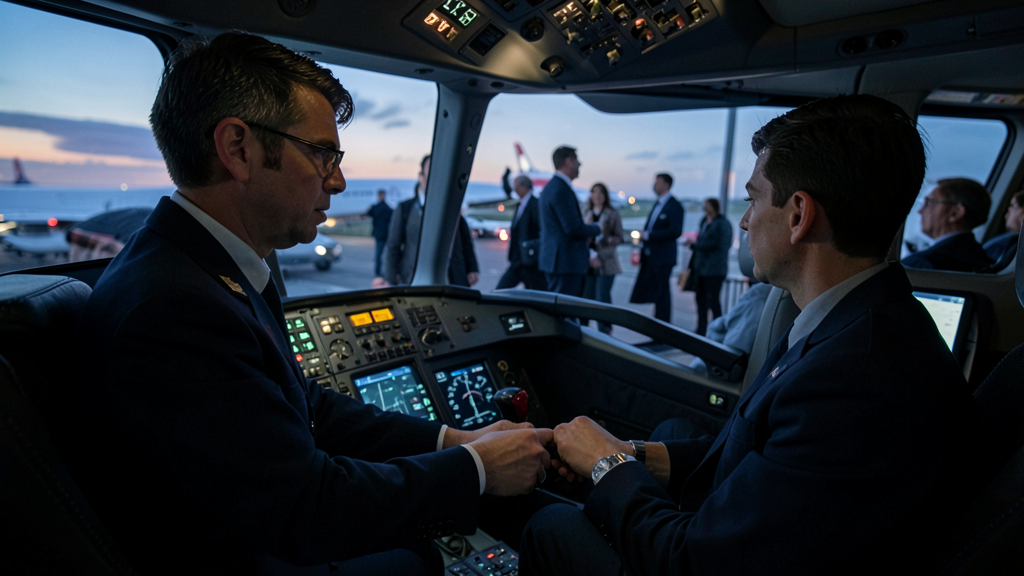
A line training captain teaches in the only environment where the lesson cannot be paused, repeated or allowed to go wrong. He is simultaneously the instructor of a pilot who is learning the aeroplane and the commander of a revenue flight carrying passengers who did not agree to be part of anyone’s training. Those two jobs pull in opposite directions several times an hour, and the quality of a line training system is essentially the quality of that arbitration. This is what the conflict actually consists of, and what an operator can build around the seat to make it survivable.
What the role is, in law and on the roster
Line flying under supervision is the last stage of a type conversion and the first stage of a career on the type. The pilot has passed the skill test, holds the type rating, and has never operated the aeroplane in the system it actually lives in: real weather, real traffic, real turnarounds, a real cabin crew, a real dispatcher with a real problem. The instructor’s job is to make that transition happen while the flight departs on time and arrives safely.
In the European system, Part-FCL defines the instructor and examiner certificates and what their holders may teach and check. The line training itself — its content, its length, and whom the operator may nominate to deliver it — belongs to Part-ORO’s flight crew provisions and is written down in Part D of the operations manual, which is why the shape of the job differs noticeably from one airline to the next. The FAA arrangement is structurally similar with different vocabulary: the pilot completes operating experience under the supervision of a check airman. The names differ; the double role does not.
The critical legal point is the one people state casually and then forget under pressure. There is exactly one pilot-in-command on the flight, and it is the instructor. The trainee may be occupying a control seat, flying the aeroplane, talking to ATC and running the flight — but he holds a delegation, not a command. If the sector goes wrong, the licence in question is the instructor’s, the operator’s report names the instructor as commander, and no amount of “he was flying” changes any of that. Everything else in this article follows from that asymmetry.
| Function | Held by | Practical consequence |
|---|---|---|
| Command of the flight | The instructor, without exception or dilution | Every decision is ultimately his, including the ones he has just delegated |
| Handling of the aircraft | The trainee, when designated pilot flying | Delegated, revocable at any instant, without discussion |
| Monitoring duties | The instructor, as the other crew member | Performed simultaneously with observation and coaching |
| Assessment of the trainee | The instructor | The person helping is the person reporting — the core conflict |
| Progression decision | The training department, on the instructor’s evidence | Individual judgement, institutional consequence |
| Commercial outcome of the sector | The operator | An external pressure present in the flight deck whether or not anyone names it |
The instructor is always in charge, even when the trainee is flying. This means the instructor must balance teaching with safety, and the trainee must accept that corrections can come at any time. It’s a delicate act where both roles must be clear to avoid confusion.
On an A320 flying into Paris Charles de Gaulle, a trainee is practicing a visual approach. The instructor notices the descent rate is too high. Instead of waiting, the instructor intervenes with a pre-briefed phrase like “Go-around, my controls.” The trainee must immediately comply, and the instructor takes over to ensure safety. Later, in the debrief, they discuss why the intervention was necessary and how the trainee can improve.
The one tool the simulator has that the line does not
In a simulator, an error is a resource. You let it develop, you let the trainee feel where it leads, you freeze the aeroplane, you reposition, you fly it again with the insight fresh. Nothing is at stake and the consequence is the teaching material. Remove that and you have removed the most powerful instructional device in aviation training.
On a revenue sector, an error is an error. There is no freeze, no reposition, no second attempt at the same approach with the same weather, and the consequences arrive on schedule. The instructor therefore has to decide, in real time and without discussion, how far a developing error is allowed to run — knowing that stopping it too early teaches nothing and stopping it too late is the reason line training accidents exist.
| Tool | Simulator | Line sector |
|---|---|---|
| Let an error run to its consequence | Yes — the primary teaching device | Only within a margin the instructor must judge continuously |
| Freeze, reposition, repeat | Yes | No |
| Choose the weather and the failure | Yes | No — you get what the day gives |
| Debrief immediately, with the situation still live | Yes | Rarely — the next task is already arriving |
| Isolate a single competency | Yes | No — everything happens at once |
| Real consequences, real people, real system | No | Yes — which is the entire point of the exercise |
| Time pressure that is genuine rather than simulated | Partially | Yes, and it does not negotiate |
Read that table honestly and the conclusion is uncomfortable: the line is a poor classroom and an irreplaceable one. It teaches the only thing the simulator cannot — operating the aeroplane inside a live commercial system — and it teaches it with almost none of the instructional apparatus. Everything the operator builds around the role exists to compensate for that.
The takeover problem
The single decision a line instructor makes most often is when to intervene, and it has no comfortable answer. Intervene early and consistently, and the trainee learns that someone will always catch it; his errors are never his, his corrections are never tested, and he arrives at his release still unproven. Intervene late, and the margin that was there when the deviation started may not be there when the hand finally moves.
The instructors who handle this well do not have better reflexes; they have decided in advance. They brief takeover criteria before the flight, in concrete terms — a deviation figure, an energy state, a configuration point, a specific ATC situation — and they brief the phrase that will be used and what the trainee is expected to do when he hears it. A takeover that was described on the ground is an instructional event. A takeover that arrives unannounced is a shock, and it costs more confidence than the error it prevented.
| Level | What the instructor does | Typical trigger |
|---|---|---|
| Observe | Nothing; note it for the debrief | A technique difference, an inefficiency, a slow but correct action |
| Prompt | A question, or a standard callout used as it would be with any colleague | A deviation the trainee has not yet detected but can still fix comfortably |
| Direct | A clear instruction, still leaving the trainee flying | A deviation approaching a briefed limit, or a time-critical item |
| Take control | The briefed phrase, positive transfer, no debate in the moment | A briefed limit reached, an escape manoeuvre required, or the instructor’s own picture becoming uncertain |
| Reset | Fly the sector himself, defer the training | The situation, the weather or the workload has stopped being a training environment |
The trap. The dangerous case is not the trainee who is visibly struggling — that one gets watched closely and taken over early. It is the competent trainee flying a normal approach that is drifting slowly, in an aircraft the instructor knows very well, with a schedule to make. Familiarity plus a good impression plus mild time pressure is the combination that stretches the intervention point, and it stretches it silently. Briefed numerical criteria exist precisely because judgement in the moment is the thing that bends.
Coach and reporter in the same person
The second conflict is quieter and does more long-term damage. The instructor is the person a trainee should be able to tell “I did not understand that”, “I have never seen this approach”, “I am behind the aeroplane” — and he is also the person who writes the report that decides whether the trainee is released, given extra sectors, or removed from the course. A trainee who is worried about the report will not say the thing that would have made the training work.
There is no way to abolish this conflict; the same person has to be in the seat. What can be done is to make it explicit rather than ambient. Instructors who say plainly, on day one, what is being assessed, what is expected to be imperfect at this stage, and what would actually constitute a problem, get far more honest reporting from their trainees than instructors who leave it unstated and hope for trust. Naming a conflict does not remove it, but an unnamed conflict is managed by guesswork on both sides of the cockpit.
The competency-based approach used in modern training helps here in a way that is often underestimated. When assessment is expressed as observable behaviours across a defined set of competencies — among them procedures, communication, flight path management, leadership and teamwork, problem solving, situation awareness and workload management — rather than as an overall impression, both parties can talk about a specific dimension without it feeling like a verdict on the person. It also gives the instructor language for the case that matters most: the trainee who flies accurately and manages badly, which an impression-based system tends to pass.
The monitoring debt nobody rosters
There is a workload problem in this role that is rarely stated as such. On a normal sector, the pilot monitoring has one job. On a training sector, the instructor performs that job while also observing a pilot who is slower than a line colleague, anticipating errors before they occur, deciding continuously whether to intervene, and mentally assembling the debrief. The monitoring capacity actually available to the flight is therefore lower on a training sector than on a normal one — at exactly the moment when the other seat is also less capable than normal.
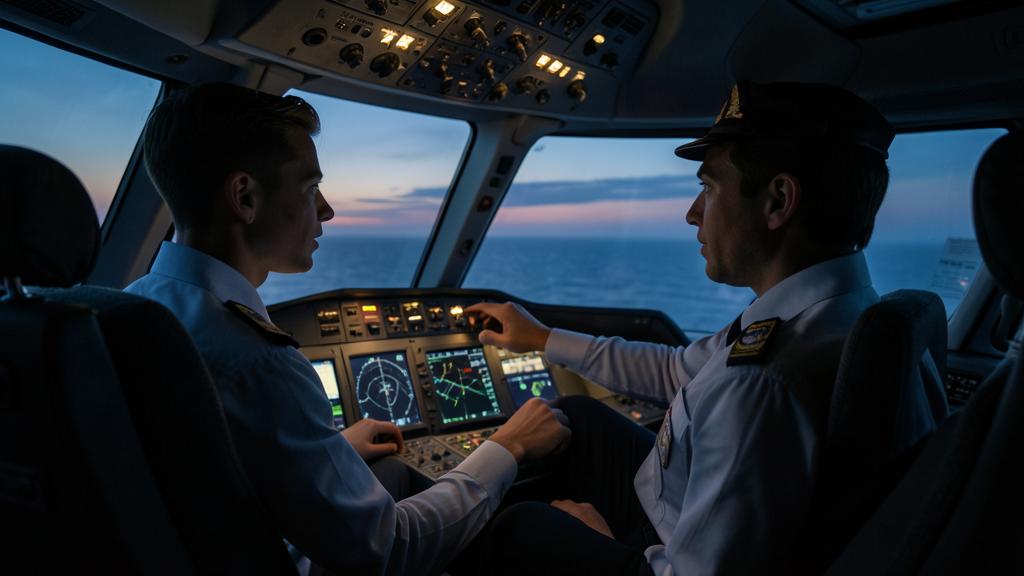
Two crew members are on board, but the crew is not two normal pilots. It is one pilot doing one and a half jobs and one pilot doing three-quarters of one. Operators who understand this build restrictions around the sector rather than exhortations to the instructor. Those restrictions are the real safety mechanism of line training.
- Crew pairing. Two inexperienced crew members are not rostered together, and cabin crew composition is considered too when the flight deck is already loaded.
- Aerodrome restrictions. Aerodromes requiring special preparation or previous experience are commonly excluded from early training sectors.
- Weather and approach restrictions. Low-visibility operations are typically not conducted with a pilot under line training, and many operators raise minima for training sectors.
- Sector selection. Early sectors are placed where the workload is manageable, not simply where the roster had a gap.
- A third pilot. Some operators require a qualified pilot in the observer seat for the first sectors, particularly where the type rating was completed under a zero flight time arrangement and the trainee has never landed the actual aeroplane.
What is almost never adjusted is duty time. Flight time limitation schemes count hours flown and duty performed; they do not count instruction delivered. An instructor at the end of a demanding four-sector training day is legal, and is not in the same state as a line pilot at the end of the same day. The only correction available is at the rostering level, and it requires the training department to actually ask for it.
The reflex that works. Brief the arbitration before you brief the sector. Say out loud what you will take over for, what phrase you will use, what you expect the trainee to do when he hears it, and what you consider normal to get wrong today. Two minutes on the ground converts every intervention of the day from a judgement on the trainee into an agreed part of the exercise. It is the habit that most distinguishes instructors whose trainees improve from instructors whose trainees merely survive — and it is the first thing covered in the instructor material at FL330 training.
What the line teaches that nothing else can
It is worth being precise about what the sector is for, because instructors who are vague about it default to teaching handling — the thing the trainee already demonstrated in the simulator, and the thing the line teaches least well.
The line teaches the system. It teaches what a real turnaround does to a plan, what a slot message does to a briefing, how a cabin crew report actually arrives and how it should be handled, what a dispatcher can and cannot change, how a technical defect is discussed with maintenance, what a diversion decision costs the company and why that must not decide it. It teaches the pace: the difference between doing everything correctly and doing everything correctly in the time available. And it teaches the trainee where he sits in a crew that is real, with a commander whose authority is real, which is the beginning of understanding the command he will one day hold himself.
None of that appears in a simulator session, and all of it appears in the first month on the line. An instructor who spends the sector correcting flare technique and finishes the day without having discussed a single one of those things has used a scarce and expensive resource on the wrong lesson.
Doing the double role well
The conflicts described here cannot be resolved, only managed, and the pilots who manage them well share a small number of habits. They separate the two hats in time rather than trying to wear both at once: commander first, always, and instructor in the space the commander’s judgement leaves free — never the reverse, and never with the order negotiated in the moment. They decide their intervention criteria on the ground. They say what they are assessing. They protect the debrief, because a sector without a debrief is flying with a witness rather than training. They ask the training department for the roster conditions the job actually requires, instead of absorbing the deficit personally and calling it professionalism.
And they remember what the trainee is watching. A pilot in line training is not only learning the aeroplane; he is learning what a commander on this type, in this company, looks like. Whatever the instructor does under pressure — how he speaks to the cabin, how he handles a late clearance, whether he is honest about his own errors — is being copied, and will be flying the line for the next thirty years. That is the part of the job that no syllabus contains and no report captures, and it is the part with the longest reach.


Leave a Reply
You must be logged in to post a comment.