

Aircraft cross borders without paperwork problems. The people who sign them off do not. Maintenance organisations, design approvals and production approvals are covered by agreements between States; personnel licences were deliberately left out of almost all of them. Understanding why explains everything a difference examination is, everything it is not, and which parts of a career simply do not move.
Recognition and conversion are not the same transaction
Two words get used interchangeably in every conversation about moving abroad, and they describe opposite mechanisms. Recognition means an authority accepts a document issued by another authority as it stands, without reissuing anything. Conversion means you obtain a new licence from the destination authority, with some credit given for what you already hold. The first is rare for maintenance personnel. The second is the normal path, and it is a project rather than a formality.
The confusion has a respectable origin. The Chicago Convention obliges contracting States to recognise certificates of airworthiness and certificates of competency and licences issued by the State of registry, provided the standards under which they were issued are equal to or above the international minima. That provision is what allows an aircraft registered in one State to be operated into another without its documents being re-examined at every border. It is not a labour-mobility clause. It concerns the operation of the aircraft in international air navigation, and it leaves each State entirely free to decide who may certify maintenance on aircraft on its own register, or within an organisation it approves.
The international standard for the aircraft maintenance licence sets a floor: the knowledge, experience and skill a State must require before issuing one. Every substantial system then builds well above that floor, in its own shape. Two licences can both satisfy the international minimum and still be structured so differently that no direct mapping exists between them.
What States actually agreed to recognise
Bilateral aviation safety agreements, and the implementation procedures that give them teeth, are real and they work. They cover the certification of products — type certificates, supplemental type certificates, parts and appliances — and they cover approvals of organisations, most visibly maintenance organisations. A repair station can hold an approval from its own authority and a corresponding approval from the partner authority, with the oversight largely performed once, by the home authority, on behalf of both.
Personnel licences are conspicuously absent from that architecture, and the absence is a design decision rather than an oversight. An organisation can be audited: it has procedures, records, a quality system and an address. Confidence in an individual comes from a national chain of approved training, examination, logged experience and continuing assessment, none of which the other State has ever inspected. Auditing an organisation is a finite task. Validating another State’s entire training and examination system, permanently, is not.
The practical consequence catches people out. You can be employed by an organisation approved by both authorities, working on an aircraft covered by both, and still be unable to sign a release under one of the two approvals. The dual approval belongs to the company. The certifying privilege belongs to a person, and it is backed by a licence issued under one system only.
Countries have agreements for aircraft and organisations, but not for people. Your licence is tied to one country’s system, and moving requires converting it, not just showing it. The rules are different everywhere, so you can’t just transfer your licence as-is.
An EASA-licensed engineer working for a Part-145 organisation in France cannot sign off work under a US FAA Part-145 approval, even if the organisation is approved by both. The engineer must convert their licence to an FAA mechanic certificate before signing off work in the US.
What a licence is actually made of
It helps to stop treating a licence as a single object. It is a stack of independent components, each with its own issuing body, its own validity and its own portability. Some of them cross a border almost intact; some cross with an examination attached; some do not cross at all, and never will, because they were never yours to carry.
| Component | Issued by | Portability |
|---|---|---|
| Basic knowledge, examined by module or by written test | Approved training organisation or the authority | Partial — credit is assessed subject by subject, never granted wholesale |
| Practical experience | Employers, evidenced by records | Usually accepted in substance, subject to the evidence satisfying the destination authority’s format |
| Type rating or type competence | Approved training organisation, endorsed on the licence in some systems and not in others | Poor — the training must generally be delivered under the destination system |
| Certifying authorisation | The maintenance organisation employing you | None — it is scoped to that organisation and ends when you leave |
| Recency of experience | Demonstrated by the holder | None — it is a rolling condition, not an asset |
| Human factors, fuel tank safety and wiring awareness training | The organisation, on a repeating cycle | None in practice — repeated on arrival |
| Right to work in the destination State | Immigration authority | Independent of everything above, and frequently the binding constraint |
Two systems, two shapes
The European system organises the licence by category. There is a category for line maintenance certification of simple scheduled tasks and defect rectification, a mechanical category subdivided by aeroplane or helicopter and by turbine or piston, an avionics category with a variant of restricted scope for less complex aircraft, a category for light piston aeroplanes, and a base maintenance category for the person who releases a complete aircraft after a heavy check. Basic knowledge is examined through a set of seventeen numbered modules, of which each category takes a defined subset at a defined depth. Practical experience is required before issue, and the amount depends on the category and on the training already completed: for the main turbine and avionics categories it is of the order of two years after an approved basic course and around five for a candidate with no prior relevant technical training, with lower figures for the lighter categories. Type ratings are then endorsed on the licence itself, each one obtained through approved theoretical and practical training, with on-the-job training required for the first type in a category.
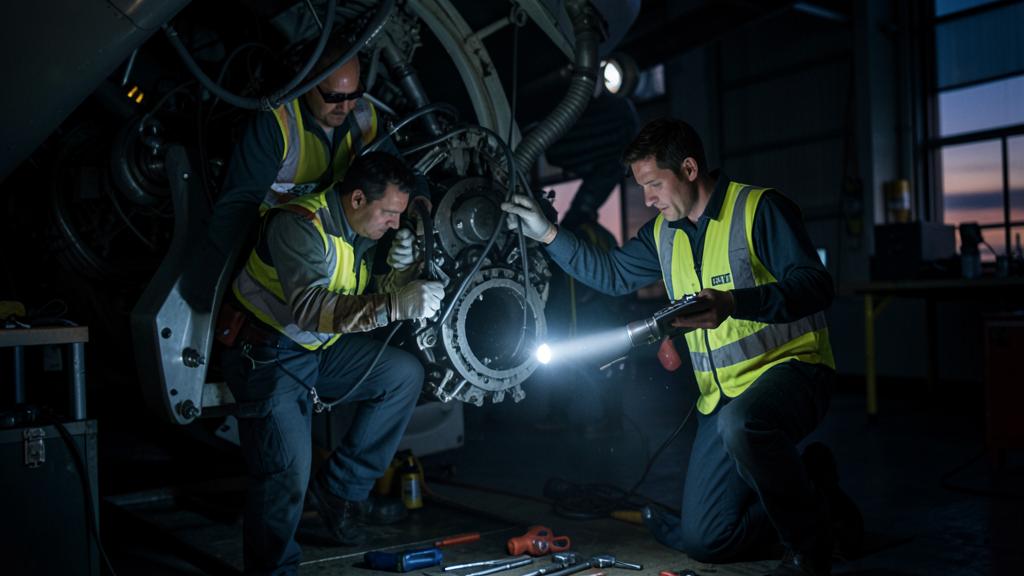
The United States system takes a different route to the same destination. The mechanic certificate carries airframe and powerplant ratings; the candidate qualifies either by graduating from an approved maintenance technician school or by documented practical experience — commonly cited as eighteen months for a single rating and thirty months for both — and then passes written, oral and practical tests. There are no type ratings on the certificate. Competence on a particular aircraft is handled by the employer’s training programme and by the repair station’s own procedures and capability list, under the oversight of the authority. A separate later qualification, requiring a minimum period of holding the certificate and of active practice, allows certain inspections and approvals for return to service that the base certificate does not.
Neither shape is better. They distribute the same assurance differently: Europe puts type competence on the licence and audits the training organisation; the United States puts it inside the maintenance organisation and audits that. Which is exactly why a holder of one arrives at the other with a mismatch rather than a shortfall.
| Question | European approach | United States approach |
|---|---|---|
| How is basic knowledge examined? | Modular examinations, subset by category, at an approved organisation or the authority | Written tests by rating, followed by oral and practical testing |
| Where does type competence live? | As a rating endorsed on the licence, from approved type training | Inside the employer’s training programme and the organisation’s capability |
| What creates the right to sign? | Licence plus an authorisation issued by the maintenance organisation | Certificate, plus the organisation’s authorisation when the work is released under a repair station approval |
| How is currency maintained? | Recent experience condition plus periodic continuation training | Recent experience condition plus the organisation’s recurrent training |
| What does an arriving holder of the other licence lack most? | Legislation, organisational rules and type ratings under the destination system | Evidence in the destination format, and the oral and practical testing |
What a difference examination actually measures
The phrase misleads. A difference examination does not assess how good an engineer you are, and it is not a shorter version of the full examination set given to a beginner. It measures the distance between two regulatory systems, which is why its content is so heavily weighted towards subjects that have nothing to do with turning a spanner.
The largest single block is normally legislation and organisational rules. This is the subject with the least overlap between systems, because it is the system: the structure of approvals, the responsibilities attached to each role, the documentation that constitutes approved maintenance data, the rules on modification and repair, the release procedure and what it legally asserts. Nothing you learned about the other system’s equivalent transfers, and this block alone is enough to make a difference examination non-trivial.
The second block is the destination system’s codification of human factors and of the specialised safety training it mandates. The underlying concepts are international; the required content, the assessment and the renewal cycle are not.
The third block is whatever the two systems examine at different depths. Digital techniques and electronic instrument systems, materials and hardware, and maintenance practices are the usual candidates, because their treatment varies sharply between a modular written system and a system built around oral and practical testing. Credit is assessed subject by subject, by the destination authority or by an approved organisation acting on established mapping rules, and it is issued in writing — which is the document to obtain before you sit anything.
The reflex worth having. Ask for the credit assessment in writing, from the destination authority or an organisation it has approved, before booking a single examination or paying for a single course. Attempt limits, waiting periods between attempts and the validity window of passed subjects all exist in both systems, and the exact figures depend on the authority. Discovering them after a failed attempt is expensive in a way that has nothing to do with money.
The parts that do not transfer at all
The item that surprises experienced engineers most is the certifying authorisation. Inside an approved maintenance organisation, the licence is a prerequisite and not a permission. What allows you to sign a release is a document issued by the organisation that employs you, after its own assessment of your competence, scoped to that organisation, to specified aircraft and to specified tasks. It has no existence outside the company. It ends on your last day, and the next organisation starts its assessment from the beginning, even in the same country. Where a mechanic works outside such an organisation — the classic United States case of an individual releasing work on general aviation aircraft — the privilege attaches to the certificate itself, which is one more structural difference to establish before assuming anything about the destination system.
Recency is the second. Certification privileges are conditional on having performed relevant maintenance within a recent rolling window — in the European system, six months of relevant experience within the preceding two years. This is a condition rather than an asset, and it works against exactly the people converting a licence, because the months spent studying and waiting for examinations are months not spent maintaining aircraft. It is entirely possible to obtain a new licence and find that the privileges it carries cannot be exercised until experience has been rebuilt under supervision.
Type ratings are the third. Where a system endorses types on the licence, the training that supports them has to have been delivered under that system’s approvals. A type course completed elsewhere is real training and real knowledge; it is simply not the evidence the destination authority is empowered to accept. Some credit may be available where the course content and the approvals align, and it is worth asking, but the default answer is that the type training is repeated.
The trap. Buying a type course before deciding which system you are converting into. Type training is the most expensive single element of the whole move and the least portable. Purchased under the wrong approval, it delivers knowledge you keep and paperwork the destination authority cannot use.
The order of operations that saves a year
Sequence matters more than speed. Decide the destination system first, because almost every subsequent purchase is system-specific. Obtain the written credit assessment second, because it determines both the examination plan and its cost. Reconstruct the experience evidence third, and do it while your current and previous employers still exist and still have records with your name on them; retrospective reconstruction of logged experience is the single most common reason a conversion stalls, and it becomes harder every year.
Then check the recency condition against the calendar you actually expect, not the optimistic one, and if a gap is unavoidable, plan for a period of supervised work on arrival rather than being surprised by it. Finally, approach organisations before the licence is finished rather than after. In tight labour markets employers routinely sponsor conversions, and being employed in a non-certifying capacity during the process solves the recency problem, the evidence problem and the income problem simultaneously. Which organisations do this, in which countries, is the kind of information that circulates between engineers rather than through official channels — the vacancy side of it sits on jobs.fl330.com, and the experience side on forums.fl330.com.
The honest cost
The financial cost of a conversion is dominated by type training and by the income gap, not by examination fees. The time cost is dominated by the credit assessment and the availability of examination sittings, not by studying. And the risk is concentrated in two places that look administrative and are not: evidence of experience that the destination authority will accept, and the right to work, which is granted by an entirely different arm of the State and answers to none of the reasoning above. An engineer who plans for the second and the last of those, rather than for the examinations, arrives with a usable licence in a predictable time. The rest is arithmetic.


Leave a Reply
You must be logged in to post a comment.