
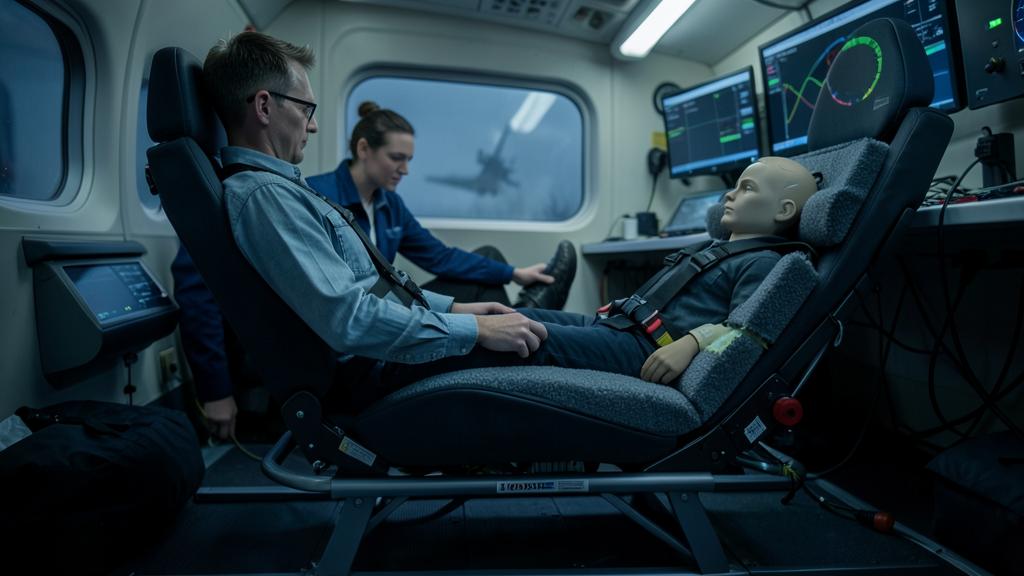
A passenger seat is designed backwards. The shape of the frame, the stiffness of the legs, the density of the foam and the bracket holding a retrofitted screen are all downstream of a single event that happens in a laboratory: a controlled deceleration pulse applied to a rigid fixture with an instrumented dummy strapped into the seat. Everything the cabin looks like is the visible residue of that pulse. Understanding it explains most of the design choices in a seat, and nearly all of the unpleasant surprises in a cabin retrofit programme.
What the sled reproduces, and what it deliberately ignores
The dynamic seat test — 14 CFR 25.562 in the American rule and CS-25.562 in the harmonised European certification specifications — does not reproduce a crash. It reproduces a survivable emergency landing: an impact severe enough to destroy the aeroplane’s ability to fly again, but within the envelope where occupants can walk away if the cabin does its job.
That premise fixes what the seat is asked to do. In survivable impacts the dominant injury mechanisms are not the structural break-up of the airframe; they are occupant deceleration, loss of restraint, secondary impact against the structure ahead, and obstruction of the escape path by displaced furnishings. A seat that keeps the occupant attached, spreads the deceleration over the strongest parts of the body and does not become a barrier afterwards addresses all four.
The test is equally interesting for what it excludes. The seat is bolted to a rigid sled fixture, not to a fuselage: no fuselage crush, no floor-beam collapse. That is deliberate. It isolates seat behaviour from airframe behaviour, so the sled asks one question only — given this deceleration at the floor, what happens to the occupant?
The sled test simulates a survivable crash, not a total destruction. It checks if seats keep passengers safe by controlling their deceleration and preventing injuries from impacts or blocked exits. The test ignores how the plane’s structure behaves, focusing only on the seat’s performance.
On an Airbus A320, a seat must withstand a 16g deceleration pulse in the horizontal test. If the seat legs fail or the cushion collapses too early, the test fails, meaning passengers could be injured in a real emergency landing.
Two pulses, two entirely different failure modes
There are two dynamic conditions, and they load the seat in ways that have almost nothing in common.
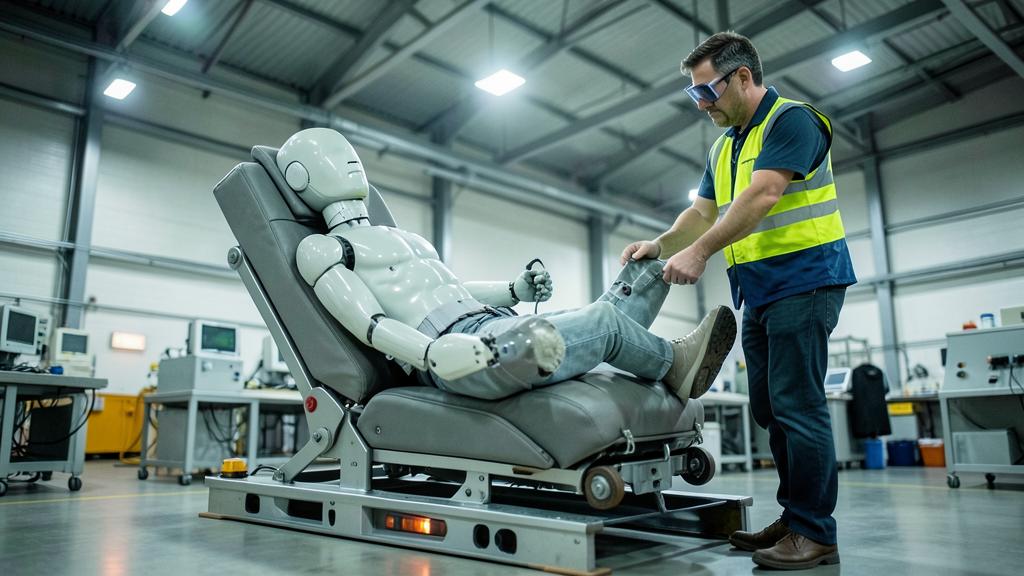
The first is primarily vertical. The seat is pitched nose-up on the fixture, and the pulse simulates the aeroplane arriving with substantial sink rate. The load path runs up the spine. What is being measured, above all, is compression in the lumbar column of the anthropomorphic test device — the instrumented dummy representing a mid-size adult male occupant. This condition is where the cushion becomes a structural component, and where energy-absorbing features in the seat pan earn their mass.
The second is primarily horizontal, with the seat yawed on the fixture so that the occupant is not loaded in a perfectly symmetric direction. Here the story is restraint geometry, head trajectory, femur loading against the structure ahead, and the transfer of a large forward force through the seat legs into the floor fittings. Nothing about surviving the vertical case guarantees survival of the horizontal one.
- The vertical test checks how the seat absorbs downward forces, protecting the spine.
- The horizontal test evaluates how the seat restrains passengers and prevents injuries from forward impacts.
The velocity changes, peak decelerations and rise times are fixed by the rule rather than negotiated programme by programme, and within one set of certification specifications they are the same for every seat. Which amendment level applies follows from the certification basis of the change — which is why the first question in a seat programme is administrative, not technical.
The floor will not be flat, and the rule says so
The single most instructive feature of the dynamic test is one that surprises engineers arriving from other industries. Before the horizontal pulse is applied, the floor tracks of the test fixture are deliberately misaligned: one track is pitched out of parallel with its neighbour, and one is rolled. The seat must then survive the full pulse while installed on a floor that is no longer flat.
This exists because fuselage floors distort in an impact. The structure below is being crushed and bent, and the two tracks under a triple seat unit do not stay parallel. A seat design that is torsionally rigid — the intuitive way to make something strong — will lock onto the warped tracks, pre-load its own fittings before the pulse even arrives, and then fail at a fraction of the load it survives on a flat fixture.
The consequences run right through the design. Legs are given self-aligning fittings; fittings accommodate angular misalignment rather than resist it; spreaders and beams are deliberately compliant in torsion while staying stiff in the direction that carries load. The result is a structure that is simultaneously strong and, in one degree of freedom, floppy — an arrangement that looks like a defect on the drawing and is in fact the whole point.
The trap. A stiffening modification made for a good reason — a heavier monitor, a rigid tablet ledge tying the two seat backs together, a reinforcement to cure a rattle — can remove exactly the torsional compliance the seat needs to pass the warped-track condition. The change looks conservative because it adds material. It is not conservative, and it cannot be justified by comparison with the previously tested configuration.
The pass criteria, and what each one is really protecting
A dynamic test is not passed by surviving. It is passed by surviving while the instrumented occupant stays inside a set of limits, and while the structure behaves in a defined way afterwards.
| Criterion | What it is protecting | Where it shows up in the design |
|---|---|---|
| Retention at every attachment point | The seat becoming a loose mass in an occupied cabin | Fitting design, track engagement, stud and plunger geometry, shear pin sizing |
| Restraint stays on the occupant | Ejection from the seat before the deceleration is over | Belt anchor position relative to the pelvis, buckle location, harness routing |
| Head injury criterion, where head contact is possible | Secondary impact against the structure ahead | Seat-back breakover, padded surfaces, monitor bezel design, seat pitch |
| Femur compression | Lower-limb fracture that would end the occupant’s ability to evacuate | Clearance and stiffness of the structure directly ahead of the knees |
| Lumbar compression | Spinal injury in the vertical case | Cushion construction, seat-pan stroke, energy-absorbing features |
| No deformation that impedes evacuation | A survivable impact followed by an unsurvivable egress | Controlled yield direction, seat-back travel, aisle geometry after the pulse |
The last line deserves emphasis, because it is the one most often forgotten in a cabin refresh. Structure is permitted to yield. Permanent deformation is not a failure. What is a failure is deformation in a direction that puts material into the aisle, blocks the row’s access to the aisle, or jams a seat against the one behind it. A seat can be strong enough and still fail.
Head injury is only evaluated where the head can strike something. The head path through the pulse is bounded, and if nothing within that volume can be contacted, the criterion does not apply. That single conditional is why seat pitch, monitor position and even the shape of a literature pocket are certification items rather than marketing items: reduce the pitch, or move hard structure into the swept volume, and a criterion that did not apply suddenly does.
The cushion is a structural part, not a comfort item
In the vertical condition, the lumbar load recorded on the dummy depends heavily on how the cushion behaves during the few tens of milliseconds of the pulse. A cushion that bottoms out early transmits the deceleration almost undiminished into the pelvis. A cushion that is too compliant allows the occupant to travel too far, degrading restraint geometry and raising the risk that the pelvis slides under the lap belt in the horizontal case.
Seat cushions are therefore engineered assemblies: layered foams of different densities, sometimes with an energy-absorbing core, sized as a system with the seat pan. The comfort a passenger perceives is a by-product of a specified dynamic response.
The right reflex. Treat any change to foam density, thickness, layer order, cover fabric or fire-blocking layer as a change to a certified part with a dynamic pedigree, not as an upholstery decision. The cushion is part of the tested configuration; a like-for-like replacement is only like-for-like if the specification says so.
The same hardware also carries fire requirements, and those follow a completely different logic. Cushions are covered by their own burner test regime and by the fire-blocking layer that makes them pass it; smaller non-metallic seat parts fall under vertical burn testing; and whether a large seat-back surface falls inside the heat-release and smoke requirements depends on the configuration and the certification basis. A retrofit that changes materials therefore triggers two independent evidence trails — dynamic and flammability — that have no reason to arrive at the same answer.
Adding mass to the seat back is never a small change
Most cabin retrofit work today is not seat replacement. It is the addition of equipment: an inflight entertainment monitor, a power supply unit, a tablet holder, a device shelf, a coat hook, a redesigned tray table with a heavier hinge. Each item added to the back of a seat does three separate things, and it is common to consider only the first.
It adds an inertial mass that must be retained through the pulse. It changes the strike environment for the occupant seated behind. And it changes the qualified configuration of a seat whose approval was granted for a specific build standard.
| Change | Effect on the load path | Evidence usually needed |
|---|---|---|
| Larger monitor, same mounting frame | More mass higher in the seat back; higher moment at the frame | Delta analysis if within the qualified mass and centre-of-gravity envelope; otherwise a new test |
| Monitor bezel changed to a harder or sharper section | Alters the surface the head behind may contact | Head-path assessment, and head injury measurement if contact becomes possible |
| Power supply unit added under the seat pan | Mass low in the structure, new brackets into the pan | Static and dynamic substantiation of the bracket and its attachment, plus retention |
| Rigid ledge tying two seat backs together | Removes torsional compliance across the unit | Full re-test on warped tracks; similarity is hard to sustain |
| Seat pitch reduced by one or more track holes | May bring structure into the swept head path | Re-assessment of head contact, and possibly head injury testing at the new pitch |
The recurring error is to assume that adding material is conservative. In a static problem it often is. In a dynamic one, mass, stiffness and geometry all change the response, and moving mass upward and rearward in a seat back is an efficient way to make a compliant design fail.
From the laboratory fixture to a real aeroplane floor
A seat qualified on a sled is qualified as an article. It is not, by that fact, installable. The aeroplane’s floor has its own published allowables: a maximum load per fitting, a maximum load per unit length of track, minimum distances from track splices, and interaction rules with the beams below. Those numbers belong to the airframer, they differ between types and between zones of the same type, and they are the reason an identical seat can be approved in one cabin and refused in another.
Two further practical points follow from the track itself. The holes are on a fixed pitch, one inch on many transport aeroplanes and metric on others, so seat pitch is quantised: a cabin moves by whole track holes, not by arbitrary fractions. And the fitting is a two-part affair, a stud that carries vertical and lateral load and a plunger or pin that engages a hole to carry the fore-and-aft load. The fore-and-aft path is the one that has to absorb the horizontal pulse, and it is the one that quietly loses capability when a track is worn, corroded or previously repaired.
Approval likewise comes in two layers that are easy to confuse. The seat carries its own article-level approval as an item of equipment. The installation in a specific aeroplane is approved through the aeroplane’s own certification path, as a design change. Holding the first does not deliver the second, and a programme that budgets for one approval and needs two will discover it late.
What triggers a new test, and what can be argued
Dynamic tests are destructive, slow and expensive, so a large part of cabin engineering consists of arguing that a new one is not required. The argument runs on identity of load path. If the hardware carrying load is unchanged, the masses are within the envelope already demonstrated, the geometry that defines occupant contact is unchanged, and the interfaces to the floor are the same, then a rational analysis anchored to the existing test can carry the change.
The argument breaks whenever one of those four conditions moves — and, less obviously, when small changes accumulate: three modifications each justified against the original test may collectively describe a configuration nobody has ever tested. Keeping one current definition of the qualified configuration, rather than a stack of deltas against a decade-old report, is the discipline that prevents it. The practical side of this is discussed regularly on the FL330 forums.
Which fleet the requirement actually reaches
Applicability is a genuine point of divergence, not a global rule. The dynamic requirement bites through the aeroplane’s certification basis, so whether a given aeroplane in service carries dynamically qualified seats depends on when its type was certificated and what has changed since. The United States additionally reached part of the existing fleet through its operating rules, tied to date of manufacture for air carrier service; the European route runs through the certification basis and the design change process. For any specific aeroplane the answer is in its type certificate data sheet and its modification history.
What every cabin change is answering
The sled test is one brutally simple question asked twice from two directions, on a warped floor, with an instrumented occupant. Everything else — the compliance of the legs, the layering of the foam, the shape of a bezel, the number of track holes between rows — is an answer to it. A cabin change that cannot be traced back to that question has not been engineered; it has been decorated.


Leave a Reply
You must be logged in to post a comment.