
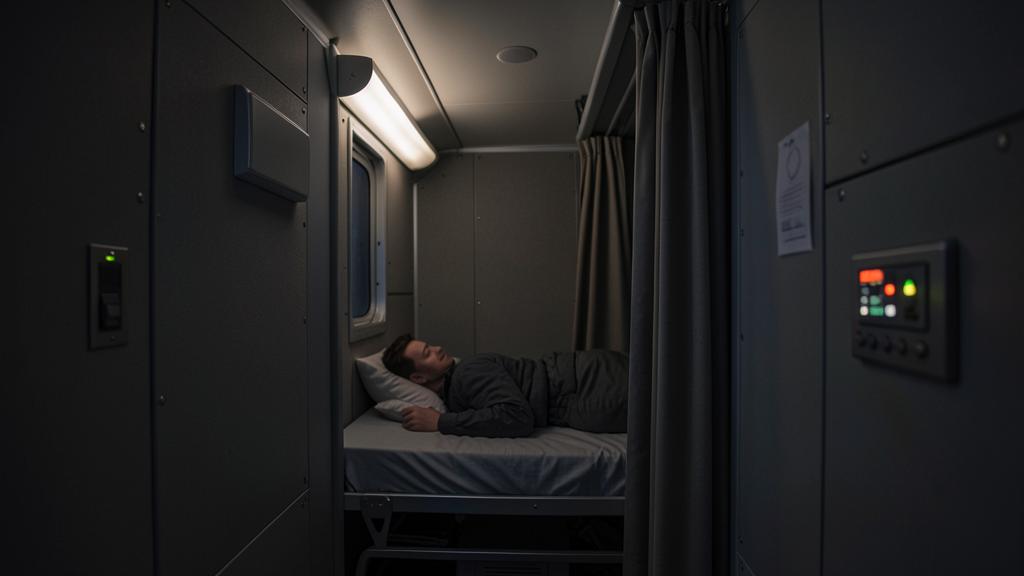
An augmented crew does not buy a longer duty day by being more numerous. It buys it by being able to sleep, and the regulator prices that sleep according to where it happens. The class of the rest facility is the hinge: a bunk, a curtained flat seat and a reclining cabin seat are three different physical propositions, and the table converts them into three different ceilings. Understanding why the hierarchy exists is what lets a crew see when a facility that meets its class on paper is not delivering what the class assumes.
Two regimes meet on one bunk
The single most useful thing to understand about in-flight rest is that two entirely separate rulebooks govern the same piece of furniture, they are approved by different processes, and they answer different questions.
The first is airworthiness. Whether a crew rest compartment may exist at all — its structure, its restraints, its oxygen provision, its smoke detection, its emergency egress, its placarding, the number of occupants it may hold and the phases of flight during which it may be occupied — is a certification matter. It is settled by the type certificate or a supplemental type certificate, and it is written in the aircraft flight manual and the cabin configuration documents. That regime never mentions duty hours.
The second is flight time limitations. Whether the existence of that compartment lets you extend a flight duty period, and by how much, is an operational rule. In Europe it lives in the flight time limitation requirements under Part-ORO, reproduced in the operator’s manual; in the United States the equivalent sits in the flight and duty rules for scheduled passenger operations. That regime never certifies anything.
The practical consequence is that « how long can we operate? » and « may we lie down here? » are answered by different documents. A compartment can be perfectly airworthy and still not be the class the extension assumed.
The three classes, and what actually separates them
Both the European and the American frameworks describe three classes of rest facility, and although the wording differs, they are recognisably the same hierarchy. The criteria are physical, not commercial: what matters is posture, separation and the ability to control the environment.
A Class 1 facility is a bunk or equivalent surface allowing a flat or near-flat sleeping position. It is separated from both the flight deck and the passenger cabin, isolated from passengers and from crew who are not resting, and it allows control of light, temperature and — to the extent the airframe permits — noise. This is the dedicated crew rest compartment, whether overhead, on a lower deck or built into a cabin module.
A Class 2 facility is a seat that allows a flat or near-flat sleeping position, separated from passengers by at least a curtain to provide darkness and some sound mitigation, and reasonably free from disturbance by passengers or crew. It is, in practice, a lie-flat cabin seat with a screen around it.
A Class 3 facility is a seat that reclines substantially — at least forty degrees from the vertical in the European definition — and provides leg and foot support, again with at least a curtain separating it from passengers. It is a good cabin seat, and it is explicitly not a bed.
Read those definitions carefully and one thing stands out: nowhere do they mention the cabin class in which the seat is sold. The class of a rest facility is a physical determination about posture and isolation. Marketing names have no standing in it.
| Class | Posture | Separation | What it assumes about sleep |
|---|---|---|---|
| Class 1 | Flat or near-flat bunk | Isolated from flight deck and cabin; light and temperature controllable | Consolidated sleep including deep sleep is achievable |
| Class 2 | Flat or near-flat seat | Curtain at minimum; reasonably free from disturbance | Real sleep is likely, more fragmented than in a bunk |
| Class 3 | Reclining seat, at least forty degrees from the vertical, with leg and foot support | Curtain at minimum | Rest and some napping; consolidated deep sleep is not assumed |
Why horizontal is not a comfort preference
The hierarchy looks like a comfort ranking and is often defended as one. It is not: it follows the sleep physiology, and the physiology is unambiguous on the points that matter.
Posture affects how quickly sleep arrives and what kind of sleep it is. Upright and semi-upright postures lengthen the time to fall asleep, increase the number of awakenings, and cut the proportion of slow-wave sleep — the deep stage that does most of the restorative work. A seated rest of a given duration therefore does not deliver a given fraction of a bunk rest of the same duration; it delivers a different and shallower thing. That is the entire justification for treating a flat surface as categorically better rather than incrementally better.
Noise and vibration act on the same variables. A cruise cabin is loud by any domestic standard, and broadband noise fragments sleep even when the sleeper reports having slept. A curtain does not fix either.
Light matters for a different reason: it is the principal signal driving the circadian system. A facility that cannot be darkened is not merely uncomfortable — it is telling the body it is daytime at the exact moment the crew member needs the opposite.
Interruption is the fourth variable, and it is the one most often underestimated. A rest that can be interrupted by a passenger, a service, or a colleague looking for something is a rest whose occupant does not fully let go. The requirement for isolation in Class 1 is not about privacy. It is about the difference between sleeping and lying down waiting to be needed.
The rest facility class matters because it determines how well a crew member can sleep. A flat bunk (Class 1) lets you sleep deeply, while a reclined seat (Class 3) only allows light rest. Noise, light, and interruptions can ruin even a good facility.
On a Boeing 787-9 flying from London to Singapore (about 10,900 km, 13 hours flight time), a crew using a Class 1 bunk can extend their duty period by 1h30 compared to a Class 3 seat. If the bunk’s ventilation fails, the facility drops to Class 2, reducing the extension to 1h.
Where the credit actually comes from
With the classes established, the operational rule becomes readable. The maximum flight duty period for an augmented crew is a function of two inputs: how many additional flight crew members are carried, and which class of facility is available to them. The tables in the applicable regulation give the figures, and the operator reproduces them in the manual — that is where the exact numbers must be read, because they differ between frameworks and are amended.
What matters here is the shape of the table rather than its contents. Each step up in facility class buys additional duty time; carrying a second additional crew member buys more again; and the steps are smaller than expected — about an hour each in the European table — which surprises people who assume a bunk must be worth far more than a seat. It is not worth much more, because the constraint being managed is not only sleep quantity but the total length of time awake and on duty, and no rest facility fixes that.
Two further conditions travel with the credit and are frequently forgotten. First, the rest has to be a usable block, not an accumulation of fragments: the regulation imposes a minimum consecutive duration, on the reasoning that a rest shorter than that produces little consolidated sleep and considerable sleep inertia. Second, the allocation is not free — the frameworks and their guidance material place conditions on the rest of the crew member who will perform the landing, precisely because rest taken in the first hours of a long duty has largely worn off by the approach.
There is a corollary worth stating: if the facility available on the day is of a lower class than the one the roster assumed, the maximum duty period drops with it. This is not a paperwork detail. An unserviceable bunk on a long sector is a rostering event, and the crew is entitled to know what class the plan was built on before departure rather than discovering it in cruise.
The trap. A rest facility that is unserviceable, occupied by equipment, or unusable because of a defect does not degrade gracefully into « a bit less rest ». It changes the class, and changing the class changes the legal maximum for the whole duty period. Reporting a broken bunk light or a failed rest-compartment ventilation fan as a cabin defect, rather than as something that may alter the crew’s limits, is how operators discover the problem retrospectively.
Two Class 1 facilities that do not deliver the same sleep
The class is a legal floor, not a prediction. Two compartments that both qualify as Class 1 can produce measurably different sleep, and crews know exactly which is which long before any study says so.
Location dominates. A compartment behind an aft galley inherits the galley’s noise, its lighting spill and its traffic. One near an air-conditioning riser inherits duct noise. One far aft inherits more airframe motion in turbulence. Overhead compartments and lower-deck compartments have quite different acoustic and thermal characters, and a module built into the cabin sits in a different world again.
Temperature is the most commonly reported failure, in both directions, and it is the one that most reliably ruins a rest period regardless of how long it is. Bunk ventilation that cannot be adjusted by the occupant turns a compliant facility into an unusable one.
None of this makes the class wrong. It makes it insufficient as an operational assumption. An operator that gathers subjective sleep reports by type and by bunk position — the standard fatigue scales take a minute to complete — will find the pattern within months, and can then reassign positions, fix the ventilation, or plan the sector on what the facility actually delivers.
| Factor | Effect on sleep | Visible in the class definition? | Who can change it |
|---|---|---|---|
| Compartment location in the airframe | Noise, vibration, thermal behaviour | No | Nobody, once built — plan around it |
| Ventilation and temperature control | Frequent cause of an unusable rest | Partly | Maintenance, if reported as such |
| Circadian timing of the break | Very large; the same hours are worth different amounts | No | The crew, when allocating breaks |
| Interruptions | Prevents consolidated sleep even when duration looks fine | Yes, for Class 1 | The cabin and flight crew together |
| Time already awake before the break | Determines how quickly sleep arrives | No | Rostering and the crew’s own preparation |
Timing beats duration
Two rest periods of identical length, in an identical bunk, on the same aeroplane, can be worth very different amounts. What separates them is where they fall against the crew member’s body clock.
The frameworks recognise a window of circadian low — in the European definitions, the small hours by the time reference the crew member is acclimatised to — during which alertness is at its worst and, correspondingly, sleep comes most easily and most deeply. A break that falls inside that window is physiologically cheap to use and valuable to have had. A break falling in the late afternoon or early evening of the body clock sits close to what sleep researchers call the forbidden zone, when falling asleep is genuinely difficult regardless of how tired the person is.
This is why the ritual of allocating breaks by seniority, or by rotation, or by whoever asks first, is worse than it looks. The rational allocation considers who will perform the landing, who is acclimatised to what, and where each break sits relative to each person’s own body clock — and on a crew drawn from different patterns, those clocks are not aligned. A five-minute conversation before top of climb, taken seriously, is one of the highest-value fatigue interventions available on a long sector.
Sleep inertia and the end of the rest period
The most operationally awkward property of good sleep is that waking from it is not instantaneous. Sleep inertia is real, measurable, and worst exactly when the rest has been most successful.
Its practical effect is a buffer requirement. A crew member who wakes and takes a seat immediately is not the crew member they will be twenty or thirty minutes later, and the operator’s procedures should say so explicitly: end the rest early enough, get up, get light, get fluid, and do not conduct the approach briefing inside the buffer. Where a rest period is short, the same phenomenon argues for keeping it genuinely short rather than allowing it to run into the depth of sleep from which waking is hardest.
It is also why a break that ends at top of descent has part of its benefit cancelled by its own timing.
Cabin crew, cargo and the edges of the table
Three edges are where confident generalisations go wrong.
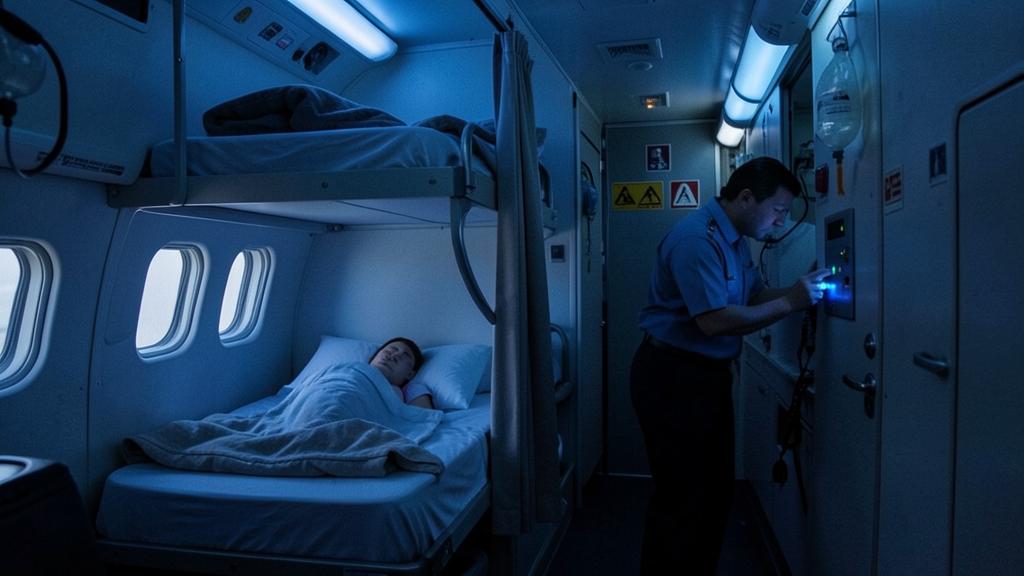
Cabin crew do not sit inside the flight crew table. Their limits are set separately — in Europe within the same subpart but under their own provisions, in the United States outside those rules altogether — and a cabin crew rest compartment is a distinct installation from the flight crew one, often built to a different physical standard.
All-cargo operations are the second edge. In the United States, the flight and duty rules built around the science apply to scheduled passenger operations, and cargo operators remain under the older regime unless they opt in — a divergence that has been publicly contested for years and that anyone comparing the two systems needs to know about. European coverage is drawn differently, and treating either as a global norm is an error.
The third edge is the fatigue risk management route. Where an operator can demonstrate, with data, that a different arrangement delivers an equivalent or better level of alertness, an approved fatigue risk management system allows departure from the prescriptive table. That route is demanding — it requires measurement, analysis, safety assurance and a regulator willing to approve it — and it is the only legitimate way past the table. Nothing else is.
The right reflex. Three habits do most of the work, and none needs a regulatory change or a new bunk: know which class the roster was built on and say so when the facility does not match it; allocate the breaks against body clocks rather than seniority, out loud, before the cabin gets busy; and end the last break with the inertia buffer intact, treating the buffer as part of the rest rather than as time stolen from it.


Leave a Reply
You must be logged in to post a comment.