

Four pilots in an augmented crew, two legs per rotation, one landing to share at each end: the arithmetic of recency plays out here, not in the manuals. The rule of three takeoffs and three landings in ninety days is considered a logbook formality; in reality, it is one of the most precise requirements of the corpus—it does not protect experience, judgment, or aircraft knowledge, but a gesture of a few seconds whose calibration expires faster than anything else. Understanding what the threshold compensates for, and what it does not, changes the way it is managed.
Three events, ninety days: the exact form of the rule
The mechanism boils down to one sentence: to operate as a captain or first officer with passengers on board, the pilot must have performed, within the previous ninety days, at least three takeoffs, three approaches, and three landings in the same aircraft type or class—or in a full-flight simulator representative of that type or class. The window is sliding: it recalculates with each flight, day by day, and not in civil periods. There is no tolerance or extension: past the deadline, the transport privilege ceases automatically, without anyone’s decision.
Three clarifications delimit the scope. First, the events must have been performed, not observed: legs flown as pilot monitoring do not count. Second, the count is linked to the type or class: a pilot operating two types maintains two separate counts. Finally, transporting passengers at night as a captain also requires, in the same window, at least one night takeoff, approach, and landing—the holder of a valid instrument rating is exempt.
It is also important to clarify what the rule is not. It does not condition the validity of the license or the type rating: an expired recency does not take anything away; it only suspends the exercise of a privilege until it is restored. And it does not overlap with the operator’s periodic checks, nor with route and aerodrome competence: three mechanisms, three cycles, three distinct objects. Recency is the shortest of the three—and that is precisely what makes it interesting.
What degrades quickly—and what does not
Research on skill loss has long distinguished two families. Declarative knowledge and procedures—limitations, flows, action sequences—degrade slowly and reactivate well with periodic reviews and training. Fine motor skills, on the other hand, depend on continuous calibration between perception and action; without practice, they dull in a few weeks, and no documentary work restores them.
The landing clearly belongs to the second family. Reading the closure rate in the ground movement, choosing the flare height, adjusting the pitch attitude while energy dissipates, combining crab and sideslip in a crosswind: none of this is stored in words or procedures. It is a calibration in the literal sense—the fine adjustment of a sensorimotor loop to the time constants of a given machine. It is not reviewed; it is maintained.
The rule protects the pilot’s ability to perform a landing, not their overall experience. It’s like a muscle that needs regular exercise—if you don’t practice landings often, your skill fades quickly, and no amount of reading or studying can replace that hands-on practice.
A pilot flying an Airbus A320 on a 3,000-meter runway in calm conditions at 15°C maintains their landing skill differently than one landing the same aircraft in a 1,800-meter runway with a 20-knot crosswind at 5°C. The rule counts both, but the second scenario keeps the pilot’s skills sharper for real-world challenges.
This explains a singularity of the system: the captain with fifteen thousand hours is subject to the same count as the first officer starting on the type. Experience slows the degradation of judgment, anticipation, and situation management—but not that of the maneuver. The short window says nothing more: the rule has isolated the only component whose decay is measured in weeks, and monitors only that one.
The segment that the window protects
The text includes three things—takeoffs, approaches, landings—and this trio defines the real scope of the protection. On the arrival side, the target sequence goes from the final approach to rollout control: acquisition of visual references, flare, touchdown, deceleration. On the departure side, rotation and initial directional control carry their own calibration, less commented on but equally perishable. Between the two, everything that constitutes most of the flight time—cruise, energy management in descent, integration into traffic—falls outside the rule.
This narrowness is not a weakness; it is the principle. Flight preparation, the decision to interrupt the approach, and teamwork are covered by training and periodic checks, which do it better than an event counter. Recency does not aim to guarantee a complete pilot; it guarantees that the flight segment where the machine is still flown manually—and where the irreversible happens in seconds—is never entrusted to a maneuver that has been dormant for months.
Where the count is correct and competence is absent
The rule counts events; it says nothing about their content. Three touchdowns in calm wind, on a long, dry runway, at the usual weight, are legally equivalent to three limit landings in strong crosswind on a contaminated runway. However, the competence required by the difficult day is only maintained with exposure—and that is precisely what operations tend to make rarer, as difficult conditions are not planned.
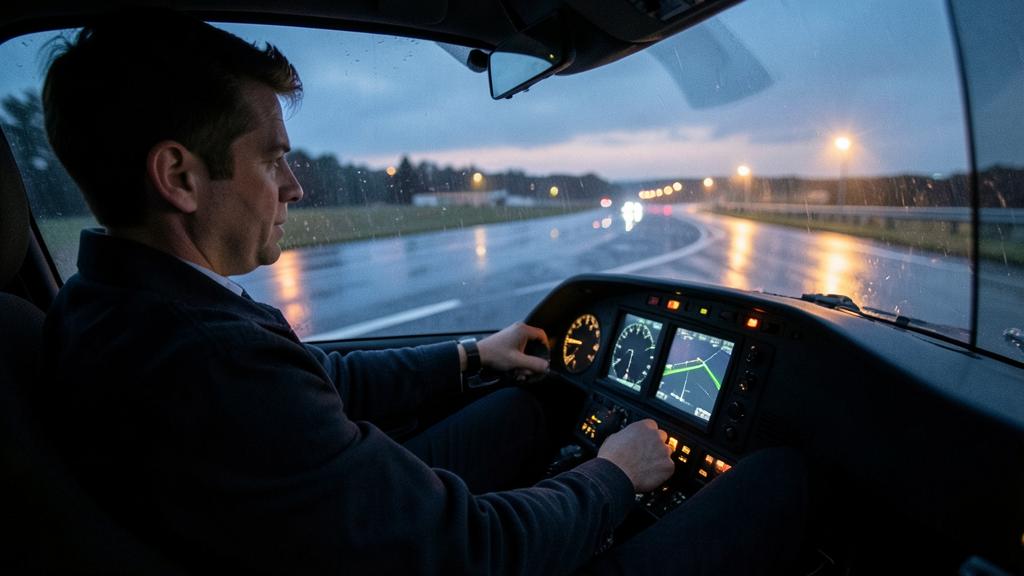
The automatic landing pushes the question into the gray area. When the autopilot holds the controls until touchdown, who has « performed » the landing? The letter counts an event; the spirit targeted a maneuver that did not take place. Operators handle this differently in their documentation, and the point is worth verifying rather than assuming.
The opposite also exists: maneuvers that maintain the skill without counting. A pilot flying two types maintains on one a calibration that partially transfers to the other—but the count for the other remains at zero. And the leg flown as pilot monitoring feeds judgment, terrain knowledge, and the reading of conditions, but neither the count nor the sensorimotor loop. The map of events that count and the map of those that maintain only overlap halfway.
| Event | Feeds the recency count | Maintains the maneuver | Practical limit |
|---|---|---|---|
| Landing as PF in the type, in line | Yes | Yes | Its training value depends on the conditions encountered, which the rule ignores |
| Dedicated session in a representative FFS | Yes | To a large extent | Partial restoration of the visual and vestibular signals of the last meters |
| Monitored automatic landing | According to the operator’s doctrine | Very little | The flare maneuver is not executed by the pilot |
| Landing as PF in another type | No, for the type in question | Partially | The fine calibration remains specific to each type |
| Leg flown as PM | No | No | Feeds judgment and condition reading, not the sensorimotor loop |
The trap: reading the tracking table as an indicator of fitness. « Green » only means that the regulatory floor has been reached—three events, perhaps all in calm wind, perhaps including an automatic landing. The symmetrical trap is more insidious: the captain who keeps the legs as PF out of habit or because of systematically easy conditions pushes the first officer out of the window, and the crew discovers this on the day when scheduling no longer leaves a choice of pilot flying.
The arithmetic of long-haul operations
In the short- and medium-haul network, the count feeds itself: several legs per day, a natural balance between flying and monitoring, a recency that no one checks because it is never at risk. Long-haul operations reverse the situation term by term. One rotation offers only two legs; each leg offers only one takeoff and one landing; and the augmented crew shares them between three or four pilots, some of whom will only hold the controls in cruise.
The result is a tight arithmetic: for a relief first officer, the natural pace usually averages one or two landings per month. The window then barely fills, and the slightest interruption empties it—a leave, a ground course, an unavailability, a rotation where the distribution of legs left nothing. Here, loss of recency is not individual negligence; it is a structural property of the operations, which scheduling must continuously compensate for.
That is why operational regulations place monitoring under the operator’s responsibility: crew management systems maintain the count, activate alerts as the deadline approaches, and schedule recovery sessions. But a system only counts what is declared to it. A leg recorded as flown as PF when it was flown as PM falsifies the monitoring in the only dangerous direction: where the table stays green while the maneuver fades.
The correct reflex: keep your own count. Know your recency expiry date as you know your medical expiry date—recalculate it after each leg, in your logbook, without waiting for the system’s alert. And in an augmented crew, the distribution of legs as PF is decided during the rotation preparation, reviewing everyone’s counters, not on board according to preferences.
Restoring: the value of each path
Restoration is not a check: the rule does not ask for an evaluation, it asks for events. Two paths lead to it. The first is the full-flight simulator representative of the type or class, where takeoffs and landings count the same as in flight. The second is the aircraft itself, without passengers, within the framework defined by the operator—ferry flight, technical flight, training flight. In both cases, the goal is to produce the missing events before recovering the privilege of carrying passengers.
Each path has its own texture. The simulator restores most of the loop—the visual movement, the aircraft dynamics, the maneuver time—with known limitations in vestibular signals and the feeling of the last meters; the rule accepts this, and the operator can be more demanding. The aircraft restores everything, at the cost of a dedicated flight whose cost is debatable. A point deserves attention for those returning from a long absence: recency is then only the smallest step. The procedures for returning to line after a prolonged interruption stack other requirements, graduated according to duration—the exact thresholds are in the operator’s manual, and that is where they must be read.
What to check in your documentation
With the mechanism in place, four points are worth checking in your own documentation, because that is where the gray areas are closed. How does your operator count the automatic landing in terms of recency—and is it written, or is it an oral custom? How does the tracking system record the distribution of legs, and what is the process for correcting a false entry? What thresholds does your manual provide between a simple loss of recency and a return to line after a long interruption? And for multiple counts—two types, a mixed activity—which of the counts does your tracking table actually show?
The gray area that nothing will close through this channel remains: the quality of the counted events. A counter cannot measure it, and the rule will never attempt to. It is up to the recurrent training programs, fed by operational data, to expose crews to what the line no longer gives them frequently enough. For those preparing for a type rating or a selection, the distinction makes an excellent interview topic: reciting the threshold is within everyone’s reach; explaining what it compensates for—and what it leaves exposed—shows that you have understood that recency is a floor, not a training program.
The preceding developments describe a general mechanism. The applicable texts, their acceptable means of compliance, and your operator-approved documentation prevail in all circumstances over this article: it is against them, and only them, that an individual situation must be checked.


Leave a Reply
You must be logged in to post a comment.