
A briefed exercise is handled without delay: the crew knows what is coming, the hand is already on the right control, the first action follows almost immediately. The same exercise slipped unannounced into an ordinary session produces something else entirely — several seconds of silence, a first action sometimes the opposite of the right one, a diagnosis that only comes afterwards. That delay is not a competence failing: it is the price of rebuilding a mental model that has just been invalidated. It can be measured, and it can be reduced.
Startle is not surprise
The two words are used interchangeably, and that is the first confusion to clear up, because the countermeasures have nothing in common. Startle is a reflex. A sudden, intense stimulus — a high-priority aural warning, an impact, a jolt — triggers a stereotyped motor sequence that starts at the neck and shoulders, closes the eyelids and flexes the arms. It begins on the order of a few tens of milliseconds after the stimulus and ends within a fraction of a second. It requires no interpretation: it is produced before one has known what the event was.
Surprise is something else. It arises from a gap between what the world does and what one expected it to do. It needs no noise: an automatic mode that is not the one believed to be armed, a speed drifting quietly, a system state discovered where nobody was looking, all produce a complete and perfectly silent surprise. Its duration bears no relation to that of the reflex. Rebuilding a frame of interpretation takes on the order of a few seconds when the situation resembles a known one, and far longer when it fits none of the available categories.
One can therefore be startled without being surprised — the warning one was expecting still makes you blink — and one can be surprised without the slightest startle. The second case is the more insidious, because nothing tells the crew that its internal clock has just started running.
Startle is an automatic reaction to a sudden shock, like blinking at a loud noise. Surprise happens when reality doesn’t match expectations, like realizing the autopilot is off when you thought it was on. Startle lasts less than a second, but surprise can take much longer to recover from.
An A320 pilot at 35,000 feet suddenly feels a buffet and sees the stick shaker activate. The startle reflex makes them flinch, but the surprise lasts longer as they realize the aircraft is in a stall. The reflex took 0.3 seconds, but rebuilding their mental model takes 5-10 seconds while they assess the situation and react correctly.
| Criterion | Startle | Surprise |
|---|---|---|
| Trigger | Sudden, intense stimulus: noise, jolt, flash of light | Gap between what was expected and what is observed, with or without noise |
| Latency | On the order of a few tens of milliseconds | Immediate in principle, but awareness can be greatly delayed |
| Duration | A fraction of a second | From a few seconds to several tens of seconds |
| What is affected | Posture, vision, grip; involuntary contraction | Working memory, attentional scanning, communication |
| What reduces it | Habituation through repeated exposure to the same stimulus | Variety of scenarios, overlearned actions, explicit recovery procedure |
| What is observed in a session | A brief movement, often unnoticed by the practitioner concerned | A silence, a hesitating hand, a call-out that does not come |
What collapses, and what remains
Under surprise, the degradation is not uniform. What contracts first are the most expensive functions: working memory, which holds far fewer items at a time; attentional scanning, which stops exploring and fixes on a single source; speech production, which becomes rare and brief at the very moment the crew would need to talk to each other. Perception narrows at the same time: one sees less widely, hears less, and badly underestimates the time that has elapsed.
What remains available are the overlearned sequences. An action repeated to the point of automaticity consumes almost no resource: it runs while the rest is busy elsewhere. That is the only solid justification for the fact that certain actions are carried out from memory rather than by reading a list. Not because there would be no time to read, but because for a few seconds the resource needed to read and understand is no longer there. The corollary is severe: any procedure that demands reasoning in the very first seconds is badly placed, however technically correct it may be.
The textbook case of upset prevention and recovery training lies entirely within this constraint. Faced with an excessive nose-high attitude, what recovers the aircraft is reducing the angle of attack, that is, pushing — whereas the experience of the whole rest of the flight associates “pushing” with “losing height”, and height is precisely what is lacking. Adding thrust, the natural reflex when speed is collapsing, makes matters worse on architectures where the engines are mounted under the wing, because it produces an additional nose-up pitching moment. At high altitude it gives back almost nothing anyway: available thrust is low there and the range between the low-speed limit and buffet onset is narrow. The correct action is therefore both counter-intuitive and never reinforced by ordinary practice. It can only come from deliberate overlearning, obtained somewhere other than on the line.
The loop that closes too fast
The absence of a frame is a state the mind does not tolerate for long. It closes one as soon as a plausible hypothesis presents itself, and plausibility is not truth: it is simply the first explanation compatible with what has already been noticed. From that instant, attention stops searching and starts confirming. The cues that contradict the hypothesis are not dismissed by reasoning, they are not seen.
The consequence is a loop. Action taken on a false hypothesis produces an aircraft response that is not the expected one, hence a new discrepancy, hence a new surprise — but this time on an already degraded state, with less margin and less time. Each turn of the loop costs more than the last. The way out is never faster reasoning: it is an action that suspends the degradation and buys time, after which reasoning becomes possible again.
The hypothesis that closes is not drawn at random. It comes from the library of cases one has lived through. A practitioner who has met many situations has many entries and quickly falls back on the right one, or at least observes that several compete for the explanation — which is enough to keep the frame open. Someone whose experience is still short and largely scripted has few, and the first available explanation then fills the whole space for want of a competitor. The point matters if the teaching diagnosis is not to be mistaken: this is not a deficit of technical competence, the manoeuvre often being better known by the young pilot who has just worked on it, but a deficit of repertoire. The deliberate variety of scenarios is therefore not primarily aimed at making the exercise harder; it aims to fill that library faster than ordinary operations would, presenting as they do the same situations for years on end.
The trap. The dangerous form is not the five seconds of silence, it is the fast and wrong action. A frame closed on the first plausible hypothesis produces an immediate, confident movement, often recorded afterwards as a “prompt reaction”; the aircraft responds otherwise than expected, which creates a second surprise on an already degraded state. A hand that waits two seconds longer and acts correctly has done better, and the observation grid must be able to say so.
What the seconds cost
The cost of a delay is not proportional to its duration. In a divergent state, the deviation grows while nothing is being done, and the corrective action required grows with it. A bank angle that settles in increases the load factor needed to hold the flight path, hence the induced drag, hence the rate of descent; recovery will then have to be achieved within a height that has decreased in the meantime. Two seconds lost at the start do not impose two extra seconds of work: they impose a larger manoeuvre within a smaller margin.
When something unexpected happens, every second of delay makes the situation worse. In a bad situation, like a steep dive, the problem gets bigger faster than the time passing. A 2-second delay doesn’t just mean 2 seconds of extra work – it means you have to fix a bigger problem with less time and space to work with.
An A320 at 10,000 feet in a 30-degree bank loses 1,000 feet per minute. A 3-second delay in recovery means the aircraft loses 50 feet more, but also means the bank angle has increased to 40 degrees, requiring more force to correct. The correction now needs to be done with 50 feet less margin, making the maneuver harder and riskier.
The same second is not worth the same thing everywhere. In cruise, some ten seconds of rebuilding are paid for in altitude and discomfort: the situation remains affordable. On a go-around, in the initial climb, in low-height manoeuvring, that duration does not exist — the total budget is of the order of a few seconds, and it is entirely consumed by rebuilding the model if that has not been shortened in training. Working on the delay is therefore not a teaching refinement, it is a margin issue.
The type of operation shifts the cursor further, and two effects work in opposite directions. The first has to do with the number of seats occupied: with two on the flight deck, one pilot’s fixation can be broken from outside, because the other is looking elsewhere and a factual call-out is often enough to reopen the frame. Alone at the controls — aerial work, single-pilot transport, ferry flights — that external trigger does not exist: the way out must be carried entirely by procedure and by automatism, which makes overlearning that much less negotiable and shifts the issue towards the few actions that are genuinely kept current. The second has to do with the share of the flight spent where the rebuilding budget does not exist. An operation made up of short, low segments — aerial work, demanding airfields, air rescue — repeats those moments several times a day, whereas a long-haul flight spends most of its time in a phase where a few seconds are paid for in comfort. A training programme built on cruise alone then works on the wrong part of the flight, and the delay it measures is not the one that will cost.
What a briefed session really measures
A briefed exercise measures what it announces. That is useful, and it is even the only way to install a technique properly. But the forewarned crew has rebuilt its model before the event; there is nothing left to rebuild, hence nothing left to observe on the delay side. Confusing the two objects leads to believing that a programme covers the reaction to the unexpected on the grounds that it contains the corresponding manoeuvres.
| Item | Announced event | Unannounced event |
|---|---|---|
| What is really assessed | Knowledge of the manoeuvre and quality of the action | The recovery delay and the correctness of the first action |
| Time before the first action | Almost nil: the hand is already in place | Several seconds, with wide scatter from one crew to another |
| Typical error observed | Imprecise action, incomplete sequence, reversed order | Action opposite to the expected one, or no action at all |
| Value of re-running it | Retained: repetition consolidates the technique | Sharply reduced from the second presentation of the same scenario |
| What is recorded at the debriefing | The outcome and the conformity of the sequence | The two clocks: first action, first diagnosis called out |
| Inherent limitation | Says nothing about behaviour in the face of the unexpected | Hard to standardise, hence to compare between crews |
The debriefing gains from separating two clocks rather than judging the outcome. The first is the time elapsed before the first action on the controls; the second, the time elapsed before a correct diagnosis is called out. A short first clock and a longer second one describe exactly the behaviour sought: stabilise, then understand. The reverse pattern — diagnosis called early, action late — signals a crew that reasoned instead of flying. And immediate action accompanied by a wrong diagnosis signals a frame closed too early, which is the most expensive of the three configurations.
The trap. A surprise scenario only surprises once. Replayed in the next programme, it becomes a briefed exercise again: the delay falls back to zero and crew and instructor alike draw from it a confidence that rests on nothing. A precaution of the same order on the tool side: beyond the domain covered by flight-test data, the simulator model extrapolates. A technique learned in that zone may not transfer to the aircraft, and the training then becomes negative.
The levers that shorten the delay
None of them removes surprise. What training can reduce is the length of time for which it paralyses.
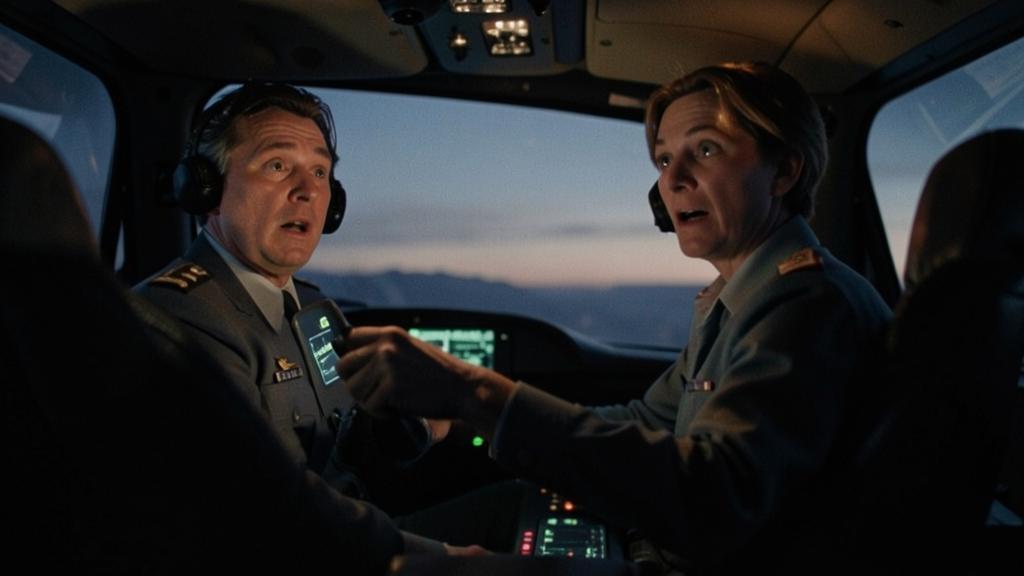
- Variety before difficulty. What trains recovery is not the severity of the scenario but its unpredictability. A modest event inserted at an unplanned moment is worth more than a spectacular failure at the announced point of the programme. The requirement of fairness remains: unexpected does not mean unfair, and a scenario nobody could have got out of teaches nothing.
- The overlearning of a very small number of actions. Only those that must come out with no cognitive resource, that is, those that give time back. Beyond a few sequences, automaticity is not maintained between two training courses.
- Physiological exposure. Real load factor, disorientation, an element of apprehension: the simulator does not produce them, and that is the reason for the on-aircraft component. Habituation attenuates the reflex part and lowers the level of arousal reached.
- An explicit way out. Taught as a procedure and not as a piece of common-sense advice: stabilise, breathe out, state, diagnose, in that order.
- Verbalisation as an external trigger. A factual, standardised call-out by the other crew member breaks the fixation more reliably than an open question, which on the contrary adds a cognitive task to someone who no longer has the means for it.
- Debriefing the delay. As long as only the outcome is recorded, nothing pushes anyone to work on recovery, and the competence remains invisible in the records.
The right reflex. Do not try to understand first. Put the flight path into a state that gives time back — pitch attitude, bank, thrust — breathe out once, at length, then say aloud what you see, not what you conclude from it. The factual statement breaks the fixation in the speaker as much as in the listener, and it timestamps the start of the diagnosis for the debriefing.
These levers have one thing in common: none of them asks for faster reasoning. All of them shift the load away from the moment when the resource is missing — towards automatism, towards habituation, towards the other seat, or towards an action that buys time. That is also what makes them transferable from one type to another, whereas the manoeuvres themselves are not.
What to go and check in your own operation
Three questions are addressed to the manual rather than to experience. First, where does the training programme describe the insertion of unannounced events, who decides on them, and under what rule of variation from one session to the next: without a written rule, variety depends on the instructor and dies with him. Next, how many of the type’s immediate actions require a choice, a reading or a piece of reasoning before the first movement — each one is a bet on a resource that will not be available. Finally, what the observation grid actually allows to be written down: if it has no box for the delay, the delay will not be worked on, whatever the department’s intentions.
For anyone preparing a first type rating, the consequence is direct. What is really assessed is not knowledge of the recovery manoeuvre, which is quickly acquired, but behaviour at the moment the frame breaks. The on-aircraft component cannot be made up for in the simulator because it does not deal with the same object, and instructors’ feedback on scenario design circulates mostly by word of mouth, sometimes on the FL330 professional forum.
One grey area remains that nobody closes: outside the domain covered by flight-test data, the fidelity of the simulator is not guaranteed, and no session can produce genuine surprise twice in the same crew. So a capability is trained by means of a tool that reproduces it only imperfectly, which shifts the effort towards the design of the scenarios far more than towards their number.
This text describes a mechanism, not a procedure. The applicable regulation, the type specifications and the operator’s approved documentation prevail in all circumstances over this article; in the event of any discrepancy, the manual is authoritative.
Questions fréquentes
What practical difference is made between startle and surprise in a training session?
Startle is a brief motor reflex, triggered by a sudden stimulus, and it is over within a second; it fades with simple repeated exposure to the stimulus. Surprise is the rebuilding of an invalidated mental model: it lasts from a few seconds to several tens of seconds and needs no noise to occur. In a session, startle shows as a brief movement, surprise as a silence and a hesitating hand. The two are dealt with differently: by habituation for the first, by variety of scenarios and overlearned actions for the second.
Why does a briefed exercise tell you nothing about the real reaction?
Because it measures knowledge of the manoeuvre and the quality of the action, not the recovery delay. The forewarned crew has rebuilt its model before the event: there is nothing left to rebuild, hence nothing left to observe on the freeze side. The exercise remains indispensable for installing a technique properly, but it must be distinguished, both in the programme and at the debriefing, from events inserted without announcement.
What should be timed during an unannounced event?
Two distinct clocks: the time elapsed before the first action on the controls, and the time elapsed before a correct diagnosis is called out. The configuration sought is a short first clock and a longer second one, a sign that the crew stabilised before understanding. The reverse pattern, fast diagnosis followed by late action, indicates that reasoning took the place of flying; immediate action accompanied by a wrong diagnosis indicates a frame closed too early.
Are training in the aircraft and training in the simulator interchangeable?
No, they do not deal with the same object. The aircraft exposes the pilot to real load factor, to disorientation and to an element of apprehension that the simulator does not produce, which acts on the physiological component of startle. The simulator deals with recognition on the type, crew coordination and procedure, but its model extrapolates beyond the domain covered by flight-test data. The two components are complementary and are planned separately.
Does a young pilot really react more slowly than an experienced one?
Most often yes, but not through a deficit of technical competence. Fast recognition of a situation rests on a library of cases lived through, and that library is built up with hours and with the variety of situations encountered. A cadet whose experience is essentially scripted has few models with which to identify what departs from the ordinary. That is precisely what the deliberate variety of training scenarios seeks to compensate for.
What should actually be done in the very first seconds?
Stabilise the flight path before trying to understand: pitch attitude, bank, thrust, in that order of priority. One long breath out is enough to bring part of the physiological arousal down and gives back some working memory. Only then, say aloud what is observed — a parameter, a state — rather than what is concluded from it, which protects against fixation on the first plausible hypothesis.


Leave a Reply
You must be logged in to post a comment.