
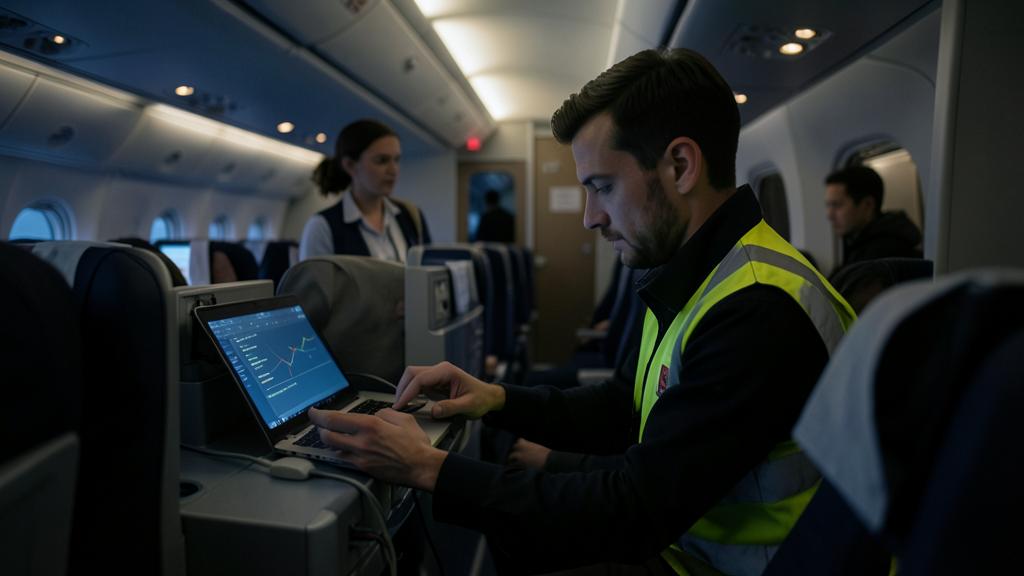
The reassurance usually offered to the public is that the entertainment system and the avionics are « not connected ». It is a comforting sentence and it is not the design. Modern aeroplanes are built as a small number of network domains with deliberately engineered crossings between them, because the crossings are useful: the moving map needs aircraft position, the flight bag needs live aircraft data to compute its figures, the maintenance system needs to reach the ground, and software has to get in somehow. The security argument does not rest on the absence of connections. It rests on knowing exactly which connections exist, what enforces each one, and which of them are worth watching.
Why total isolation was never the objective
An aeroplane with no path at all between its flight-critical systems and anything else would be a maintenance and dispatch problem of its own. Fault data would have to be read by hand at every turnaround, software would move only on physical media carried aboard by an engineer, performance figures would be recomputed from paper, and the cabin would learn nothing about the flight. Every one of those frictions has a safety cost as well as a commercial one, because a system nobody can inspect efficiently is a system that gets inspected less often.
So the architecture accepts connections and constrains them instead. The design question becomes a containment question: if something in the least trusted zone behaves in an arbitrary, hostile way, what is the worst effect it can have on the most trusted zone, and by what path? That framing is what makes the domain model useful. It is not a promise of separation; it is a map of the only places where separation can fail.
Four zones, not two
The industry model, set out in the network domain and information security standards produced by the avionics standardisation bodies, divides the aircraft into domains by trust level and by who administers them. The essential point is that there are four, not two, and that the third and fourth are frequently collapsed together in conversation when they behave very differently.
| Domain | What lives there | Who administers it | Assurance basis |
|---|---|---|---|
| Aircraft control | Flight controls, engine and fuel management, navigation, communication and surveillance, aircraft systems | The type certificate holder, through approved configuration control | Certified software and hardware, developed to the applicable design assurance levels |
| Airline information services | Maintenance and cabin support applications, operational data, the electronic flight bag infrastructure, administrative functions | The operator, within limits set by the manufacturer | Managed but not flight-critical; the operator carries much of the responsibility |
| Passenger information and entertainment | Seat-back systems, cabin servers, connectivity portal, media content, sometimes cabin retail | The operator, often through a supplier under contract | Commercial-grade, frequently updated, wide software surface |
| Passenger-owned devices | Everything a passenger carries aboard and connects to the cabin network | Nobody | None; treated as fully untrusted by definition |
Trust decreases down the table and change frequency increases. The aircraft control domain changes rarely and only through approved configuration control. The entertainment domain changes constantly, is often maintained by a third party, and carries software of ordinary commercial quality. That mismatch is not a defect — it is the reason the domains exist. It also explains why the interesting engineering is concentrated at the boundaries and not inside the zones.
Airplanes are divided into four security zones, not just two. The most critical systems (like flight controls) are strictly controlled, while entertainment systems change often and are less secure. The real security work happens at the borders between these zones, not inside them.
On an Airbus A350, the aircraft control domain (like the flight management system) is physically separated from the passenger entertainment system. However, the moving map in the cabin receives position data from the avionics via a one-way, hardware-enforced link. If the entertainment system were hacked, it couldn’t directly affect the flight controls, but it could display false information to passengers.
What actually enforces a boundary
Not all separation is the same strength, and the vocabulary matters when reading a security argument. Four mechanisms recur, in decreasing order of how hard they are to defeat and increasing order of how often they are used.
| Mechanism | What it enforces | How it fails |
|---|---|---|
| Physical separation | No shared medium at all: separate cabling, separate equipment, separate power | Only through a later modification that quietly introduces a shared path |
| Hardware-enforced direction | Data can move one way and not the other, because the medium itself is unidirectional — the classic case being a bus with one transmitter and many receivers | By the receiving side being given a back channel through some other route |
| Protocol and traffic constraint | Deterministic networking with pre-declared virtual links, fixed bandwidth allocation and configuration-controlled tables; a device cannot address what it was never configured to address, nor flood what it shares | By a fault or modification in the configuration tables, or by trusting content that arrives on a legitimate link |
| Cryptographic and procedural control | Signed software parts, authenticated sessions, controlled key material, two-person procedures for loading | By key management, by expired trust anchors, and by people — the usual place |
A good architecture stacks these rather than choosing one. The traffic reaching the aircraft control domain from a lower domain typically crosses a controlled interface unit, on a route that is direction-constrained, carrying only message types that the receiving side was configured to accept, having been authenticated at the point of origin. Any single one of those controls, alone, would be a weak argument. Together they mean that an attacker who owns the entertainment server owns an entertainment server.
The trap. « There is a firewall between the domains » is not a security argument. A firewall is a policy device on a shared medium, and it is only as good as its ruleset, its patch state and the assumption that the medium below it is behaving. Ask instead what would still hold if the firewall were bypassed entirely — physical separation, unidirectional media and configuration-controlled traffic tables all survive that question; a ruleset does not.
The legitimate crossings, one at a time
Every crossing that exists was put there for a reason, and each has a characteristic risk shaped by its direction. The single most useful discipline in this field is to insist on knowing the direction of every flow, because a one-way flow out of the protected domain is a very different proposition from a flow into it.
| Crossing | Direction | Why it exists | What deserves monitoring |
|---|---|---|---|
| Moving map and flight information to the cabin | Out of the control domain only | Passenger display of position, altitude, time to destination | That the return path is genuinely absent, not merely unused |
| Flight bag to aircraft interface | Predominantly out, with a constrained return in some designs | Performance and mass-and-balance calculation with live aircraft data | The device itself, its applications and its update channel |
| Air-ground datalink and satellite communication | Both | Operational and air traffic messaging, position reporting, weather | Message authenticity and the router that terminates the link |
| Maintenance and condition monitoring offload | Predominantly out | Fault data and recorded parameters reaching ground engineering | Whether the offload channel can also be used to command or load |
| Wireless ground link at the stand | Both | Bulk data transfer and content or software distribution without a physical connection | Access control at the stand, and what the link is authorised to write |
| Software and database loading | Into every domain | Navigation databases, field-loadable software, entertainment content | Signature verification, part provenance, and who held the media |
Read the right-hand column and a pattern appears. Almost none of the monitoring effort belongs on the entertainment system itself. It belongs on the interfaces, on the devices that straddle a boundary, and above all on the one path that writes into the most trusted domain by design.
Loading is the path that matters
An attacker who wants to affect an aircraft function does not need to break a network boundary if a legitimate process will carry the payload across for them. Software and database loading is precisely such a process: it exists to write into the aircraft control domain, it is used routinely, and its supply chain runs through several organisations before the aeroplane sees it.
The countermeasure is cryptographic rather than architectural. Loadable parts are packaged and signed at the point of production, and on types designed for it the verification is carried out by the aircraft itself before the part is accepted. That verification is what turns a long, untrustworthy distribution chain — supplier, operator engineering, a laptop, a portable drive, a wireless link, a technician — into a chain that does not need to be trusted, because tampering anywhere along it invalidates the signature.
Which means the real questions are all about key material and process. Are trust anchors current, and is their expiry tracked as a configuration item? Is verification enforced by the aircraft, or performed by a ground tool that the aircraft then believes? Who can produce a validly signed part, and what happens when a supplier’s signing capability changes hands? Is the loading media controlled, and is its use recorded against the airframe? None of these are network questions, and all of them decide whether the network boundaries mean anything.
The reflex. When a portable device, a loading tool or a maintenance laptop is connected to an aircraft, treat it as a boundary crossing and not as a tool being used. That means recorded, authorised, and traceable to a person — the same discipline that already applies to a part number. The device is, for the duration of the connection, part of the aircraft’s attack surface.
The flight bag is a boundary somebody carries
The electronic flight bag sits awkwardly across the model, which is why it attracts so much attention. It holds operationally significant data, it is used to compute figures that go into the aeroplane, it connects to a network the operator does not fully control, and in many fleets it is physically carried off the aircraft and home.
The architecture responds with three separations that are worth keeping straight. First, hardware class: whether the device is portable and uncertified, or installed and part of the aircraft configuration. Second, software type: whether an application is administratively simple, or whether it produces results with operational consequence and therefore requires evaluation. Third, connection: whether the device receives aircraft data through a dedicated interface unit that constrains what can flow, or is merely near the aeroplane.
The failure mode that recurs is not a dramatic one. It is an application update distributed through a channel with weaker controls than the application’s operational significance deserves — a database, a performance module, a chart set — arriving on a device whose output the crew treat as authoritative. No network boundary is crossed. The wrong number simply arrives by the front door and is used.
Where the security analysis meets the safety analysis
The airworthiness security standards developed alongside the classical safety process share its structure deliberately. A security risk assessment identifies threat scenarios, traces each one to the aircraft function it could affect, and classifies the effect using the same severity language the safety assessment uses. The strength of the countermeasures then has to be commensurate with that severity, exactly as design assurance levels are allocated in the safety process.
That structural alignment produces the field’s most useful sentence: a security finding is only interesting to airworthiness insofar as it reaches a function whose loss or corruption matters. An entertainment system compromise with no path to a classified function is a commercial and reputational problem, not an airworthiness one. A modest weakness on a path that reaches a classified function is the reverse. Judging severity by the excitement of the technique rather than by the function reached is how attention gets spent in the wrong place.
The same standards extend the obligation past delivery, into continuing airworthiness. Security is not a certification event that closes; it is a state that has to be maintained against a threat landscape that changes after the type certificate is issued — which is why the organisational information security requirements now placed on operators, design organisations and service providers exist at all. They oblige an organisation to run an information security management system proportionate to its activity, to detect and report events with a potential effect on aviation safety, and to keep doing so.
What the operator actually owns
The manufacturer owns the architecture. The operator owns almost everything that can weaken it in service, and the list is more mundane than the subject’s reputation suggests: the entertainment supplier’s update process and contract terms; the flight bag fleet, its applications and its distribution channel; the wireless ground link at each station and who can associate with it; loading media and the people who hold them; modifications, especially cabin ones, and whether their security effect was assessed rather than only their structural and electrical effect; and the reporting route that lets a technician who saw something odd put it somewhere it will be read.
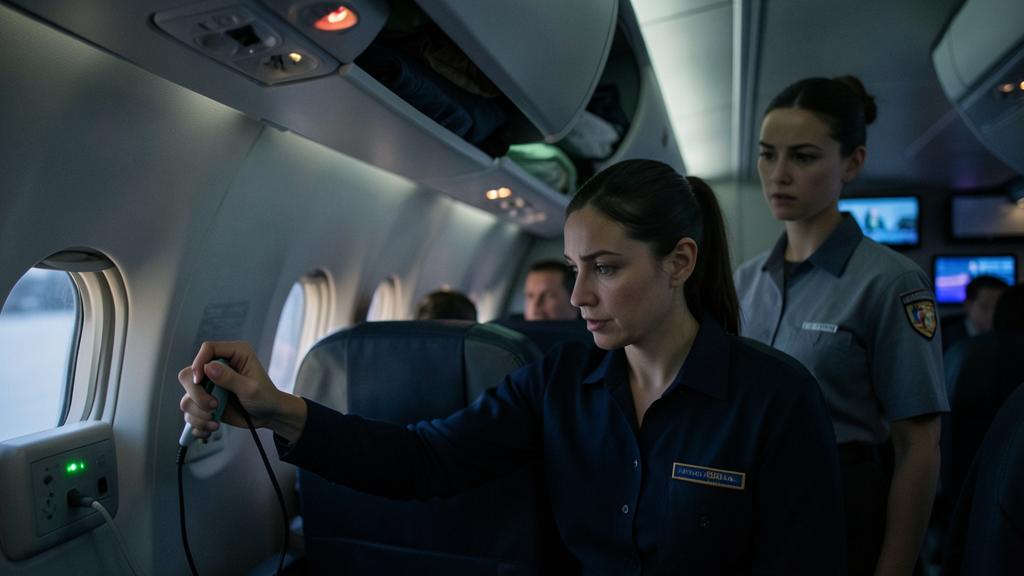
That last item is the one most often missing. A cabin crew member who finds an unexpected socket live, an engineer whose loading tool reports a signature failure, a first officer whose flight bag offers an update it should not have — each of these is an observation with a natural home in the occurrence reporting system, and each is routinely discarded because it does not look like a safety event. Aviation already knows how to run that machinery. Onboard network security does not need a new reporting culture; it needs to be admitted to the existing one. Crews comparing how their operators handle this in practice tend to do it at the FL330 forums, which is a reasonable place to discover that the answers vary widely.


Leave a Reply
You must be logged in to post a comment.