
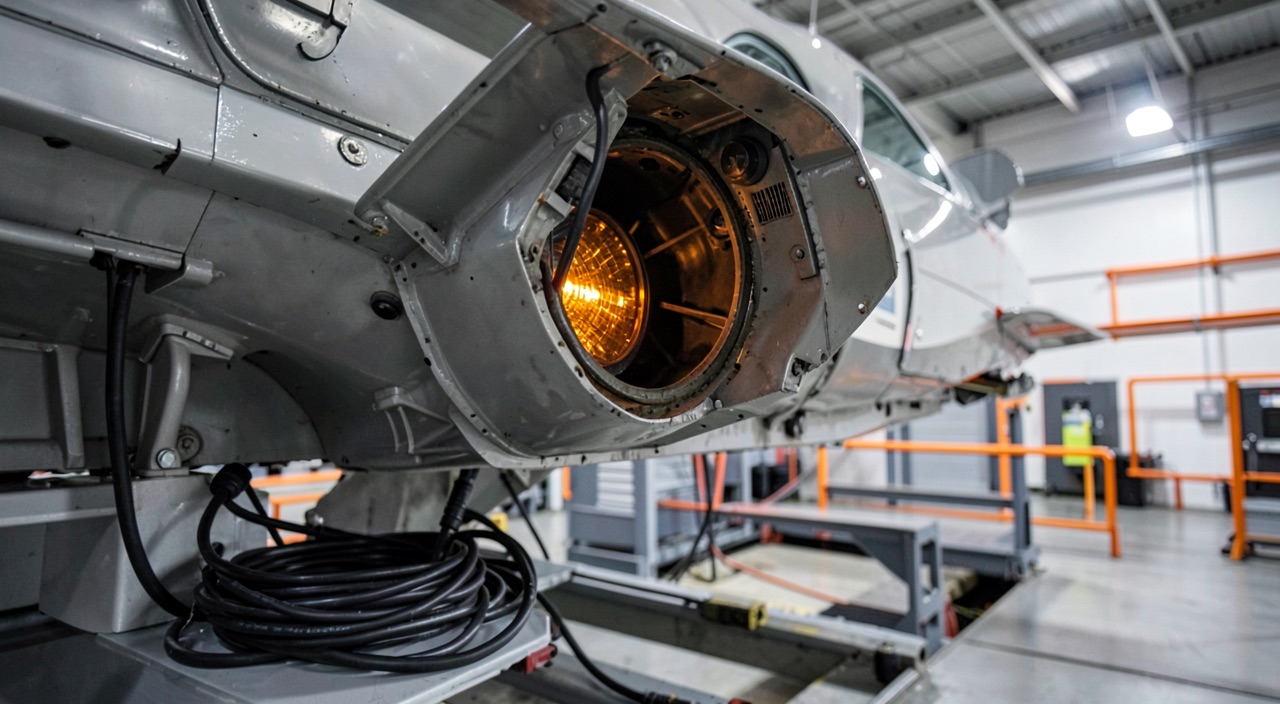
« A crew reports a slow pressure decay on a hydraulic system in cruise. No maintenance message, quantity stable, nothing on the ground. The aircraft leaves again in three hours, and you are the only one on call. Talk me through it. » The prompt contains no chapter reference, no value, no history. This gap is not carelessness on the recruiter’s part: it is the exercise itself. What gets scored lies entirely in how you go about filling it.
A question with no answer key, and that is the point
A technical maintenance interview mixes three families of questions that do not assess the same thing. A knowledge question has a verifiable answer: an operating principle, a system architecture, a unit, an order of magnitude. A procedure question has a documentary answer: what the work card prescribes, who holds the privilege to sign, which data is the reference. The open-fault question has neither. It describes an incomplete symptom and stops there.
The recruiter asking it has almost always lived the case. They know how the story ends and are not waiting for you to find it — it is even common for the scenario to have been chosen precisely because the real cause was counter-intuitive, and therefore unreachable by pure deduction. What they are listening for is a trajectory: where you enter, what you ask for, what you eliminate and on what evidence, what you refuse to do, and at what point you decide it is over.
The panel is often two people: a technical manager and someone from compliance. The two are not listening for the same thing. The first tracks economy of movement — that is, the number of openings, spare parts and slot-hours your reasoning consumes. The second tracks traceability: where the action you propose comes from, how it attaches to applicable maintenance data, what will be written down and passed on. An answer that satisfies only one of the two sounds brilliant and goes nowhere.
The interviewer isn’t looking for the right answer—they’re testing how you think. They want to see if you can ask the right questions, eliminate possibilities, and make decisions based on evidence, not just guesses.
On an Airbus A320, a slow hydraulic pressure decay in cruise with no message could be caused by a faulty servo valve or a temperature-sensitive leak. A technician might first check the hydraulic quantity indication for consistency, then verify the system’s operation in different flight phases before deciding whether to open panels or defer the issue to the next shift.
Prioritising is not listing
The most common failure does not look like ignorance: it looks like a list. The candidate rattles off everything in the system that could produce the symptom, often accurately. It is the schoolroom reflex, and it is counter-productive — an exhaustive enumeration proves you revised, not that you know how to search. A hierarchy requires an ordering criterion, and the prompt, however thin, already supplies several.
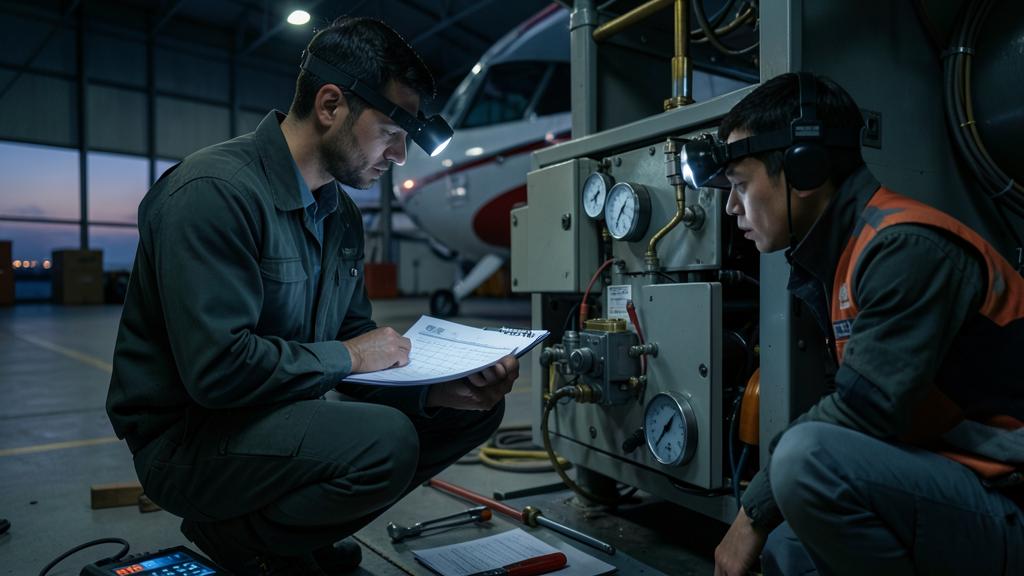
The symptom is never « loss of pressure. » It is « slow loss, in cruise, with no associated message, quantity stable, nothing on the ground. » Every qualifier is a filter. Stable quantity: a clean external leak becomes less likely, an internal leak or an indication fault rises. No message: the monitored parameters stayed within their window, which tells you where to look and is therefore not an absence of information. In cruise and not on the ground: a dependency on temperature, on system load, or on a consumer that is only called on in flight.
Then comes the criterion that really separates candidates, and one that few state out loud. It is not the general frequency of the fault, it is the ratio between how plausible a hypothesis is given that specific symptom and what the test that settles it costs. An unlikely cause that a glance rules out is dealt with before a likely cause that requires opening a panel. In other words, the ordered list is not a list of faults: it is a list of tests.
One last filter, almost always worthwhile and almost always forgotten: what has changed. A fault that appeared yesterday has a good chance of having been manufactured the day before — a nearby removal, a connector unplugged then replugged, a panel refitted, a modification applied, a spare installed. Asking for the history of the relevant chapter is not an interview trick, it is the first line of any serious investigation, and its absence is noticed immediately.
The right reflex. Before any hypothesis, restate the symptom in one sentence that includes the flight phase, the reproducibility and what was not observed. Then ask three things, in this order: the crew’s report in their own words, the history of the relevant chapter over the last few days, and the last work performed nearby. A fault that appeared yesterday was often manufactured the day before, during nearby work.
The cost of a test is not its duration
When a candidate announces « we’d start by checking such-and-such component, » the panel first hears a bill. A test costs on four distinct fronts, and only the first is measured in minutes. Access: removing panels, staging, chocking, restoring the area, checking after closing up. The slot: downtime is not measured by the duration of the test but by the space it takes up in a night that has little to spare. Induced risk: whatever you open, you close again, and a healthy system that you disturb becomes a fault source in its own right. Practical irreversibility, finally: the spare pulled from the pool, the trace in the file, the item that will come back from the shop with no fault found.
From this comes an ordering rule that is far from obvious and that separates a practitioner from a good student: you do not look for the cheapest test, you look for the cheapest test that settles something. A free test that decides nothing is not economical, it is useless; it gives the illusion of progress and consumes the one resource that cannot be bought back — the team’s attention at three in the morning.
Opening up deserves separate treatment, because in practice it is irreversible: the slot is consumed the moment the first panel comes off. The decision to open is therefore made once, and everything that can be observed within that same opening must have been listed beforehand — the points to inspect, the measurements to take, the views to keep, the parts to have on hand just in case. A candidate who prepares an opening instead of enduring it stands out in a single sentence.
| Test family | What it yields | What it consumes | Induced risk | Reversibility |
|---|---|---|---|---|
| Re-reading reports and history | Context: phase, reproducibility, associated parameters, recent work | A few minutes, no access | None | Full |
| Functional test on the ground, aircraft closed | Confirmation that the symptom still exists, and under what conditions | A ground run, a crew, power | Low, except when it exercises an already-degraded system | Full |
| Instrumented measurement at a test point | A value that separates two families of causes | Some tooling, sometimes partial access | Low | Good |
| Opening an access panel and inspecting | The actual condition: a trace, seepage, overheating, a connector’s contact | The entire slot, a platform, restoring the area | Real: seals, fasteners, foreign object, a healthy system disturbed | Partial: what is opened must be closed and checked again |
| Remove-and-replace as a substitution | A binary answer, and only if the fault is present during the test | A spare from the pool, a shop movement, a trace in the file | High: an item returned with no fault found, the fault relocated, a false confirmation | Low in practice |
Substitution replacement deserves to be named for what it is. It only yields information if the fault is present during the test. On an intermittent symptom, it yields nothing at all, and it costs three times over: a spare pulled, an item that will come back with no fault found, and above all a false confirmation if the symptom does not reappear for some other reason. This is the passage recruiters listen to most closely, because it is the one that, in service, often costs the operator the most.
What the documentation frames, and what it leaves open
« We’d follow the troubleshooting manual. » The answer is correct and not sufficient; it is sometimes even an elegant way of not answering. What the panel wants to know comes down to four points: which entry point you open the manual from — a message, a symptom, a chapter — what you do when the symptom the crew reported does not appear there in any form, what you do when the procedure ends in « if the fault persists, replace » an item that is not in stock, and what will be written at the end.
The structuring distinction is this: reasoning is free, action is not. You are entitled to formulate any hypothesis, including ones outside the documentation, and that is in fact how you break out of a procedure that loops. You are not entitled to return an aircraft to service on an action that does not attach to applicable maintenance data. A candidate who holds both ends — imagination about causes, rigour about actions — describes exactly the job, and the panel has little left to check.
The minimum equipment list is not a diagnostic tool, and mistaking it for one is costly in maintenance. It does not say what is broken; it says whether the aircraft can depart in that state, under what operating restrictions, under what maintenance conditions and for how long. Invoking it to close an investigation is answering one question with another. Invoking it to decide on a departure, while stating in writing that the investigation remains open and fixing the point at which it will resume, is by contrast a perfectly defensible maintenance decision before any panel.
The trap: the fault that disappears. A symptom that does not recur after an intervention proves nothing — neither that the intervention fixed it, nor that it was intermittent. The candidate who closes the case because « the test is good, » without being able to explain the mechanism linking the cause to the symptom, has just told the panel that one day they will sign off a return to service on a coincidence. The honest way out of a fault that has not been reproduced is a written monitoring instruction, not a conclusion.
Knowing when to stop: four acceptable outcomes
The real question behind the scenario is almost always this: what makes you stop? Candidates who address it explicitly are rare, and they are remembered. There are four acceptable outcomes, and it is worth being able to name them before walking into the room.
The first is isolation. The fault is attributed to a replaceable item, the action comes from applicable data, and a confirmation test reproduces the conditions under which it appeared — not just a pressurisation on the ramp when the symptom occurred in cruise. A confirmation test that does not recreate the condition confirms nothing at all, and this is a point panels readily come back to.
The second is framing. The fault is not isolated but it is bounded: an applicable tolerance, a deadline, a defined monitoring plan, a scheduled follow-up. This is an outcome, not a resignation, on the sole condition that what remains open is written down and dated.
The third is hand-over, the least well regarded and the most professional. The investigation passes to the next team with a written record: what was tested, what was ruled out and on what evidence, what remains open, what to watch for on the next flight. An investigation handed over without that record is an investigation lost; the next team will start from scratch and the operator will pay for the same work twice.
The fourth is escalation: when the data runs out, you ask the technical office or the manufacturer, and you do it with a file rather than a question. What is not an outcome, on the other hand: « the fault has gone away, » « the item was changed and the test is good » with no mechanism explained, and « keep going until we find it, » which is not a criterion but its absence.
At bottom, the issue is one of yield. The first tests eliminate entire families of hypotheses; past a certain point, every additional hour only refines a detail, while the cost keeps growing at the same rate as before. Knowing where these two curves cross is not resignation: it is precisely the competence an employer is trying to recruit for, because it is barely acquired in initial training.
What the panel hears in the way you say it
How you put it into words matters as much as the content. State the hypothesis, then the test that would kill it: a test that cannot invalidate any hypothesis is not a test, it is an observation. The phrase « here is what I expect to find, and here is what I conclude if I don’t find it » is recognised instantly, because it is the one actually used on the ramp when two people are working together.
Asking questions is not a weakness, and the panel counts them. The good ones cover reproducibility, flight phase, associated parameters, the aircraft’s condition on arrival, and above all what was not observed. The candidate who answers a deliberately incomplete prompt without asking anything has just shown that they would treat an incomplete crew report the same way — by filling the gaps with their own assumptions.
« I don’t know » is fine to say, provided it is followed through. « I don’t know, and here is how I would find out » — the documentation entry, the person to call, the previous occurrence to look up — is worth infinitely more than a hypothesis made up on the spot. Panels recognise improvised reasoning on an unfamiliar system, and what they take away from it is not the technical error: it is that a candidate preferred to appear certain rather than stay accurate, in a job where a signature commits a named individual.
The second trap: the deadline mistaken for an argument. The three hours in the scenario are placed there on purpose. They carry no technical value whatsoever: they may point toward a tolerance or toward a hand-over, but they can never lower the standard of proof required to conclude. A candidate who shortens their diagnosis because the aircraft has to leave is showing, in front of witnesses, exactly how one comes to sign off something one should not sign off.
Preparing without reciting
Useful preparation does not consist of revising system architectures, which the panel will check elsewhere anyway. It consists of preparing three faults you have actually lived through, including ones that ended badly, and telling them in the order of the reasoning: the symptom as stated, the data requested, the hypotheses ruled out and on what evidence, the cost of the tests run, the outcome chosen, and what you would do differently today. An unresolved fault that was properly handed over is better material than a successful repair told as if it were obvious.
Three points are worth checking in your own organisation’s documentation before the interview, because they vary from one organisation to another and the panel knows its own house version. The first: how the hand-over of an open fault is formalised where you work — medium, minimum content, who validates it. The second: what becomes of the record of an unresolved investigation, and whether it stays usable by the next team or disappears with the shift change. The third: from what point a fault becomes repetitive under your procedures, and what that status triggers in terms of analysis and follow-up.
There remains a grey area better acknowledged than silently filled in: the scenario offered is sometimes under-specified, even contradictory, whether because it was simplified or because the memory of it has drifted. The right conduct is not to quietly pick the most convenient interpretation, but to state the working assumption — « I am assuming the quantity indication is reliable; if it is not, the investigation changes in nature » — and then carry on. For anyone preparing a licence extension or the addition of a type rating, this form of question has a practical consequence: you can answer it on a type you do not hold, provided you reason in systems rather than part numbers, and say so before you start. Interview accounts shared on the FL330 forum and the courses described at formations.fl330.com give an idea of what organisations expect according to their size.
Where anything above diverges from a real case, the applicable regulations, the manufacturer’s maintenance data and the organisation’s approved procedures prevail in all circumstances: this text describes an interview-preparation method and authorises no action on an aircraft.
Questions fréquentes
Should I still answer when the fault concerns an aircraft type I do not hold?
Yes, and stating that upfront counts in your favour. The panel is assessing a method, not a memory of part numbers: you reason in systems, functions and cause families, naming the documentation you would open. Refusing to answer because the type is not on your licence reads as evasion, while reasoning blind without saying so reads as improvisation.
How long should an answer to an open-fault question last?
Duration matters less than structure. Two to four minutes are enough to restate the symptom, ask for the missing data, put forward two or three ranked hypotheses, name the test that separates them and state the stopping criterion. After that you need to hand the floor back: the panel pushes further, adds a constraint or changes the symptom, and it is this second part that is truly discriminating.
Can you propose applying a tolerance to let the aircraft depart?
Yes, provided you present it for what it is: a departure decision, not a diagnostic conclusion. The complete answer specifies the associated operating and maintenance conditions, the deadline, what remains open and the point at which the investigation will resume. Proposed this way it is solid; proposed to avoid searching, it is disqualifying.
Does the panel expect you to name the faulty component?
Rarely, and believing so makes you miss the point of the exercise. Many scenarios are built on cases where the cause was counter-intuitive, precisely so that pure deduction is not enough. Naming an item too early is the classic mistake: it closes the investigation around one hypothesis and leads to a blind replacement. What is expected is the order of the tests and the evidence that will accompany each elimination.
How do you talk about a fault you never solved?
It is often the best material. Describe what was ruled out and on what evidence, what each test cost, why the investigation was stopped and how it was handed over. A candidate able to describe an unresolved investigation without dressing it up shows exactly the behaviour expected at shift change, when the aircraft is left with an open defect.
What should you answer if the recruiter adds time pressure mid-exercise?
You need to say explicitly that the deadline changes the outcome chosen, never the method or the standard of proof. Under constraint, you shift toward a bounded tolerance or a written hand-over, both traceable. Speeding up the diagnosis itself, skipping a confirmation test, or concluding on a symptom’s disappearance are the three answers that fail the exercise.


Leave a Reply
You must be logged in to post a comment.