

Two first officers can start line training in the same month, one with fourteen hundred hours in the logbook, the other with nine hundred, and the second one be released to the line first. There is nothing exceptional about this, and it comes down to neither talent nor luck: both logbooks count the same quantity, time, whereas the two jobs have not brought them up against the same number of situations. The useful question, when building towards a first line flying job, is therefore not how many hours are needed, but which opportunities you have actually had — and how to create them when you choose neither your roster nor your airfield.
The logbook counts time, not opportunities
The flight logbook was born in an era when the flight hour was both the dominant cost and the best available indicator of exposure. It therefore records a duration, and usage has ended up confusing that duration with what it was meant to represent. But what builds a pilot’s competence is not the time spent on board: it is the number of complete cycles gone through. A preparation, a taxi, a decision at take-off, a climb through traffic, a descent to organise, an approach to fly, a landing to judge, an aircraft to put away. Cruise brings something else — monitoring, fatigue management, long-duration coordination, sometimes a fuel decision that cannot be replayed — but it adds no cycle.
The arithmetic is brutal. At nine hundred hours, a pilot flying one-hour-twenty sectors back to back has completed on the order of six hundred of them. The same total, made up of ten-hour sectors, yields fewer than a hundred. No application form asks for that second figure, and yet it is the one that describes what the person has lived through.
A pilot’s logbook tracks flight hours, but what really matters is how many complete flight cycles they’ve experienced—takeoffs, landings, approaches, etc. Flying many short flights gives more of these opportunities than a few long flights, even if the total hours are the same.
A pilot flying 900 hours on 120-minute sectors (like an Airbus A320 on a Paris-Lyon route) completes about 600 cycles. Another pilot with the same 900 hours but on 10-hour sectors (like a Boeing 777 on a Paris-Dubai route) only completes about 90 cycles. The first pilot has far more experience in key phases of flight.
The regulator, for its part, settled the matter long ago. As soon as the point is no longer to measure a volume but to know whether someone is still capable, the unit of account changes. The recent experience required before carrying passengers is counted in take-offs and landings over a rolling window — ninety days in the most widespread wording, but the exact count belongs to the applicable text and to the operator’s manual — and not in hours. The maintenance of instrument flight privileges is checked by an exercise flown in front of an examiner, not by an accumulation. Recurrent training is built in sessions and in themes. Wherever the question becomes “can he still do it?”, time gives way to the opportunity.
Why repetition eventually stops paying
A situation met for the first time produces a model: a provisional explanation of what happened and of what worked. The second encounter confirms or corrects that model, and that is worth a great deal. The tenth identical encounter does almost nothing, beyond consolidating an automatic response already in place. What restarts learning is not repetition but variation around the situation: another runway, another wind, another weight, a failure in the same place but not at the same point in the flight.
This does not make repetition useless, and the symmetrical mistake is just as costly. The first few hundred hours serve precisely to make things automatic: as long as holding the flight path, phraseology and the vital actions consume attention, none is left for anything else, and the slightest new situation saturates. Repetition buys available capacity. The mechanism is sequential: repeat until the action becomes free, then diversify. The fault lies in staying in the first phase long after it has given everything it had to give.
Repeating the same flight over and over helps at first, but after a while, it stops improving your skills. To keep learning, you need to experience different situations—different runways, weather, or aircraft weights. Just doing the same thing won’t make you a better pilot after a certain point.
A pilot who always flies the same route in good weather (like a daily Paris-Marseille flight) will stop improving after a while. But a pilot who flies different routes, in varying conditions (like a mix of short and long flights, with different weather challenges) will keep developing their skills, even if they have fewer total hours.
A logbook can therefore grow quickly along an almost flat curve — same airfield, same aircraft, same weather window, same type of mission — while another progresses strongly while banking fewer hours. The two totals look alike on a form; the two pilots are not doing the same job.
The gap between what you think you have and what you actually have
The first year on the line produces a phenomenon that every instructor knows and no one names. The visible part of the job — the nominal flight — is the part acquired fastest: after a few months, the callouts come on their own, the aircraft no longer impresses, the slot is held. Perceived competence therefore soars. Actually available competence, the kind that shows itself when the situation moves outside the envelope of what has already been seen, rises far more slowly, because it depends on events that the schedule does not supply on demand.
When you first start flying regularly, you quickly become comfortable with routine flights. But your ability to handle unexpected situations grows much more slowly. There’s often a gap between how confident you feel and how ready you actually are for something out of the ordinary.
A new first officer might feel very confident after six months of flying the same routes in good weather. But if they encounter a sudden wind shear or a technical issue, they might struggle because they haven’t practiced handling those situations enough. Their perceived competence (how they feel) is higher than their actual competence (what they can really do).
The practical marker is easy to spot in yourself: it is the moment when you stop re-reading the approach chart for an airfield you know. The act is not absurd, the chart is indeed known; it simply signals that the model has taken precedence over observation. It is also the moment when the gap between the two curves is widest, and therefore the moment when an unusual situation costs the most.
The trap. A counter that climbs fast in an environment poor in variation gives exactly the opposite feeling to the one it should. Five hundred hours flown in one season over two airfields, in clear weather, with the same arrivals and the same mission profile, produce a pilot who is very much at ease and very little exposed. The first winter, the first low-visibility approach, the first hold with a fuel decision to make then fall on someone whose logbook says five hundred and whose experience says two situations. No regulatory threshold flags that discrepancy, because no threshold measures that quantity.
What turns a flight into experience
An event lived through and not explained does not become experience. It produces a memory, possibly an anecdote, sometimes a superstition — “that airfield is always bumpy” — but not a model reusable elsewhere. The transformation takes four steps, and it is the third one that is almost always missing.
Just flying a lot doesn’t automatically make you a better pilot. To turn a flight into real experience, you need to analyze what happened, understand why it happened, and then adjust your approach for the next time. Many pilots skip the analysis step, which means they don’t learn as much as they could from each flight.
Imagine an approach that became unstable at 1,000 feet. The pilot recovers and lands safely. If they just note that it happened without analyzing why, they won’t learn anything. But if they identify the cause (like a tailwind or a late descent clearance) and adjust their approach for the next flight, they’ve turned that flight into real experience.
An example: an approach that became unstable at a thousand feet, recovered and then continued. The first step consists in saying what happened without judging it. The second looks for the mechanism: the tailwind at altitude, the shortcut accepted too late, gear extension delayed for comfort, the speed profile imposed by air traffic control. The third revises the model — “at that airfield, a late descent clearance is paid for two minutes further on” — and that is the one that costs time and a little honesty. The fourth checks it on the next flight, by anticipating. Without the third step, the same approach will be flown again unchanged and the logbook will simply have gained an hour.
The right reflex. Two minutes of debriefing during taxi, and one line written down in the evening. Neither a report nor self-flagellation: one sentence naming the situation, one sentence naming the mechanism retained. Alongside the hours, keep a second column that counts not duration but situations — airfields, types of approach, conditions encountered, failures seen, decisions carried. After a year, it is that notebook that tells a story in an interview, not the total.
Four vectors of exposure, four uses
Since line flying delivers events at the pace at which the world produces them, that is to say rarely for the rare cases, exposure has to be sought elsewhere as well. Four vectors exist, and each gives something the other three will not.
| Vector | What it gives | What it cannot give | Condition for it to count |
|---|---|---|---|
| The line | Real time pressure, real consequence, a real crew | Rare cases: it does not supply them on demand | A debriefing, however short, on every sector that was not routine |
| The simulator | Rare situations on demand, and the repetition of a costly action | Surprise: you know something is going to happen | Treating the session as exposure, not as an examination to get through |
| The jump seat | Another crew’s decision, seen from the outside and without workload | Commitment: you are not deciding, so you do not get it wrong | Calling out to yourself what you would do before the other does it |
| Reports and investigation files | Volume and diversity, at no cost in exposure | The action, the pace, the fatigue of the moment | Reconstructing the mechanism, not memorising the outcome |
That leaves the question that is rarely asked out loud: how to create variety when the roster decides in your place. The levers are modest and real. Asking for the demanding sector rather than the one you know, when the captain grants it and conditions allow. Flying an approach by hand, without flight director, on a day when everything is calm, so that it is not the first time on a day when nothing is. Taking the slots nobody wants: early morning, night, the short-runway airfield, the season when the weather is bad — those are exactly the ones that produce situations. Using the spare time in a simulator session to ask for the approach never flown rather than the one you get right. Finally, comparing these choices with those of crews from other networks avoids taking a local habit for a rule of the trade, and that is one of the uses of the forum.
What an application reveals, and what it hides
A logbook is read line by line, never by its total. Two constructed cases, each as ordinary as the other, are enough to show that the counter can be wrong in both directions.
| What is recorded | Logbook A | Logbook B | What the line teaches |
|---|---|---|---|
| Total hours | 900 | 1,400 | The only figure the form asks for |
| Sectors completed | on the order of 620 | on the order of 1,100 | B has flown more of them: here the hour total was wrong in the other direction |
| Distinct aerodromes | about thirty | three | A has seen environments, B has seen one environment in depth |
| Main role | co-pilot in a multi-pilot crew | instructor, decision carried alone | Who carried the decision: two kinds of learning, not two levels |
| Instrument approaches actually flown | several dozen | very few | What the type of mission and the weather allowed |
| Longest interruption | three weeks | four months | Continuity, which the memory of the action demands |
| Situations explained in writing | four | none | What remains transferable once the total is forgotten |
Neither of these two logbooks is better than the other in absolute terms, and that is precisely the point. The first has seen many environments and few decisions carried alone, the second the opposite. What a recruiter or a chief pilot reconstructs is not a ranking, it is a composition: where the hours come from, what they exposed the pilot to, what they did not expose him to, and whether the candidate can say so. An application that announces a total but can describe no situation lived through reads like an empty application, whatever the total.
Continuity weighs more heavily than is generally believed. A long interruption does not destroy knowledge, it destroys the pace: the speed at which a flight path is corrected, the promptness of a callout, the anticipation of a configuration change. That is exactly what regulatory recent experience targets, and what the operator restores by imposing, after an absence, a return-to-line flight or a session. A gap of several months in a logbook is therefore not disqualifying; being unable to say what was done to fill it is.
What remains to be checked in your own documentation
Three things are to be checked in your own documentation, and they differ from one operator to another. First, the way recent experience is counted: rolling window or calendar months, and from which event the count restarts — the nuance decides whether an additional rotation is required before a return to line. Next, the aerodrome categorisation adopted by the operator, which governs the way you are declared fit to land there: self-briefing from documentation, simulator session or a prior visit from the jump seat. It is also, incidentally, the best available inventory of the airfields that produce situations. Finally, the definition the manual gives of the experience required before a command upgrade course, which is almost never a simple total: it combines hours on type, a number of sectors and a time in role.
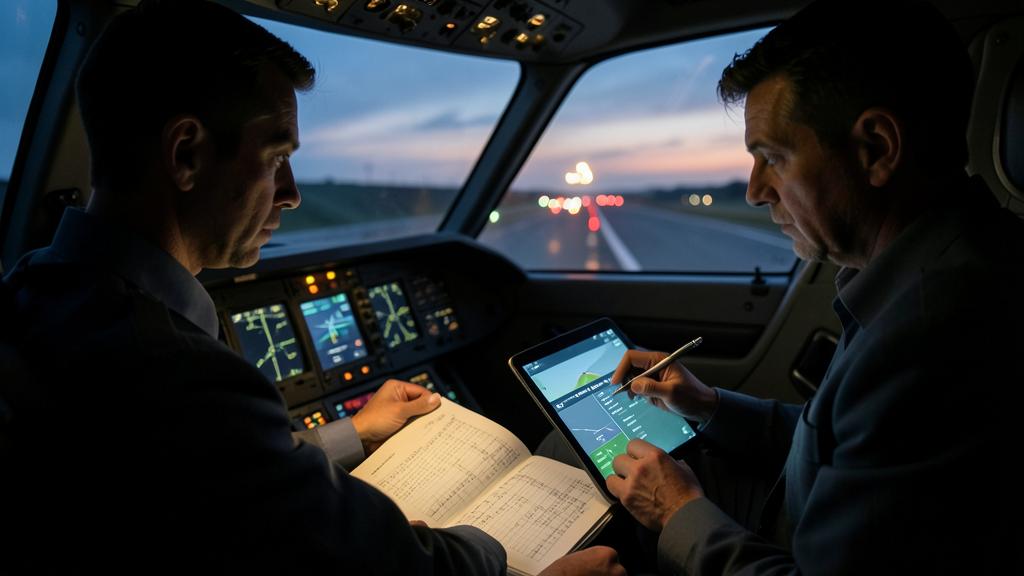
That leaves a grey area that no one will fill in on the pilot’s behalf. Useful experience is not a regulatory category: no form asks for it, no authority validates it, no seniority system distributes it fairly. Two pilots from the same intake, on the same fleet, can come out of three years with very different exposure depending on the rotations the roster gave them, and no one will ever see it in their totals. The only thing that remains under control is what you do with the situations actually encountered, and the fact of having written them down while they were fresh.
For anyone preparing a rating, a change of aircraft or a command upgrade course, the consequence is direct: what is at stake in a check is not the recall of a volume, it is the ability to hold a situation that is not in the manual, and therefore to draw on a model built elsewhere. Competency-based training schemes work, moreover, on scenarios and on observable behaviours, not on counters; the same logic is found in the preparation pathways. Being able to recount four situations with their mechanism is worth more than three hundred further hours in the same place.
In all circumstances, the applicable regulations, the requirements of the oversight authority and the operator’s approved documentation take precedence over this article, the purpose of which is to set out a mechanism and not to serve as a rule on experience.
Questions fréquentes
How many hours do you really need before a first line flying job?
The entry threshold is set by the licence and by the operator’s selection criteria, and it is not negotiable. But what determines the length of line training is not that total: it is the number of complete cycles already flown and the variety of environments encountered. Two candidates admitted at the same threshold may take twice as long as one another to be released to the line.
Do cruise hours count for nothing?
They count, but not for the same thing. Cruise builds systems monitoring, long-duration coordination, fatigue management and the fuel decisions that cannot be replayed. What it does not build is the complete cycle: preparation, decision at take-off, descent, approach, landing. A long-haul pilot knows this and compensates for it in the simulator.
Is it better to instruct or to join an airline in order to build experience?
The two produce different things that are not interchangeable. Instructing gives decisions carried alone, a high density of landings and the observation of errors made by others. The airline gives an established crew, variety of airfields and conditions, and operational constraint. The right criterion is to choose whatever will be hardest to acquire later on.
How do you keep the second column without turning it into a heavy file?
One line per sector that was not routine is enough, with four fields: the situation, the conditions, the decision taken, the mechanism retained. It takes less than two minutes and can be noted during taxi or in the evening. The point is not the archive but the re-reading: after a season, the repetitions leap out and point precisely to what you have not been exposed to.
Is an interruption of several months a deal-breaker in an application?
No, provided it is explained and made up for. A long absence does not erase knowledge, it degrades pace and anticipation, which is precisely what regulatory recent experience targets and what the operator restores through a return-to-line flight or a session. What worries a chief pilot is not the gap: it is a candidate unable to say what he did to fill it.
Can the simulator replace exposure on the line?
It complements it without replacing it. The simulator supplies on demand the rare and costly situations that the line may never deliver, which is irreplaceable. On the other hand it implicitly announces that something is going to happen, and it removes the real consequence: surprise, fatigue and commitment cannot be built there.


Leave a Reply
You must be logged in to post a comment.